
DESIGN DEVELOPMENT AND EVALUATION OF MODIFIED RELEASE TABLET OF MONTELUKAST SODIUM BY DRY COMPRESSION AND TABLET COATING
7
0
0
Full text
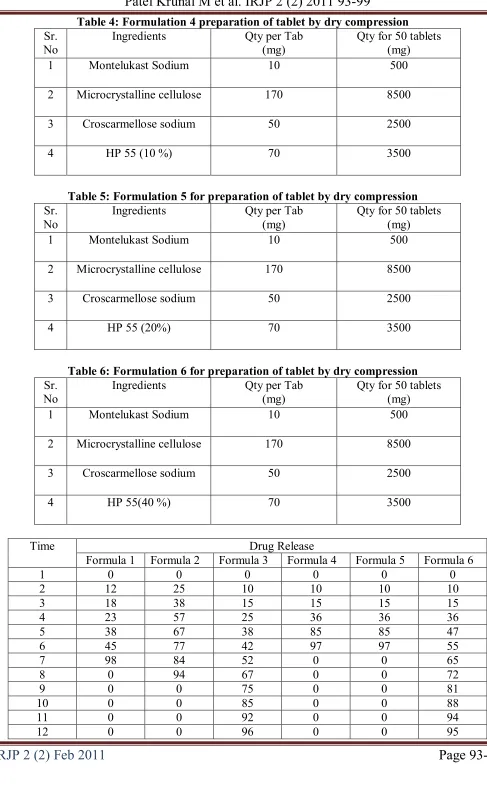
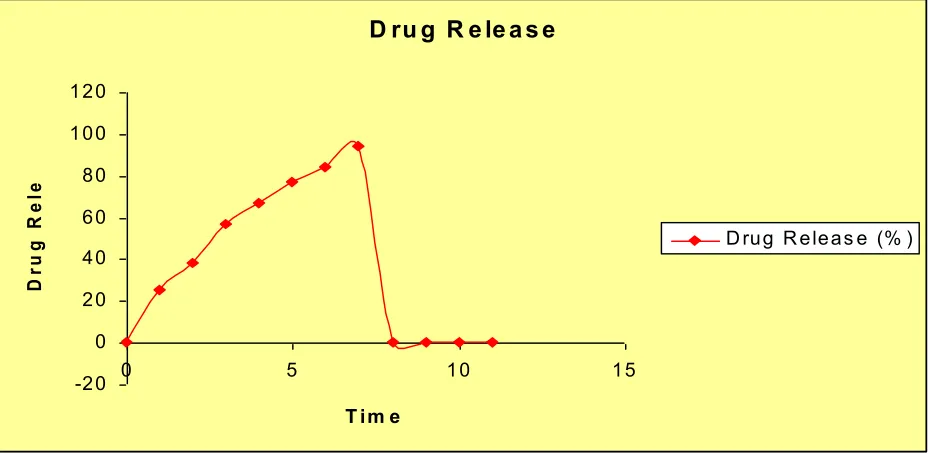
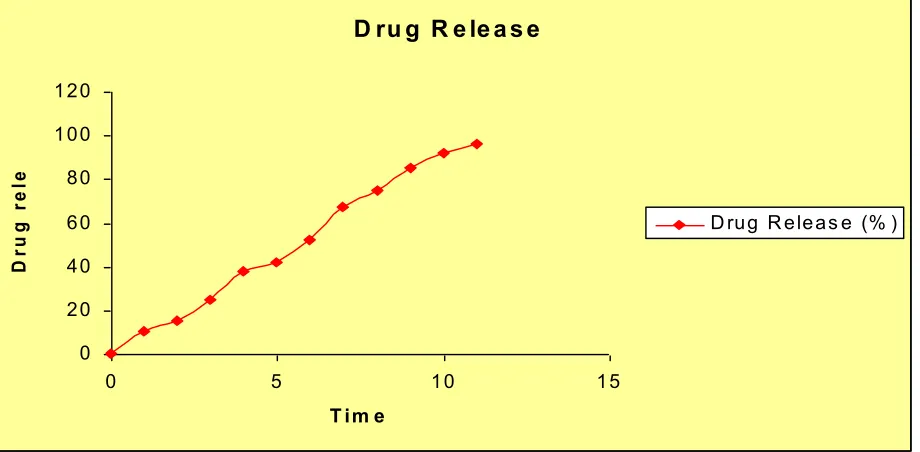
(2) Patel Krunal M et al. IRJP 2 (2) 2011 93-99 Procedure for the tablet coating The compressed tablets were coated with the different concentration of the coating polymer mention in the formula. Pan coater was utilized to perform the coating. Along with the tablet dummy tablets were also placed so that uniform coating is applied to the tablets. Dissolution Studies The dissolution of coated tablet was carried out for 12 hrs, for first two hr it was carried out in pH 1.2 buffer solution and for the next 10 hr it was carried out in pH 7.2 buffer solution. The dissolution was carried out using USP basket app. After every 1 hr 5 ml sample was withdrawn and was analyzed using UV spectrophotometer at max absorbance at 350 nm. RESULT AND DISCUSSION From the dissolution studies it was seen that formula no 1, 2, 4 and 5 were unable to give the sustain release of the drug from the tablet, the simple reason for this must be that the coating polymer which was used for this formula were of the low concentration. In the formula no 3 and 6 the drug release was more than 95%. So it can be concluded that in the formula no 3 and 6 the coating polymer utilize were of the optimum concentration. ACKNOWLEDGEMENT I am thankful to the company who provided me with the gift sample for carrying out my research work. REFERENCES Alderman DA, A review of cellulose ethers in hydrophilic matrices for oral controlled-release dosage forms. Int. J. Pharm. Tech. Prod. Mfr., 1984: 1-9. Colombo P et al. Drug release modulation by physical restriction of matrix swelling. Int. J. Pharm 1990; 63: 43-48. Colombo P, Catellani PL, Peppas NA, Maggi L and Conte U. Swelling characteristics of hydrophilic matrices for controlled release. New dimensionless number to describe the swelling and release behavior. Int. J. Pharm 1992; 88 : 99-109. Ford JL, Rubinstein MH and Hogan JE. Formulation of sustained release promethazine hydrochloride tablets using hydroxypropylmethylcellulose matrices. Int. J. Pharm 1985; 24: 327-338. Ford JL, Rubinstein MH and Hogan JE. Propranolol hydrochloride and aminophylline release from matrix tablets containing hydroxypropylmethylcellulose. Int. J. Pharm 1985; 24: 339-350 Ford JL, Rubinstein MH and Hogan JE. Dissolution of a poorly water soluble drug, indomethacin, from hydroxypropylmethylcellulose controlled release tablets. J. Pharm. Pharmacol 1985; 37 : 33P. Ford JL, Rubinstein MH, McCaul F, Hogan JE and Edgar PJ. Importance of drug type, tablet shape and added diluents on drug release kinetics from hydroxypropylmethylcellulose matrix tablets. Int. J. Pharm 1987; 40: 223-234. Ford JL et al. Mathematical modeling of drug release from hydroxypropylmethylcellulose: effect of temperature. Int. J. Pharm 1991; 71: 95 104 Harland RS, Gazzaniga A, Sangalli ME, Colombo PC and Peppas NA. Drug/polymer matrix swelling and dissolution. Pharm. Res 1988; 5: 488 494. Higuchi T. Mechanism of sustained-action medication. Theoretical analysis of rate of release of solid drugs dispersed in solid matrices. J. Pharm. Sci 1963; 52: 1145-1149. Higuchi WI. Analysis of data on the medicament release from ointments. J. Pharm. Sci 1962;52:802-804. Hogan JE. Hydroxypropylmethylcellulose sustained release technology. Drug Dev. Ind. Pharm 1989; 15:975-1000. Korsmeyer RW, Gurny R, Doelker E, Buff P and Peppas NA. Mechanisms of solute release from porus hydrophilic polymers. Int. J. Pharm 1983; 15 :25 35. Langer RS and Peppas NA. Present and future applications of biomaterials in controlled drug delivery. Biomaterials 1987; 2 :201-214.. IRJP 2 (2) Feb 2011. Page 93-99.
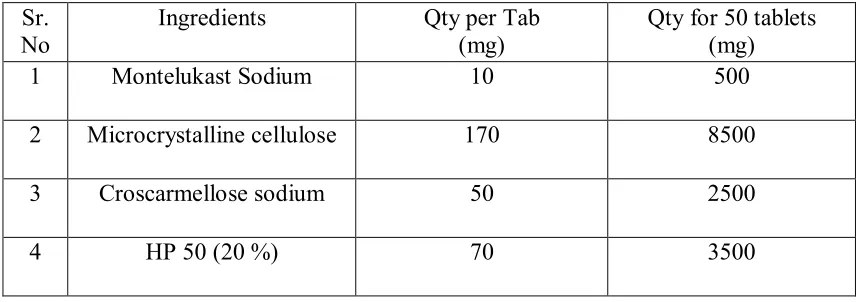
(3) Patel Krunal M et al. IRJP 2 (2) 2011 93-99 Lapidus H and Lordi NG. Some factors affecting the release of water-soluble drug from a compressed hydrophilic matrix. J. Pharm. Sci 1966; 55:840-843. Lapidus H and Lordi NG. Drug release from compressed hydrophilic matrices. J. Pharm. Sci 1968;57:1292-1301. Lee PI and Peppas NA. Prediction of polymer dissolution in swellable controlled-release systems. J. Control. Release 1987; 6:207-215. Table 1: Formulation 1 preparation of tablet by dry compression. Montelukast Sodium. Qty per Tab (mg) 10. Qty for 50 tablets (mg) 500. 2. Microcrystalline cellulose. 170. 8500. 3. Croscarmellose sodium. 50. 2500. 4. HP 50 (10 %). 70. 3500. Sr. No 1. Ingredients. Table 2: Formulation 2 preparation of tablet by dry compression Sr. No 1. Ingredients Montelukast Sodium. Qty per Tab (mg) 10. Qty for 50 tablets (mg) 500. 2. Microcrystalline cellulose. 170. 8500. 3. Croscarmellose sodium. 50. 2500. 4. HP 50 (20 %). 70. 3500. Table 3: Formulation 3 preparation of tablet by dry compression Sr. No 1. Montelukast Sodium. Qty per Tab (mg) 10. Qty for 50 tablets (mg) 500. 2. Microcrystalline cellulose. 170. 8500. 3. Croscarmellose sodium. 50. 2500. 4. HP 50 (40 %). 70. 3500. Ingredients. IRJP 2 (2) Feb 2011. Page 93-99.
(4) Patel Krunal M et al. IRJP 2 (2) 2011 93-99 Sr. No 1. Table 4: Formulation 4 preparation of tablet by dry compression Qty per Tab Ingredients Qty for 50 tablets (mg) (mg) Montelukast Sodium 10 500. 2. Microcrystalline cellulose. 170. 8500. 3. Croscarmellose sodium. 50. 2500. 4. HP 55 (10 %). 70. 3500. Table 5: Formulation 5 for preparation of tablet by dry compression Ingredients Qty per Tab Qty for 50 tablets Sr. No (mg) (mg) 1 Montelukast Sodium 10 500 2. Microcrystalline cellulose. 170. 8500. 3. Croscarmellose sodium. 50. 2500. 4. HP 55 (20%). 70. 3500. Table 6: Formulation 6 for preparation of tablet by dry compression Ingredients Qty per Tab Qty for 50 tablets Sr. No (mg) (mg) Montelukast Sodium 10 500 1 2. Microcrystalline cellulose. 170. 8500. 3. Croscarmellose sodium. 50. 2500. 4. HP 55(40 %). 70. 3500. Time 1 2 3 4 5 6 7 8 9 10 11 12. Formula 1 0 12 18 23 38 45 98 0 0 0 0 0. IRJP 2 (2) Feb 2011. Formula 2 0 25 38 57 67 77 84 94 0 0 0 0. Drug Release Formula 3 Formula 4 0 0 10 10 15 15 25 36 38 85 42 97 52 0 67 0 75 0 85 0 92 0 96 0. Formula 5 0 10 15 36 85 97 0 0 0 0 0 0. Formula 6 0 10 15 36 47 55 65 72 81 88 94 95. Page 93-99.
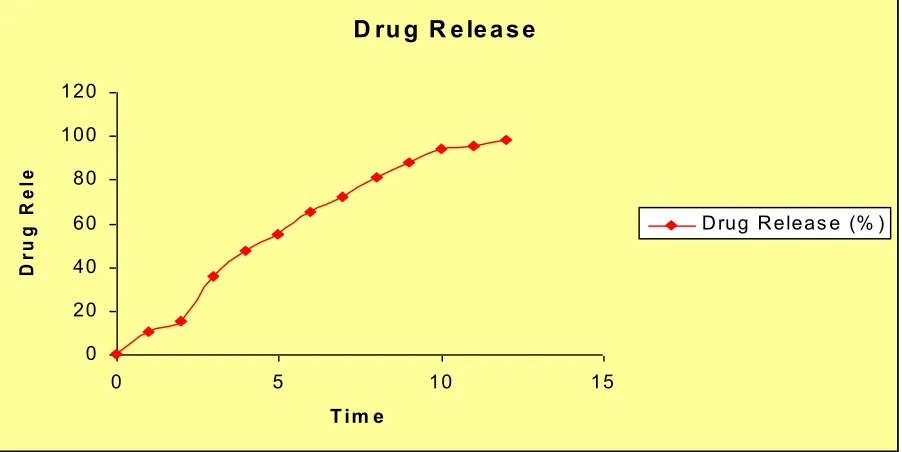
(5) Patel Krunal M et al. IRJP 2 (2) 2011 93-99 D r u g R e le a s e. D r u g R e le a s e. 120 100 80 60. D ru g R e le a s e (% ). 40 20 0 -2 0 0. 5. 10. 15. Tim e. Fig 1: Cumulative percent drug release for formulation 1. D ru g R e le a s e 120 D ru g R e le a s e. 100 80 60. D ru g R e le a s e (% ). 40 20 0 -2 0. 0. 5. 10. 15. T im e. Fig 2: Cumulative percent drug release for formulation 2. IRJP 2 (2) Feb 2011. Page 93-99.
(6) Patel Krunal M et al. IRJP 2 (2) 2011 93-99 D ru g R e le a s e. D ru g re le a s e. 120 100 80 60. D ru g R e le a s e (% ). 40 20 0 0. 5. 10. 15. T im e. Fig 3: Cumulative percent drug release for formulation 3 D ru g R e le a s e 120 D ru g R e le a s e. 100 80 60. D rug R eleas e (% ). 40 20 0 -20. 0. 5. 10. 15. T im e. Fig 4: Cumulative percent drug release for formulation 4. IRJP 2 (2) Feb 2011. Page 93-99.
(7) Patel Krunal M et al. IRJP 2 (2) 2011 93-99 D ru g R e le a s e. D ru g R e le a s e. 120 100 80 60. D ru g R e le a s e (% ). 40 20 0 0. -2 0. 5. 10. 15. T im e. Fig 5: Cumulative percent drug release for formulation 5. D ru g R e le a s e. D ru g R e le a s e. 120 100 80 60. D rug R eleas e (% ). 40 20 0 0. 5. 10. 15. T im e. Fig 6: Cumulative percent drug release for formulation 6. Source of support: Nil, Conflict of interest: None Declared. IRJP 2 (2) Feb 2011. Page 93-99.
(8)
Figure
+2
Related documents
Molecular docking studies indicated that the piperine derivative 2a stably interacts with the amino acid residues of the PPAR γ complex active site, which is consistent with the
Therefore, although the mother showed a significant antibody rise and became viuric during the second pregnancy, it is very unlikley that a new primary infection with an
Three main endpoints were included in the analysis: lives, quality-adjusted life-years, and costs. The total number of deaths, given detection on a given day following an attack,
Intervention effects with respect to ‘ PTA ’ , ‘ INFO ’ , ‘ SAFED ’ , clinical patient outcomes, and health-related quality of life were estimated using general- ised
Keywords: Autoinflammatory diseases, Histiocytosis and lymphadenopathy syndrome (H Syndrome), NLRP12 Associated Periodic Syndrome (NAPS12), Deficiency of Interleukin 1
Reference [10] built regulatory compliant architectures using a risk management frame- work to address functional capabilities, operational reliabil- ity, regulatory compliance,
The most important contributions of this paper are (i) the proposal of a concern mining approach for KDM, what may encourage other groups to start researching on
Weekly seminars were arranged; ad- ditionally, prion research novel strategies to develop virus- like particles (VLP) as a vaccine against neurodegenerative viral diseases
