GENERAL DESCRIPTION
A
lfalfa (Medicago sativa L.) is the oldest and most important foragecrop globally (Michaud et al., 1988). It is a perennial legume widely adapted to continental and temperate climates. Alfalfa can be conserved as hay, silage or pellets or grazed in pure stands or in mixtures with grasses. It is an effective source of nitrogen from symbiotic fixation which contributes to its high leaf protein and metabolizable energy content.
Alfalfa originated in the Caucasus region with related species scattered throughout central Asia. It was initially sown across Europe, Mexico and South America by invading armies to feed horses. China has had cultivated alfalfa for over 2 000 years with renewed interest in recent times for its ability to mitigate damage in erosion prone landscapes. In North America, Australia and New Zealand germplasm was introduced from various sources by colonists to support livestock farming. There are now over 30 million ha of alfalfa grown throughout the world as monocultures or in pasture mixes with grasses. (Figure 1 shows the world harvested areas).
The specific agronomic and management requirements of alfalfa are dependent on its intended use and the agro-climatic environment. Alfalfa can be used to dry the soil profile, reduce drainage and nitrogen losses to ground water, and minimize seepage of saline water to the soil surface. It can be established by conventional sowing, after plough, into a fine, firm seed bed or by direct drilling into existing herbage that has been suppressed with a broad spectrum herbicide. Alfalfa seeds are small (~2.0 g/1 000 seeds) so should be sown at depths less than 20 mm when soil moisture conditions are favourable and no deeper that 35 mm in drought prone or semi-arid soils. When spring sown, post emergent alfalfa should be left to grow until plants approach the flowering stage. This enables them to build up root reserves to aid stand establishment. Shoot growth and canopy expansion are slower during the seedling stage because alfalfa preferentially allocates photosynthates below ground. Alfalfa can fix nitrogen (N) once it has formed a symbiotic relationship with rhizobia bacteria, more specifically
Ensifer meliloti. E. meliloti was formally known as Rhizobium meliloti and
was also referred to as Sinorhizobium meliloti (Willems, 2006).
Alfalfa
LEAD AUTHOR Derrick Moot (Lincoln University, Lincoln, New Zealand)
CONTRIbUTING AUTHORS Edmar Teixeira,
Hamish Brown (Plant & Food Research Ltd, New Zealand)
ACkNOwLEDGmENTS Julio Dardanelli, (INTA, Buenos Aires, Argentina), Gilles Lemaire (INRA, Paris, France),
Michael Robertson (CSIRO, Clayton South, Australia), Alexandre Varella, (EMBRAPA, Brasília, Brasil)
SCIENTISTS CONTRIbUTING wITH ExPERImENTAL DATA AND TESTS FOR THE CALIbRATION OF AQUACROP
Senthold Asseng (formerly CSIRO, Wembley, Australia; currently University of Florida, Gainesville, USA),
Steven R. Evett, Terry A. Howell, Judy A. Tolk (USDA-ARS, Conservation & Production Research Laboratory, Bushland, Texas, USA),
ALFALFA 213
GROwTH AND DEvELOPmENT
Sowing of alfalfa can occur throughout the year depending on environmental conditions such as the availability of soil moisture and the occurrence of frosts. In temperate and continental climates that experience cold winters, stands must be established before the end of summer to enable plants to survive through winter. The earlier the sowing date in spring or summer, the higher the production in the following spring (Justes et al., 2002). The timing and rate of germination are dependent on temperature, moisture conditions, soil salinity and seedling depth. In regions with warm winters, autumn sowing is preferred to ensure adequate weed control and obtain suitable soil moisture and temperature conditions.
Once the crop is established, stand longevity depends largely on plant population, climate and stand management. The initial plant population, determined by sowing and emergence rates, progressively self-thins and consequently the population declines. In most cases this progressive decline does not immediately affect shoot yield. Alfalfa stands have been shown to maintain maximum yields with populations declining from 140 to less than 60 plant/m2. Yields are maintained over a wide range of populations because the self-thinning is compensated by increases in other yield components namely; (i) the number of shoots per plant (ii) the individual shoot weight, and (iii) the degree of branching. Plant
death is mainly caused by competition for light, among alfalfa plants or with other species (e.g. weeds), and accentuated by poor management (e.g. not allowing sufficient regrowth before winter dormancy). Additional stresses such as the occurrence of pests and diseases accelerate plant death. Yield and stand longevity are compromised once plant populations fall below a critical level at which compensation by other yield components is impossible. At this point, re-establishment of the stand is necessary to recover productivity. To maintain high yielding (greater than 10 tonne DM/ha) stands, a plant population of higher than 40 plant/m2 or about 450 stems/m2 is required.
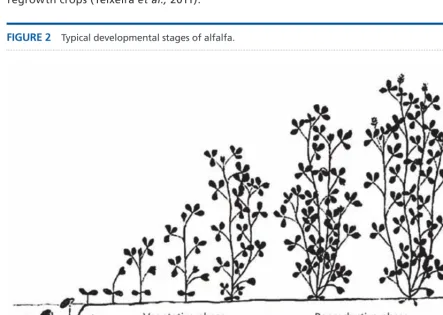
The phenological development of alfalfa, from emergence to maturity (Figure 2), is mainly driven by temperature (Fick et al., 1988), quantified by accumulated temperature units (thermal-time in degree-days: °Cd). Development rates are negligible below 5 °C, which defines the base temperature (Tbase) of alfalfa. Above Tbase, development rates increase linearly with temperature until an optimum (Topt) of ~30 °C. Above Topt, development rates decline to be zero at greater than 45 °C. Daylength also influences alfalfa development during the vegetative stage. Alfalfa is a long-day plant and reaches reproductive stage (characterized by the appearance of floral buds) faster during summer when daylengths are longest, whereas the vegetative stage is extended when daylength shortens in late summer and autumn. After emergence, in the seedling stage, growth and development is slower than during regrowth. This is because seedlings lack a mature root system, nodulate and preferentially accumulate carbon and nitrogen reserves in perennial organs during this early stage. The seedling crop goes through a ‘juvenile’ period of vegetative growth when development is insensitive to daylength and flowering is delayed relative to regrowth crops (Teixeira et al., 2011).
ALFALFA 215
The number of times alfalfa can be harvested during a year depends on climatic conditions and management (Teixeira et al., 2007). After each harvest a new cohort of vegetative shoots are generated. The duration from the initiation of new shoots to the reproductive stage may be modified by daylength and temperature. The response to daylength differs with cultivar and is more pronounced at high latitudes. After floral initiation, temperature alone drives development through flowering, seed filling and maturity. Temperatures above 27 °C, water stress or excessive soil moisture conditions can decrease seed yields.
The main factor determining alfalfa growth, i.e. the rate of biomass accumulation, is the amount of carbon assimilated through photosynthesis, which in turn is dependent on the amount of light intercepted by the canopy. Light interception increases with canopy cover as new leaves appear and expand. The rate of leaf appearance is driven by temperature with a new main-stem leaf appearing every 34–37 °Cd under optimal conditions. Daylength can also regulate the rate of leaf appearance with a delay observed during autumn, particularly for dormant cultivars. In summer, alfalfa may expand up to 20 main-stem nodes. It is an indeterminate plant and therefore leaf appearance continues after flowering, although at slower rates. Leaf senescence is a function of leaf age, the canopy light environment, and other environmental stresses. The canopy architecture of alfalfa enables efficient light capture as a result of the distribution of flat leaves in the lower canopy and vertical leaves in the top. This is characterized by its high light extinction coefficient per unit of leaf area of 0.8–0.9, which is high and stable in different commercial alfalfa cultivars. The rate of leaf area expansion is higher in spring and summer than autumn, in response to higher temperatures and longer daylengths.
Alfalfa radiation use efficiency for total biomass (shoots, crowns and roots), a proxy for net canopy photosynthesis, is ~1.8 g/MJ (total solar radiation). Once carbon is assimilated though photosynthesis, biomass can be partitioned to above (leaves and stems) or perennial below-ground organs (crowns and roots). Alfalfa survives during winter by storing carbon and nitrogen compounds as reserves in its perennial organs. These reserves are then used to resume growth during the following spring and after each harvest (Avice et al., 1997). Nitrogen and carbon are mobilized to form new leaves and stems while carbon is also respired to supply energy to sustain root metabolic activities. The partitioning of assimilated carbon to crowns and taproots is seasonal.
wATER USE & PRODUCTIvITy
As a perennial crop, alfalfa can produce dry matter throughout the year if environmental conditions are favourable. During the most active growth period from spring to autumn, daily values of evapotranspiration (ET) are driven by the interaction of environment and defoliation (cutting) management. The removal of leaf area reduces transpiration so ET values less than 1 mm/day occur immediately after defoliation, mainly through soil evaporation, and in cool winter conditions. When the crop reaches full canopy, ET can rise to over 8 mm/day. As the canopy recovers and leaf area index increases the daily ET can be estimated from potential ET multiplied by the fraction of canopy cover (French and Legg, 1979). During this phase the proportion of soil evaporation in relation to ET declines and transpiration increases. The ratio of actual to reference ET peaks at around 1.1-1.15 at full canopy and declines when senescence occurs as a result of self-shading (i.e. at high leaf area indices), the onset of flowering or frost events. Total cumulative ET ranges from less than 200 mm in arid conditions to over 1 000 mm in well watered conditions.
The slope of the relationship between cumulative herbage yield against cumulative water use gives an indication of water productivity (WPY/ET). The average WPY/ET is typically around 1.0–2.6 kg/m3 (Grimes et al., 1992) but has been reported as high as 2.9 kg/m3 (Brown et al., 2005). In one study, WPY/ET dropped from 2.1 kg/m3 to 0.4 kg/m3 immediately after defoliation (Asseng and Hsiao, 2000). In temperate climates, the highest water productivities are recorded in the spring and values decrease through summer and autumn. The high spring time water productivity results from low vapour pressure deficits in the atmosphere and the highest proportions of total biomass production being partitioned to the harvested shoot (leaf and stem) fraction. Water productivity is lower in the summer because of the high evaporative demand and concomitant higher vapour pressure deficits. Water productivity declines in the autumn because of changes in crop partitioning to roots and cold temperatures. This reduces shoot production per unit of water use. The linear relationship between dry matter production and ET appears stable across cultivars of different fall dormancy ratings.
The annual water requirement of an alfalfa crop can be estimated for any location by the sum of daily estimate of ET for the period that the crop is actively growing. The irrigation requirement can then be estimated by subtraction of effective rainfall during the growth period plus the amount of readily available soil water at the start of the growing season from the total crop water demand. If complete recharge of soil water is achieved prior to the start of the growing season a value of 50 percent of the soils available water capacity (field capacity minus lower limit to a depth of 1.5 m) is commonly taken to represent the readily available water. If incomplete recharge occurs, a simple water balance can be used to estimate soil water content at the start of the season and 50 percent of this value used to represent readily available water.
RESPONSE TO wATER STRESS
ALFALFA 217
by the requirement set by transpiration demand for the crop canopy which is driven by atmospheric conditions.
When crop water requirements are greater than total soil water available in the root zone, it restricts the major plant processes of canopy expansion, transpiration and photosynthesis or radiation use efficiency, and accelerates leaf senescence. Relative leaf area expansion rates decrease from their maximum at a threshold between 15-20 percent below field capacity, to be negligible as the total available soil water decreases from field capacity down to about 30 percent or more of the total available water capacity of the soil. Radiation use efficiency is less sensitive to water stress than canopy expansion and declines in a 1:1 response to the decrease in available soil water (Brown et al., 2009). If water supply is only half of crop demand, production will only be half of potential.
The amount of water extraction can be calculated for different layers of soil (Brown et al. 2009). Starting in the top layer, extraction is the minimum of potential supply from that layer and demand from the atmosphere. Water extraction from underlying layers depends on the remaining demand after extraction by overlying layers. Effectively, alfalfa has a top-down water extraction pattern throughout the growing season for seedling and regrowth crops. Reductions in water extraction rates are observed in situations of water shortage. In the absence of other measurements, it can be assumed that alfalfa can extract about 3 percent of the plant available water from the soil on any day. Effectively the potential daily water supply can be estimated from the available water capacity of the soil and the rooting depth of the alfalfa crop. The extraction rate coefficients of alfalfa are low compared with other crops (Dardanelli et al., 1997) so alfalfa will prolong the use of the soil water it has access to, mainly because its deep rooting enlarging the supply reservoir.
Alfalfa is less tolerant of waterlogging (saturated soils) than other forage (grass) species. Anaerobic conditions for more than 7-14 days lead to root death and secondary disease infection, particularly from Phytophthora species.
SOIL FERTILITy
Successful alfalfa stands are grown on deep (>1.0 m) free-draining soils, to take advantage of its taproot, with a pH of 6.0–8.0. Adequate phosphorous (P), Sulphur (S), Boron (B) and Molybdenum (Mo) are usually required depending on soil nutrient status. Potassium (K) based fertilizers are recommended, particularly under intensive cutting, because leaves of alfalfa, a natrophobe, have a higher potassium and lower sodium (Na) content than many other forage species.
TEmPERATURE
SALINITy
Alfalfa is tolerant to relatively high salinity in the lower root zone provided the upper zone is saline free. It is more sensitive to Na+ than Cl- so that sodium accumulation is the dominant reason for yield decreases when irrigating with saline water. Irrigation, even with moderately saline water, can cause salts to accumulate deeper into the soil profile which enables roots to proliferate in regions of relatively low salinity. At salt concentrations above 10 dS/m significant yield reductions are expected. In these conditions, the absolute yield of alfalfa may still be greater more than ‘salt-tolerant’ grasses.
yIELD AND QUALITy
The diversity of climate and soil types used to grow alfalfa means reported yields range from less than 1 tonne DM/ha in rainfed systems, on soils of low water holding capacity combined with low annual rainfall (<300 mm/year) to over 28 tonne DM/ha per year in well watered deep silt loam soils in New Zealand (Brown et al., 2005). A similar maximum yield has been reported in Africa, with yields of 10 to 20 tonne DM/ha commonly produced in Europe, China and North America under irrigated conditions. Under rainfed conditions with 500-800 mm of annual rainfall, yields of 5 to 17 tonne DM/ha have been reported. The productivity and persistence of alfalfa stands are affected by management and location with a decline in plant population expected over the first 4–5 years. Stands can persist for over 20 years in low rainfall climates that have a distinct winter dormant period, provided soils do not freeze and cause plant death.
For alfalfa, the quality of herbage is directly related to the fraction of leaf and palatable stem compared with lower quality lignified stem. During vegetative crop growth, the first 2 tonne DM/ha is predominantly high quality forage with a crude protein content of at least 25 percent. As alfalfa matures beyond this stage the proportion of lower quality stem material increases and the overall leaf to stem ratio declines (Marten et al., 1988). So for high quality hay, alfalfa is cut normally at the early flowering stage or sooner. When alfalfa is grazed in a rotational system it is recommended that each paddock is rested for 35–42 days before re-entry of livestock (Moot
et al. 2003). Continuous grazing (or set stocking) contributes to a decline in root reserves and
ALFALFA 219
REFERENCES
Asseng, S. & Hsiao, T.C. 2000. Canopy CO2 assimilation, energy balance, and water use efficiency of an alfalfa crop
before and after cutting. Field Crops Research 67(3): 191-206.
Avice J.C., Lemaire G., Ourry, A. & boucaud, J. 1997. Effects of the previous shoot removal frequency on subsequent
shoot regrowth in two Medicago sativa L. cultivars. Plant and Soil 188, 189-198.
brown, H. E., moot, D. J., Fletcher, A. L. & Jamieson, P. D. 2009. A framework for quantifying water extraction and
water stress responses of perennial lucerne. Crop & Pasture Science, 60, 785-794.
brown, H. E., moot, D. J. & Pollock, k. m. 2005. Herbage production, persistence, nutritive characteristics and water
use of perennial forages grown over 6 years on a Wakanui silt loam. New Zealand Journal of Agricultural Research, 48, 423-439.
brown, H.E., moot, D.J. & Teixeira, E.I. 2006. Radiation use efficiency and biomass partitioning of lucerne (Medicago
sativa) in a temperate climate. European Journal of Agronomy 25: 319-327.
Dardanelli, J. L., bachmeier, O. A., Sereno, R. & Gil, R. 1997. Rooting depth and soil water extraction patterns of
different crops in a silty loam Haplustoll. Field Crops Research, 54, 29-38.
Fick, G.w., Holt, D.A. & Lugg D.G. 1988. Environmental physiology and crop growth. In: Hanson, A.A., Barnes, D.K. &
Hill, R.R., Jr. eds. Alfalfa and alfalfa improvement. Madison, Wisconsin: American Society of Agronomy, Inc., Crop Science Society of America, Inc., Soil Science Society of America, Inc., Vol. 29, 163-194.
French, b.k. & Legg, b.J. 1979. Rothamsted irrigation 1964–76. Journal of Agricultural Science, U.K. 92, 15 – 37. doi:
10.1017/S0021859600060469.
Grimes, D.w., wiley, P.L. & Sheesley, w.R. 1992. Alfalfa Yield and Plant Water Relations with Variable Irrigation.
Crop Science 32: 1381-1387.
Justes, E., Thiébeau, P., Avice, J.C., Lemaire, G., volenec, J.J. & Ourry, A. 2002. Influence of summer sowing dates,
N fertilization and irrigation on autumn VSP accumulation and dynamics of spring regrowth in alfalfa (Medicago
sativa L.). Journal of Experimental Botany 53:111-2121.
marten, G.C., buxton, D.R. & barnes, R.F. 1988. Feeding value (Forage Quality). In: Hanson, A.A., Barnes, D.K. &
Hill, R.R., Jr. eds. Alfalfa and alfalfa improvement. Madison, Wisconsin: American Society of Agronomy, Inc., Crop Science Society of America, Inc., Soil Science Society of America, Inc., Vol. 29, 463-491.
michaud, R., Lehman, w. F. & Rumbaugh, m. D. 1988. World distribution and historical development. In: Hanson,
A.A., Barnes, D.K. & Hill, R.R., Jr. eds. Alfalfa and alfalfa improvement. Madison, Wisconsin: American Society of Agronomy, Inc., Crop Science Society of America, Inc., Soil Science Society of America, Inc, Vol. 29, 25-91.
moot, D.J., brown, H.E., Teixiera, E. & Pollock, k.m. 2003. Crop growth and development affect seasonal priorities for
lucerne management. In: Moot, D.J., ed. Legumes for dryland pastures. Proceedings of a New Zealand Grasslands Association Symposium, Lincoln University, 18–19 November 2003. Grassland Research and Practice Series No. 11, pp. 201–208.
SAGE. 2000. Center for Sustainability and the Global Environment, University of Wisconsin-Madison. Online database
available at link http://www.sage.wisc.edu/mapsdatamodels.html. Accessed on December 2011.
Sheaffer, C. C., Tanner, C. b. & kirkham, m. b. 1988. Alfalfa water relations and irrigation. In: Hanson, A.A., Barnes,
D.K. & Hill, R.R., Jr. eds. Alfalfa and alfalfa improvement. Madison, Wisconsin: American Society of Agronomy, Inc., Crop Science Society of America, Inc., Soil Science Society of America, Inc., Vol. 29, 373-409.
Teixeira, E.I., moot, D.J., Pollock, k.J. & brown H.E. 2007. How does defoliation management affect yield, canopy
forming processes and light interception in lucerne (Medicago sativa L.) crops? European Journal of Agronomy 27, 154-164.
Teixeira, E. I., moot, D. J. & brown, H. E. 2008. Defoliation frequency and season affected radiation use efficiency
and dry matter partitioning to roots of lucerne (Medicago sativa L.) crops. European Journal of Agronomy, 28 (2): 103-111.
Teixeira, E.I., brown, H., moot, D.J. & meenken, E.D. 2011. Growth and phenological development patterns differ
between seedling and regrowth alfalfa crops (Medicago sativa L.). European Journal of Agronomy 35(1): 47-55