
COMPARATIVE EVALUATION OF THE BONDING EFFICACY OF SIXTH, SEVENTH AND EIGHTH GENERATION BONDING AGENTS: AN IN VITRO STUDY
5
0
0
Full text
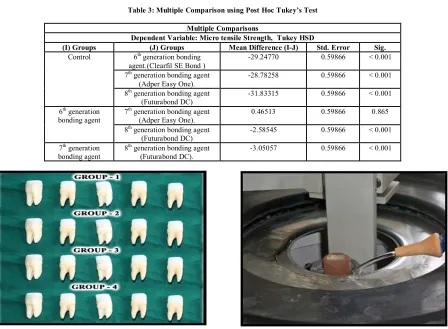
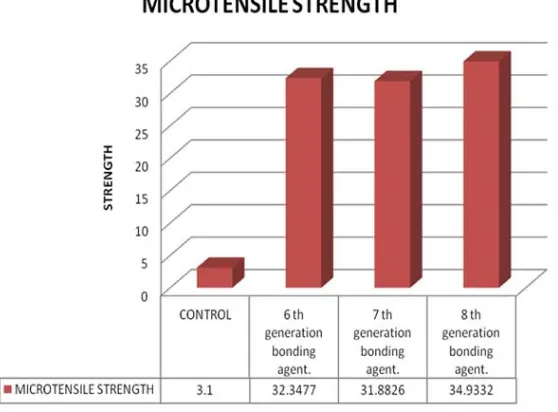
(2) Paul Joseph et al. Int. Res. J. Pharm. 2013, 4 (9) application of bonding agents. The adhesives were applied according to the manufacturer’s instructions and cured via Light Emitting Diode (3M ESPE) unit set at 1000 milli Watt/cm². Resin composite build-ups (Filtek Z350, 3M ESPE, St. Paul, Minn, USA) were constructed on the bonded surfaces in 1.5 mm increments; each was light cured for 20 seconds with the same light unit at a distance of 2 mm (Figure 1). The teeth were individually embedded in acrylic resin blocks. The blocks were mounted in hard tissue microtome and sectioned into one mm thick specimens (Figure 2). The resulting specimen was rotated another ninety degree and serial sectioning continued. The resulting specimens had a cross sectional area of 1 mm square (Figure 3). The cross-sectional area of each stick/specimen was measured individually with a digital caliper. The sectioned teeth were divided into four experimental groups with twenty specimens in each group according to bonding agent applied. All the specimens were stored in distilled water for 24 hours prior to micro tensile bond strength testing. Micro tensile bond strength testing was done using a universal testing machine (KIC-2-050-C, Kalpak Instruments and Controls) which was available at Department of Mechanical Engineering, IIT Chennai (Figure 4). The specimens were attached to a modified device (Custom made jig for micro tensile testing) and subjected to a tensile force in a Universal Testing Machine at a crosshead speed of 0.5 mm/minute. Bond strength values were calculated in MPa, where the applied force (N) was divided by the stick cross-sectional area (mm²) Universal testing machine is a very precise machine used for subjecting small size specimens for various tests. The failure load was observed on the display panel attached to the universal testing machine. Tensile force required to debond the specimen, was recorded. Debonding stress in Megapascal was then calculated by the ratio of maximum load in Newton to the surface area of the prepared specimen (Mpa = N/mm2). The data so obtained were tabulated and analyzed statistically. RESULTS The mean micro tensile bond strength and standard deviation were calculated for each group and are summarized in the Table 1. The mean micro tensile bond strength value for sixth generation adhesive was 32.3477 Mpa, seventh generation adhesive was 31.8826 Mpa and eighth generation adhesive was 34.9332 Mpa respectively. The highest strength was seen in 8th generation bonding agent (Futura bond DC, Voco, Germany) followed by 6th generation bonding agent (Clearfil SE Bond ,Kuraray dental, Japan) and the 7th generation agent (Adper Easy One, 3M ESPE, Germany). ANOVA Test was performed to determine any statistically significant differences among the groups compared in this study. The Analysis of variance test compared the mean scores of four groups. In this analysis the difference between the mean micro tensile bond strength values of Group 1, Group 2, Group 3 and Group 4 were compared. The results of comparison of all the four groups are shown in Table 2. The analysis of variance showed that there was statistically significant difference in micro tensile bond strengths between the four groups. The highest strength was seen in eighth generation bonding agent (Futurabond DC, Voco, Germany) followed by sixth (Clearfil SE Bond, Kuraray Dental, Japan) and the seventh generation (Adper Easy One, 3MESPE, Germany) respectively. To identify which sub group (control versus 6th, 7th and 8th generation; 6th generation versus 7th and. 8th generation; 7th generation versus, 8th generation) was showing the difference Post Hoc Tukey’s Test was done. The results are given in Table 3. The result showed that the eighth generation bonding agent( Futurabond DC, Voco, Germany) showed highest bond strength followed by sixth generation bonding agent (Clearfil SE bond, Kuraray Dental, Japan) and seventh generation bonding agent (Adper Easy One, 3M ESPE, Germany) respectively. The results are summarized in Graph1. DISCUSSION The objective of bond strength test is to establish a demonstrative value for how strong the bonding of an adhesive system is to the dental hard tissues. Polymerization shrinkage is still a major problem when composites are bonded to tooth. Polymerization shrinkage is induced during the conversion of monomer molecules into a polymer network. During this process Vander Waals and hydrogen interactions are replaced with shorter covalent bonds. This creates contraction stress which initiates the failure of the composite-tooth interface if the forces of polymerization contraction exceed dentin bond strength. If this occurs, adverse consequences such as postoperative sensitivity, micro leakage, secondary caries and micro cracking of the restorative material can occur. An estimated bond strength of 17-21MPa has been proposed as the critical value needed to withstand these stress of polymerization contraction of the composite material.11,12 Several factors influence in-vitro bond strength to dentin such as the type and age of the teeth, the degree of dentin mineralization, the dentin surface being bonded, the type of bond strength test (shear or tensile), the storage media, environmental relative humidity in substrates, complex nature of the testing procedures, sensitivity of manipulation of these systems and the composite restorative material. 13 All the four dentin bonding agents tested in this study were self etching bonding agents. Self etch approach can in general be classified into a two step or one step application procedure. Self-etch adhesives differ in their aggressiveness. Therefore they are classified in three categories according to acidity: mild, moderate and aggressive. Since the self-etch adhesives are not as aggressive as the phosphoric acid gel in etch-and-rinse adhesives, most do not remove the smear layer.4 Strong self etch adhesives cause complete dissolution of nearly all hydroxyapatite crystals. The underlying bonding mechanism is primarily diffusion based and have been often documented with rather low bond strength values. Mild self etch systems, in general have a pH of around 2 and demineralise dentin only to depth of one micro meter. The superficial demineralization partially keeps the residual hydroxyapatite still attached to collagen.14 16 The pH of the bonding agents used in this study varied and was 1.9 for the sixth generation dentin bonding agent (Clearfil SE Bond, Kuraray Dental, Japan), 2.3 for the seventh generation bonding agent (Adper Easy One, 3M ESPE, Germany) and 2.0 for the eighth generation bonding agent (Futurabond DC, Voco, Germany). The pH of all the adhesives used comes around the range of two and belonged to the mild self etch category. However difference in bond strengths was shown between these adhesives. The recently introduced eighth generation dentin bonding agent (Futurabond DC, Voco, Germany) contains significant amounts of highly functional nano sized cross linking agents, the silica particles and has the advantage of being dual cured.. Page 144.
(3) Paul Joseph et al. Int. Res. J. Pharm. 2013, 4 (9) Table 1: Comparison of mean micro tensile bond strength and standard deviation of control, sixth generation, seventh generation and eighth bonding agents Group Control Sixth Generation (Clearfil SE Bond) Seventh Generation (Adler Easy One) Eighth Generation (Futurabond DC). Range Min Max 2.103 5.124 30.124 35.510 28.786 35.784 30.122 38.541. Mean. SD. 3.1000 32.3477 31.8826 34.9332. 0.91191 1.57502 2.14201 2.53679. Table 2: Comparison of micro tensile bond strength of all four groups using ANOVA test N 20 20. Micro tensile Strength Mean Std. Deviation 3.1000 0.91191 32.3477 1.57502. Mean Square CONTROL 4522.368 6th Generation bonding agent (CLEARFIL SE BOND) 7th Generation bonding agent (ADPER 20 31.8826 2.14201 EASY ONE) 20 8th Generation bonding agent (FUTURA 34.9332 2.53679 BOND DC) 80 25.5659 13.23568 Total (N – Sample Size, F – Value of the test, Sig – Significance). F 1261.842. Sig. < 0.001. Table 3: Multiple Comparison using Post Hoc Tukey’s Test. (I) Groups Control. 6th generation bonding agent. 7th generation bonding agent. Multiple Comparisons Dependent Variable: Micro tensile Strength, Tukey HSD (J) Groups Mean Difference (I-J) 6th generation bonding -29.24770 agent.(Clearfil SE Bond ) -28.78258 7th generation bonding agent (Adper Easy One). th 8 generation bonding agent -31.83315 (Futurabond DC) 7th generation bonding agent 0.46513 (Adper Easy One). th 8 generation bonding agent -2.58545 (Futurabond DC) 8th generation bonding agent -3.05057 (Futurabond DC).. Figure 1: Composite bonded to tooth samples after application of different bonding agents. Std. Error 0.59866. Sig. < 0.001. 0.59866. < 0.001. 0.59866. < 0.001. 0.59866. 0.865. 0.59866. < 0.001. 0.59866. < 0.001. Figure 2: Sample mounted in the hard tissue microtome for sectioning. Page 145.
(4) Paul Joseph et al. Int. Res. J. Pharm. 2013, 4 (9). Figure 3: Specimens obtained after hard tissue microtome sectioning. Figure 4: Universal Testing Machine. Graph 1: Comparative evaluation of micro tensile bond strengths of sixth, seventh and eighth generation bonding agents. In this study the highest mean micro tensile bond strength (34.9332 MPa) exhibited by the eighth generation bonding agent (Futurabond DC, Voco, Germany) group may be attributed to this nano sized cross linking agents as claimed by the manufacturer. In the present study, the mean value showed by the sixth generation dentin bonding agent (Clearfil SE Bond, Kuraray Dental, Japan) was 32.3477 MPa and by the seventh generation dentin bonding agent (Adper Easy One) was 31.8827 MPa respectively which are almost in agreement with recent studies. In this case the two step self etch adhesive, Clearfil SE Bond showed slightly higher bond strength than Adper Easy One, the one step self adhesive. This may be due to the component 10-MDP (10methacryloxydecyl dihydrogen phosphate) in the Clearfil SE Bond, which has the potential to bond chemically with the hydroxyapatite crystal.17 In addition the one step self-etch adhesive systems generally have less cross-linking monomers. These cross-linking monomers provide most of the mechanical strength, therefore there is a potential for lower bond strength as shown by seventh generation bonding agent, Adper Easy One (3M ESPE, Germany). Other variables like functional monomers, cross-linking monomers, solvents, inhibitors and activators may also differ in proportions and can affect bond strength. In brief, the amount. of monomers, diluents and filler loads differs between products according to manufacturer’s technology which is not well described in adhesive composition. Also little is known about the shrinkage and stiffness of these filled adhesives after polymerization. These factors could affect the micro tensile bond strength significantly but is not listed by manufacturer as the final formulation is proprietary secret. Errors in application technique, operator variability and inadequate primer drying time can also affect the bond strength of self etch adhesives specially water based system. 18 It can be concluded within the limitations of this study conducted and results obtained that eighth generation (Futurabond DC, Voco, Germany) dentin bonding agents showed higher mean micro tensile bond strength (34.9332 MPa) than sixth generation dentin bonding agent (Clearfil SE Bond, Kuraray Dental, Japan) and seventh generation dentin bonding agent (Adper Easy One ,3M ESPE,Germany). CONCLUSION Based on the results it was evaluated that eighth generation dentin bonding agent (Futurabond DC, Voco, Germany) performed the best in micro tensile bond strength to tooth than sixth generation dentin bonding agent (Clearfil SE Page 146.
(5) Paul Joseph et al. Int. Res. J. Pharm. 2013, 4 (9) Bond, Kuraray Dental, Japan) and seventh generation dentin bonding agent (Adper Easy One, 3M ESPE, Germany). REFERENCES 1. Buonocore MG. A simple method of increasing the adhesion of acrylic filing materials to enamel surfaces. J Dent Res 1955; 34: 849–53. http://dx.doi.org/10.1177/00220345550340060801 PMid:13271655 2. Anusavice KJ, Santos JD, Shen C, Phillips RW. Phillips science of dental materials. 11th ed. St. Louis (MO): Saunders; 2003. 3. Kugel Geroard, Ferrari Marco. The science of bonding from first to sixth generation. J Am Dent Assoc 2000; 131 Suppl: 20S-25S. 4. Jorge Perdigao. New developments in dental adhesion. Dent Clin North Am 2007; 51(2): 333-57. http://dx.doi.org/10.1016/j.cden.2007.01.001 PMid:17532916 5. Van Meerbeek B, Yoshihara K, Yoshida Y, Mine A, De Monck J, Van Panduit KL. State of the art of self-etch adhesives. Dent Mater 2011; 17-28. http://dx.doi.org/10.1016/j.dental.2010.10.023 27(1): PMid:21109301 6. Pashley DH, Tay FR. Aggressiveness of contemporary self-etching adhesives. Part II: Etching effects on un-ground enamel. Dent Mater 2001; 17(5): 430-44. http://dx.doi.org/10.1016/S01095641(00)00104-4 7. Tay FR, Pashley DH. Aggressiveness of contemporary self-etching systems. Part I: Depth of penetration beyond smear layers. Dent Mater 2001; 17(4): 296-308. http://dx.doi.org/10.1016/S01095641(00)00087-7 8. Jhaveri HM, Balaji PR. Nano technolology: The future of dentistry. J Indian Prosthodont Soc 2005; 5: 15-17. http://dx.doi.org/10.4103/09724052.16335 9. Mitra SB, Wu D, Holmes BN. An application of nanotechnology in advanced dental materials. J Am Dent Assoc 2003; 134(10): 1382-90. PMid:14620019 10. John M Powers, Robert G Craig. Craig’s Restorative Dental Materials. 11th edition. Mosby, St. Louis; 2002.. 11. Davidson CL, De Gee AJ, Feilzer A. The competition between the composite-dentin bond strength and the polymerization contraction stress. J Dent Res 1984; 63(12): 1396-9. http://dx.doi.org/10.1177 /00220345840630121101 PMid:6239886 12. Munksgaard EC, Irie M, Asmussen E. Dentin-polymer bond promoted by Gluma and various resins. J Dent Res 1985; 64(12): 1409-11. http://dx.doi.org/10.1177/00220345850640121801 PMid:2934449 13. Diaz Arnold AM, Williams VD, Acquilino SA. A review of dentinal bonding in-vitro-the substrate. Oper Dent 1990; 15(2): 71-5. PMid:2197607 14. Shirai K, De Munck J, Yoshida Y, Inoue S, Lambrechts P, Suzuki K et al. Effect of cavity configuration and aging on the bonding effectiveness of six adhesives to dentin. Dent Mater 2005; 21(2): 110-24. http://dx.doi.org/10.1016/j.dental.2004.01.003 PMid:15681009 15. De Munck J, Shirai K, Yoshida Y, Inoue S, Van Landuyt K, Lambrechts P, et al. Effect of water storage on the bonding effectiveness of six adhesives to Class I cavity dentin. Oper Dent 2006; 31(4): 456-65. http://dx.doi.org/10.2341/05-57 PMid:16924986 16. Brackett WW, Covey DA, St Germain Jr HA. One-year clinical performance of a self-etching adhesive in class V resin composites cured by two methods. Oper Dent 2002; 27(3): 218-22. PMid:12025819 17. Yoshida Y, Nagakane K, Fukuda R, Nakayama Y, Okazaki M, Shintani H, et al. Comparative study on adhesive performance of functional monomers. J Dent Res 2004; 83(6): 454-8. http://dx.doi.org/10.1177/ 154405910408300604 PMid:15153451 18. Duke ES, Lindemuth J. Variability of clinical dentin substrates. Am J Dent 1991; 4(5): 241-6. PMid:1810335 Cite this article as: Paul Joseph, Chakravarthy Yadav, Kumar Satheesh, Raju Rahna. Comparative evaluation of the bonding efficacy of sixth, seventh and eighth generation bonding agents: An in vitro study. Int. Res. J. Pharm. 2013; 4(9):143-147 http://dx.doi.org/10.7897/2230-8407.04930. Source of support: Nil, Conflict of interest: None Declared. Page 147.
(6)
Figure
Related documents
CBP: consolidated bioprocessing; E: amplification efficiency; EG II: endo- glucanase II; gal1 : galactokinase gene; GH: glycoside hydrolase; PBS: phosphate-buffered saline; pyk
Phytosociologicnl features of plant community on unburnt sites during Wet season (Number of quadrats q 50, IV1 = Importance Value Index).. Aspilia africona
While microelectronics community continues to invent new solutions around the world to keep Moore‟s law alive, there are ever-increasing awareness, R&D effort and
In order to reduce the defects of variable reluctance machine (VRM) which include: high acoustic noise and torque pulsations, a novel doubly salient PM (DSPM)
Prevalence and Antibiotic Resistance of Bacteria Isolated from Urinary Tract Infections of Pregnant Women in
In order to compensate the current related problems such as load unbalance compensation, reactive power compensation , current harmonic filter shunt active power
Here we describe referrals from two aspects: firstly, from that of primary level facilities which refer patients (step 4), and secondly from that of the referral hospital where
When luliconazole 1% was evaluated against bifonazole 1% for tinea pedis, no significant difference in the rate of overall cure, resolution of symptoms, or conversion to
