Multibiometric System for Newborn Recognition
Ms. Kajal A. Kotecha Ms. Komal S. Panpaliya
Student Student Department of Electronics and Telecommunication
Engineering
Department of Electronics and Telecommunication Engineering
Dhamangaon Education Society College of Engineering and Technology, Dhamangaon Rly, India
Dhamangaon Education Society College of Engineering and Technology, Dhamangaon Rly, India
Ms. Pallavi D. Mohod Ms. Tejshwini P. Kapase
Student Student Department of Electronics and Telecommunication
Engineering
Department of Electronics and Telecommunication Engineering
Dhamangaon Education Society College of Engineering and Technology, Dhamangaon Rly, India
Dhamangaon Education Society College of Engineering and Technology, Dhamangaon Rly, India
Prof. K. S. Khandare
Professor
Department of Electronics and Telecommunication Engineering
Dhamangaon Education Society College of Engineering and Technology, Dhamangaon Rly, India
Abstract
Biometrics as a tool for authentication for adults has come into existence in all the application areas. Similarly, now a days, the identification of newborn is becoming a necessity to avoid baby swapping, mixing, child kidnapping and illegal adoptions in hospitals. Hence, a newborn personal authentication system is proposed for this issue based on multi biometrics. The biometric traits considered are the Footprint of the newborn and the fingerprint of the mother. Additionally a temperature sensor is used .The four important module of biometrics are Sensor module, Feature extraction module, Matching module, Decision-making module. The experimental results are prove to be an effective system.
Keywords: Biometric; Fusion; Match Score-Level; Multibiometric; Newborn
________________________________________________________________________________________________________
I. INTRODUCTION
Now a days, the problem of missing children is a very serious issue. Seeing the importance of this issue, May 25 is observed as National Missing Children’s Day since it was first proclaimed by President Ronald Reagan in 1983. How can the mother be sure that her new born will not be mixed up in hospital? The question is inevitable and none should be answered with greater care, sympathy and understanding than this of the incoming maternity patient. The use of identification document (ID) like bracelet and radio frequency identification (RFID) tag by hospital authorities has not solved the problem of newborn swapping or mixing completely but the database is disappear after longer duration. Fingerprints, hand geometry, ear patterns, eye patterns (iris and retina), facial features, included in Physiological biometric. Behavioral identifiers include voice, signature, key stroke, and others. Biometrics technology use for identifying or verifying a person based on physiological or behavioral traits. The term bios (life) comes from the Greek words and metrikos (measure). A biometric system is important for pattern-recognition system that recognizes a person based on a feature vector derived from a specific biological characteristic that the people possess. Biometrics is a good and feasible choice for considering factors, such as easy usage, fast processing, and low cost, good accuracy, etc Multi-biometrics is a new approach to biometric knowledge representation to overcome the several problems. The security level of only one system can be improve by the combination of different systems. For the identification of user the unimodal biometric employs single biometric trait.
Newborn Recognition
Fig. 1(a): Inked Footprint Fig. 1(b): ID Band Fingerprint Database
A fingerprint is the pattern of ridges and furrows (valley) on the surface of a fingertip. Ridges are the lines on the tip of one’s finger. The unique pattern of lines can either be loop, whorl, or arch pattern. Valleys are the spaces or gaps that are on either side of a ridge. The most important features in fingerprints are called the minutiae, which are usually defined as the ridge endings and the ridge bifurcations. A ridge ending is the point, where a ridge ends abruptly. A ridge bifurcation is the point, where a ridge forks into a branch ridge. The captured fingerprints must be pre-processed to segment the unwanted regions. The estimation of the ridges is followed by an effective minutiae extracting algorithm that involves ridge map, thinning and post processing using morphological functions. In a well-defined fingerprint image, the ridge and valley structure stands out in an alternate fashion with their smooth flow lines. This regularity facilitates the detection of ridge endings and bifurcation and consequently, allows minutiae to be precisely extracted from the thinned ridges. However, in practice, a fingerprint image may not always be well defined due to elements of noise that corrupts the clarity of the ridge structures. This corruption may occur due to variations in skin and impression conditions such as scars, humidity, dirt, and non-uniform contact with the fingerprint capturing device. Therefore, image enhancement techniques are often employed to reduce the noise and enhance the definition of ridges against valleys. Methodology and implementation of a fingerprint image enhancement, image binarisation, thinning or skeleton of the image and finally minutiae extraction. All 1680 images in FVC2006 database had been enhanced utilising all these stages prior to minutiae extraction process. The results of the experiments involving each stage of the fingerprint enhancement algorithm and minutiae extraction are then presented and discussed.
Fingerprint Database
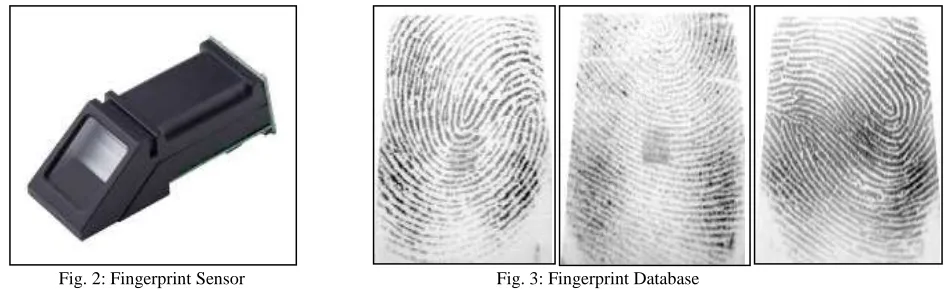
R305 optical fingerprint sensor is used for scanning the fingerprint of the mother. The database of the mother and newborn is stored in the arduino.
Fig. 2: Fingerprint Sensor Fig. 3: Fingerprint Database
The sample fingerprint images collected are shown in figure3. The different fingerprint is taken and stored in database.
Footprint Recognition
The captured footprint is pre-processed to remove the unwanted background. The various pre-processing steps are Particle Filter
Clamp Function
Gray Scale Image Segmentation Morphology
The next step involves extracting discriminating features based on texture information from the footprint. A Gabor filter with proper setting of its parameters is used to extract the information. This extracted information is stored as patterns in the database. These are known as the training/gallery images. A similarity measure is used to find the match between the test/probe pattern to the training/gallery pattern. Higher scores between patterns represent greater similarity such that they belong to the foot of the same infant.
Previous Work
Previoues work includes the use of identification document (ID) like bracelet and radio frequency identification (RFID) tag b y hospital authorities has not solved the problem of newborn swapping or mixing completely. Also previous works include biometrically recognizing the newborn using footprint feature which involves online image capture from two different types of background conditions.
Proposed Work
Proposed work include the matching of the footprint of the baby and fingerprint of the mother. For the scanning purpose R305 fingerprint sensor module is used. The keypad is used for providing the id. By using the keypad we can increament or decreament the id. If the decision is false then the buzzer will be turn ON.
Fingerprint Recognition
Ridges are the lines on the tip of one’s finger. A fingerprint is the pattern of ridges and furrows (valley) on the surface of a fingertip. The unique pattern of lines can either be loop, whorl, or arch pattern. Valleys are the spaces or gaps that are on either side of a ridge. The most important features in fingerprints are called the minutiae, which are usually defined as the ridge endings and the ridge bifurcations a ridge ending is the point, where a ridge ends abruptly. A ridge bifurcation is the point, where a ridge forks into a branch ridge as shown in figure.
Fig. 4: (a) Ridge Ending (b) Ridge Bifurcation
The two main categories of fingerprint matching techniques are minutiae-based matching and pattern matching. Pattern matching simply compares two images to see how similar they are. Pattern matching is usually used in fingerprint systems to detect duplicates. The captured fingerprints must be pre-processed to segment the unwanted regions. The estimation of the ridges is followed by an effective minutiae extracting algorithm that involves ridge map, thinning and post processing using morphological functions. Now, the minutiae are represented in a format that stores the x, y co-ordinates along with the orientation angle information. An alignment based elastic string pattern matching is used and a similarity measure is the performance metric used.
Footprint Scanner
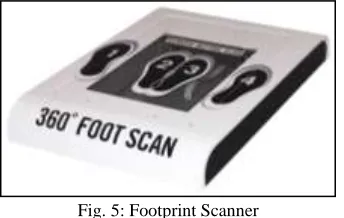
Fig. 5: Footprint Scanner
Footprint Database
There are no available newborn footprint databases in the web. Hence, our own newborn footprint database is created. The newborn’s footprint images are captured using a digital SLR (DSLR) camera, whose type is Canon EOS 7D .Since there is no available newborn footprint database, the images must be captured in real time. The image capturing work was done in the Primary Health Centre (PHC), Medavakkam, which is one of the Government run hospitals in India. After getting the legal permission from the health services officials, the images were captured. When capturing images, two persons are needed. One person is the author of the paper whose task is to pacify and hold the foot of the newborn and the other person is a well qualified professional photographer to take pictures of the newborn foot. A black cloth was wrapped around the ankle to facilitate image segmentation. All the images were collected in one session during the first 2 days following birth. After we explained some knowledge about the importance and significance about Newborn’s biometrics to newborn’s parents, they consented that we can capture footprint images once. In image acquisition stage, a crucial problem is to select an opportune time to capture images. If a newborn is hungry, crying or suffering from any minor illness, he/she will ceaselessly move his/her hands, feet, and whole body. In this time, it is difficult to hold and capture footprint images with desirable quality. On the contrary, if a newborn is calm or sleeping, the task of image captured.
II. CIRCUIT DIAGRAM
III. EXPERIMENTAL RESULTS
IV. CONCLUSION
In this paper, we have presented a detailed description in designing a multi-biometric system for newborn recognition. In addition to this, we have also presented a brief review of our related work in designing an appropriate biometric system for the identity verification of the newborn. Since the work presented in this paper focuses on data fusion at the match score level experimental results obtained by the unimodal biometric systems and serial mode are not presented here. They can be seen on and respectively. Experimental results show that the efficiency and the performance speed is also considerably increased for the multimodal biometric fusion system proposed the results are promising. Multimodal biometric data fusion of several biometric modalities combines the information provided by each unimodal modality to obtain a final decision. It has been demonstrated that multimodal fusion increases the robustness of the recognition system to obtain a recognition decision even when one or more of the biometric decisions cannot be accomplished. A fusion scheme applied as early as possible in the recognition system is more effective. T he performance of sum rule-based fusion depends on the choice of normalization technique.
REFERENCES
[1] S.Balameenakshi. S.Sumathi,‖ Biometric Recognition of Newborns: Identification using Footprints‖, Proceedings of 2013 IEEE International Conference on Information and Communication Technologies (ICT 2013), 737-742, Tamilnadu, India
[2] Hai-Yang Cai, et al ―Newborn Footprint Recognition using Orientation Feature‖, Neural Computing & Applications: 1-9, Dec ICIC 2010.
[3] S.Balameenakshi, S.Sumathi and R.Rani Hemamalini,‖Identity Verification of Newborn Using Biometrics‖, International Journal of Engineering Research and Applications (IJERA) ISSN: 2248-9622 National Conference on Advanced Communication & Computing Techniques (NCACCT-19 March 2013, Chennai)
[4] Peter, W. I. L. D."Single-sensor hand and footprint-based multimodal biometric recognition."
[5] Anil Jain, Karthik Nandakumar, Arun Ross,‖ Score normalization in multimodal biometric systems‖, Pattern Recognition 38 (2005) 2270 – 2285
[6] Horng, Shi-Jinn, et al. "An improved score level fusion in multimodal biometric systems." Parallel and Distributed Computing, Applications and Technologies, 2009 International Conference on. IEEE, 2009.
[7] Sahoo, Soyuj Kumar, Tarun Choubisa, and Mahadeva Prasanna SR. "Multimodal biometric person authentication: A review." IETE Technical Review29.1 (2012): 54.
[8] L. Hong, A.K.Jain, S. Pankanti, and R. Bolle, ―An identity authentication system using fingerprints,‖ Proc. IEEE, vol. 85, no. 9, pp.1365–1388, Sep. 1997. [9] Utkarsh Gupta et al,―Score Level Fusion of Face and Finger Traits in Multimodal Biometric Authentication System‖ IJCA Proceedings on International