Food Recommendation System
Ms. Pranoti D Patil Ms. Neha P Patil
UG Student UG Student
Department of Computer Engineering Department of Computer Engineering
NBN Sinhgad School of Engineering Ambegaon (bk), 411041 NBN Sinhgad School of Engineering Ambegaon (bk), 411041
Ms. Pallavi Y Geete Ms. Anuja V Nikat
UG Student UG Student
Department of Computer Engineering Department of Computer Engineering
NBN Sinhgad School of Engineering Ambegaon (bk), 411041 NBN Sinhgad School of Engineering Ambegaon (bk), 411041
Mr. Parag S Kulkarni Assistant Professor
Department of Computer Engineering
NBN Sinhgad School of Engineering Ambegaon (bk), 411041
Abstract
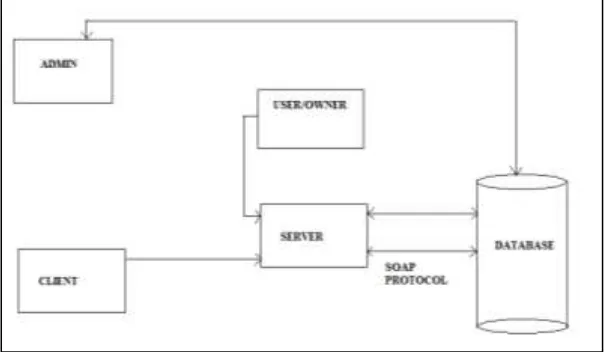
Now a day’s number of people using mobile applications for food and hotel searching are constantly increasing, but to recommend right hotel or dish for each user according to his/her personal interest is difficult task. In this paper an intelligent recommendation system is proposed for more personalized experience. This Application considers customer’s interest along with previous ratings for that particular hotel and food item. User recommendations are based on their Age, Gender and Profession. Our system consist three modules viz. Admin, Client and Owner .Admin part provides registration interface to new users. Client provides recommendation interface to customers. Owner module manages the information regarding hotels and menu items. Our proposed system successfully gives the recommendations to achieve user’s personal goals. It helps user for decision making of hotel and food.
Keywords: Android, Artificial Neural Network, Back-Propagation Network, Data Mining, Feed-Forward Network ________________________________________________________________________________________________________
I. INTRODUCTION
Whenever we plan to go out for dinner or lunch, very first question arises in our mind is “Which restaurant we should prefer for lunch or dinner?”,”Which food item is best in that particular hotel?”, etc [7]. There may be many options available to think about. But deciding which option we should pick is little confusing. As we know user wants multiple options and from that choice they can choose best one. An advice system helps people to make selections in these complex options. Consideration of location of customer and hotel is also important [8].Recommendation system predicts something is best or deserves to be chosen. There are many more food applications available in the market which can help you with this issue but these applications gives the recommendations based on feedback given by the previous customers. There is no classification of user responses depending upon their age, gender and profession.
We are focusing on the query “What should I prefer to eat?” [3] within the scope of this project. Our project considers three parameters viz. customer’s age, gender, profession and category of dish. It is often observed that food choices varies with particular age group .For example most of the teenage or young age people usually likes fast food or spicy food. In contrast to this fact, senior citizen doesn’t prefer fast food or spicy food. Similar scenario can be observed regarding gender parameter. The percentage of men preferring spicy food is more than the women. These all aspects are taken into consideration in this project to help the customers to get more personalized experience. The food recommendation system currently available in the market does not consider these facts [6]. It gives suggestion regarding hotel and food choice based on ratings given by previous customers. Existing systems focuses only on which hotel or dish is liked most. Considering the positive and negative comments is also an important part in food recommendation system [9].
II. EXISTING SYSTEM
Recommendation systems have become increasingly popular in recent years, and are utilized in a variety of areas including food, book, movies, social tags, music, restaurants, hotels, news, research articles and products.
In menu based recommendation system, Menu recommends on users choice. System provides menu of different canteens, Users can segregate meal according to their rate and taste.
In content based food recommendation system, food is recommended on profile of user interest and item specification. This system includes food profiling, user profiling and recommending food based on users previous feedback.
An intelligent catering system, it is a food ordering system has begun in 1998. It has been smoothly working but there was some incomplete server management of food. Catering system has been already exists. On the statistics and analysis, order management should be depended[2].
Situation-based food recommendation system, it gives recommendation of food which yields good result. They are successfully avoided recommendation of food which yield bad result. They constructed a system in which they bethink the tweets related to food. Also it recommends the food which has good yields along with their evidences. It is beneficial for decision making [3].
III. ALGORITHM
We are using predictive data mining method to train the input dataset. For that we are using algorithms of Artificial Neural Network. ANN is computation model which works similar to the Human Neural System [4]. In our system we are using two algorithms viz. Feed Forward Algorithm (FF) and Back-Propagation Neural Network (BPNN).
FF Algorithm:
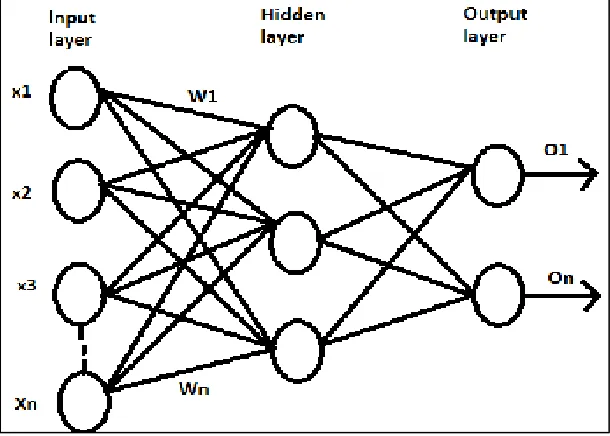
A FF network is artificial network. It is biologically inspired algorithm. FF connections do not form cycles between units. It contains a simple neuron and they are organized in layers. These neurons are like processing units[1]. In this type of network information can be sent only in single direction from input node to output node. There are no loops and cycles in the network. Units are connected through layer, every unit in a layer connected with previous layer unit. Every connection can have different weights [5] so these connections are not equal. Information on these layers encoded the knowledge of network. While performing the normal operations they act as a classifier and no feedback between layers. Hence it is known as FF neural network.
Fig. 1: Feed Forward Network
BPNN:
Back propagation is training algorithm which consist two steps: 1) Feed-Forward the values
Fig. 2: BPNN
In BPNN learning,
Input value of training data sample is present.
Correlation of Output (o) value is checked with estimated value (d). The squared difference of the two is given below,
∑𝑒𝑟𝑟𝑜𝑟 = (𝑑 − 𝑜)2
The error value describes the difference between obtained output and expected output. The objective of using BPNN is to minimize difference between output values. So the network works in that case is,
Minimize∑𝑒𝑟𝑟𝑜𝑟 = (𝑑 − 𝑜)2 We can denote the errors using,
I=Input value W=Weights
Bias function of perception
In order to describe Gradient function, continuous function can be used as threshold function. It is expressed with respect of W in terms of w and i. The fact is decreasing value of W leads to rapid decrease in error. Update the weight vector every time. The new weight values are calculated by using formula:
𝑊𝑛𝑒𝑤 = 𝑊𝑜𝑙𝑑 − 𝑛 𝛿𝑒𝑟𝑟
𝛿𝑤 Where, n is rate of learning.
Using these formula weights is changed in every cycle which helps to decrease error for that specific input. Then the summation of total error value decreases gradually to minimum value. So the data set can be train and we get our desired output.
IV. SYSTEM ARCHITECTURE
User information includes user’s personal details .System consists following three modules:
Android Client:
The android client provides following functionalities:
1) Login and Authentication:Users need to install client application on their mobile device having android OS [2]. The login page is the first interface. Already registered user can login here by submitting their username and password. New users can register themselves by clicking “Register New Users” button. If your login details do not match with entries available in server’s database then it shows “Login Failed!”. If details are correct then system will jump to main interface where user can search for hotels, dishes, give ratings to them and view recommendation etc.
2) Menu Suggestions: This page provides the recommendations to customers about which food item you should prefer .Users are also allowed to give feedback about specific dish they liked.
(a) Login Interface (b) Sign Up Interface (c) Main Interface (d) Recommendation Interface Fig 4: Android Client
Owner:
Similar to the client application, Owner application is connected to the database through server. Each hotel owner need to register first .In registration interface ,hotel owner is asked to enter his/her personal details as well as hotel details like hotel name, its location ,special services available in it and type of hotel(e.g. Veg/Non-veg).This module can display all the food items of that hotel. The hotel manager can perform some tasks like updating, adding and deleting of food items regularly based on the sales report in the history. This is beneficial to improve the overall business of the restaurants.
(a) Owner Login (b)Management of Food Items Fig 5: Owner Application
Admin
V. CONCLUSION AND FUTURE SCOPE
We are proposing a new application that will help customers to view recommendation of dishes, rate the dishes on the basis of their profession, age and gender and buy the dishes. Since previous systems were recommending on the basis of likes and ratings, through this it will recommend you according to your gender, age and ratings. Hence, customers will find out quickly a good dish and good hotel according to their choice. The System is developed in such way that it will fulfil the user requirement food ordering system based on interest can be developed. Prior reservation of tables for hotels can be done. Also similar idea can be used for product recommendation system.
REFERENCES
[1] Parag Kulkarni,Pranoti Patil,Neha Patil,Pallavi Geete,Neha Patil.”A Survey on Existing Food Recommendation System”. IJSTE - International Journal of Science Technology & Engineering, January 2017
[2] Xi Liang, Yang Xiaozhou, Mu Hongzhi.“An intelligent catering service platform based on the Android and J2EE”.2015 4th International Conference on Advanced Information Technology and Sensor Application,24 - 27
[3] KatsumiTanaka, Yoko Yamakata, Takuya Kadowaki.“Situation-based Food recommendation for yielding good results”. Multimedia Expo Workshops (ICMEW), 2015 IEEE International Conference 1 – 6
[4] CHENHua, SUNHuili, YIXiangxi, CHENXin(2011) .“Artificial Neural Network in Food Processing”. Proceedings of the 30th Chinese Control Conference July 22-24, 2011, Yantai, China, 2687 – 2692
[5] AmitavaNag, Soumadip Ghosh, JyotiPrakash Singh, DebasishBiswas, DebasreeSarkar, SushantaBiswas, Partha PratimSarkar(2011).“Weather Data Mining Using Artificial Neural Network”. Recent Advances in Intelligent Computational Systems (RAICS), 2011 IEEE. 192 – 195
[6] Wei-Ti Kuo, Yu-Chun Wang, Richard Tzong-Has Tsai, Jane Yung-Jen Hsu. ’’Contextual Restaurant Recommendation Utilizing Implicit Feedback”.2015 24 th Wireless and Optical Communication Conference(WOCC)
[7] Shashank S U, RakshaHegde M, K Raghuveer, “A Survey on Food Recommendation Systems”, International Journal of Advanced Research in Computer Science and Software Engineering, Volume 6, Issue 4, April 2016
[8] Marian Runo,” FooDroid:A Food Recommendation App for University Canteens”, June 21,2011