ISSN (e): 2250-3021, ISSN (p): 2278-8719
Vol. 08, Issue 6 (June. 2018), ||V (II) || PP 01-07
Models and methods of calculating the optimal development and
optimal operation of Vietnam's power system
LUONG Ngoc Giap
*1,3, VU Huu Hai
*1, NGO Van Dung
*2NGUYEN Binh Khanh
*3, TRAN The Vinh
*3, LE Tat Tu
*3*1 National University of Civil Engineering,
No. 55 Giai Phong str., Hai Ba Trung dist., Hanoi, Vietnam
*2 University of Science and Technology - The University of Da Nang *3 Institute of Energy Science, Vietnam Academy of Science and Technology
A9 Building, 18, Hoang Quoc Viet str., Cau Giay dist., Hanoi, Vietnam Corresponding Author: LUONG Ngoc Giap
Abstract:
Vietnam power system is growing fast and will be a large complex system with multiple, diversified and irregularly distributed power sources. Optimal operations and optimal development of Vietnam power system have been studied by many researchers and groups. This paper presents the results of a research on optimal modeling of Vietnam power system taking into account the characteristics of power sources and transmission lines. An objective function and a system of constraints are established to formulate a mathematical simulation model of Vietnam power system with any number of nodes. The model is designed to optimize the development and operation of the power system with the objective of minimizing the cost of power supply and determining the necessary constraints to determine the optimal operating mode for power plants in Vietnam power system.Keywords: Optimal model, Vietnam power system(VPS), Power source characteristics, Transmission line.
--- Date of Submission: 28-05-2018 Date of acceptance: 11-06-2018 ---I.
INTRODUCTION
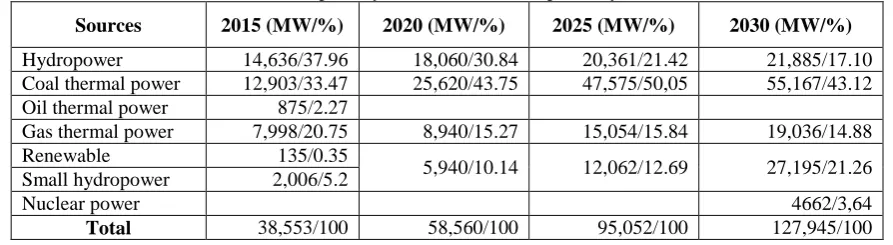
Total power of Vietnam power system as of 31/12/2015 was 38.553 MW and is likely to substantially increase from 2016 to 2020. According to Vietnam Electrical Company - EVN, in 2016, the total electricity output was 183.28 billion kWh, increased by 11.54% compared to 2015. Most of Vietnam's energy resources have been mobilized in order to meet the demand for socio-economic developments. Structure of primary energy sources for electricity generation until 31/12/2015 and forecast until 2030 is shown in Table 1 below. ([1],[2]).
Table 1: Structure of primary sources of Vietnam power system 2015-2030
Sources 2015 (MW/%) 2020 (MW/%) 2025 (MW/%) 2030 (MW/%)
Hydropower 14,636/37.96 18,060/30.84 20,361/21.42 21,885/17.10 Coal thermal power 12,903/33.47 25,620/43.75 47,575/50,05 55,167/43.12 Oil thermal power 875/2.27
Gas thermal power 7,998/20.75 8,940/15.27 15,054/15.84 19,036/14.88
Renewable 135/0.35
5,940/10.14 12,062/12.69 27,195/21.26 Small hydropower 2,006/5.2
Nuclear power 4662/3,64
Total 38,553/100 58,560/100 95,052/100 127,945/100
Diversified and irregularly distributed power sources: Areas of large hydropower plants are concentrated in the North and central regions ([3]). The characteristics of these sources are the large variations in power generation between dry and rainy seasons, between years of water abundant and years of water scarce. It should be noted that, between the regions, seasons come at different times of the year (a dry season in the North happens at the same time with a rainy season in the Central and vice versa). Small hydropower plants are found mostly in the North and the Central while wind and solar power are mainly located in the Central and South. ([4], [5], [6]).
- Hydroelectric power sources are not only seasonally dependent but also vary from zero to the predetermined power of the day (short consumption period of a predetermined power). The prices of electricity from these sources are high and varied in each region.
- Thermoelectric centers are located near the fuel (coal or gas) and in convenient locations for transportation, so they are often far away from major load centers.
At present, there are quite a number of software programs that are used to study the structure of rational development of the power system and also to solve the problem of mobilizing rational sources of power to meet the load demand. These software programs are produced abroad and have been imported into Vietnam. Most of commercial software programs are built upon different, state-of-the-art, non-linear mathematic models such as: Convex planning, Dynamic planning and Optimal process theory. In particular, the models that are currently being used extensively in the world are: WASP III, EFOM-ENV, ENPEP-Balance, LEAP, MARKAL, MESAP, MESSAGE, RETScreen, STRATEGIST-EVN from the USA, DPAT II, LP-ESPS level B of ETB, CORRECTIVE …([16,17,18,19,20,21]). However, the actual application of the imported software in Vietnam shows that the models always require their own input data sets, accompanied by conditions not all countries are capable of responding. For Vietnam, with the particularities of the power system, it is almost impossible to directly apply the imported commercial software. Therefore when using imported software, researchers have to have different input data processing solutions, so they do not always meet the requirements. Furthermore, the commercial program is designed like a black-box, users have no knowledge of its structure and calculation processes, it is difficult to detect unreasonable or non-optimal results. Therefore, the results often have to be adjusted to meet Vietnam conditions according to the experience of research groups.
Ngo Duc Cuong (2002 – Hanoi University of Technology) used a linear approximation of the linear approximation algorithm to construct the optimum distribution program in the VPS considering the transmission limits of the regions. The problem concentrates on solving the optimal power sources, but does not take into account the cost of the transmission between areas (nodes) [22].
Tran Vinh Tinh (2002 - Hanoi University of Technology) has studied the optimization methods to improve the efficiency of power supply operation. The author has applied the optimization methods to solve some problems in the field of management and operation of Vietnam power system. Research subjects are of small scales serving the independent operation and management of the districts, towns and cities [23].
From 1993-1995, a group of scientists at the Institute of Energy Science led by Prof. Dr. Nguyen Huu Mai, succeeded in solving the optimal development of Vietnam power system using 3-node-model: the North, the Central and the South. In particular, the 500kV Hoa Binh station is the central point of node 1. Node 2 consists of the 500kV Da Nang station and node 3 is the 500kV Phu Lam station. For costs and transmission losses calculations, the distances between nodes are fixed: node 1 – node 2: 640 km, node 2 – node 3: 557 km, node 1 – node 3: 1.497 km. The problem is solved using a linear approximation method and the result is the optimal structure of the power system (locations, size of power sources, 500 kV transmission lines of Vietnam power system) ([12], [24]). However, this approach has a limitation that only major sources connected to the 500 kV and 220 kV power grids are taken into consideration.
From 2005-2012, inheriting the research achievement of the authors from Research center of Energy science, Vietnam Institute of Science, researchers at the Institute of Energy Science, Vietnam Academy of Science had several studies to complete and improve the optimal model of power system development taking into account characteristics of power sources and transmission lines. Basically, ideas and algorithms had not changed, except the solution using linear planning method for the optimal problem. ([6],[7],[8],[9],[10],[11],[13],[14],[15]).
From the above-mentioned points, it can be seen that, in general, optimal operations of a power system have been considered, however due to the diversity and unique conditions in each country, there is no common model or software for the optimal operation of a power system. Depending on the particularities of each country, the problem of an optimal operation of the power system is solved separately.
II.
AN
OPTIMAL
MODEL
FOR
A
MULTI-NODE
POWER
SYSTEM
(ANY
NUMBER
OF
NODES)
Vietnam power system is geographically divided into regions. Each region is considered as a load node in the optimal model. Power generation characteristics and a load graph for each node are described with same principles. Nodes are connected with equivalent transmission lines. The goal is to find the optimal solution to cover load graphs of all n nodes. The optimum objective is to minimize total cost (cost of generation and cost of transmission) of the power system. Power supplies in each region (or each load node) will compete by cost (power generation + transmission) to cover the load graph of the local node itself and other nodes under a principle of „A load graph will be covered by the sources with lower cost first‟.
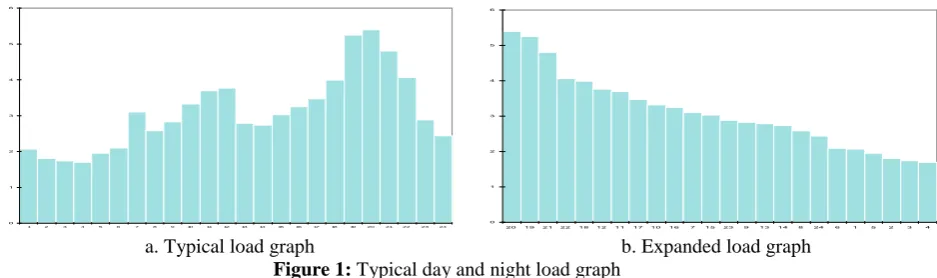
In order to solve the problem according to the proposed methodology, a typical daily load graph (Fig. 1a) is transformed into an expanded load graph (Fig. 1b).
0 1 2 3 4 5 6
1 2 3 4 5 6 7 8 9 10 11 12 13 14 15 16 17 18 19 20 21 22 23 24
0 1 2 3 4 5 6
20 1921 2218 12 1117 1016 7 15 23 9 13 14 8 24 6 1 5 2 3 4
a. Typical load graph b. Expanded load graph Figure 1: Typical day and night load graph
Figure 1b shows an expanded load graph with 24 steps (one step for each hour during a day) continuously from high to low from a typical load graph as shown in Figure 1a. A typical expanded day-night load graph is constructed for each node. The node‟s load graph covering process of a power system is carried out in two stages. In stage 1, the top of the load graph is covered with small power sources of the actual node. The rest shall be described by an objective function and constraints to solve by a linear planning method.
The power system in the proposed optimization model is described based on the following principles:
a. Load: National load of the power system is described via regional load graphs (by nodes). Each node collects all required information to build a typical day-night load graph and converts into an expanded load graph as mentioned above.
b. Power sources: All power sources of the power system shall take part in covering the 24 steps expanded load graph. Each power source is described with n components corresponding to N nodes of the power system. Complex characteristics of the source: fuel costs in thermal power plants; the capacity of the hydroelectric power plant, the power generation time of the renewable energy sources, the location of work on the typical load chart, etc., will be described under a “power increment” when moving from one step to another in 24 steps of the expanded load graph in Figure 1b.
A “Power increment” is the power difference between two steps in an expand load graph. The number of working hours of a power source must be equal to the number of hours of a step in the load graph that is covered by the mentioned power source (minimum is 1 hour and maximum is 24 hours). The power increment of node i is called the local node value added power component. This is the portion of the power of node i that overlaps a step k on the expanded load graph at that node. The remaining power to be covered for (N-1) nodes is called inter-regional power increment. This is the portion of the power at the node i that overlaps some of the load graph of the node j of the system. Thus, for an N-node power system, a power plant at node i will have N possibilities to supply power (N power increments).
c. 220 kV and 500 kV transmission lines: The relationship between nodes in an optimal problem is described by distance and capacity of equivalent transmission lines. Total transmission capacity of an equivalent line is equal to total transmission capacity of all 500 kV and 220 kV lines connecting two corresponding regions. The length of equivalent transmission lines is the average length of all 500 kV and 220 kV lines connecting two corresponding regions. In case calculation for of small regions, 110 kV lines shall be included and calculated along with 500 kV and 220 kV according the principle above.
regions) at all load levels corresponding to those regions.
The calculated cost factor for a unit of power of a power plant and transmission lines is determined dynamically and converted to a corresponding value in year t during the calculation process. Each power sources in the model at each moment is described as N variables, in which, 1 power variable for supplying power to that node itself and another N-1 variables for supplying to the remaining N-1 nodes.
The calculated cost factor (Ci) of any power plant is expressed in four main components: investment cost (Cđt), fuel cost (Cnl), operating and maintaining cost, (COM) and transmission cost (Cđd).
Ci = Cđt + Cnl + COM + Cđd (1) e. The objective function and constraints: Vietnam power system is geographically divided into domains and regions. Each region is considered as a load node in the optimal model. Power generation characteristics and a load graph for each node are described with same principles. Nodes are connected with equivalent transmission lines. The goal is to find the optimal solution to cover load graphs of all n nodes. The optimum objective is to minimize total cost (cost of generation and cost of transmission to load points) of the power system. Power supplies in each region or each load node will compete by cost (power generation + transmission) to cover the load graph of the node itself and other nodes under a principle of „A load graph will be covered by the sources with lower cost first‟.
The objective function of an optimal model
The objective function to describe the general optimization problem of Vietnam power system in order to minimize the total cost of power generation and transmission according to load demands of nodes and the entire system is as follow:
N i M m K k N j L l K k lk ji jlk ji jlk ji lj mk ii imk ii imkmi
C
P
C
P
Z
1 1 1
1
1 1 1
min
1
1
(2)Where: Zmin - value of the objective function; N - Number of nodes in the system; M - Number of
power plants at node i; K - Number of load levels at node i; min - rate of self-consuming at power plant m at
node i;
C
imkii - Calculated cost of power plant m at node i, supplying power to load level k of node i itself; ∆Pimk- Incremental value of power of plant m, at node i, level k; τmk - Working time of plant m at load level k; L -
Number of power plant at node j; lj - Rate of self-consuming of plant 1 at node j; ji - Rate of losses on
transmission line ji;
C
jlkji - The cost of the inter-regional plant l is set at node j, which supplies the load level k ofthe node i. (In addition to the cost of the plant, the cost of the transmission line from node j to node i must be added); ∆Pjlk – Incremental power of inter-regional plant 1 transmitting form node j to node i, level k and τlk is
the working time of plant l at power step k.
The constraints in the power system optimization model include: - Constraints on power balance for each node of the power system:
At each time t, at any node i, there are two inequalities in balancing power and electricity to be satisfied. The total power supplied to any node from power plants of that region (+) when receiving the transmission power from another node to and (-) when the power transmitted to the other nodes, must be greater than or equal to the power load demand of that region, including reserve power (if any).
1
(
1
)
1 1
1
1 1 1
N
i
P
P
P
P
M m dt i nc i K k N j L l K k ji jlk ji iiimk
(3)- Constraints on power balance: The power produced by the plant can supply to any node that must always be greater than or equal to the power demand of that node.
1
(
1
)
1 1
1
1 1 1
N
i
E
P
P
M m nc i K k lk N j L l K k ji jlk ji mk iiimk
(4)Where: Pinc - power demand of node i; Pidt - power reserve of node i; Einc - energy demand of node i.
The number of pairs of constrained inequalities equals the number of nodes in the system.
- Constraints on power plant capacity limitation:The total capacity of a power plant supplying to the node (containing the considered plant) and adjacent nodes at all levels shall not exceed the plant available capacity. The number of constrained inequalities is equal to the number of power plants in the system. Considering the power station m at node i we have:
td mi lm mi K k N j
kij
P
P
P
1 1Where: K = 124 load level; N - number of nodes in the system; Pkij - local and inter-regional powers
of plant m; Pmilm - installed power of plant m và Pmitd - Self-consuming power of plant m.
The number of constrained inequalities is equal to the number of power plants in the system.
- Constraints on the average daily power limit of a power plant: The total power of a power plant supplying to the local region and adjacent ones at all levels must not be greater than the plant's average daily power. Considering the power station m at node i we have:
td mi ng mi K
k N
j
mk
kij
E
E
P
1 1
(6)Where: K=124 load level; N - number of nodes in the system; Pkij - local and inter-regional powers of
plant m; mk - Working time on load level; Eming - average daily generating energy of plant m và Emitd -
self-consuming energy of plant m.
The number of constrained inequalities is equal to the number of power plants in the system.
- Constraints on the transmission limit of the transmission line: The limit on the total transmission power on the line at any point t shall not be greater than the transmission capacity of the line. Considering transmission line ij: The value of the load on the considered line shall be less than or equal to the load capacity limit of the line:
M
m
dd ij K
k
mkij
P
P
1 1
(7)
Where: M - Number of power plants capable of transmitting toward direction ij; K = 1-24 load levels on an expanded load graph; Pmkij - Transmission power of plant m level k from i to j and Pddij - Transmission
power of plant m level k.
The number of constraints of this type is equal to the number of equivalent transmission lines of the system.
- Constraints on the interconnectivity of lines:The transmission power flow from one power plant to all other nodes that do not contain the plant has a reasonable interconnection (practically feasible in terms of technology). This constraint is considered at each power level and for each plant.
When considering the power plant m of the node i at the load level k, transmitting power through node j to the other nodes: On the interconnected transmission lines from plant m, the power flow on the lines from plant m to node j (and/or other nodes) must be greater than or equal to the power flow out of that node.
D d
rjd kim K
k
vjd kim
di
)
P
1P
1
(
(8)Where: k - power level;
di- Losses rate on interconnected lines; d; D - number of interconnected lines to transmit power from plant m of node i to and out of node j to other nodes;P
kimvjdandP
kimrjd: Respectivelypowers of plant m in and out of node j on the interconnected line d.
The maximum number of constraints of this type for a plant is [24 x (number of regions -1)].
- Constraints on the limitation of the power generation ability at Pmax, Pmin of a thermal power plant: The variation of the power output between the hours of the day of the thermal power plant must be consistent with the power capacity of the plant. Considering a thermal power plant: Total power (peak output + half peak output + half bottom output) is less than or equal to the product of the minimum power and limit coefficient:
K
m i i
m i
P
P
1
(9)Where: K - Power level in consideration; Pi - Power of the thermal plant on level i; Pm - Minimum
power of the plant in consideration (m=24) and is the limit coefficient ( = 0,3 0,5).
- Constraint on environmental emission:Total greenhouse gas emission (CO2 equivalent) of all plants
in the system must be less than a predetermined limited value. Total environmental emission is equal the product of total power output from plants (including self-consumption) and the coefficient of CO2 (or
equivalent) emission.
Total power output of a plant is the total power of that plant supplying to the local region and total power of that plant transmitting from the local region to adjacent regions:
1 1 1 1 1 1
(1
)
N M K M J Z
ii ij
mi mi mik ik mijz jz t
i m k m j z
b
P
P
A
Where: bmi - Coefficient of CO2 equivalent emission of plant m at node i (ton/MWh); N - Number of
nodes in the system; M - Number of plants at node i; K - Number of load levels at node i; mi - Rate of
self-consumption of plant m at node i.; ∆Piiimk - Local power value of plant m, at level k of node i; ik - Time of
power level k of node i; J - Number of adjacent nodes to node i; ∆Pijmijz - Inter-regional power value of plant m, load to level z of node j (MW); jz - Time of power level z of node j and At is the limited value of total emission.
III.
CONCLUSION AND RECOMMENDATION
3.1. Conclusion
The research results of the article have clarified the contents related to the structure and characteristics of Vietnam power system (Vietnam power system has complicated structure, diversified and multi-voltage grid system, which extends from the North to the South to connect with the national load regions) as the basis to build the simulation model for the optimal operation of power sources in the real power system.
The mathematical simulation model of Vietnam power system has been studied and solved to fully describe the characteristics of the power stations in the power system both in terms of location, power generation together with the cost of electricity generation in real time and the actual grid connected between the source and the load center. The model is designed to optimize the development and operation of the power system with the objective of minimizing the cost of power supply and the necessary constraints to determine the optimal operating mode for power plants in Vietnam power system.
3.2. Recommendation
The system of the objection function and constraints mentioned above shall be applied to cover the national load graph with any node number.
Solving an objection function with nonlinear parameters for complex n-node systems is difficult. The authors have studied the optimal solution for the operation of Vietnam power system with n-node by linear planning method, with proposals for linearization of the objection function and constraints in accordance with the specific conditions of the power system in Vietnam. The built software allows to properly describing the characteristics of the power of each node and the equivalent transmission line between the nodes. The methods and programs obtained not only allow solving optimization problems, but also can be applied to optimize the operation of the power system. Analyzing the results of the computation according to the established program allows asserting conformity with other research results and reality ([12, 13, 14, 15]). Details of the results will be presented in the next study.
ACKNOWLEDGEMENT
This paper was supported by the Institute of Energy Science, Vietnam Academy of Science and Technology, the National University of Civil Engineering and the University of Science and Technology - The University of Da Nang. We would like to extend our gratitude to our colleagues and scientists for their excellent comments on this article and hope to continue to receive comments from these specialized experts in future articles.