Design of a Secure Mutually Authenticated Key-Agreement
Protocol for Multi-server Architecture
Alavalapati Goutham Reddy
1, Eun-Jun Yoon
2, Young-Ju Kim
1, Kee-Young Yoo
1*1 School of Computer Science and Engineering, Kyungpook National University, Daegu, Republic of Korea. 2 Department of Cyber Security, Kyungil University, Gyeongbuk, Republic of Korea.
* Corresponding author. Email: [email protected]
Manuscript submitted January 5, 2017; accepted April 20, 2017.
doi: 10.17706/jcp.13.2.194-203
Abstract: Authentication with key-agreement protocols for multi-server architecture are emerging as a solution to conquer the traditional client-server architecture’s limitations such as repeated registrations with distinct tokens and credentials. Since Li et al.’s first proposed authentication protocol for multi-server architecture, several liken protocols have tailed this queue. Majority of these protocols have been designed while the users sharing their plain or digested credentials with the servers during either registration or authentication phases. This weakens the security by making it vulnerable to severe security threats called privileged insider attacks, user impersonation attacks and server impersonation attacks. To overcome the aforementioned problems, this paper put forwards an authentication with key-agreement protocol for multi-server architecture based on biometrics. The proposed protocol is absolutely light-weight due to its design mainly based on one-way hash function. The analysis section of this paper shows that the proposed protocol performs better than related protocols and makes it suitable for practical applications.
Key words: Authentication, key-agreement, protocol, multi-server, three-factor, security, performance.
1.
Introduction
The vast expansion of internet and ubiquitous computing technologies have necessitated the authentication of every remote user. Cryptographic authentication is a secure practice of transferring credentials to determine someone, in fact, who they are proclaimed to be and providing authorization to access the services subsequently. Typical authentication can be obtained in distinctive ways namely knowledge factors (passwords), possession factors (tokens) and inherence factors (biometrics) are some well-known methods. Several authors designed authentication protocols for multi-server environment using either two of the above factors or all the three factors [1]-[22]. This paper discusses the recently proposed three-factor authentication protocols under the hypothesis of biometrics are more robust than passwords and smartcards.
phases. In 2014, Chuang et al. [5] proposed an anonymous three-factor multi-server authenticated key agreement protocol. Their protocol is constructed mainly on one-way hash function which makes it suitable for real time applications. Unfortunately, Mishra et al. [6] in 2014 & Lin et al. [7] in 2015 pointed out several weaknesses of Chuang et al.’s protocol such as lack of user anonymity, susceptible to server spoofing attacks, stolen smartcard attacks, user impersonation attacks, denial-of-service attacks and session-key compromise. Then they proposed an improved protocols over Chuang et al.’s protocol. However, Lu et al. [8] in 2015 & Wang et al. [9] in 2016 stated that Mishra et al.’s protocol is exposed to user and server masquerading attacks, replay attacks, forgery attacks, denial-of-service attacks, lack of perfect forward secrecy and user anonymity. Lu et al. [8] in 2015 & Wang et al. [9] in 2016 proposed improved protocols over Mishra et al.’s protocol. In 2015, Jiang et al. [10], He et al. [11] & Odelu et al. [12] put forward various authenticated key-agreement protocols for multi-server environment based on biometrics. Above three protocol involves registration center in the authentication phase which makes them inefficient due to overwhelming calculations at registration center. Additionally, Odelu et al. asserted that He et al.’s protocol has drawbacks in login and password change phases and is also prone to impersonation attacks. Jiang et al.’s protocol cannot provide user anonymity and makes it prone to trace attacks. In 2016, Reddy et al. [13] cryptanalyzed Lu et al.’s protocol and showed the weaknesses such as prone to impersonation attacks, man-in middle attacks, clock synchronization problem, lack of user anonymity and lack of perfect forward secrecy. Then they proposed an improved robust protocol built on elliptic curve cryptography. Most recently, Wang et al.
proposed another three-factor authenticated key agreement protocol for multi-server environment. However, their protocol also shown the flaws such as lack of anonymity, vulnerability to impersonation attacks, insider attacks and clock synchronization problems.
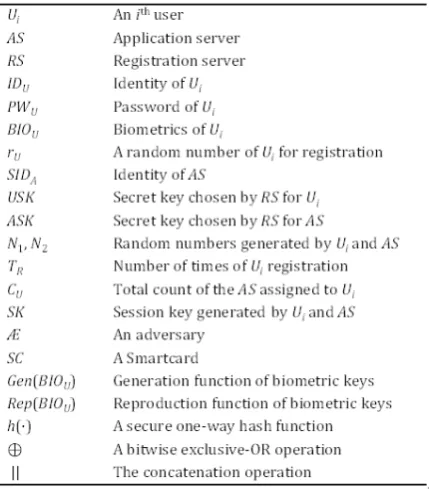
Table 1. Notations of the Proposed Protocol
Our contributions: The keen observation of above related works clearly proves that most of them are vulnerable to impersonation attacks. Therefore, this paper proposes another three-factor authentication protocol for multi-server architecture. Unlike the existing protocols, the proposed protocol attains perfect mutual authentication without sharing its user’s credentials throughout any phase. This nature of proposed protocol resists all sorts of attacks and makes it robust compared to other protocols.
the proposed scheme in detail. Section 4 affords performance analysis. At last, Section 5 concludes the paper.
2.
The Proposed Protocol
This section proposes three-factor remote mutual authentication with key agreement protocol for multi-server architecture. The proposed protocol comprises three participants: user (Ui), application server (AS), registration server (RS) and seven phases: application server registration phase, user registration phase, login phase, mutual authentication with key agreement phase, password and biometrics changing phase, dynamic server addition phase, and user revocation/re-registration phase. The various notations used in the proposed protocol are listed in Table 1.
2.1.
Application Server Registration Phase
2.2.
User Registration Phase
Ui RS
(USK, ASK, TS)
< PIDU,PWDU> ∀J,S =1 tonofT S
ComputeQS=h(PIDU||KS)
RS=QS⊕PWDU
Store {SIDA,RS} in the tableTU
ComputeWS=h(PIDU||USK)
Store {WS,TU,h(ASK)} intoSC
< SC{WS,TU, h(·), h(ASK)} >
XS=WS⊕PWDU
CU=h(IDU||WS)
ScanBIOU
Compute (σU,θU)= Gen(BIOU)
VU=rU⊕h(σU)
ReplaceWSwithXSand Store {CU,VU,θU} onSC
SC{XS,VU,CU,TU,θU,h(·),h(ASK)}
InputIDU, PWU
GeneraterU∈Zp*
PIDU= h(IDU|| rU)
PWDU= h(PWU|| rU)
SIDA RS
SID1 SID2 . . SIDn R1 R2 . . Rn TU :
(Secure channel)
PIDU CU TR
PID1 PID2 . . PIDn C1 C2 . . Cn TR TR . . TR TC:
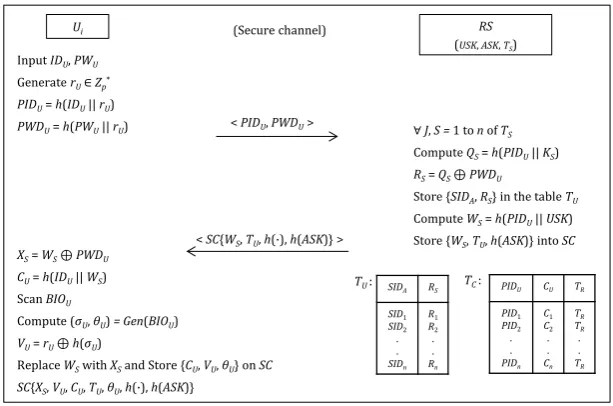
Fig. 1. Summary of user registration phase.
In this phase, a newASsends a registration request to the RS in order to become an authorized server of
the network. TheAS registration process occurs via a secure channel with following steps:
Step 1: ASsends registration request <SIDA> to the RS.
Step 2: RScomputes KS= h(SIDA|| ASK) and RSstores {SIDA,KS} in its database table TS.
Step 3: RSsends < KS, h(ASK) > to AS, which can be used in further phases of authentication.
A new Ui, who desires to avail the services provided by any ASmust register with RS. Assume that Ui
obtains a SC with the value {h(·)} upon formal request to RS. Uigoes after the following steps to register with
RS via a secure channel as shown in Fig. 1.
Step 1:Uichooses IDU, PWU, and generates a random number ru∈ Zp*. Uicomputes PIDU= h(IDU|| ru),
PWDU= h(PWU|| ru) and sends a request message < PIDU, PWDU> to RS.
Step 2:RSverifies the duplication of PIDU and then computes QS= h(PIDU|| KS), RS = QS⊕ PWDUfor all the
registered SIDAand stores {SIDA, RS} in the table TU. RSalso stores {PIDU, CU, TR= 1} in the table TC, where TR = 1 means Ui is registered once and is in active state. RScomputes WS =h(PIDU|| USK) and personalizes {WS, TU, h(ASK)} into the SCto be delivered toUi.
Step 3:Uiscans his/her BIOUat the provided sensor with card reading machine and computes XS= WS⊕
2.3.
Login Phase
When a Ui wants to access the services of any registered AS, he/she can launch the login request by
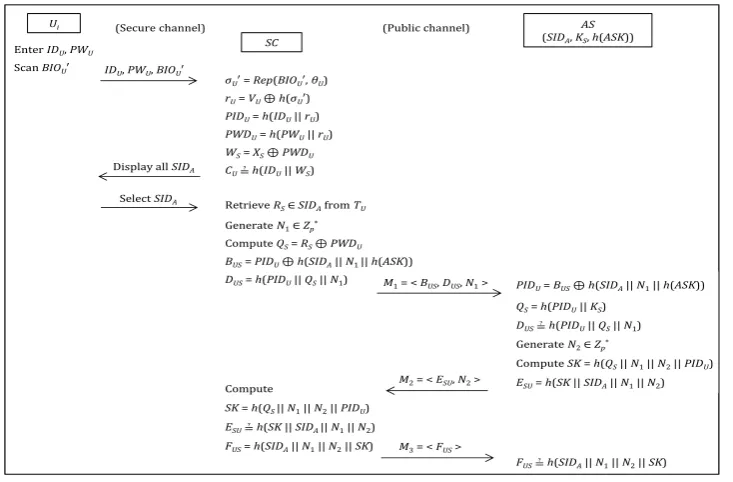
inserting SCand inputting IDU, PWUandBIOU′as detailed in the Fig. 2.
Step 1: SC computes σu′= Rep(BIOU′, θu), ru = VU⊕ h(σu′), PIDU = h(IDU|| ru), PWDU= h(PWU|| ru),
WS= XS⊕ PWDUand then verifies whether the conditionCU≟ h(IDU|| WS) holds. If it generates a negative
result, the login request can be terminated. Otherwise, the list of ASappears on the card reading machine.
Step 2: SC AS: M1= <BUS, DUS, N1>
Uiselects the AShe wanted to communicate, then SCretrieves corresponding AS’s RSvalue from TUand
extracts QS= RS⊕ PWDU. SCgenerates N1∈ Zp* and computes QS= RS⊕ PWDU, BUS = PIDU⊕ h(SIDA|| N1|| h(ASK)), DUS= h(PIDU|| QS|| N1). SClaunches the login request message M1= < BUS, DUS, N1> to AS.
2.4. Mutual Authentication with Key-Agreement Phase
During this phase, Ui and AS authenticates each other and computes a session key for further secure
communication over public channel. The entire mutual authentication with key agreement phase is illustrated in Fig. 2.
Ui
SC IDU,PWU,BIOU′
σU′ =Rep(BIOU′,θU)
rU=VU⊕h(σU′)
PIDU= h(IDU|| rU)
PWDU= h(PWU|| rU)
WS=XS⊕PWDU
CU≟h(IDU||WS)
RetrieveRS∈SIDAfromTU
GenerateN1∈Zp*
ComputeQS=RS⊕PWDU
BUS=PIDU⊕h(SIDA||N1||h(ASK))
DUS=h(PIDU||QS||N1) EnterIDU,PWU
ScanBIOU′
Display all SIDA
Select SIDA
(Secure channel)
PIDU=BUS⊕h(SIDA||N1||h(ASK))
QS=h(PIDU||KS)
DUS≟h(PIDU||QS||N1) GenerateN2∈Zp*
ComputeSK=h(QS||N1||N2||PIDU)
ESU=h(SK||SIDA||N1||N2)
AS
(SIDA, KS, h(ASK))
M1= < BUS, DUS, N1>
Compute
SK=h(QS||N1||N2||PIDU)
ESU≟h(SK||SIDA||N1||N2)
FUS=h(SIDA||N1||N2||SK)
M2= < ESU, N2>
M3= < FUS>
FUS≟h(SIDA||N1||N2||SK) (Public channel)
Fig. 2. Summary of login and mutual authentication phases.
Step 1:AS computesPIDU = BUS⊕ h(SIDA|| N1|| h(ASK)), QS= h(PIDU|| KS) and verifies the condition DUS≟
h(PIDU || QS || N1). If the condition holds, then AS can authenticate Ui otherwise the process can be
terminated.
Step 2:AS SC: M2= < ESU, N2>
ASgenerates N2∈ Zp* and computes SK= h(QS|| N1|| N2|| PIDU), ESU =h(SK|| SIDA|| N1|| N2), and then sends M2= < ESU, N2> to SC.
Step 3:SC AS: M3= < FUS>
SCcomputes SK = h(QS|| N1|| N2|| PIDU) and verifies the conditionESU≟h(SK || SIDA|| N1|| N2). If the
condition holds, then Ui can authenticate AS, otherwise the process can be terminated. SC computes FUS=
h(SIDA|| N1|| N2|| SK) and sends it to AS.
Step 4:ASverifies FUS≟ h(SIDA|| N1|| N2||SK) and reconfirms the authenticity ofUi. Now, Uiand ASare
2.5.
Password and Biometrics Changing Phase
This procedure is invoked when Ui wish to update his/her existing password or biometrics with new ones.
In this procedure, Ui can change his password or biometrics by inserting SC and inputting IDU, PWU and BIOU′
over a secure channel without the help of RS as follows.
Step 1: SC computes σU′ = Rep(BIOU′, θU), rU = VU ⊕ h(σU′), PIDU = h(IDU|| rU), PWDU = h(PWU|| rU), WS = XS
⊕ PWDU and then verifies whether the condition CU ≟ h(IDU|| WS) holds. If it generates a negative result,
the login request can be terminated.
Step 2: SC retrieves RS = QS⊕ PWDU for all SIDA using the current PWU. Ui chooses a new password PWU#
and scans new BIOU# and then computes PWDU# = h(PWU# || rU), XS# = WS ⊕ PWDU#, (σU#, θU#) = Gen(BIOU#),VU# = rU⊕ h(σU#), RS# = QS⊕ PWDU# for all SIDA.
Step 3: Uiupdates the table TU# and the parameters XS#, VU#, θU# on the SC. Thus, the SC finally consists of the
parameters SC{XS#, VU#, CU, TU#, θU#, h(·), h(ASK)}.
2.6.
Dynamic Addition of Application Server Phase
In this phase, a new application server ASnew can join the existing network by sending a registration
request to the RS in order to become an authorized server. The new application server’s information will be
forwarded to the existing users of the network periodically using their stored {PIDU, CU} or upon the request
for updates from Ui. In any of the above two cases, Ui is expected to pass through login phase successfully.
The ASnewregistration process consists of following steps.
Step 1: ASnew sends registration request < SIDAnew> to the RS.
Step 2: RS computes KSnew = h(SIDAnew || ASK), and RS stores {SIDAnew, KSnew} in TS.
Step 3: RS sends < KSnew > to ASnew via a secure channel, which can be used in further phases of
authentication.
Step 4: RS retrieves the {PIDU, CU} of users and computes QSnew =h(PIDU|| KSnew), and then delivers it to Ui via a secure channel. RS updates {PIDU, CU} in the table TC. Upon receiving the new AS’s information, Ui
computes RSnew= QSnew⊕ PWDU and adds it to their TU.
2.7.
User Revocation/Re-Registration Phase
This phase directs Ui when he/she wants revoke the available services or re-register with different
identity. In any of the above two cases, Ui is expected to pass through login phase successfully. Both the
phases occurs via a secure channel as explained below.
Revocation: During the revocation phase, Uiproves his/her legitimacy and submits the acquired SC to the
RS. Upon receiving the request, RS sets TR = 0 and updates {PIDU, CU, TR = 0} in the table TC, where TR = 0
means Ui is revoked and inactive. When Ui wishes to resume his/her previous services, then Ui must prove
his/her PIDU ≟ h(IDU|| rU), PWDU ≟ h(PWU|| rU) by retrieving QS = RS⊕ PWDU using the last recent IDU, PWU,
and BIO. If Ui holds the correct credentials, then RS resumes Ui’s services and updates {PIDU, CU, TR = 1} in
the table TC.
Re-registration: When Ui wants to re-register with the new credentials, then he/she must prove his/her
legitimacy and send the request to RS. Upon receiving the request, RS follows the steps described in user
registration phase and updates {PIDU, CU, TR = TR + 1} in the table TC.
3.
Security Analysis
Proposition 1. The proposed protocol achieves user anonymity and untraceability.
Proof. The transmitted messages < M1, M2, M3 > between Ui and AS during the login and authentication
phases are arbitrary for each session due to their association with the random numbers N1 and N2. Ui’s
original identity IDU is encapsulated in the form of BUS = PIDU ⊕ h(SIDA|| N1|| h(ASK)), where PIDU = h(IDU|| rU). The similar approach is followed in case of all the parameters < BUS, DUS, N1>, < ESU, N2>, and < FUS> and accomplished user anonymity. The proposed protocol also provides another important feature called untraceability. The randomness of all the parameters makes it unidentifiable and untraceable to the adversaries.
Proposition 2. The proposed protocol is secure against replay attacks.
Proof a. Ӕ may try to establish a new session while impersonating a valid user by replaying the previous
transmitted message < M1>. However, the proposed protocol can withstand replay attacks using random
number N1 as explained here. During the login and mutual authentication phase, AS receives the message <
BUS, DUS, N1 > and stores the pair {PIDU, N1} in its database. If Ӕ replays the same message < M1Ӕ>, AS
retrieves {PIDU, N1Ӕ} and compares with the stored {PIDU, N1}. When AS finds N1Ӕ== N1, then it drops the
request and terminate the process. Uiand AS follows the similar way to defy the replay attack on response
messages < ESU, N2> and < FUS>.
Proposition 3. The proposed protocol is secure against stolen smartcard attacks.
Proof. With the hypothesisthat Ӕ can read a SC stored values using various methods as discussed in, this
section describes the resistance of the proposed protocol to stolen smartcard attack. Assume that Ӕ is able to
read the stored parameters {XS, VU, CU, TU, θU, h(·), h(ASK)} on a stolen legitimate SC. Now, Ӕ may try either
launching an authentication request to gain the access to AS or try deriving actual Ui’s credentials from the
extracted parameters. However, Ӕ undeniably cannot perform any of above actions using these values, since
all the important parameters such as RS = QS⊕ PWDU, XS = WS⊕ PWDU, VU = rU⊕ h(σU) are safeguarded
with h(.), where PIDU = h(IDU|| rU) and PWDU = h(PWU|| rU). Ӕ can neither obtain the credentials nor build
an authentication request < M1> using the stolen SC due to the unavailability of IDU, PWU and BIOU. At the
same time guessing the IDU, PWU and forging BIOU are impractical. Therefore, the proposed protocol can
withstand smartcard stolen attacks.
Proposition 4. The proposed protocol is secure against user impersonation attacks.
Proof a. Assume a situation where Ӕ possesses a valid SC and wants to gain network access by perpetrating
user impersonation attack. If Ӕ wants to impersonate a legitimate Ui, he/she requires to build a login request
message M1= < BUS, DUS, N1>. On the other hand, Ӕ should undergo login phase before making authentication
request. During login phase, SC computes σU′ = Rep(BIOU′, θU), rU = VU ⊕ h(σU′), PIDU = h(IDU|| rU), PWDU = h(PWU|| rU), WS = XS⊕ PWDU and then verifies whether the condition CU ≟ h(IDU|| WS) holds. Unless the Ӕ
passes the correct credentials, he/she cannot enter into the further phases. Therefore, Ӕ certainly requires
legitimate credentials for any likewise computations. However, the probability of yielding correct IDU and
PWU is negligible. Though the Ӕ performs guessing attacks for IDUand PWU, he/she definitely cannot forge or
copy valid Ui’s BIOU.
Proof b. The proposed protocol does not share much personal identifiable information of Ui to any AS. During
login and mutual authentication phase, AS can obtain only PIDU of legitimate Ui via PIDU= BUS ⊕ h(SIDA|| N1
|| h(ASK)). For instance, if any AS turns as Ӕ and wants to impersonate a valid Ui, he/she still requires KS of
targeted AS to construct QS = h(PIDU|| KS). In the proposed protocol, QS value is unique for each AS, where KS = h(SIDA || ASK). Aforementioned constraints prove that our scheme is secure from user impersonation attacks.
Proof. Consider a scenario where a registered AS turned as Ӕ captures < M1 > and tries to impersonate valid
AS by responding with computed message < M2Ӕ >. From the captured M1, Ӕ can barely obtain PIDU= BUS ⊕
h(SIDA|| N1|| h(ASK)) and N1 when it is assumed of having SIDA. In order to compute the response M2Ӕ, QS
value of the targeted AS and Ui is a prerequisite since each AS of the proposed protocol holds unique
long-term key KS which is computed based on SIDA as KS = h(SIDA || ASK). Thus, Ӕ cannot compute SK = h(QS || N1|| N2|| PIDU), ESU= h(SK || SIDA|| N1|| N2) and reply Ui. Let’s take another case where Ӕ computes SKӔ = h(QSӔ|| N1|| N2|| PIDU), ESUӔ = h(SKӔ|| SIDA|| N1|| N2),and then sends M2Ӕ = < ESUӔ, N2> to SC.Upon
receiving the response, Ui computes SK = h(QS || N1|| N2 || PIDU), ESU= h(SK || SIDA || N1|| N2) and can
identify it as a malicious attempt due to the non-equivalence of messages ESUӔ ≠ ESU. It is evident from the
above statements that the proposed protocol can withstand application server impersonation attacks.
Proposition 6. The proposed protocol is secure against password guessing attacks.
Proof. Ӕ may try to guess the PWU using the extracted parameters stored on SC{XS, VU, CU, TU, θU, h(·), h(ASK)}
or keep trying to login while guessing the PWU. However, Ӕ cannot validate the guessed PWU due to
non-availability of parameter rU.
On the other hand, rU value is protected with Ui’s BIOU in the form of (σU, θU) = Gen(BIOU), and VU = rU⊕
h(σU) and it is believed to be impractical to forge a valid Ui’s BIOU. The Ӕ definitely cannot proceed further
without passing correct BIOU resulting in failure of validating the guessed password using PIDU = h(IDU|| rU),
PWDU = h(PWU|| rU), WS = XS⊕ PWDU, CU ≟ h(IDU|| WS). In this way, the proposed protocol is secure against password guessing attacks.
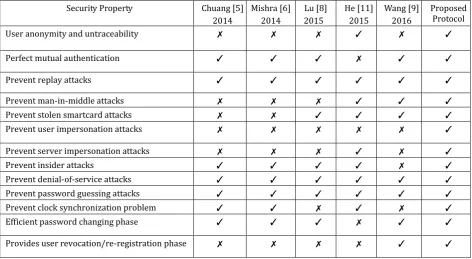
Table 2. Comparison of Security Properties with Other Three-Factor Protocols
Security Property Chuang [5]
2014
Mishra [6] 2014
Lu [8] 2015
He [11] 2015
Wang [9] 2016
Proposed Protocol
User anonymity and untraceability ✗ ✗ ✗ ✓ ✗ ✓
Perfect mutual authentication ✓ ✓ ✓ ✗ ✓ ✓
Prevent replay attacks ✓ ✓ ✓ ✓ ✓ ✓
Prevent man-in-middle attacks ✗ ✗ ✗ ✓ ✓ ✓
Prevent stolen smartcard attacks ✗ ✗ ✓ ✓ ✓ ✓
Prevent user impersonation attacks ✗ ✗ ✗ ✗ ✗ ✓
Prevent server impersonation attacks ✗ ✗ ✗ ✓ ✗ ✓
Prevent insider attacks ✓ ✓ ✓ ✓ ✗ ✓
Prevent denial-of-service attacks ✓ ✓ ✓ ✓ ✓ ✓
Prevent password guessing attacks ✓ ✓ ✓ ✓ ✓ ✓
Prevent clock synchronization problem ✓ ✓ ✗ ✓ ✗ ✓
Efficient password changing phase ✓ ✓ ✓ ✗ ✓ ✓
Provides user revocation/re-registration phase ✗ ✗ ✗ ✗ ✓ ✓
Proposition 7. The proposed protocol is secure against privileged insider attacks.
Proof. During user registration phase of the proposed protocol scenario, Ui does not submit either the plain credentials or the digest of credentials alone to the RS. Ui submits PIDU = h(IDU|| rU), and PWDU = h(PWU||
rU) to RS, where rU ∈Zp* is a random number. Thus, an insider cannot obtain the original credentials of any
Ui. Additionally, the proposed protocol is designed on the basis of not maintaining password verification
tables and the authentication of entities is being done by verifying the accuracy of received messages such
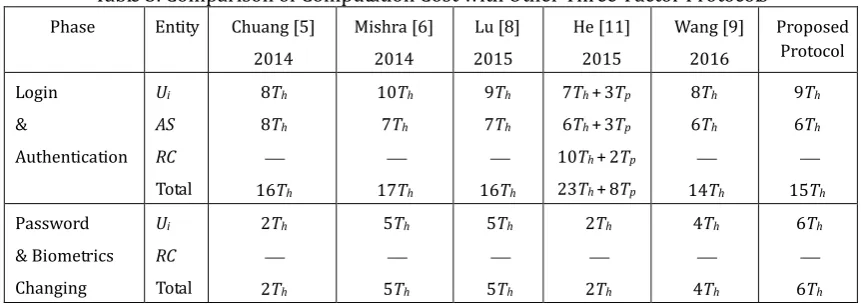
Table 3. Comparison of Computation Cost with Other Three-Factor Protocols
Phase Entity Chuang [5]
2014 Mishra [6] 2014 Lu [8] 2015 He [11] 2015 Wang [9] 2016 Proposed Protocol Login & Authentication Ui AS RC Total
8Th
8Th
16Th
10Th
7Th
17Th
9Th
7Th
16Th
7Th +3Tp
6Th +3Tp
10Th +2Tp
23Th +8Tp
8Th
6Th
14Th
9Th
6Th
15Th
Password & Biometrics Changing Ui RC Total
2Th
2Th
5Th
5Th
5Th
5Th
2Th
2Th
4Th
4Th
6Th
6Th
4.
Performance Analysis
This section demonstrates the comparison between the proposed protocol and other related protocols in terms of various aspects such as security, and computational cost. The performance analysis ensures that the proposed protocol is efficient and better in every aspect when compared to other authentication protocols for multi-server architecture.
Functionality comparison: Here, the proposed protocol is compared with the three-factor authentication
protocols such as Chuang et al., Mishra et al., Lu et al., He et al., and Wang et al., and is showed in Table 2. It is
evident from the Table that except the proposed protocol, all the other three-factor protocols are vulnerable to various security attacks whereas the proposed protocol can prevent user and server impersonation
attacks, and also provides perfect user anonymity, user revocation and re-registration phase.
Computational cost comparison: To evaluate the computational cost analysis, we give few notations for the
involved actions in all the compared protocols such as Th: Time complexity of a one-way hash function; Tp:
Time complexity of a point multiplication operation on elliptic curve; Tf: Time complexity of encryption or
decryption function. To evaluate the computational time analysis, we account Th 0.0023ms, Tp 2.226ms,
Tf 0.0046ms as reported in [12].
From the Table 3, it is evident that Chuang et al., Mishra et al., Lu et al., He et al., and Wang et al., and the
proposed protocol’s login and authentication phase requires the computation complexity of 16Th, 17Th,
16Th, 23Th + 8Tp, 14Th, and 15Th, respectively. As shown in Table 4, Chuang et al., Mishra et al., Lu et al., He et al., and Wang et al., and the proposed protocol’s login and authentication phase requires the computation time of 0.036ms, 0.039ms, 0.036ms, 17.860ms, 0.032ms, and 0.035ms, respectively. The proposed protocol
consumes less computations compared to Chuang et al., Mishra et al., Lu et al., and He et al.’s protocols and
more computations compared to Wang et al.’s protocol.
5.
Conclusion
Acknowledgment
This work was supported by the BK21 Plus project (SW Human Resource Development Program for Supporting Smart Life) funded by the Ministry of Education, School of Computer Science and Engineering, Kyungpook National University, Korea (21A20131600005).
References
[1] Yang, D., & Yang, B. (2010). A biometric password-based multi-server authentication scheme with smart
card. Proceedings of International Conference on Computer Design and Applications: Vol. 5. (pp. 5-554).
[2] Yoon, E. J., & Yoo, K. Y. (2013). Robust biometrics-based multi-server authentication with key agreement
scheme for smart cards on elliptic curve cryptosystem. The Journal of Supercomputing, 63(1), 235-255.
[3] He, D. (2011). Security flaws in a biometrics-based multi-server authentication with key agreement
scheme. IACR Cryptology Print Archive, 365.
[4] Kim, H., Jeon, W., Lee, K., Lee, Y., & Won, D. (2012). Cryptanalysis and improvement of a
biometrics-based multi-server authentication with key agreement scheme. Proceedings of International
Conference on Computational Science and Its Applications (pp. 391-406). Berlin Heidelberg: Springer.
[5] Chuang, M. C., & Chen, M. C. (2014). An anonymous multi-server authenticated key agreement scheme
based on trust computing using smart cards and biometrics. Expert Systems with Applications, 41(4),
1411-1418.
[6] Mishra, D., Das, A. K., & Mukhopadhyay, S. (2014). A secure user anonymity-preserving biometric-based
multi-server authenticated key agreement scheme using smart cards. Expert Systems with Applications,
41(18), 8129-8143.
[7] Lin, H., Wen, F., & Du, C. (2015). An improved anonymous multi-server authenticated key agreement
scheme using smart cards and biometrics. Wireless Personal Communications, 84(4), 2351-2362.
[8] Lu, Y., Li, L., Yang, X., & Yang, Y. (2015). Robust biometrics based authentication and key agreement
scheme for multi-server environments using smart cards. PloS One, 10(5).
[9] Wang, C., Zhang, X., & Zheng, Z. (2016). Cryptanalysis and improvement of a biometric-based
multi-server authentication and key agreement scheme. Plos One, 11(2).
[10]Jiang, P., Wen, Q., Li, W., Jin, Z., & Zhang, H. (2015). An anonymous and efficient remote biometrics user
authentication scheme in a multiserver environment. Frontiers of Computer Science, 9(1), 142-156.
[11]He, D., & Wang, D. (2015). Robust biometrics-based authentication scheme for multiserver environment.
IEEE Systems Journal, 9(3), 816-823.
[12]Odelu, V., Das, A. K., & Goswami, A. (2015). A secure biometrics-based multi-server authentication
protocol using smart cards. IEEE Transactions on Information Forensics and Security, 10(9), 1953-1966.
[13]Reddy, A. G., Das, A. K., Odelu, V., & Yoo, K. Y. (2016). An enhanced biometric based authentication with
key-agreement protocol for multi-server architecture based on elliptic curve cryptography. PloS One,
11(5).
[14]Hsiang, H. C., & Shih, W. K. (2009). Improvement of the secure dynamic ID based remote user
authentication scheme for multi-server environment. Computer Standards & Interfaces, 31(6),
1118-1123.
[15]Juang, W. S. (2004). Efficient multi-server password authenticated key agreement using smart cards.
IEEE Transactions on Consumer Electronics, 50(1), 251-255.
[16]Leu, J. S., & Hsieh, W. B. (2014). Efficient and secure dynamic ID-based remote user authentication
scheme for distributed systems using smart cards. IET Information Security, 8(2), 104-113.
[17]Li, X., Ma, J., Wang, W., Xiong, Y., & Zhang, J. (2013). A novel smart card and dynamic ID based remote
85-95.
[18]Liao, Y. P., & Wang, S. (2009). A secure dynamic ID based remote user authentication scheme for
multi-server environment. Computer Standards & Interfaces, 31(1), 24-29.
[19]Reddy, A. G., Das, A. K., Yoon, E. J., & Yoo, K. Y. (2016). An anonymous authentication with key-agreement
protocol for multi-server architecture based on biometrics and smartcards. Ksii Transactions on Internet
and Information Systems, 10(7), 3371-3396.
[20]Sood, S. K., Sarje, A. K., & Singh, K. (2011). A secure dynamic identity based authentication protocol for
multi-server architecture. Journal of Network and Computer Applications, 34(2), 609-618.
[21]Tsai, J. L. (2008). Efficient multi-server authentication scheme based on one-way hash function without
verification table. Computers & Security, 27(3), 115-121.
[22]Xue, K., Hong, P., & Ma, C. (2014). A lightweight dynamic pseudonym identity based authentication and
key agreement protocol without verification tables for multi-server architecture. Journal of Computer
and System Sciences, 80(1), 195-206.
Alavalapati Goutham Reddy received his master degree in computer science and engineering from Christ University, India in the year 2013. He is currently a Ph.D. student at School of Computer Science and Engineering at Kyungpook National University, South Korea. His primary research interests revolve around cryptographic authentication protocols and information security. He is a student member of IEEE and ACM.
Eun-Jun Yoon received his Ph.D. degree in computer engineering from Kyungpook National University, South Korea in the year 2006. He is now a professor at Department of Cyber Security, Kyungil University, South Korea. His research interests are cryptography, authentication technologies, smart card security, multimedia security, network security, mobile communications security, and steganography. He has published 75 conference proceedings and 50 journal publications.
Young-Ju Kim received his B.S. degree in computer science and engineering from in the year 2015. He is currently pursuing his M.S. degree at School of Computer Science and Engineering at Kyungpook National University, South Korea. His primary research interests revolve around steganography.