Smart Reverse Parking using Raspberry PI
Mrs. Michelle Araujo e Viegas Mr. Zain Rajani
Head of Department UG student Department of Electronics & Telecommunication
Engineering
Department of Electronics & Telecommunication Engineering
Don Bosco College of Engineering Don Bosco College of Engineering
Ms. Valerie Vaz Ms. Jyoti Kumari
UG student UG student Department of Electronics & Telecommunication
Engineering
Department of Electronics & Telecommunication Engineering
Don Bosco College of Engineering Don Bosco College of Engineering
Ms. Vismita Kolvekar
UG student
Department of Electronics & Telecommunication Engineering Don Bosco College of Engineering
Abstract
This paper aims at providing a solution to the problem being caused for the drivers in reverse parking. Finding parking slot in most metropolitan areas, especially during the rush hours, is difficult for the drivers. In this paper we not only propose a solution for reverse parking but also help the drivers in identification of parking slots in areas where the number of vehicles are in large numbers. This system makes use of improved techniques and also helps in automatic billing for pay and park services. The system makes use of the ultrasonic sensor to calculate the time it remained in the parking area and then calculates the amount the customer needs to pay before he leaves the parking area. The Raspberry Pi will act as brain to control this system which uses Python programming language. This system is successfully implemented as prototype system.
Keywords: LED, Pay and Park System, Reverse Parking, Raspberry Pi, Ultrasonic Sensor
________________________________________________________________________________________________________
I. INTRODUCTION
Every year around 300 people are killed and 18000 are injured by drivers who are backing up, usually in driveways or parking lots. When parking space available is tight or not sufficient in that reverse parking is used. Car is stopped ahead of available parking lot and then it comes in reverse manner and is parked into the available space. Reverse parking is more convenient because it can park car with minimum dimensions.
In previous years various method have been proposed such as the idea of using analog circuits such as potentiometers to control the LED which indicates the distance between the object and the car but it was seen with a small change in the values of the resistor the entire system can get disturbed and the calibration of the potentiometer is very difficult [1]. The circuit was
further improved using timer IC 555 [2] but the circuit still remained analog and the problem of adjustment of potentiometer still
persists. There are many works which discuss the T&T reverse parking problem.
In [3] and [4] the authors present a partially fuzzy approach and its analysis of stability. It is true that this approach is very
efficient, but what about the cases when we do not have the luxury of exact knowledge that is required for the non-fuzzy part of the controller. In [5] authors have used a T & T model to present procedures for escaping from the jack knife situation that are based on a hierarchy of two fuzzy controllers. One is used for reverse and one for forward drive control.
The system uses a smart microcomputer and ultrasonic sensor. The ultrasonic sensor is a distance measurement sensor which uses ultrasonic waves. The speed for the ultrasonic waves is taken to be 1540 m/sec and using this and the time required for the wave to go and come back to the sensor the distance is measured.
Fig. 1: Block Diagram for Reverse Parking
The ultrasonic gets its supply voltage from the Raspberry Pi to send the trigger to determine the distance. The distance is measured using the elementary formula of speed and distance. The output that is being generated from the ultrasonic sensor is higher than 3.3 V hence a potential divider is required to get this down to required voltage for the GPIO pins on the Raspberry Pi hence for this purpose a simple potential divider circuit is used. Depending upon the distance measured the respective LED glows on which helps the driver. The overview of the entire system is shown in Fig. 1.
II. HARDWARE REQUIREMENTS
Ultrasonic Sensor:
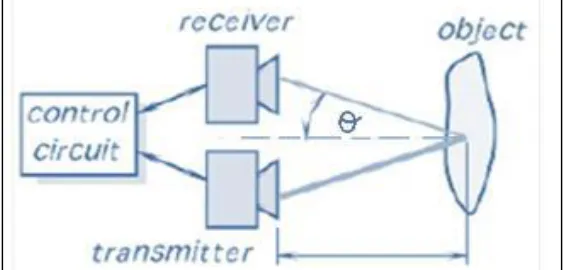
The sensor used for reverse parking is ultrasonic sensor. The Fig. 2 shows the description of ultrasonic sensor and the principle of working of ultrasonic sensor. It has 4 pins called as VCC, Trigger, Echo and ground respectively.
Fig. 2: Principle of Ultrasonic Sensor
When ultrasonic waves are incident on the object, diffused reflection of the energy takes place over a wide solid angle which might be as high as 180 degrees. Thus some fraction of the incident energy is reflected back to the transducer in the form of echoes and is detected. The distance to the object (L) can then be calculated through the speed of ultrasonic waves (v) in the medium by the relation, where,‘t’ is the time taken by the wave to reach back to the sensor and ‘Ø’ is the angle between the horizontal and the path taken as shown in the Fig. 3.
III. CIRCUIT DESIGN
The inputs for this system are from the ultrasonic sensor and depending upon the distance being received after the calculation from the Raspberry Pi the LED glows on. Fig. 6 shows the circuit connection for the ultrasonic sensor.
Fig. 6: Ultrasonic Sensor Circuit
The circuit is simple to implement and all the output in this case are digital, only a resistor value needs to be decided to get the voltage for the GPIO pins to avoid any damage. In addition to this circuit also an LED circuit is connected for the LED to glow on.
IV. ALGORITHM AND FLOWCHART
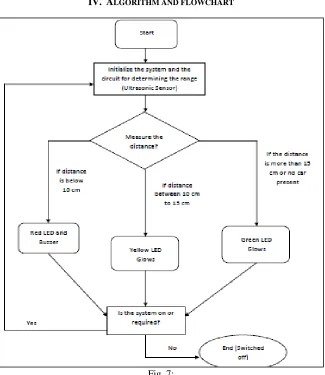
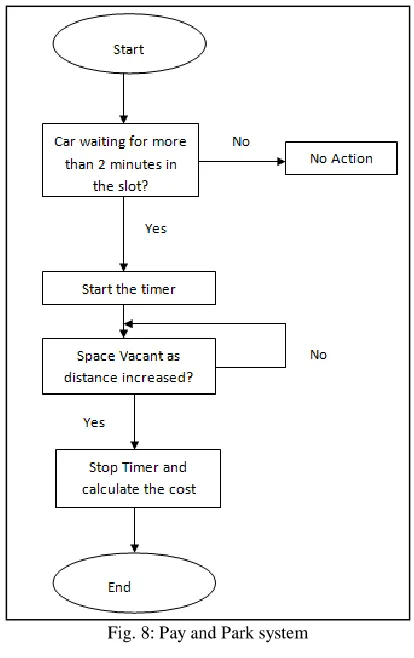
The Fig. 7 shows the entire procedure for the system and Fig. 8 shows how the cost is calculated for the pay and park system. 1) Step 1: Start
2) Step 2: Initialize Raspberry Pi
3) Step 3: Establish a connection between Raspberry Pi and computer using PuTTY 4) Step 4: Connect the circuit as per the circuit diagram for range sensor
5) Step 5: Measure the range between the wall and the car
6) Step 6: If the distance is greater than 15 cm indicate using a green LED
7) Step 7: If the distance is between the ranges of 10-15 cm indicate using a yellow LED 8) Step 8: If the distance is below 10 cm indicate a danger zone using red LED
9) Step 9: Jump to step 4 and loop continuously until system stops 10) Step 10: End
Fig. 8: Pay and Park system
V. RESULTS AND DISCUSSION
The project was aimed providing a simple and much efficient way for reverse parking in any situation.The first thing for this project is to make all the input and output ready.
The Fig. 9 shows the circuit that was implemented for this practical purpose. It was implemented and works as expected and has proved to be very useful and will fulfill all the present constraints if implemented on a large scale. In circuit shown in Fig. 10 the green LED is shown glowing as the space is vacant and no car is in danger zone of parking area.
The Raspberry Pi controls the LEDs depending upon the distance it measures. The last LED which is the red LED goes OFF after a delay of 5 seconds assuming that the car will immediately stop on the red LED and the timer then starts and continues to run till the car is not moved from the parking slot.
VI. CONCLUSION
This paper provides a design for reverse parking system in automobile. When the cars approach the wall and the distance keeps on decreasing between the wall and the car then appropriate LED goes on for the car that enters in the danger zone and buzzer turns on to indicate that car is almost near the wall. The ultrasonic sensor measures the distance with an average error percentage of 0.05%. The paper provides a efficient way to measure the distance between any two cars while the car is driving. This paper finds its application in cities where parking is a great problem and also could be used so that car is properly parked in the given slot so that it doesn’t occupy the parking space of two cars which results in efficient utilisation of parking space. This system can be used in malls where the cars are parked. These also reduce the human effort involved in car parking and pay and park syste m. Since sensors and system generates digital outputs which makes the installation of the system cheap and efficient. This system was built with the aim that it could be installed in the cars and letting the driver know if he is moving very close to the car ahead of him inorder to avoid collision.
REFERENCES
[1] http://circuitdigest.com/electronic-circuits/reverse-car-parking-circuit
[2] http://www.electronicshub.org/reverse-parking-sensor-circuit
[3] K. Tanaka, T. Taniguchi, H.O. Wang, Fuzzy controller and observer design for backing control of a trailer-truck Eng. Appl. Artif. Intell., 10 (5) (1997), pp.
441–452
[4] K. Tanaka, M. Sano, A robust stabilization problem of fuzzy control system and its application to backing up control of a truck-trailer, IEEE Trans. Fuzzy
Syst., 2 (2) (1994), pp. 119–134
[5] C. Altafini, A. Speranzon, B. Wahlberg, A feedback control scheme for reversing a truck and trailer vehicle, IEEE Trans. Robot. Autom., 17 (6) (2001), pp.
915–922
[6] http://www.raspberrypi.org
[7] Gandhi Priyanka R.,Shaikh Parvin G., Suryavanshi Nilaxi D., Abuwala Priyanka S, Multilevel Automated Car Parking with IR Security System,