Li-Fi Communication
Prof. Michelle Lilian Araujo E Viegas Ms. Rasika Patil
Assistant Professor UG Student Department of Electronics & Telecommunication
Engineering
Department of Electronics & Telecommunication Engineering
Don Bosco College of Engineering, Fatorda-Goa, India Don Bosco College of Engineering, Fatorda-Goa, India
Ms. Shreya R. Shenvi Usgaonkar Ms. Richa Kapileshwarkar
UG Student UG Student Department of Electronics & Telecommunication
Engineering
Department of Electronics & Telecommunication Engineering
Don Bosco College of Engineering, Fatorda-Goa, India Don Bosco College of Engineering, Fatorda-Goa, India
Ms. Priyanka Arsekar
UG Student
Department of Electronics & Telecommunication Engineering Don Bosco College of Engineering, Fatorda-Goa, India
Abstract
The Li-Fi stands for Light-Fidelity. Li-Fi is the transmission of wireless data by using visible light as a medium of communication. This paper presents an approach for wireless data communication between two systems through visible light. This approach creates a way which can make data transmission faster than current wireless communication technology. Li-Fi is a transmission of data through illumination, in which data can be sent using LED light bulb that varies in intensity faster than human eye can follow. Li-Fi provides high bandwidth, better efficiency, more security and availability than Wi-Li-Fi.
Keywords: Li-Fi, visible light communication (VLC), light emitting diode (LED), Wi-Fi, photo detector
________________________________________________________________________________________________________
I. INTRODUCTION
The Li-Fi (light fidelity) technology was proposed by the German Scientist namely Harald Haas. Li-Fi, light fidelity is similar to Wi-Fi technology and it is one of the future wireless communication technologies. The main feature of this technology includes fully networked, bidirectional and high-speed wireless communication [1]. Li-Fi is based on Visual Light Communication (VLC) which provides data transmission through the beam of light by sending data through a light emitting diodes (LEDs) that varies in intensity, faster than human eye can perceive. Li-Fi enables the electronic devices to connect to the internet with no wire. We all know that right now Wi-Fi is the most used technology to connect many devices to the internet. But with the increasing demand, the capacity of Wi-Fi is reduced due the limitation of radio frequency resources [6]. By Communication through visible light, Li-Fi technology has the possibility to change how we access the Internet, stream videos, receive emails and much more. Security would not be an issue as data can’t be accessed in the absence of light. As a result, it can be used in high security military areas where RF communication is prone to eavesdropping. Li-Fi would use transceiver fitted LED lamps that can light a room as well as transmit and receive information. This paper will focus on principle, working of Li-Fi technology and advantages over Wi-Fi technology.
II. WHAT IS LI-FI?
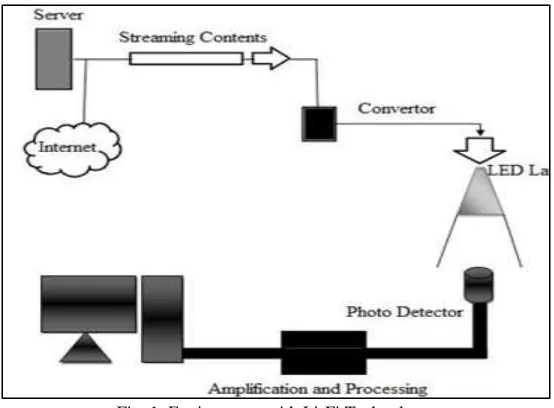
Fig. 1: Environment with Li-Fi Technology.
Furthermore, this technology can be implemented for speedy data access for the laptops and gadgets that will be transmitted using the light in a room. Li-Fi is based on VLC (visible light Communication). VLC optical carrier for data transmission and illumination uses 400 THz (780nm) and 800THz (375nm) [3].
III. WORKING TECHNOLOGY
System Design
Li-Fi comprises of multiple light bulbs that form a wireless network. When an electrical current is applied to a LED light bulb, a stream of light (photons) is emitted from the bulb. LED bulbs are semiconductor devices, which means that the brightness of the light flowing through them can be changed at extremely high speeds. Switching on an LED is binary ‘1’, switching it off is binary ‘0’. To give different strings of 1s and 0s it is possible to encode data in light by varying the rate at which LEDs flicker on and off. Modulation is so rapid that humans cannot notice it. This allows us to send a signal by modulating the light at different rates. Data stream coming from internet or any server can be converted into light signals by the help of a converter. Then a LED lamp transmit data using visible light. At the receiver end a photo detector is placed which detect the light coming from blinking LEDs and convert it into an electrical signal which is amplified and then the signal is ready to use by the respective device.
Fig. 2: Block diagram of basic Li-Fi system.
Transmitter Circuit
Fig. 3: Transmitter circuit
Figure 3 shows the transmitter circuit. On the transmitter side, the PC used should contain MATLAB software which will help us in converting the image into its binary format and later transmitting the binary conversion to the receiver via LED. Next is the USB to TTL which is used to deal with the communication of a microcontroller. Microcontroller helps to generate square wave from the binary converted image by MATLAB and inputs the square wave to the LED. ULN2803 is used as the driver IC in LED driver circuit which helps the LED to glow and allow transmission.
Receiver Circuit
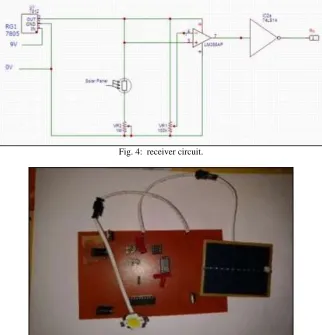
The receiver circuit is shown in Figure 4. On the receiver side exact opposite operation takes place. The light received from the LED is captured by the phototransistor (solar panel) which acts as a sensor and passes the output to the comparator. LM358 is an open collector comparator which compares the binary input and the original image is recovered using MATLAB software.
Fig. 4: receiver circuit.
IV. RESULTS & DISCUSSIONS
Output for Data Transmitter
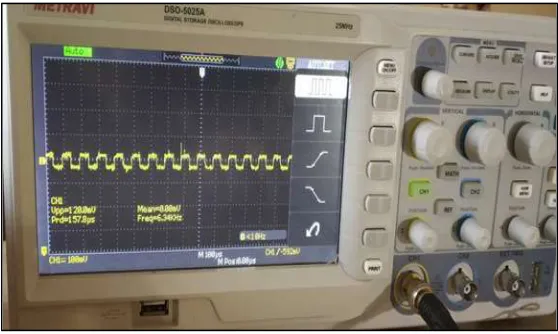
Fig. 6: Simulation result of data transmitter. Output for Data Receiver
Fig. 7: Simulation result of data receiver. V. APPLICATIONS
Military:
Li-Fi is confined to a small range. As light does not penetrate walls, data transmitted over Li-Fi can be limited to a small area. This makes Li-Fi great for use by the military even in remote locations as the data cannot be intercepted by outside hackers.
Traffic Lights:
Li-Fi can be used to provide drivers with traffic and weather updates as they wait at the traffic lights. This also eliminates the problem of getting critical traffic updates to drivers who are already on the road.
Underwater Communication:
Unlike radio waves, which are easily absorbed by water, light waves can travel great distances. This remarkable property allows diver-to-diver or diver-to-minisub communications, even if they are miles apart.
Security:
Hospitals:
As Li-Fi does not interfere with radio frequency devices, Li-Fi can be safely used in many hospital applications. For example, in corridors, waiting rooms, patient rooms and operating theatres, Li-Fi technology will allow a light communication network, which will remove electromagnetic interference issues from smartphones and the use of Wi-Fi in hospitals.
VI. CONCLUSION
The purpose of Li-Fi technology is to provide a high-speed data communication using visible light spectrum. Li-Fi is on-going of research, it has a potential advantage that can make a supplement RF communication and can be used to improve wireless network performance. Li-Fi provides bi-directional communication where traffic and security information can be pushed to smartphones. Its applications also range widely from toys to communication and can find uses in critical fields like military and medicine. Li-Fi uses visible light which is inexhaustible, accurate, fast, safe, cost effective which shows that it is the only technology which is cleaner, greener and safe in communication system.
REFERENCES
[1] M. Samuel Lazar, T. Ravi. 2015. Li-Fi Design for High Speed Data Transmission. Asian Research Publishing Network of Engineering and Applied Sciences (APRN), ISSN 1819-6608, 10(14).
[2] H. Haas, L. Yin, Y. Wang, and C. Chen, “What is lifi?” Journal of Lightwave Technology, vol. 34, no. 6, pp. 1533–1544, 2016.
[3] Anurag Sarkar Prof. Shalabh Agarwal Dr. Asoke Nath, “Li-Fi Technology: Data Transmission through Visible Light”, International Journal of Advance Research in Computer Science and Management Studies Volume 3, Issue 6, June 2015.
[4] H. Elgala, R. Mesleh, H. Haas and B. Pricope, “OFDM Visible Light Wireless Communication Based on White LEDs” in International University Bremen 28759 Bremen, Germany in 2007 IEEE.
[5] Bhaumik Gelani Prof. Gayatri Pandi (Jain) Li-Fi (Light Fidelity): Data Communication Using Visible Light, IJARIIE-ISSN(O)-2395-4396, Vol-3 Issue-6 2017.
[6] E Ramadhani G P Mahardika, “The Technology of LiFi: A Brief Introduction”, IOP Conf. Series: Materials Science and Engineering 325 (2018) 012013. [7] Bharath B., Yaswanth Digumarthi1, Ravi T.and G. Jegan, “BIDIRECTIONAL COMMUNICATION IN LI-FI TECHNOLOGY”, ARPN Journal of