Vol. 05, Issue 06 (June. 2015), ||V2|| PP 47-51
Investigation of factors affecting the Blow Holes in Die Casting
Process
Praevadee Kaewkongkha
1, Somkiat Tangjitsitcharoen
2Department of Industrial Engineering, Faculty of Engineering, Chulalongkorn University, Bangkok, Thailand
Abstract: - The objective of this research is to study the factors affecting the blow holes in the die casting process of aluminum alloys R14 for the compressor of the automotive parts. The factors such as the casting pressure, the injection speed, the high starting of the position and the vacuum pressure are investigated. A response surface analysis with the Box-Behnken Design has been employed to obtain the optimum condition in order to minimize the blow holes formation. It has been proved that the amount of blow holes can be reduced by using the experimentally obtained optimum conditions, which are the casting pressure of 85 Mpa, the die casting low injection speed of 0.30 m/s, the high injection speed of 2.49 m/s, the high-speed starting position of 326.81 mm and the vacuum pressure of -97.28 Kpa.
Keywords: - Die Casting Process, Aluminum alloys R14, Blow Holes, Response Surface Analysis
I.
INTRODUCTION
Currently, the die casting process are highly used to produce the mechanical and automotive parts. Especially the aluminum alloy parts. It has been proved that the better surface of workpiece can be obtained from the die casting [1]. According to the die casting process is controlled by several parameter. When properly determined and adjusted, they result in an improvement in quality of the die casting parts. There was experimented by employed different combination of injection parameters and aimed to assess the presence of porosity in the die casting parts, and by considerable amount of porosity in the critical region [2]
However, there are many defects occurred during the die casing process. The compressor part is normally produced by the die casting. Nevertheless, the blow holes is still the barrier of the compressor parts, The blow holes is caused by several factors such as the casting pressure, the injection speed, the high starting of position and vacuum pressure. It is required to avoid the blow holes during the die casting process.
The Box-Behnken design is normally used to design and reduce the experiments. The optimum casting condition can be obtained by utilizing the response surface analysis. Hence, the aim of the research is to reduce the amount of blow holes in the compressor parts by employed the response surface analysis with the Box-Behnken design to optimum casting condition. Therefore, must plan to design an experiment by determine the factors that are relevant and the optimization of factors. For the experiments in the production process. However, optimizing the conditions to render aluminum die castings of minimum porosity percent is costly and time consuming, because many experiments are necessary to find the optimal parameters.
II.
HIGH PRESSURE DIE CASTING PROCESS
High pressure die casting process is the most common technology for the production of components made from the alloy. Because the process is characterized by molten metal is forced into a cold empty cavity of a desired shape and is then allowed to solidify under a high holding pressure. The quickly cooling and hardening of the metal in the mold. When the die is opened, the casting is retained in the moving half, from which it is ejected by pins activated either hydraulically or mechanically [3]. These characteristics are good mechanical properties in the casting. However, the quality defects that may occur most frequently in casting processes at high pressure is blow hole defects that occur is mainly composed as follows [4];
1. The action or operations in casting process. 2. Machine used in the casting process. 3. How to design appropriate.
environment, is the trial and error method [5]. Usually, the main controlled variables are mold temperature, dosage volume, slow and fast shots, commutation spots, injection pressure, upset pressure as well as chemical composition and liquid metal temperature.
Recently, some papers have shown the die casting injection speed and the low-speed starting position. Pressure in compression during the coagulation that effect on the quality of the air inside the cavity. The time to cooling for setting workpiece in the mold which influence only to the external surface quality.
Fig 1 Critical region showing the presence of Blow holes
Blow holes caused by gas in the water, metal, or may be a result of the remaining air in the material is mixed. Pore appearance of cavitation is often a small hole. The shape of the pores with a round and sharp hole. Usually, occurs as a group within the meat casting and found after the component is turning (Fig 1). The focus of this paper is on the Blow holes of the die casting process by using the R14 aluminum alloy. The basic step as following:
1. Determine the Blow holes ratings of the die casting process. The Blow holes has been selected as the most quality problem.
2. The select of most significant factors effects on the Blow holes rating when adjusted to different levels.
3. An experimental design was created by Box-benhken under same machine.
4. Analyze the summary data to determine the significant of each factors and considering for the best condition that the minimum effects on the Blow holes rating.
5. Determine the optimum setting of controlling factors are considered.
6. Verification a result by the optimum factors setting as new levels in the predicted of the die casting process
III.
EXPERIMENT AND PROCEDURES
response surfaces [9]. For the experimental runs of 46 runs, which consists of a number of factors, divided into 3 levels in Table 1 is obtained by consideration of the possibilities and limitations of each factor.
Table 1 Factors and factor levels of the die casing process
Symbol Factors Unit
Level of Factors
Low Center High
A Casting pressure Mpa 75 80 85
B Low injection speed (m/s) 0.16 0.23 0.30
C High speed starting position mm 320 330 340
D High injection speed (m/s) 1.80 2.40 3.00
E Vacuum pressure Kpa -93 -96.5 -100
This experiment be provided order of experiments to be random. According to the different factors. Individual run order will be record 30 pieces and the proportion of the defect. By the part must be turning to inspection blow holes in the areas that the required.
IV.
EXPERIMENT RESULTS AND DISCUSSION
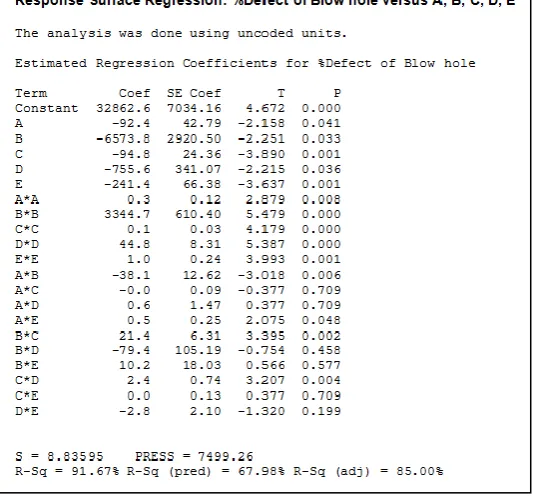
The results obtained by the Box-Behnken Design into the process of selecting a mathematical equation. Using statistical program to find the optimize factors. For the selection equation form of analysis results from a trial of Box-Behnken by the results of the analysis of the equation in terms Full Quadratic in Table 2, the confidence level 95% of the P-value of the 5 factors is less. 0.05 shows that all the factors affecting the Blow Holes.
Table 2 Variance analysis of the Blow Holes for different factors and their interactions in terms Full Quadratic
As the result, it can be seen that the effects that were all of the main effects and was also found that the interaction between the casting pressure with low injector speed (A*B), casting pressure with vacuum pressure (A*E), low injector speed with high speed starting position (B*C) and high speed starting position with high injection speed (C*D) are affects the Blow Holes. Conclusion that the factors that influence the Blow Holes, since the P-value of the analysis is more than 0.05 from Table 2, the R2 coefficient of determination of 91.67%. R2 adj coefficient of determination 85% considered is quite satisfactory, because of the close one. There is a adequacy of data. The suitability of the information and equation modeling. It can be seen that there is a reliable predictor of the proportion of the blow holes. So, to find the optimal factor to proportion the defect of to minimize blow holes are shown in the table 3.
Table 3 The optimum factors levels and blow holes response
Factors Symbol Value Unit
Casting pressure A 85 Mpa
Low injection speed B 0.30 (m/s)
High speed starting position C 2.490 mm
High injection speed D 326.81 (m/s)
Vacuum pressure E -97.28 Kpa
According to the prediction equation of the relation between factors that affect the response. The response at any regime in the interval of our experiment design could be calculated from Eqs-1, the second-order response function representing percentage defective of the blow holes as follows:
Y = 32862.6 - (92.3552A) - (6573.84B) - (94.7530C) - (755.589D) -(241.426E) + (0.34444A2) + (3344.67B2) + (0.125000C2) + (44.7531D2) + (0.975057E2) - (0.0333333AB)-(38.0952AC)+ (0.555556AD)+ (0.523810AE) + (21.4286BC) - (79.3651BD) + (2.36111BE) + (10.2041CD) +(0.0476190CE) - (2.77778DE) (Eqs-1)
It can be expressed as a factor of Casting pressure (A), Low injection speed (B), High speed starting position (C), High injection speed (D), Vacuum pressure (E). The relationship between responses and variables were obtained for three level of factors. Then using new condition of each factors that can be shown the amount of Blow holes decrease from the previous time are used old conditions as fig 2.
V.
CONCLUSION
The results of the high-pressure casting aluminum alloy type R14 was found to increase the pressure in the injection, but the low injection speed the piston speed results in a more blow holes. Low vacuum pressure, the movements of high injection speed are slow or too fast with high speed starting position plunger motion is inappropriate. Because of the inadequacy of compensation to replace the liquid aluminum is mixed with air be affect the blow holes in part as significant at a confidence level of 95 %. The optimal values of the factors has been proved that the amount of blow holes can be reduced to 5.18% by using the experimentally obtained optimum conditions, which are the casting pressure of 85 Mpa, the die casting low injection speed of 0.30 m/s, the high injection speed of 2.49 m/s, the highspeed starting position of 326.81 mm and the vacuum pressure of -97.28 Kpa.
REFERENCES
[1] Frederick P.Schleg. Die casting process (An American Foundry Society Publication, 2002).
[2] G.O. Verran, R.P.K. Mendes, L.V.O. Dalla Valentina. DOE applied to optimization of aluminum alloy die casting. Journal of Material Processing Technology 200 (2008): 120-125.
[3] Allsop DF, Kennedy D. Pressure die casting. 1st ed (New York, Pergamon Press, 1983).
[4] Yasser M. Dessouky, Adam Bayer. A simulation and design of experiments modeling approach to minimize building maintenance costs. Computer. Journal of Material Processing Technology 179 (2006) 190–195.
[5] Syrcos, G.P. Die casting process optimization using Taguchi methods. Journal of Material Processing Technology 135 (2003): 68-74.
[6] S.Tangjitsitcharoen, (2012) Reduction of void defective propotion in microchip molding process. Journal of KMUTNB., vol.22, No.3, Sep-Dec.
[7] Anderson S. Souzaa,b, Walter N.L. dos Santosa, Se´rgio L.C. Ferreiraa,T. Application of Box–Behnken design in the optimisation of an on-line pre-concentration system using knotted reactor for cadmium determination by flame atomic absorption spectrometry. Journal of Spectrochimica Acta., Part B 60 (2005) 737– 742.
[8] Parames Chutima, Engineering Design of Experiment (1st ed.Bangkok : Chulalongkorn University, 2002) [9] Kwak JS. Application of Taguchi and response surface methodologies for geometric error in surface