IJSTE - International Journal of Science Technology & Engineering | Volume 2 | Issue 11 | May 2016 ISSN (online): 2349-784X
Smart System for Medium Scale Food Service
Santosh Sanjeev Kulkarni Prof. Dr. Meghana Kulkarni
PG Student Professor
Department of VLSI Design and Embedded Systems Department of VLSI Design and Embedded Systems Centre for PG Studies, Visvesvaraya Technological
University, Belagavi, Karnataka, India
Centre for PG Studies, Visvesvaraya Technological University, Belagavi, Karnataka, India
Abstract
In traditional restaurants, serving system is still very passive: Servers have to interact with clients directly prior to processing their orders. There is a need for a high-quality customer-centric food service system which can reduce human interventions. To model such a system, Radio Frequency Identification (RFID) module is combined with Wireless Local Area Network (WLAN) technology. This proposed customer-centric intelligent medium scale food serving system enables food servers to quickly recognize the customers via RFID-membership cards and serve the food. Results obtained from a survey conducted show that the proposed system has practical potential in providing an efficient customer-centric service. The inclusion of Flipped E-shaped structure overcomes the limitations in existing systems thereby making it realizable for Indian medium scale food service architecture.
Keywords: Customer-centric, RFID, WLAN, Flipped E-Shaped structure
________________________________________________________________________________________________________ I. INTRODUCTION
Typical restaurant service such as reserving tables, processing and delivering meals generally requires the servers to input the customer information and then transmit orders to the kitchen for food preparation. Even though this procedure is simple, it significantly increases the server’s workload and leads to errors in prioritizing customers or in menu ordering. When the number of customers suddenly increases during busy hours, the overall service quality degrades. Therefore, usage of advanced technologies to improve service quality has attracted much attention in recent years.
To achieve this goal, this study uses Radio Frequency Identification (RFID) integrated with Wireless Local Area Network (WLAN) to develop a Smart intelligent system for customer-centric service.
This system enables servers to identify customers via RFID-based membership cards and then process the orders.
Radio frequency identification (RFID) has emerged as one of the greatest contributory technologies of the 21st century [1], because of its larger memory capacity, distant reading ability, and faster processing capability than the bar code system. Because of its advantages, RFID has been applied in many areas [1], such as telemedicine [2], manufacturing [5], supply chain management [3], warehouse management [4], digital learning [6], and construction industry [7].
II. MEDIUM SCALE FOOD SERVICE
Medium scale food service is an environment where the Menu is fixed, Number of customers is fixed/limited, and Timings are fixed. Examples: Hostel Mess, Cafeterias, Breakfast/Lunch homes.
Need for the smart system
Considering college mess system as reference, due to the increase in the number of students in the colleges, it is being observed that, both the students and the mess staff are facing difficulties to finish and serve the lunch within the stipulated time. In the current scenario, the students have to wait in a long queue to take their plates during the lunch break. This indicates the requirement of a customer centered high-quality intelligent food service system.
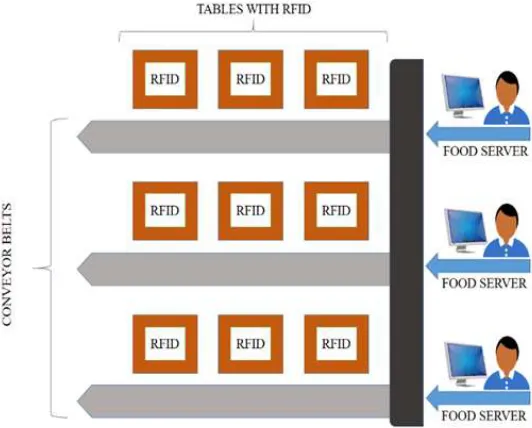
III. PROPOSED SYSTEM Fig. 1 shows a framework overview of the proposed intelligent
Fig. 1: Framework overview of the proposed intelligent Smart system.
As shown in the above figure, this system can be divided into two sides: Customer (Student) side and Server side.
Customer (Student) Side
The Customer (Student) side consists of a Microcontroller Board, RFID receiver, Sensor on Belt and a Wireless Module.
Microcontroller
The Microcontroller used here is based on a 32/16 bit ARM7TDMI-S CPU with real-time emulation and embedded trace support. It combines the microcontroller with high speed flash memory ranging from 32kB to 512kB. Due to their tiny size and low power consumption, these are ideal for applications where miniaturization is a key requirement. The ARM family offers high performance with very low-power consumption and gate count. The ARM architecture is based on Reduced Instruction Set Computer (RISC) principles [9].
ARM based microcontrollers find applications in the following fields: Industrial control
Embedded soft modem Point-of-sale
Access control Medical systems Communication gateway General purpose applications
Radio-frequency identification (RFID) receiver
RFID technology uses electromagnetic fields to identify the RFID tags attached to objects. The tags consist electronically stored information. RFID is one method for Automatic Identification and Data Capture (AIDC) [10]. The RFID module used here is a low cost, low power, compact and easy to use device. It can detect any RFID card within the range and with the frequency same as that of its working frequency (125 kHz). It can interact with a microcontroller in any one of the two supported protocols namely Wiegand 26 and TTL Serial [11].
Wireless Module
The Wireless Module used here is a low-cost 2.4 GHz transceiver specially designed for very low-power wireless applications. The circuit used here is intended for the 2400-2483.5 MHz SRD (Short Range Device) and ISM (Industrial, Scientific and Medical) frequency band. In a typical system, this module will be used with a microcontroller and some additional passive components [12]. It supports asynchronous and synchronous serial receive/transmit mode for backward compatibility with existing communication protocols
Wireless module is used in the following fields: Wireless audio
2400-2483.5 MHz ISM/SRD band systems Wireless game controllers
Smart System for Medium Scale Food Service
(IJSTE/ Volume 2 / Issue 11 / 062)
IR Based Proximity Sensor
Proximity sensing process includes detection of an object or obstacle without any physical contact. Infrared proximity sensors are inexpensive and easy and easily available. A typical infrared proximity sensor arrangement consists of an infrared IR LED and a photo diode, in which Infrared LED emits the IR radiation which are reflected back to the photo diode within a nominal range. Here, this sensor is placed on belt in such a position that the belt moves only when the plate is present on the belt. If the belt is empty the motor will not rotate.
Customer (Student) Side Algorithm
The Customer (student) side microcontroller is programmed with KeilµVision4 IDE tool. The programming language used is embedded C. The algorithm is as shown below.
1) Step1: Start
2) Step2: Store the data from all the TAGs 3) Step3: Receive the data and go to Step5 4) Step4: Control ISR
Step4.1: Compare the received TAG data with the stored data Step4.2: Check for the number of the serve (1st or 2nd) Step4.3: If second serve, check which item is ordered 5) Step5: Data Reception from customer
Step5.1: Verify the TAG data Step5.2: If appropriate go to Step4
The RFID receiver is connected to UART0 so the data is received through UART0. The processor then verifies the obtained data and then, compares it with the previously stored data. If the ID is swiped for first time, then it is taken as first serve and if it is swiped for second time, the customer is given a small menu out of which, the items of the customers’ choice could be ordered. This information is transmitted to the Server side through UART1 since wireless module is connected to UART1. The motor is also connected to this server side board.
Server Side
The Server side consists of a Microcontroller Board and Wireless Module. The Server side Microcontroller is also programmed with KeilµVision4 IDE tool. The programming language used is Embedded C. The algorithm for Server Side is as shown below. 1) Step1: Start
2) Step2: Splash Display 3) Step3: Control ISR
Step3.1 Display received String
In server side the splash display continuously displays the TABLE number from which the order is placed, the ID through which the order is placed, the number of SERVE and the ITEM ordered during second serve. The data from Customer (Student) Side is obtained through UART0 because the wireless module is connected to UART0 on Server Side.
IV. SYSTEM IMPLEMENTATION AND EVALUATION
Fig. 2: Implementation
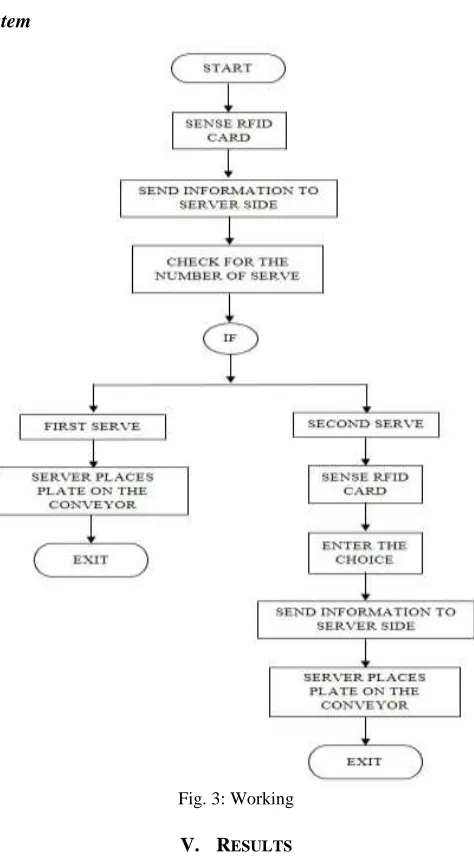
Flowchart of the Working System
Fig. 3: Working
V. RESULTS
Smart System for Medium Scale Food Service
(IJSTE/ Volume 2 / Issue 11 / 062)
Customer (Student) Side results
Initially, the LCD will be displaying the following message
Once the RFID tag is sensed the following message will be displayed i.e. the number of the student and serve will be displayed. The following message is displayed when Student 1 senses the tag for 1st time.
The following message is displayed when Student 2 senses the tag for 1st time.
The following message is displayed when Student 3 senses the tag for 1st time.
If the Customer (Student) opts for second serve, the following message will be displayed.
Food Server Side Results
The Table number, Serve number, Student number, Item number will be displayed on the sever side screen. The following message will be displayed when student1 sits on table 1 and places order for 1st time.
The following message will be displayed when student1 sits on table 1 and places order for 2nd time. The second time ordered food item’s number is 1.
VI. SURVEY
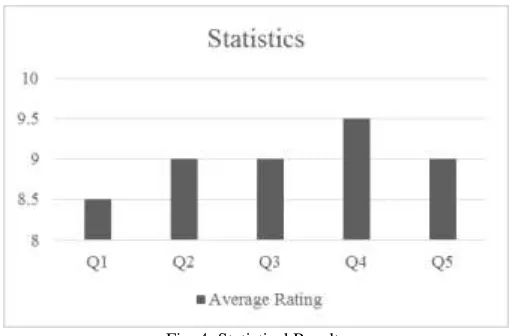
After designing the system a small survey was conducted in some of the medium scale food restaurants. The customers and the food servers / owners were explained the mechanism of the proposed system and were given a small questionnaire and were asked to give ratings out of 10. The statistical results of the questionnaire are as shown below.
Table – 1 Statistical Results
Q. No. Questions Average rating
Q1 How much is this system’s interface User-Friendly? 8.5 Q2 Can this system improve Working Efficiency? 9.0 Q3 Can this system improve the Quality of Service? 9.0 Q4 Can the system significantly reduce the waiting time? 9.5 Q5 Would you like to have this system at your food place? 9.0
Fig. 4: Statistical Results
VII. DISCUSSION AND FUTURE SCOPE
In comparison to the proposed system, Ngai [8] system lacks inventory control on the belt and its rectangular shaped structure causes billing error. But, for Indian medium scale food service, where both the food items and number of customers are fixed, the Ngai system is not feasible. Since, the prime focus is on automating the medium scale food serving system, the intelligent e-restaurant system using RFID proposed in this paper, offers customer-centric service within an affordable budget. The unique flipped E-Shaped structure facilitates smooth functioning of the system. The proposed system can be implemented using readily available laboratory equipments. This system reduces the burden of servers and also facilitates customers to get their plates filled with food quickly after the order is placed.
In future, a small menu selection facility can also be provided at the beginning to avoid the wastage of the food. If this system is implemented in educational institutions, the same RFID card can be used in library for issuing books.
ACKNOWLEDGMENT
Thanks to Prof. Dr. Meghana Kulkarni, Mr. Manjunatha MN and Prof. Subrahmanya KN for their valuable guidance.
REFERENCES
[1] Tan-Hsu Tan, Ching-Su Chang, and Yung-Fu Chen, “Developing an Intelligent e-Restaurant With a Menu Recommender for Customer-Centric Service”, IEEE Transactions On Systems, Man, And Cybernetics—part C: Applications And Reviews, Vol. 42, No. 5, September 2012
[2] Y. Xiao, X. Shen, B. Sun, and L. Cai, “Security and privacy in RFID and applications in telemedicine,” IEEE Commun. Mag., vol. 44, no. 4,pp. 64–72, Apr. 2006.
[3] M. Tajima, “Strategic value of RFID in supply chain management,” J.Purchasing Supply Manage., vol. 13, no. 4, pp. 261–273, 2007.
[4] T. C. Poon, K. L. Choy, H. K. H. Chow, H. C. W. Lau, F. T. S. Chan, and K. C. Ho, “A RFID Case-based logistics resource management system for managing order-picking operations in warehouses,” Expert Syst. Appl.,vol. 36, no. 4, pp. 8277–8301, 2009.
[5] E. Budak, B. Catay, I. Tekin, H. Yenigun, M. Abbak, S. Drannikov, and O. Simsek, “Design of an RFID-based manufacturing monitoring and analysis system,” in Proc. IEEE Int. Conf. RFID Eurasia, Sep. 2007,pp.1–6.
[6] T. H. Tan, T. Y. Liu, and C. C. Chang, “Development and evaluation of an RFID-based ubiquitous learning environment for outdoor learning,” Interactive Learning Environments, vol. 15, no. 3, pp. 253–269, 2007.
[7] T. Reisbacka, H. Hamalainen, and J. Ikonen, “Automating construction project quality assurance with RFID and mobile technologies,” in Proc.IEEE Int. Conf. Softw., Telecommun. Comput. Netw., Sep. 2008, pp. 223–227.
[8] E. W. T. Ngai, F. F. C. Suk, and S. Y. Y. Lo, “Development of an RFID based sushi management system: The case of a conveyor-belt sushi restaurant,” Int. J. Prod. Econ., vol. 112, no. 2, pp. 630–645, 2008.
[9] www.nxp.com/documents/data_sheet/LPC2141_42_44_46_48 [10] www.tomsonelectronics.com