Abstract—Cloud computing has emerged as one of the most influential paradigms in the IT industry in recent years. Since this new computing technology requires users to entrust their valuable data to cloud providers, there have been increasing security and privacy concerns on outsourced data. Several schemes employing attribute-based encryption (ABE) have been proposed for access control of outsourced data in cloud computing; however, most of them suffer from inflexibility in implementing complex access con-trol policies. In order to realize scalable,flexible, andfine-grained access control of outsourced data in cloud computing, in this paper, we propose hierarchical attribute-set-based encryption (HASBE) by extending ciphertext-policy attribute-set-based encryption (ASBE) with a hierarchical structure of users. The proposed scheme not only achieves scalability due to its hierarchical struc-ture, but also inheritsflexibility andfine-grained access control in supporting compound attributes of ASBE. In addition, HASBE employs multiple value assignments for access expiration time to deal with user revocation more efficiently than existing schemes. We formally prove the security of HASBE based on security of the ciphertext-policy attribute-based encryption (CP-ABE) scheme by Bethencourtet al.and analyze its performance and computational complexity. We implement our scheme and show that it is both efficient andflexible in dealing with access control for outsourced data in cloud computing with comprehensive experiments.
Index Terms—Access control, cloud computing, data security.
I. INTRODUCTION
C
LOUD computing is a new computing paradigm that is built on virtualization, parallel and distributed com-puting, utility comcom-puting, and service-oriented architecture. In the last several years, cloud computing has emerged as one of the most influential paradigms in the IT industry, and has attracted extensive attention from both academia and industry. Cloud computing holds the promise of providing computing as thefifth utility [1] after the other four utilities (water, gas, electricity, and telephone). The benefits of cloud computing include reduced costs and capital expenditures, increased op-erational efficiencies, scalability,flexibility, immediate time to market, and so on. Different service-oriented cloud computing models have been proposed, including Infrastructure as a Service (IaaS), Platform as a Service (PaaS), and Software as a Service (SaaS). Numerous commercial cloud computingsystems have been built at different levels, e.g., Amazon’s EC2 [2], Amazon’s S3 [3], and IBM’s Blue Cloud [4] are IaaS systems, while Google App Engine [5] and Yahoo Pig are representative PaaS systems, and Google’s Apps [6] and Salesforce’s Customer Relation Management (CRM) System [7] belong to SaaS systems. With these cloud computing sys-tems, on one hand, enterprise users no longer need to invest in hardware/software systems or hire IT professionals to maintain these IT systems, thus they save cost on IT infrastructure and human resources; on the other hand, computing utilities provided by cloud computing are being offered at a relatively low price in a pay-as-you-use style. For example, Amazon’s S3 data storage service with 99.99% durability charges only $0.06 to $0.15 per gigabyte-month, while traditional storage cost ranges from $1.00 to $3.50 per gigabyte-month according to Zetta Inc. [8].
Although the great benefits brought by cloud computing par-adigm are exciting for IT companies, academic researchers, and potential cloud users, security problems in cloud computing be-come serious obstacles which, without being appropriately ad-dressed, will prevent cloud computing’s extensive applications and usage in the future. One of the prominent security concerns is data security and privacy in cloud computing due to its In-ternet-based data storage and management. In cloud computing, users have to give up their data to the cloud service provider for storage and business operations, while the cloud service provider is usually a commercial enterprise which cannot be to-tally trusted. Data represents an extremely important asset for any organization, and enterprise users will face serious conse-quences if its confidential data is disclosed to their business competitors or the public. Thus, cloud users in the first place want to make sure that their data are kept confidential to out-siders, including the cloud provider and their potential competi-tors. This is thefirst data security requirement.
Data confidentiality is not the only security requirement. Flexible andfine-grained access control is also strongly desired in the service-oriented cloud computing model. A health-care information system on a cloud is required to restrict access of protected medical records to eligible doctors and a customer relation management system running on a cloud may allow
Hierarchical Attribute-Based Solution for Flexible and
Scalable Access Control in Cloud Computing
*k.venkateswarlu (M.tech pursuing), P.B.R.vits.Kavali,[email protected] **K.Venkata subbaiah,Assoc.proff, P.B.R.vits.Kavali,[email protected]
INTERNATIONAL JOURNAL OF ENGINEERING SCIENCES
&
access of customer information to high-level executives of the company only. In these cases, access control of sensitive data is either required by legislation (e.g., HIPAA) or company regulations.
Access control is a classic security topic which dates back to the 1960s or early 1970s [9], and various access control models have been proposed since then. Among them, Bell-La Padula (BLP) [10] and BiBa [11] are two famous security models. To achieve flexible and fine-grained access control, a number of schemes [12]–[15] have been proposed more recently. Unfortunately, these schemes are only applicable to systems in which data owners and the service providers are within the same trusted domain. Since data owners and service providers are usually not in the same trusted domain in cloud computing, a new access control scheme employing attributed-based en-cryption [16] is proposed by Yuet al. [17], which adopts the so-called key-policy attribute-based encryption (KP-ABE) to enforcefine-grained access control. However, this scheme falls short offlexibility in attribute management and lacks scalability in dealing with multiple-levels of attribute authorities. We note that in contrast to KP-ABE, ciphertext-policy ABE (CP-ABE) [18] turns out to be well suited for access control due to its expressiveness in describing access control policies.
In this paper, we propose a hierarchical attribute-set-based encryption (HASBE) scheme for access control in cloud computing. HASBE extends the ciphertext-policy at-tribute-set-based encryption (CP-ASBE, or ASBE for short) scheme by Bobba et al. [19] with a hierarchical structure of system users, so as to achieve scalable, flexiblem and fine-grained access control.
The contribution of the paper is multifold. First, we show how HASBE extends the ASBE algorithm with a hierarchical structure to improve scalability andflexibility while at the same time inherits the feature offine-grained access control of ASBE. Second, we demonstrate how to implement a full-fledged ac-cess control scheme for cloud computing based on HASBE. The scheme provides full support for hierarchical user grant,file creation,file deletion, and user revocation in cloud computing. Third, we formally prove the security of the proposed scheme based on the security of the CP-ABE scheme by Bethencourtet al.[18] and analyze its performance in terms of computational overhead. Lastly, we implement HASBE and conduct compre-hensive experiments for performance evaluation, and our exper-iments demonstrate that HASBE has satisfactory performance. The rest of the paper is organized as follows. Section II pro-vides an overview on related work. Then we present our system model and assumptions in Section III. In Section IV, we de-scribe in detail the construction of HASBE and show how it is used in access control of outsourced data in cloud computing. In Section V, we prove the security of HASBE and analyze its se-curity by comparing with Yuet al.’s scheme. Then in Section VI, we analyze computation complexity of HASBE and evaluate its performance based on real implementation. Lastly, we conclude the paper in Section VII.
II. RELATEDWORK
In this section, we review the notion of attribute-based en-cryption (ABE), and provide a brief overview of the ASBE scheme by Bobbaet al.After that, we examine existing access control schemes based on ABE.
A. Attribute-Based Encryption
The notion of ABE wasfirst introduced by Sahai and Waters [20] as a new method for fuzzy identity-based encryption. The primary drawback of the scheme in [20] is that its threshold se-mantics lacks expressibility. Several efforts followed in the lit-erature to try to solve the expressibility problem. In the ABE scheme, ciphertexts are not encrypted to one particular user as in traditional public key cryptography. Rather, both ciphertexts and users’ decryption keys are associated with a set of attributes or a policy over attributes. A user is able to decrypt a cipher-text only if there is a match between his decryption key and the ciphertext. ABE schemes are classified into key-policy tribute-based encryption (KP-ABE) and ciphertext-policy at-tribute-based encryption (CP-ABE), depending how attributes and policy are associated with ciphertexts and users’ decryp-tion keys.
In a KP-ABE scheme [16], a ciphertext is associated with a set of attributes and a user’s decryption key is associated with a monotonic tree access structure. Only if the attributes asso-ciated with the ciphertext satisfy the tree access structure, can the user decrypt the ciphertext. In a CP-ABE scheme [18], the roles of ciphertexts and decryption keys are switched; the ci-phertext is encrypted with a tree access policy chosen by an en-cryptor, while the corresponding decryption key is created with respect to a set of attributes. As long as the set of attributes as-sociated with a decryption key satisfies the tree access policy associated with a given ciphertext, the key can be used to de-crypt the ciphertext. Since users’ dede-cryption keys are associated with a set of attributes, CP-ABE is conceptually closer to tradi-tional access control models such as Role-Based Access Control (RBAC) [18]. Thus, it is more natural to apply CP-ABE, instead of KP-ABE, to enforce access control of encrypted data.
However, basic CP-ABE schemes (e.g., [18]) are far from enough to support access control in modern enterprise envi-ronments, which require considerableflexibility and efficiency in specifying policies and managing user attributes [19]. In a CP-ABE scheme, decryption keys only support user attributes that are organized logically as a single set, so users can only use all possible combinations of attributes in a single set issued in their keys to satisfy policies. To solve this problem, Bobba
et al. [19] introduced ciphertext-policy attribute-set-based en-cryption (CP-ASBE or ASBE for short). ASBE is an extended form of CP-ABE which organizes user attributes into a recursive set structure. The following is an example of a key structure of depth 2, which is the depth of the recursive set structure:
525” so as to access course grades of other students who enroll in course 525. Such a feature cannot be implemented with the original CP-ABE algorithm.
ASBE can enforce dynamic constraints on combining at-tributes to satisfy a policy, which provides great flexibility in access control. In the recursive attribute set assigned to a user, attributes from the same set can be combined freely, while attributes from different sets can only be combined with the help of translating items, whose function will be explained later. Consider attributes for students derived from courses they have taken. Every student has a set of attributes for each course he has taken. We want to have a policy “Students who took a course that satisfies
and and .”
Enforcing such a policy with CP-ABE is difficult, since a stu-dent could have taken multiple courses and obtained different grades in them. The encryptor will have to ensure the student cannot select and combine attributes from different sets to circumvent the policy. In [19], several possible solutions with plain CP-ABE are described, but none of them is satisfactory. However, using ASBE, we can solve the problem simply by assigning multiple values to the group of attributes in different sets. For each course the student has taken, he gets a separate set of values for the attributes . In this way, ASBE can enforce efficient ciphertext policy encryption for situations where existing ABE schemes are inefficient.
Furthermore, ASBE’s capability of assigning multiple values to the same attribute enables it to solve the user revocation problem efficiently, which is difficult in CP-ABE. The revoca-tion problem can be solved easily by assigning different expira-tion times.
The above desirable feature and the recursive key structure is implemented by four algorithms,Setup,KeyGen,Encrypt,
andDecrypt:
. Here is the depth of key structure. Take as input a depth parameter . It outputs a public key and master secret key .
Take as input the master secret key , the identity of user , and a key structure . It out-puts a secret key for user .
Take as input the public key , a message , and an access tree . It outputs a ciphertext
.
. Take as input a ciphertext and a secret key for user . It outputs a message . If the key structure associated with the secret key satisfies the access tree , associated with the ciphertext
, then is the original correct message . Otherwise, is null.
These algorithms are essentially similar to those of CP-ABE, except some extensions to support recursive key structure. The public key and the master key of ASBE are extended from CP-ABE to have components supporting recursive key structure. For depth , the corresponding public key component is and . The master key is extended by adding a new secret exponent for depth . The generated private keys are also different in ASBE and CP-ABE. There are translating components that enable attributes translation between different key sets.
The missing part of ASBE is the delegation algorithm, which is used in our proposed scheme to construct the hierarchical structure. We adopt the same four algorithms of ASBE, and ex-tend ASBE by proposing a new delegation algorithm.
B. Access Control Solutions for Cloud Computing
The traditional method to protect sensitive data outsourced to third parties is to store encrypted data on servers, while the de-cryption keys are disclosed to authorized users only. However, there are several drawbacks about this trivial solution. First of all, such a solution requires an efficient key management mech-anism to distribute decryption keys to authorized users, which has been proven to be very difficult. Next, this approach lacks scalability andflexibility; as the number of authorized users be-comes large, the solution will not be efficient any more. In case a previously legitimate user needs to be revoked, related data has to be re-encrypted and new keys must be distributed to existing legitimate users again. Last but not least, data owners need to be online all the time so as to encrypt or re-encrypt data and dis-tribute keys to authorize users.
ABE turns out to be a good technique for realizing scalable, flexible, andfine-grained access control solutions. Yuet al.[17] proposed an access control mechanism based on KP-ABE for cloud computing, together with a re-encryption technique for efficient user revocation. This scheme enables a data owner to delegate most of the computational overhead to cloud servers. The use of KP-ABE providesfine-grained access control grace-fully. Eachfile is encrypted with a symmetric data encryption key ( ), which is in turn encrypted by a public key corre-sponding to a set of attributes in KP-ABE, which is generated according to an access structure. The encrypted datafile is stored with the corresponding attributes and the encrypted . If the associated attributes of afile stored in the cloud satisfy the ac-cess structure of a user’s key, then the user is able to decrypt the encrypted , which is used in turn to decrypt thefile.
Thefirst problem with Yuet al.’s scheme is that the encryptor is not able to decide who can decrypt the encrypted data except choosing descriptive attributes for the data, and has no choice but to trust the key issuer. Furthermore, KP-ABE is not naturally suitable to certain applications. An example of such applica-tions is a type of sophisticated broadcast encryption, where users are described by various attributes and the one whose attributes match a policy associated with a ciphertext can decrypt the ci-phertext. For such an application, a better choice is CP-ABE.
Fig. 1. System model.
III. SYSTEMMODEL ANDASSUMPTIONS
A. System Model
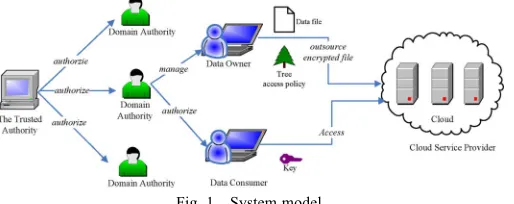
As depicted in Fig. 1, the cloud computing system under consideration consists offive types of parties: acloud service provider, data owners, data consumers, a number ofdomain authorities, and atrusted authority.
The cloud service provider manages a cloud to provide data storage service. Data owners encrypt their datafiles and store them in the cloud for sharing with data consumers. To access the shared datafiles, data consumers download encrypted data files of their interest from the cloud and then decrypt them. Each data owner/consumer is administrated by a domain authority. A domain authority is managed by its parent domain authority or the trusted authority. Data owners, data consumers, domain au-thorities, and the trusted authority are organized in a hierarchical manner as shown in Fig. 1.
The trusted authority is the root authority and responsible for managing top-level domain authorities. Each top-level do-main authority corresponds to a top-level organization, such as a federated enterprise, while each lower-level domain authority corresponds to a lower-level organization, such as an affiliated company in a federated enterprise. Data owners/consumers may correspond to employees in an organization. Each domain au-thority is responsible for managing the domain authorities at the next level or the data owners/consumers in its domain.
In our system, neither data owners nor data consumers will be always online. They come online only when necessary, while the cloud service provider, the trusted authority, and domain au-thorities are always online. The cloud is assumed to have abun-dant storage capacity and computation power. In addition, we assume that data consumers can access datafiles for reading only.
B. Security Model
We assume that the cloud server provider is untrusted in the sense that it may collude with malicious users (short for data owners/data consumers) to harvest file contents stored in the cloud for its own benefit.
In the hierarchical structure of the system users given in Fig. 1, each party is associated with a public key and a private key, with the latter being kept secretly by the party. The trusted authority acts as the root of trust and authorizes the top-level domain authorities. A domain authority is trusted by its sub-ordinate domain authorities or users that it administrates, but may try to get the private keys of users outside its domain. Users may try to access data files either within or outside the scope of their access privileges, so malicious users may collude with each other to get sensitivefiles beyond their privileges. In
Fig. 2. Example key structure.
addition, we assume that communication channels between all parties are secured using standard security protocols, such as SSL.
IV. OURCONSTRUCTION
In this section, we first present our HASBE scheme, which extends the ASBE algorithm with a hierarchical user structure. We then show how HASBE is applied for hierarchical user grant, data file creation, file access, user revocation, and file deletion.
A. Preliminaries
Bilinear Maps: Let , be cyclic (multiplicative) groups of prime order . Let be a generator of . Then :
is a bilinear map if it has the following properties:.
• Bilinearity: for all and ,
.
• Nondegeneracy: .
is called a bilinear group if the group operation and the bilinear map are both efficiently computable.
In our HASBE scheme, a data encryptor specifies an access structure for a ciphertext which is referred to as the ciphertext policy. Only users with decryption keys whose associated at-tributes, specified in their key structures, satisfy the access struc-ture can decrypt the ciphertext.
Key Structure: We use a recursive set based key structure as in [19] where each element of the set is either a set or an element corresponding to an attribute. The depth of the key structure is the level of recursions in the recursive set, similar to definition of depth for a tree. For a key structure with depth 2, members of the set at depth 1 can either be attribute elements or sets but members of a set at depth 2 may only be attribute elements. Consider the example shown
in Fig. 2, where ,
, is a key structure of depth 2. It represents the attributes of a person who is both a director of level 3 for a unit and a coordinator of level 6 for another unit in the Defense Ad-vanced Research Projects Agency (DARPA) of the Department of Defense (DoD).
Fig. 3. Example access structure.
at depth 2 then a unique index where is as-signed to each set. The set at depth 1 is referred to as set 0. Using this convention, a key structure of depth 2 can be
repre-sented as , where is the set at depth
1 while is the th set at depth 2, for . In the key structure in Fig. 2,
corresponds to , and
correspond to and , respectively. Individual attributes inherit the label of the set they are contained in and are uniquely defined by the com-bination of their name and their inherited label. For example,
attribute is defined as . When
trying to satisfy a given policy, a user may only use attribute elements within a set, but may not combine attributes across the sets by default. However, if the encryptor has designated trans-lating nodesin an access structure, users can combine attributes from multiple sets to satisfy the access structure, as will be ex-plained later in the scheme construction as well as in [19].
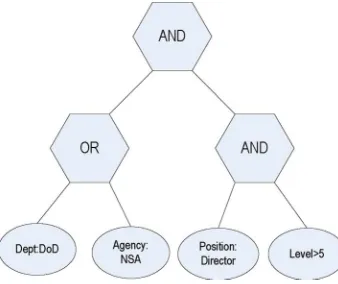
Access Structure: In our scheme, we use the same tree access structure as in [19]. In the tree access structure, leaf nodes are attributes and nonleaf nodes are threshold gates. Each nonleaf node is defined by its children and a threshold value. Let denote the number of children and the threshold value of node . An example of the access tree structure is shown in Fig. 3, where the threshold values for “AND” and “OR” are 2 and 1, respectively.
The above access structure demands that only a director in DoD or NSA of level larger than 5 can access the datafiles pro-tected by the access policy. In CP-ABE schemes, a person who has private keys corresponding to attributes on the key structure shown in Fig. 2 would be able to access the data files, which compromises the security of the access policy in Fig. 3. Such problems are effectively prevented using attribute-set-based encryption which forbids combining attributes across multiple sets.
Let be the access structure rooted at node and be the access structure rooted at the root node . Without loss of generality, we consider key structure of depth 2,
, where is the th
attribute set and is the label. We say that satisfies if and only if a function returns a nonempty set of labels. The function is computed recursively and will be introduced in the encryption algorithm later. is said to satisfy if
Fig. 4. Hierarchical structure of system users.
it contains at least one set that has all the attributes needed to satisfy and that the attributes belonging to multiple sets in cannot be combined to satisfy , except when there are designated translating nodes in . If node is a translating node in , then if the attribute elements used to satisfy the predicate represented by the subtree rooted at belong to a different set in than those used to satisfy the predicates represented by the siblings of , the decrypting user is able to combine them to satisfy the predicate represented by the parent node of .
Several functions are defined for the purpose of dealing with the access structure. We define as the parent node of and as the index number of node . The function is defined only if is a leaf node and denotes the attribute associated with the leaf node in the tree.
B. HASBE Scheme
The proposed HASBE scheme seamlessly extends the ASBE scheme to handle the hierarchical structure of system users in Fig. 4.
Recall that our system model consists of a trusted authority, multiple domain authorities, and numerous users corresponding to data owners and data consumers. The trusted authority is re-sponsible for generating and distributing system parameters and root master keys as well as authorizing the top-level domain au-thorities. A domain authority is responsible for delegating keys to subordinate domain authorities at the next level or users in its domain. Each user in the system is assigned a key structure which specifies the attributes associated with the user’s decryp-tion key.
We are now ready to describe the main operations of HASBE: System Setup, Top-Level Domain Authority Grant,
New Domain Authority/User Grant,New File Creation,User Revocation,File Access, andFile Deletion.
System Setup: The trusted authority calls the algo-rithm to create system public parameters and master key . will be made public to other parties and will be kept secret.
. Here is the depth of the key structure. We describe the HASBE scheme for key struc-tures of depth 2, and it can be extended to any depth . The algo-rithm selects a bilinear group of prime order with generator
support key structure of depth , will range from 1 to . This algorithm sets the public key and master key as follows:
Top-Level Domain Authority Grant: A domain authority is associated with a unique ID and a recursive attribute set
, where with
being the th attribute in and being the number of at-tributes in . When a new top-level domain authority, i.e., DA , wants to join the system, the trusted authority willfirst verify whether it is a valid domain authority. If so, the trusted authority calls to generate the master key for DA . After get-ting the master key, DA can authorize the next level domain authorities or users in its domain.
. This algorithm creates the master key for top-level DA . It selects a unique number for the domain authority, which is also for the set , and selects random numbers , one for each set . Furthermore, it picks a random number for each . It computes the master key for DA as follows:
In the above master key, is for translation from of to of at thetranslating node. Elements and can be used as to translate to at thetranslating nodes, we will give the details later in the algorithm.
New Domain Authority/User Grant: When a new user, denoted as , or a new subordinate domain authority, de-noted as DA , wants to join the system, the administrating domain authority, denoted as DA , will first verify whether the new entity is valid. If true, DA assigns the new entity a key structure corresponding to its role and a unique ID. Note that is a subset of , where is the key struc-ture of DA . In , every element is labeled the same as it
is in . For example, ,
,
and ,
then is labeled as set in both
and , and is labeled as (2, ).
For a new user , DA calls to
gen-erate the secret key for this user. Otherwise, if it is a new domain
authority DA , DA calls to
generate the master key for DA . Then DA can authorize the lower level domain authorities or users in its domain.
. This algorithm uses the master key of , which is for the key structure , and a new key
struc-Fig. 5. Format of a datafile on the cloud.
ture , which is a set of . The master key of is in the form
. As in the algorithm, this al-gorithm randomly chooses a unique number for each user or domain authority, a random number for each set , and a random number for each . Then it computes the new secret key as
The new secret key or is a secret key for the key structure . Because the algorithm rerandomizes the key, a delegated key is equivalent to one received directly from the trusted authority.
New File Creation: To protect data stored on the cloud, a data ownerfirst encrypts datafiles and then stores the encrypted datafiles on the cloud. As in [16], eachfile is encrypted with a symmetric data encryption key , which is in turn encrypted with HASBE. Before uploading to the cloud, a datafile is pro-cessed by the data owner as follows:
• Pick a unique ID for this datafile.
• Randomly choose a symmetric data encryption key , where is the key space, and encrypt the data file using .
• Define a tree access structure for the file and encrypt
with using algorithm of
HASBE which returns ciphetext .
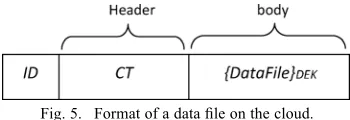
Finally, the encrypted datafile is stored on the cloud in the format as shown in Fig. 5.
. is the message to encrypt. In the
New File Creationoperation, is the of a datafile. is the tree access structure. Encrypt algorithm is the same as that of ASBE [19]. The algorithm associates a polynomial with each node in the tree , which is chosen randomly in a top-down manner from the root node . For every node in , the degree of is set to be one less than the threshold value of and denoted as . If is a leaf node, then is set to 0.
For each nonroot node , . The
where denotes the set of leaf nodes in , denotes the set of translating nodes in the access tree .
User Revocation: Whenever there is a user to be revoked, the system must make sure the revoked user cannot access the associated datafiles any more. One way to solve this problem is to re-encrypt all the associated datafiles used to be accessed by the revoked user, but we must also ensure that the other users who still have access privileges to these datafiles can access them correctly.
HASBE inherits the advantage of ASBE in efficient user revocation. We add an attribute to a user’s key, which indicates the time until which the key is considered to be valid. Then the policy associated with data files can include a check on the attribute as a numer-ical comparison. For example, assuming a user has a key with and a data file whose access policy is associated with , then can decrypt this datafile only when and the rest of the policy matches ’s attributes. This numeric comparison of attributes can be implemented by the “bag of bits” as in [18]. In practice, the validity period of sensitive attributes must be kept small to reduce thewindow of vulnerabilitywhen a key is compromised, for example, a day, a week, or a month [19]. With this feature, we allow multiple value assignments to the
attribute so as to add a new expiration value to the existing key. In this way, we can update user’s key without entire key regenerating and redistributing at the end of expiration time. On the other hand, the data owner can change the policy over datafiles by updating the attribute associated with the leaf node in the access tree. The update of user’s key and re-encryption of datafiles can be done as follows:
Key Update. Suppose that there is a user , who is adminis-trated by the domain authority DA . DA maintains some state information about ’s key and adds a new value of to ’s existing key when it wants to up-date ’s key. Then DA computes the secret key compo-nents corresponding to the attribute and sends them to . Transmission of the secret key compo-nents to the user can be accomplished with an out-of-band channel between DA and the user . While DA is re-quired to maintain some state information about user’s key, DA avoids the need to generate and distribute the entire keys on a frequent basis. This reduces the workload on DA and saves considerable computing resources.
Data Re-encryption. When the data owner wants to re-encrypt a data file, he changes the value of the attribute in the key policy and com-putes the new ciphertext components and , where is the leaf node on the access tree corresponding the attribute. Then the data owner sends these new ciphertext components to the cloud and the cloud service provider can re-encrypt the data file by simply updating these ciphertext components. So when re-encrypting a data file, the data owner just needs to compute the ciphertext components associated with the attribute while other parts of the cipher-text remain unchanged, which effectively reduces the workload of the data owner. Furthermore, in this process
the cloud just knows the two ciphertext components and can not get the plaintext of the datafile.
File Access: When a user sends request for data files stored on the cloud, the cloud sends the corresponding ci-phertexts to the user. The user decrypts them byfirst calling to obtain and then decrypt datafiles
using . algorithm is as follows:
. This algorithm accepts ciphetext CT and user ’s key structure as input. The algorithm first calls to verify whether the key structure in satisfies the tree access structure associated with the CT. The func-tion is performed recursively. For each node in , there is a set of labels returned by . If does not satisfy , the algorithm returns null; otherwise the algorithm picks one from the set returned by , and calls function on the root node of , where
is a node from . is defined as
follows:
If is a leaf node, and if , where , then
. If ,
where , then
.
If is a nonleaf node, then is
defined as follows:
• Let be an arbitrary sized set of child nodes such that only if (1) label or (2) label
for some and is atranslating node. If no such set exists then return .
• For each node , if , then call
and store output in .
• For each node , if and , then
call and store output in .
Then if , translate to as follows:
Otherwise, if , then translate to as follows:
• Compute using polynomial interpolation as follows: , where
. So when ,
, else when , .
So the function on
the root node returns . If , then
. If , then
and .
Then the message can be computed as .
V. SECURITYPROOF ANDDISCUSSION
A. Security Proof
Though HASBE is extended from ASBE by Bobbaet al.with a hierarchical structure using a delegation algorithm similar to the one described in the CP-ABE scheme by Bethencourtet al., we do not use the proof technique by Bobbaet al.Instead, we prove the security of our scheme directly based on the security of CP-ABE. We show that if there are any vulnerabilities in the proposed scheme, these vulnerabilities can be used to break CP-ABE. Thus, HASBE is expected to have the same security property as CP-ABE, which has been proven to be secure under the generic bilinear group model and the random oracle model. A generic security model to be defined below describes inter-actions between an adversary and an encryption algorithm like HASBE or CP-ABE. Identical to the model used in CP-ABE, the security model allows the adversary to query for any private keys that cannot be used to decrypt the challenge ciphertext. In CP-ABE and HASBE the ciphertexts are associated with ac-cess structures and the private keys are identified with attributes. Thus, the security model requires that the adversary chooses to be challenged on an encryption to an access structure and can ask for any private key such that does not satisfy .
1) Formal Security Model: Before giving a formal proof for the proposed scheme, wefirst describe the formal security model for ciphertext-policy ABE schemes. In this model, the adversary will choose to be challenged on an encryption to an access structure and can ask for any private key such that does not satisfy . The formal security model is defined as follows between an adversary and a challenger :
• Setup. The challenger runs the Setup algorithm and gives
the public parameters, PK to the adversary.
• Phase 1. The adversary makes repeated private key
queries corresponding to sets of attributes . The challenger responds by running algorithm
(Top-level domain) to generate the private key cor-responding to the attribute set . Or else, the adversary makes private key queries for a lower-level domain au-thority or end users with the private key of an upper level domain authority. The challenger responds by running algorithm to generate the private key.
• Challenge. The adversary submits two equal length
mes-sages and . In addition, the adversary gives a challenge access structure such that none of the sets from Phase 1 satisfy the access structure. The challenger flips a random coin , and encrypts under
. The ciphertext is given to the adversary.
• Phase 2. Phase 1 is repeated with the restriction that none
of the sets of attributes satisfy the access structure corresponding to the challenge.
• Guess. The adversary outputs a guess of .
The advantage of the adversary in this game is defined as .
Definition 1: A ciphertext-policy ABE scheme is secure if all polynomial time adversaries have at most a negligible ad-vantage in the above game.
Theorem 1: Suppose there is no polytime adversary who can break the security of CP-ABE with nonnegligible advantage; then there is no polytime adversary who can break our system with nonnegligible advantage.
Proof: Suppose we have an adversary with nonneg-ligible advantage against our proposed scheme. Using , we show how to build an adversary, , that breaks the CP-ABE scheme with nonnegligible advantage. The adversary can play a similar game with the CP-ABE scheme. The CP-ABE secu-rity model [18] is also composed of four steps: Setup, Phase 1, Challenge, Phase 2 and Guess. That is to say, can make private queries during the game to obtain private keys in the CP-ABE scheme.
• Initialization. The adversary takes the public key of
CP-ABE , and
the corresponding private key is unknown to the adversary.
• Setup. The adversary selects a random number ,
and computes the HASBE public parameters from as
. That is, the adversary sets
and . Then the public key is given to the adversary.
• Phase 1. In this phase, answers private key queries.
Sup-pose the adversary is given a private key query for a set where does not satisfy . In order to answer the query,
makes a private key query to CP-ABE challenger for the same set twice. As a result, obtains two different pri-vate keys:
where ’s are attributes from , and are random numbers in .
From and , can obtain by dividing in
with in . selects random number ,
and let and . Then can
derive the private key requested by as
. Then the private key is returned to the adversary .
Note that attribute in or may appear multiple times in . The above private key derivation deals with this issue by randomly selecting and from . If the adversary requests for a lower-level domain au-thority’s private key or an end user’s private key, it is noted that the master key of the domain authority can
be obtained by querying and for
the algorithm using the attributes in only, and returns the result to .
• Challenge. When decides that Phase 1 is over, it
out-puts an access structure and two messages , which it wishes to be challenged. gives the two messages to CP-ABE challenger, and is given the challenge cipher-text
.
Then computes the challenge ciphertext for from as:
. In , , , and are readily ob-tained from . Note that is a linear combination of and other known values, which are determined by the public access structure. Thus can be computed from and other known values. Finally, the challenge cipher-text is returned to the adversary .
• Phase 2. issues queries not issued in Phase 1. responds
as in Phase 1.
• Guess. Finally, outputs a guess , and then
concludes its own game by outputting . According to the formal security model, the advantage of the adversary against HASBE is
This means has nonnegligible advantage against the CP-ABE scheme, which completes the proof of the theorem.
B. Discussion
In this subsection, we compare our scheme with the one pro-posed by Yuet al.[17] on security features in implementing access control for cloud computing.
1) Scalability: We extend ASBE with a hierarchical structure to effectively delegate the trusted authority’s private at-tribute key generation operation to lower-level domain thorities. By doing so, the workload of the trusted root au-thority is shifted to lower-level domain authorities, which can provide attribute key generations for end users. Thus, this hierarchical structure achieves great scalability. Yuet al.’s scheme, however, only has one authority to deal with key generation, which is not scalable for large-scale cloud computing applications.
2) Flexibility: Compared with Yuet al.’s scheme, HASBE or-ganizes user attributes into a recursive set structure and al-lows users to impose dynamic constraints on how those attributes may be combined to satisfy a policy. So HASBE can support compound attributes and multiple numerical assignments for a given attribute conveniently. As illus-trated with the example key structure in Fig. 2 and access structure in Fig. 3, HASBE can enforce more complex ac-cess policies than Yuet al.’s scheme.
3) Fine-grained access control: Based on HASBE, our scheme can easily achievefine-grained access control. A data owner can define and enforce expressive andflexible access policy for datafiles as the scheme in [17].
4) Efficient User Revocation: To deal with user revocation in cloud computing, we add an attribute to each user’s key and employ multiple value assignments for this attribute. So we can update user’s key by simply adding a new expiration value to the existing key. We just require a domain authority to maintain some state infor-mation of the user keys and avoid the need to generate and distribute new keys on a frequent basis, which makes our scheme more efficient than existing schemes.
5) Expressiveness: In HASBE, a user’s key is associated with a set of attributes, so HASBE is conceptually closer to tra-ditional access control methods such as Role-Based Ac-cess Control (RBAC) [18]. Thus, it is more natural to apply HASBE, instead of KP-ABE, to enforce access control.
VI. PERFORMANCEANALYSIS ANDIMPLEMENTATION In this section, wefirst analyze theoretic computation com-plexity of the proposed scheme in each operation. Then we im-plement an HASBE toolkit based on the toolkit devel-oped for CP-ABE [18], and conduct a series of experiments to evaluate performance of our proposed scheme.
A. Performance Analysis
We analyze the computation complexity for each system op-eration in our scheme as follows.
System Setup. When the system is set up, the trusted
au-thority selects a bilinear group and some random numbers. When and are generated, there will be several exponentiation operations. So the computation complexity ofSystem Setupis .
Top-Level Domain Authority Grant. This
oper-ation is performed by the trusted authority. The master key of a domain authority is in the form of , where is the key structure associated with a new domain authority, is the set of . Let be the number of at-tributes in , and be the number of sets in . Then the computation of consists of two exponentiations for each attribute in , and one exponentiations for every set in . The computation complexity ofTop-Level Domain Authority Grantoperation is .
New User/Domain Authority Grant. In this operation, a
new user or new domain authority is associated with an at-tribute set, which is the set of that of the upper level domain authority. The main computation overhead of this opera-tion is rerandomizing the key. The computaopera-tion complexity is , where is the number of attributes in the set of the new user or domain authority, and is the number of sets in .
New File Creation. In this operation, the data owner needs
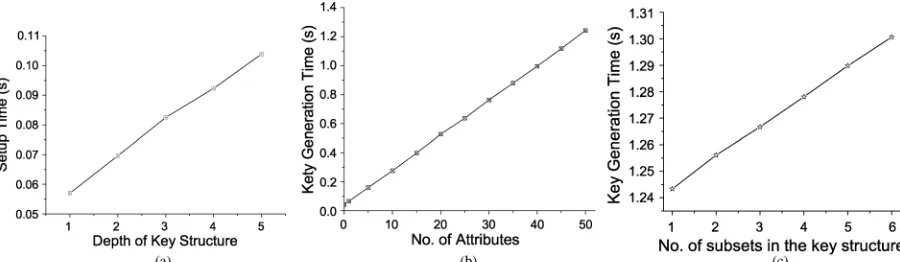
Fig. 6. Experiments on system setup and top-level domain authority grant. (a) Setup operation; (b) top-level domain authority grant (the number of subsets in the key structure is 1); (c) top-level domain authority grant (the total number of attributes in the key structure is 50).
TABLE I
COMPARISON OFCOMPUTATIONCOMPLEXITY
where denotes the leaf nodes of and denotes the
translating nodesof .
User Revocation. In this operation, a domain authority just
maintains some state information of users’ keys and as-signs new value for expiration time to a user’s key when updating it. When re-encrypting datafiles, the data owner just needs two exponentiations for ciphertext components associated with the attribute. So the com-putation complexity of this operation is .
File Access. In this operation, we discuss the decrypting
operation of encrypted datafiles. A userfirst obtains with the algorithm and then decrypt data files using . We will discuss the computation complexity of the algorithm. The cost of decrypting a cipher-text varies depending on the key used for decryption. Even for a given key, the way to satisfy the associated access tree may be various. The algorithm consists of two pairing operations for every leaf node used to satisfy the tree, one pairing for eachtranslating nodeon the path from the leaf node used to the root and one exponentia-tion for each node on the path from the leaf node to the root. So the computation complexity varies depending on the access tree and key structure. It should be noted that the decryption is performed at the data consumers; hence, its computation complexity has little impact on the scalability of the overall system.
File Deletion. This operation is executed at the request of
a data owner. If the cloud can verify the requestor is the owner of the file, the cloud deletes the data file. So the computation complexity is .
Computation complexity of each system operation is shown in Table I, in which denotes the number of attributes in the key structure, is the attribute set of the datafile, is the set of leaf nodes of the access tree or policy tree, and is the set of translating nodes of the policy tree.
B. Implementation
We have implemented a multilevel HASBE toolkit based on the toolkit (http://acsc.csl.sri.com/cpabe/) developed for CP-ABE [18] which uses the Pairing-Based Cryptography library (http://crypto.stanford.edu/pbc/). Then comprehensive experiments are conducted on a laptop with dual core 2.10-GHz CPU and 2-GB RAM, running Ubuntu 10.04. We make an analysis on the experimental data and give the statistical data. Similar to the toolkit, our toolkit also provides a number of command line tools as follows:
hasbe-setup: Generates a public key and a master key
.
hasbe-keygen: Given and , generates a private
key for a key structure. The key structure with depth 1 or 2 is supported.
hasbe-keydel: Given and of DA , delegates
some parts of DA ’s private keys to a new user or DA in its domain. The delegated key is equivalent to generating private keys by the root authority.
hasbe-keyup: Given , the private key, the new
at-tribute and the subset, generates a new private key which contains the new attribute.
hasbe-enc: Given , encrypts afile under an access tree
policy specified in a policy language.
hasbe-dec: Given a private key, decrypts afile.
hasbe-rec: Given , a private key and an encryptedfile,
re-encrypt thefile. Note that the private key should be able to decrypt the encryptedfile.
Fig. 6(a) shows the time required to setup the system for a different depth of key structure. Our scheme can be extended to support any depth of key structure. The cost of this operation increases linearly with the key structure depth, and the setup can be completed in constant time for a given depth. Except for this experiment, all other operations are tested with the key structure depth of 2.
Fig. 7. Experiments on new user/domain authority grant and key update. (a) New user/domain authority grant (the total number of attributes in the master secret key of DA is 50 and the total number of attributes is 45); (b) new user/domain authority grant (the total number of attributes in the master secret key of DA is 50 and the number of subsets is 1); (c) key update (the total number of attributes in the original private key is 50).
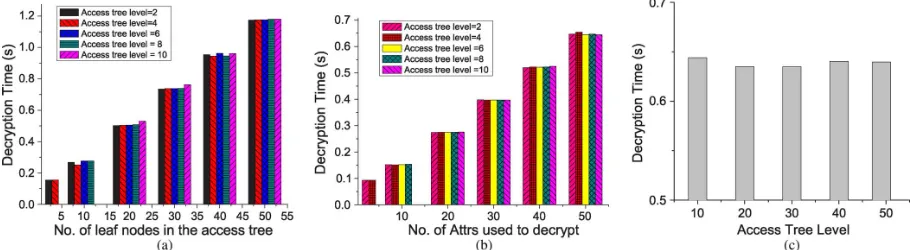
Fig. 8. Experiments onfile creation and decryption. (a) Encryption/newfile creation; (b) decryption/file access (there is 1 subset with 50 attributes in the private key); (c) decryption/file access (there is 1 subset with 50 attributes in the private key and the number of attributes used for decryption is 50).
shown in Fig. 6(c). Results of these twofigures conform to the theoretic analysis.
With the command , a domain authority DA can performNew User/Domain Authority Grantfor a new user or another domain authority in his domain. The cost depends on the number of subsets and attributes to be delegated. Assume the domain authority DA has a private key with 50 attributes. When DA wants to delegate 45 of the attributes, the cost grows linearly with the number of subsets to be delegated as shown in Fig. 7(a). If DA delegates 1 of the subsets, the cost also increases linearly with the number of attributes in the subset as in Fig. 7(b).
User Revocation operation consists of two steps:Key Up-dateandData Re-encryption.Key Updateis implemented with the command . The root authority or domain au-thority can assign a new attribute to the user or domain auau-thority. Adding a new attribute to one subset of private key can be done in constant time as the complexity is . If the new attribute needs to be assigned to several subsets, the cost is linear with the number of the subsets, as shown in Fig. 7(c).
Data Re-encryption is performed with the command . The data owner can re-encrypt the datafile. For example, there is an encryptedfile named which is encrypted with a policy and and the data owner re-encrypts
it with the command - ,
then the new encrypted datafile is associated with a policy
and and . When a user is revoked, the associated datafile can be re-encrypted in this way, and the new attributes can be assigned to valid user with command . The cost of operationData Re-encryptiondepends on the number
of attributes on the access tree, which is same as the encryption operation, so we do not give the analysis here.
The data owner can use the command to encrypt afile to create a new encryptedfile. The time for this operation depends on the access tree structure. According to the number of leaf nodes and the level of the access tree policy, the time required to encrypt thefile is shown in Fig. 8(a). We can see the cost is linear with the number of leaf nodes on the access tree and unrelated to the level of the access tree.
To access the file, decryption should be done with the command . The time of decryption is different depending on the access tree and key structure. Here we assume that there is just 1 subset with 50 attributes in the key structure associated with the private key. As shown in Fig. 8(b), the decryption time is proportional to the number of leaf nodes needed for decryption, and the level of the access tree has no impact on the decryption time.
In Fig. 8(c), assuming that the number of leaf nodes used for decryption is 50, we show the relationship between the access tree level and the time for decryption. We can see that the access tree level have no impact on the cost.
VII. CONCLUSION
of attributes. We formally proved the security of HASBE based on the security of CP-ABE by Bethencourtet al.. Finally, we implemented the proposed scheme, and conducted comprehen-sive performance analysis and evaluation, which showed its ef-ficiency and advantages over existing schemes.
ACKNOWLEDGMENT
The authors would like to thank the anonymous reviewers for their valuable comments.
REFERENCES
[1] R. Buyya, C. ShinYeo, J. Broberg, and I. Brandic, “Cloud computing and emerging it platforms: Vision, hype, and reality for delivering com-puting as the 5th utility,”Future Generation Comput. Syst., vol. 25, pp. 599–616, 2009.
[2] Amazon Elastic Compute Cloud (Amazon EC2) [Online]. Available: http://aws.amazon.com/ec2/
[3] Amazon Web Services (AWS) [Online]. Available: https://s3.ama-zonaws.com/
[4] R. Martin, “IBM brings cloud computing to earth with massive new data centers,”InformationWeekAug. 2008 [Online]. Available: http:// www.informationweek.com/news/hardware/data_centers/209901523 [5] Google App Engine [Online]. Available:
http://code.google.com/ap-pengine/
[6] K. Barlow and J. Lane, “Like technology from an advanced alien cul-ture: Google apps for education at ASU,” inProc. ACM SIGUCCS User Services Conf., Orlando, FL, 2007.
[7] B. Barbara, “Salesforce.com: Raising the level of networking,”Inf. Today, vol. 27, pp. 45–45, 2010.
[8] J. Bell, Hosting Enterprise Data in the Cloud—Part 9: Investment Value Zetta, Tech. Rep., 2010.
[9] A. Ross, “Technical perspective: A chilly sense of security,”Commun. ACM, vol. 52, pp. 90–90, 2009.
[10] D. E. Bell and L. J. LaPadula, Secure Computer Systems: Unified Ex-position and Multics Interpretation The MITRE Corporation, Tech. Rep., 1976.
[11] K. J. Biba, Integrity Considerations for Secure Computer Sytems The MITRE Corporation, Tech. Rep., 1977.
[12] H. Harney, A. Colgrove, and P. D. McDaniel, “Principles of policy in secure groups,” inProc. NDSS, San Diego, CA, 2001.
[13] P. D. McDaniel and A. Prakash, “Methods and limitations of secu-rity policy reconciliation,” inProc. IEEE Symp. Security and Privacy, Berkeley, CA, 2002.
[14] T. Yu and M. Winslett, “A unified scheme for resource protection in automated trust negotiation,” inProc. IEEE Symp. Security and Pri-vacy, Berkeley, CA, 2003.
[15] J. Li, N. Li, and W. H. Winsborough, “Automated trust negotiation using cryptographic credentials,” inProc. ACM Conf. Computer and Communications Security (CCS), Alexandria, VA, 2005.
[16] V. Goyal, O. Pandey, A. Sahai, and B. Waters, “Attibute-based encryp-tion forfine-grained access control of encrypted data,” inProc. ACM Conf. Computer and Communications Security (ACM CCS), Alexan-dria, VA, 2006.
[17] S. Yu, C. Wang, K. Ren, and W. Lou, “Achiving secure, scalable, and fine-grained data access control in cloud computing,” inProc. IEEE INFOCOM 2010, 2010, pp. 534–542.
[18] J. Bethencourt, A. Sahai, and B. Waters, “Ciphertext-policy attribute-based encryption,” inProc. IEEE Symp. Security and Privacy, Oak-land, CA, 2007.
[19] R. Bobba, H. Khurana, and M. Prabhakaran, “Attribute-sets: A practi-cally motivated enhancement to attribute-based encryption,” inProc. ESORICS, Saint Malo, France, 2009.
[20] A. Sahai and B. Waters, “Fuzzy identity based encryption,” inProc. Acvances in Cryptology—Eurocrypt, 2005, vol. 3494, LNCS, pp. 457–473.