ISSN (Online): 2320-9364, ISSN (Print): 2320-9356
www.ijres.org Volume 6 Issue 5 Ver. I ǁ 2018 ǁ PP. 53-61
Anapproach for Processing Fuzzy Data Based On Hedge Algebras
Conghao Nguyen
Information Technology Faculty, Hue University, Vietnam Corresponding Author: Conghao Nguyen
Abstract:
In the paper we introduce a new model of fuzzy relational databases in which uncertain data are represented as just linguistic terms with the hedge algebra-based semantics. That is these terms can be considered as elements of hedge algebras and their quantitative semantics are defined by semantically quantifying mappings of hedges algebras that are defined by the fuzziness measure of terms. These mappings assign each linguistic term of an attribute a real value in the real domain associated with the attribute, called the semantic representative or semantic value of this term. Based on fuzziness measure of terms, a system of fuzziness intervals of an attribute domain can be determined, from which we can construct k-neighbourhoods of linguistic terms and k-partition of the attribute domain, where k is the length of strings which represent linguistic terms of hedge algebras. This k-partition allows define k-matching relations on the attribute domain under consideration. We show that under the equivalence classes of this k-partition, which are intervals, and the semantic representatives of linguistic data in the database, we can manipulate the data in a unified way, because the queries related to linguistic data can be converted into the classical ones.Keywords:
fuzzy relational databases, hedge algebra, linguistic term, fuzziness measure.--- --- Date of Submission: 13-06-2018 Date of acceptance: 28-06-2018 --- ---
I. INTRODUCTION
We are often faced with fuzzy or uncertain information in almost fields of our life. Therefore, it is natural that there were many works dealing with relational database models with uncertain information, normally called fuzzy database models. There are several approaches to such fuzzy databases to solve the problem of representation and semantic treatment of fuzzy information. They depend of course on the viewpoint, upon which one models the fuzzy data.
In the simplest case, the fuzziness of database model lies in the fact that some of the relations of the database are viewed as fuzzy sets on the cross product of their attribute domains, that is each tuple of the relations is associated with a membership degree taking values in the interval [0,1]. The handling of the data in such a database is rather simple, because the attribute values are still crisp ones, i.e. the attributes of the database are not allowed to take fuzzy data. To compare two values of an attribute domain D, a fuzzy relation RES is utilized, where RES is a reflexive and symmetric relation defined on the cross product of D, RES: DD [0,1], and called resemblance or proximity relation.
The original approach to fuzzy database is the one in which some attributes allow taking fuzzy sets as their values, which represent the meaning of vague terms, i.e. the uncertain information of the available knowledge about the elements of the attribute domain. For an attribute A, A(x) denotes the value of the object or individual x at the attribute A. In the case A(x) is an uncertain data, A(x) is a fuzzy set defined on the real domain of A. To capture the semantics of this kind of data, there are various approaches to utilize the semantics of fuzzy sets for defining the similarity between two fuzzy sets. For example, to compare two fuzzy sets A and B one can introduce different equality indexes, which indicate their similarity, or different comparability measures Com(A,B), which are also fuzzy sets but defined on [0,1] to measure the extent to which the one fuzzy set is compatible with the other or to measure the compatibility of the fact that “A is B” [13]. There are also several other compatibility measures established based on certain intuitive semantic idea for particular categories of fuzzy sets such as the one of triangular and/or trapezoidal fuzzy sets [14].
It may be observed that although these approaches achieve many successes in both theory and applications, there are still some inconveniences in data manipulation for these databases:
i) Normally, fuzzy data in such fuzzy databases provided by the database user are linguistic data which are considered as the labels of fuzzy sets or possibility distributions. As it can be seen above, there are many computational approaches to the representation of the meaning of linguistic information.
www.ijres.org 54 | Page distributions. In comparison with the classical database it causes many changes in data manipulation. The difficulty lies in the fact that how we can define matching relations such as =, , ≤, ≥, <and > between values of completely different types in a fuzzy environment. For example, how we can understand the expression t[A]
s[A], where t and s are tuples of the database and t[A] and s[A] denote the values of different types of these tuples of the attribute A and is one of the matching relations =, , ≤, ≥, <and >. Therefore, this problem may become simpler if we can give another approach in which we can treat all uncertain data as real data in the data manipulation.
Hedge algebras form an algebraic approach to the natural qualitative semantics of linguistic terms [7] and establish a quite new methodology to solve effectively approximate reasoning problems [9]. So, it may allow us introduce a new approach to fuzzy databases. In the algebraic approach, each term-domain X = LDom(A) of the linguistic variable [6], or an attribute A of a database can be considered as an algebra in the category of universal algebras: (LDom(A), G, C, H, ≤), where C is a set of constants, G is a set of primary terms considered as generators, X is freely generated from G by means of one-argument operations in H, a set of linguistic hedges or modifiers in question, and is a semantics-based ordering relation on X. Intuitively, we can observe that term-domains can be ordered based on the natural meaning of their elements and two terms x and y satisfy the inequality xy if the meaning of x is less than the one of y.
In this paper, we will introduce a notion of neighbourhoods of the representative of a term x, called also neighbourhoods of the term x. They are subintervals of [0,1] that contain the representative of x considered as their topologically internal point and they can be defined based on the fuzziness measure of terms. It is interesting that this provides an ability to define fuzzy matching relations, called matching relations of degree k, where k is the length of a term, and to translate queries related with linguistic data into traditional ones. The paper is organized as follows: In the second section, some results of hedge algebras are introduced. In the section 3, a relational model of databases with linguistic data is proposed. Some conclusions will be given in the end of the paper.
II. FUNDAMENTAL CONCEPTS
In this section, we will shown that the meaning of linguistic terms can be expressed by utilizing the structure of hedge algebras or, in the other words, each terms-domain which can be ordered by the semantics of terms becomes a hedge algebra. Since in databases the attribute domains are linearly ordered sets, we shall restrict our presentation to linear hedge algebras.
2.1. Qualitative semantics of linguistic terms
It has been seen above the meaning of terms of a linguistic variable X can be expressed through an ordering relation on its terms-domain. In other words, the meaning of a term is revealed through the algebraic structure related to this term. This viewpoint is similar to the observation that the meaning of the truth value “totally true” in the classical logics is interpreted not only by 1 itself, but by 1 in the context of 0 defined by the order-based structure of a two-element Boolean algebra. Therefore, the meaning of a term in a terms-domain X of a linguistic variable X can be represented by its ordering relationships with the remaining ones in this domain, i.e. by an algebraic structure of terms-domains. In [6-9], it is shown that each term-domain X can be regarded as an abstract algebra AX = (X, G, C, H, ≤), where C = {0, W, 1} is a set of constants, X = H(G) C with H(G) being freely generated from the set of generators G by means of one-argument operations in H, a set of linguistic hedges or modifiers, and is a semantics-based ordering relation on X. Such algebras are called hedge algebras. In the case that the sets H, H+ and G are linearly ordered, where H and H+ are, respectively, the sets of negative and positive hedges and H = HH+, AX is called a linear hedge algebra. For instance, the domain of the linguistic variable TRUTH: T = {0, W, 1, true, false, very true, more true, rather true, very false, rather false, less false,...} can be considered as a linear hedge algebra AT = (T, G, C, H, ) with G = {true, false}, H+ = {very, more}, H = {rather, less} and is a relation induced by the natural meaning of terms in X, e.g. we have 1>very true>true, more true>true>rather true>less true, ... >W>less false>rather false>false>very false, … >0 …
2.2. Fuzziness measures and semantically quantifying mappings
Definition 2.1[8]. A Comp-HAsAX = (X, G,C, H, , , )is said to be a linear hedge algebra(Lin-HA, for short) if the sets GC = {0, c, W, c+, 1}, H+ = {h1,..., hp}and H- = {h-1, ..., h-q}are linearly ordered with
h1<...<hpand h-1< ...< h-q,where p, q >1. Note that H = HH+.
Let Xbe a linguistic variable and AX = (X, G,C, H, , , ) be a ComHA which models a linguistic domain Dom(X) of the variable X. Assume that this algebra is free, that is hxx, for every xH(G) and h H. Semantically, for each term x, the set H(x) consists of all terms whose meaning originates from a definitive essential meaning of the term x. For example, consider two terms x = RatherTrue and y = ApproximatelyTrue. The term VeryRatherTrue reflects a certain meaning of RatherTrue but not of AppTrue, while the term VeryAppTrue reflects a definitive meaning of AppTrue, but not of RatherTrue. In addition, it can be observed that a term x is vague if and only if its meaning is still changed by using hedges. For example, True is vague, but Absolutely True is not and hence H(Absolutely True) = {Absolutely True}. Therefore, we may consider the set H(x) as an expression of certain essential characteristics of fuzziness of the term x and we may use it to model the fuzziness of the linguistic term, qualitatively.
In connection with measuring the fuzziness of linguistic terms in the algebraic approach, we need study the problem of quantification of hedge algebras. Similarly, as the fuzzy defuzzification which assigns a real number of the reference domain to each fuzzy set, we introduce a notion of semantically quantifying mappings (SQMs) of hedge algebras. Fuzziness measure of terms and hedges are very difficult to define in the framework of the fuzzy sets theory. But hedge algebras provide a good intuition and good mathematical basic to define these notions in a reasonable way. Moreover, as it can be seen below, there is a close relation between SQMs and fuzziness measure of hedge algebras.
Definition 2.2[8].Given a Lin-HA AX = (X, G,C, H, , , ). A mapping f: X [0,1] is called a semantically quantifying mapping (SQM) of AX if it satisfies the following conditions:
1)f is a one-to-one mapping;
2)fpreserves the ordering relation on X, i.e. x < y f(x) <f(y), and f(0) = 0, f(1) = 1; 3)f is continuous in the sense that for xX,f(x) =inf f(H(x)) and f(x) = sup f(H(x)).
Note that x = supremum H(x) and x = infimum H(x), where the supremum and infimum are taken in the linearly ordered set X.
Based on the structure of freeLin-HAs, it is observed that the “size” of H(x) can model the fuzziness degree of the term x, since it consists of terms which have a meaning originating from that of x. If x is an exact concept, then it is a fixed point and hence H(x) = {x}, a single element – a minimal set among the sets H(x), xX. And, if x = hu and y = kv, h, kH, h k,we always have H(hu) H(x) and H(hu) H(ku) = , that is that if x and y originate from two terms having essentially different meaning then their fuzziness models can be consider as independent events. In addition, the equality H(x) = kHH(kx) indicates that the fuzziness model of x equals the
union of the fuzziness models of the more specific and “independent” terms originated from x. So, as a consequence, for a given SQM f, the diameter of the image f(H(x)) [0,1] can be interpreted as fuzziness measure of the term x. Therefore, we can introduce the following definition which can be adopted as an axiomatization of the fuzziness measure:
Definition 2.3 [8]. Given a freeLin-HA AX = (X, G, C, H,,,). An fm: X[0,1] is said to be a fuzziness measure (FM, for short) of terms in X if:
1)fm(c) + fm(c+) = 1 and for u X,
fm
(
hu
)
fm
(
u
)
H
h
; In this case fm is called complete;2) If H(x) = {x}, then fm(x) = 0. Especially, fm(0) = fm(W) = fm(1) = 0;
3)x, y X, h H, ( ) ( ) ( ) ( ) fm hx fm hy
fm x fm y
, that is this proportion does not depend on specific elements and, hence,
it is called the fuzziness measure of the hedge h and denoted by (h).It is easy to show the following proposition:
Proposition 2.1 [8].For fm and (h) defined in Definition. 2.3, the following statements hold: 1) fm(hx) = (h)fm(x), xXandfm(x) = 0, for allx Lim(X);
2) fm(c) + fm(c+) = 1;
3)
0
,
) ( ) ( i p i q
ic fm c
h
fm , where c {c , c+};
4)
(
)
(
),
;
0 ,
X
x
x
fm
x
h
fm
i p i q
i
5)
{(h):qi1}www.ijres.org 56 | Page 2.3. A family of fuzziness intervals and its structure
The following notion will be useful for studying the structure of a family of fuzziness intervals and for defining a specific family of SQMs induced by the fuzziness measure fm. It is interesting that we can define the sign of elements of hedge algebras, based on the positiveness and negativeness of primary terms and PN-property of hedges:
Definition 2.4 (Sign function) Sign:X{1, 0, 1}is a function which is defined recursively as follows, where h, h’ H, c {c, c+}:
1) Sign(c) = 1, Sign(c+) = +1,
2) Sign(h'hx) = Sign(h'hx) , if h’hx = hx and otherwise,
Sign(h'hx) = Sign(hx), if h’hxhx and h' is negative w.r.t. h (or w.r.t. c, when h = I and x = c); Sign(h'hx) = +Sign(hx), if h’hxhx and h' is positive w.r.t. h (or w.r.t. c, when h = I and x = c). 3) Sign(x) = 0, for all limit elements x X\ X, where X = H(G).
Based on the fuzziness measure above, we define a notion of fuzziness intervals of terms that model an aspect of quantitative term meaning. For every term x, the fuzziness interval of x is a subinterval of [0,1] of length fm(x), denoted by fm(x), which is defined by induction on the length of x as follows:
i) For terms x of length 1, i.e. x {c+, c}, fm(c) and fm(c+) are defined so that they constitute a partition of
[0,1] and satisfy the conditions that fm(c) fm(c+), i.e. their order is induced by that between c+ and c,
|fm(c
)| = fm(c) and |fm(c
+
)| = fm(c+), where |(x)| denotes the length of (x). Here, the notation UV means that, for xU, yV, we have xy.
ii) Suppose that fm(x) has been defined and |fm(x)| = fm(x), for all x of length k. Then, {fm(hix): i[-q^p]} is
constructed so that it is a partition of fm(x) and satisfies the conditions that |fm(hix)| = fm(hix) and {fm(hix): i
[-q^p]} is a linearly ordered set, whose order is induced by that of {h-qx, h-q+1x, ..., hpx}, i.e. if, for example, h -qx>h-q+1x> ... >hpx, then fm(h-qx) fm(h-q+1x) ... fm(hpx) (see Figure 2.2).
Assume from now on that the fuzziness intervals of linguistic terms always contain their right end-point, e.g. by this convention we have fm(c) = [0, fm(c)] and fm(c+) = (fm(c+), 1].
If l(x) = k, then the fuzziness interval fm(x) of x is said to be of depth k and, if necessary and the index fm is
understood, we use the notation k(x) to indicate explicitly that this fuzziness interval is of depth k.
Set Xk = {xX :l(x) = k}. Obviously, X = 1k<Xk.
Put Ik = {k(x): xXk}, the set of all fuzziness intervals of depth k (or fuzziness k-intervals for short), for a given
positive integer k, and put I = {(x): xX} = 1k<Ik, the set of all fuzziness intervals of a hedge algebra AX.
The following proposition describes the structure of the family of the fuzziness intervals which serves as a basis for studying the similarity of data in an attribute domain (refer to Figure 2.1).
Definition 2.5 [7]. Let AX = (X, G, C, H,,, ) be a free complete Lin-HA and fm(c), fm(c+) and (h) be fuzziness measures of the primary terms c, c+ and hedge hH, respectively, which satisfy 2) and 5) of Proposition 2.1. Then, the mapping induced by the fuzziness measure fm is defined recursively as follows: 1)(W) = = fm(c), (c) = - fm(c)= fm(c), (c+) = +fm(c+);
2)
( )
(
h x
j)
( )
x
Sgn h x
(
j){
i Sgn jj( )
h fm x
i( )
(
h x
j) ( )
h fm x
j( )}
, where1
(
)
[1
(
)
(
)(
)] { , }
2
j j p j
h x
Sgn h x Sgn h h x
, for all j [-q^ p];3)(c) = 0, (c) = = (c+), (c+) = 1, and for all j [-q^ p], we have:
(hjx) = (x) +
2 ) ( 1 ) ( ) (
(
)
(
)}
){
(
x j h Sign j sign j j sign i ij
x
h
fm
x
h
Sgn
and(hjx) = (x) +
2 ) ( 1 ) ( ) (
(
)
(
)}
){
(
x j h Sign j sign j j sign i ij
x
h
fm
x
h
Sgn
.Figure 2.1
3(RVy)
3(LVy )
2(Ry)
3(VMy)
3(MMy)
3(MVy)
3(VVy)
2(My)
2(Vy)
3(RMy)
3(LMy)
3(VRy)
3(MRy)
A(y)
A(My)
A(Vy)It will be seen that there is a close relationship between this SQM and the fuzziness intervals of a hedge algebra which is shown in the following theorem:
Theorem 2.1 [7].Let AX = (X, G, H,,,) be a free complete Lin-HA and be defined as in Definition 2.5. Then, is an SQM and (H(x)) is dense in the interval [(x),(x)],x X. Moreover, (x) = inf(H(x)),(x) = sup (H(x)) and fm(x) = (x)(x), and hence fm(x) = d((H(x))), whered(A) denotes the diameter of A [0,1]. As a consequence,[H(G)] is dense in [0,1].
Example 2.1. Let us consider a linear hedge algebra of AGE, AX = (X, G, C, H,,,), where G = {young, old}, H = {P, L} and H+ = {M, V}, where P, L, M and V stand for Rather, Less, More and Very, respectively. Suppose that DA = [0, 120], fm(old) = 0.55, fm(young) = 0.45, (R) = 0.32, (L) = 0.20, (M) = 0.30 and (V) =
0.18. So, = 0.52 and = 0.48. Since, in applications instead of the SQM taking values in [0,1], it should takes values in [0, 120], we set A,r(x) = A(x)×120, where the index r means that it is a value of the “real” domain in
question. So, by Definition 2.5, we have:
A,r(young) = (0.45 – 0.45×0.52)×120 = 0.234×120 = 25.92
A,r(Ryoung) = 25.92 + 0.48×0.32× 0.45×120 = 34.2144
A,r(MRyoung) = 34.2144 + (1)×[1 ]×0.30×0.32× 0.45×120 = 31.51872
A,r(VRyoung) = 34.2144 + (1)×[0.30+0.18 0.18×]×0.32× 0.45×120 = 27.412992
A,r(Vyoung) = 25.92 + (1)[0.30 + 0.18 0.48×0.18]× 0.45×120= 4.6656
A,r(Vyoung) = 25.92 + (1)×0.30× 0.45×120= 9.72
A,r(Lyoung)= 25.92 + (+1)×0.32× 0.45×120= 42.2
III. A RELATIONAL MODEL OF DATABASES WITH LINGUISTIC DATA
As usual, a relational database model is a set DB = {U, R1, R2, …,Rm; Const}, where U = {A1, A2, …,
An} is the universe of attributes, Ri is a relation scheme, which is a subset of U, Const is a set of constraints on
data in database. Each Aj will be associated with a set DAj, called the domain of Aj.
In a relational database with linguistic data, if an attribute Ai is allowed to take linguistic values, it can
be regarded as a linguistic variable, denoted also by Ai, whose reference set is the real domain DAi of Ai. So, the
domain of such an attribute Ai consists of two parts, a real domain DAi and a terms-set X =LDom(Ai), a linguistic
domain of the linguistic variable Ai. Such attributes are called linguistic attributes. Set D(Ai) = DAiLDom(Ai).
Here, assume that for Ai not being linguistic attribute, LDom(Ai) = . Elements of DAi will be denoted by a, b, c,
… and elements of LDom(Ai) will be denoted by x, y, z, u, v …
As usual, a tuple t onU is a mapping t: U → D(A1) … D(An) such that t(Ai) D(Ai), for 1 ≤ i ≤ n.
Tuples will be denoted by t, s with indexes, if necessary. By t[Ai] we mean the value of a tuple t at the
attributeAi. For any subset X of U, t[X] denotes the restriction of the mapping t onX and it is called a tuple on X.
Consider a relation scheme, i.e. a subset R of U. An instance of R is a set of distinct tuples on R and called a relation. Relations of R are denoted by r[R], s[R] ... If R is understood and there will be no confusion, R may be omitted in these notations. Because t may take real data as well as linguistic ones, it is necessary to construct a method for handling the data in database based on their semantics. If we interpret linguistic data as labels of fuzzy sets then we can manipulate data based on fuzzy sets theory and we have a concept of fuzzy databases.
In this paper, linguistic domain LDom(Ai) is assumed to be a subset of the underlying set of a complete
linear hedge algebra AXAi= (X, G, H,,,) of the linguistic variable Ai. It raises a question: is there a method to
manage the semantics of data based on hedge algebras? If the answer is positive, we may consider linguistic values in databases as elements of hedge algebras, whose underlying set is a term-set. From this viewpoint, the above database model is called a relational database model with linguistic data.
3.1. HA-based semantics of linguistic data and semantics-based topology
Let us consider a linguistic attribute A and suppose as above that D(A) = LDom(A) DA is a mixed
domain of A. The question is that how we can define a similarity of data in the mixed domain D(A)?
In traditional way, each linguistic value is interpreted as the label of a fuzzy set on DA. It is well known
that under such fuzzy data representation, manipulation of data is much more difficult than in the case of crisp data. Especially, it is not easy to define data similarity in a unified way, since its data types are not unique and their semantics is completely different.
We shall solve this question in such a way that we can manipulate the data in databases simply and in a unified way. Firstly, to unify the data types, we embed LDom(A) into the underlying set of a Lin-HA AXA = (X,
G, H,,,) and utilize a quantitative semantic mapping A,r associated with the variable A to transforms
linguistic data to real data, i.e. A,r : X → DA, where the index r indicates as above that A,r takes values in the
real domain DA. So, each linguistic datum x of A can be regarded as a label of a real value defined by A,r. Since
www.ijres.org 58 | Page However, the semantics of A,r(x) is completely different from the usual real data, because the real value A,r(x)
is only a representative of the term x that depends on the fuzziness parameters. So, we can not handle by simply using A,r(x) instead of x in comparison with real values or linguistic values of A, but we should handle it in
another way, utilizing the fuzziness intervals of x.
Let a terms-domain X of a linguistic attribute A be given and Xk be the set of all term x of the length k.
Let us denote by x0k the least element in Xk. Then, A(x0k) = 0 and according to Theorem 2.1 and the definition
of the fuzziness intervals, we have k(x0k) = [A(x0k),A(x0k)] and k(x) = (A(x),A(x)], for all xXk and x
x0k with a note, by our convention, that the fuzziness intervals are closed at their right end-point. If we denote
by k the greatest length of intervals in Ik = {k(x): xXk) and bythe greatest fuzziness measure of hedges in H,
then by (1), Proposition 2.1 we have k+1 ≤ k ≤ k1. Since < 1, it follows that we can find a fuzziness interval of x as small as we desire.
Let AX be a Lin-HA with H+ = {h1,...,hp}and H- = {h-1, ..., h-q} being linearly ordered sets with h1<...<hpand h
-1< ...< h-q,where p, q >1. In applications, we usually assume p, q ≤ 3. Denote by H1 = {hi, h-j : 1 ≤ i ≤ [p/2] & 1
≤ j ≤ [q/2]} the set of hedges that generate terms which have a meaning near the meaning of the original x and by H2 = {hi, h-j : [p/2] <i ≤ pand [q/2] <j ≤ q} the set of hedges that generate terms which have meaning far
from x. This partition of hedges has only a technical value to serve our definition of basic open sets of certain depth k. First of all, we need some notions and notations.
Let INTk be a set of fuzziness intervals of depth k. Two fuzziness intervals of depth k, k(x) and k(y), is said to
be connected in INTk if there is a chain of consecutive fuzziness intervals in INTk such that it connects k(x) and
k(y). In this case k(x) is also said to be connected in INTk to a point ain k(y). The set INTk is said to be
connected if any two of its intervals are connected and, otherwise, it is said to be disconnected.
This notion of connectivity defines the so-called connectivity relation on INTk and it is an equivalence relation.
Set INTk(Hn) = {k(hiy): yXk-1, hiHn} and INTk(Hn, x) = {k(hix): l(x) = k – 1, hiHn}, where n = 1, 2. By the
definition of H1, it can easily be verified that INTk(H1, x) is connected. Note that the point A(x) is the unique
common end-point of the intervals k(h1x) and k(h-1x). Hence, every fuzziness interval in INTk(H1, x) is connected to A(x), that is they lie around the point A(x). From this observation, for every term xH(G), l(x) = k
– 1, we put Ok,H1(x) = {k(y) : l(y) = k, k(y) is connected to A(x) in INTk(H1, x)} = hiH1k(hix).
For illustration, it can be seen in Figure 2.1 that O2,H1(y) = 2(My) 2(Py) and O3,H1(My) =
3(MMy)3(PMy), where H1 = {M, R} and y is an abbreviation of “young”.
In the contrast, INTk(H2, x), where H2 = {L, V}, is disconnected and consists of the fuzziness intervals which can be considered as lying far from the point A(x). For example, in Figure 2.1, 3(VMy) and 3(LMy) belonging to
INT3(H2, My) are disconnected in INT3(H2) and lie far from A(My), but 3(LMy) and 3(VPy) are connected in
INT3(H2) and lie around the value A(y), since they are connected to A(y) in INT3(H2). Note that l(y) = 1 < 3. Now, we are ready to define a system of neighbourhoods of a linguistic term. Remember that for x = hk-1... h1c,
x|i = hi-1... h1c.
Definition 3.1.For each term x= hk-1... h1c of length k, where cG, a basic semantic neighbourhoods system of x up to a depth l, l ≥ k, under the mapping A, denoted by Neigl(x), is the set of the following intervals i(x):
1) i(x) = i(x|i) = (A(x|i),A(x|i)], k ≥ i ≥ 1;
2) k+1(x) = O(k+1),H1(x), i = k + 1;
3) j(x), l ≥ j>k+1, is defined as follows: j(x) = {j(y) : l(y) = j, j(y) is connected to A(x) in INTj(H2)}. As an example, from the structure of fuzziness intervals given in Figure 2.1, we have
2(y) = O2,H1(y) = 2(My)2(Py)
3(y) = {3(y) :l(y) = 3, 3(y) is connected to A(y) in INT3(H2, y)} = 3(LMy)3(VPy)
Neig3(y) = {1(y), 2(My)2(Py), 3(LMy)3(VPy)},
Neig3(Vy) = {1(y), 2(Vy), 3(MVy)3(PVy)}.
It is worth emphasizing that A(x) is always an internal point of every neighbourhood in Neigl(x).
Example 3.1.Let us consider a linear hedge algebra of AGE, AX = (X, G, C, H,,,), where G = {young, old}, H = {P, L} and H+ = {M, V}, where R, L, M and V stand for Rather, Little, More and Very, respectively. SetDA
= [0, 120], fm(old) = 0.55, fm(young) = 0.45, (R) = 0.32, (L) = 0.20, (M) = 0.30 and (V) = 0.18. So, = 0.52. Note that H1 = {R, M} and H2 = {L, V}.
1) Basic semantic neighbourhoods of young: By the definition, the basic semantic neighbourhood system of depth 1 of young, Neig1(young), consists of a unique interval 1(young) = [A,r(young),A,r(young)] = [0,
fm(young)×120] = [0, 54.00], where the subscript r indicates, as previously, that the mapping A,r is defined in
the real domain DA.
The basic semantic neighbourhoods system of depth 2 of young, Neig2(young), consists of the intervals
(A,r(My),A,r(Ry)] = (A,r(y) – 120fm(My), A,r(y) + 120fm(Ry)] = (25.92 – 0.30×0.45×120, 25.92 +
0.32×0.45×120) = (9.72, 43.20], where y stands for young, for short.
The neighbourhood of depth 3 of young under A,r is the interval 3,r(young) = 3(LMy)3(VPy) = (A,r(LMy),A,r(LMy)] (A,r(VRy),A,r(VRy)] = (A,r(LMy),A,r(Vy)] = (A,r(y) 120fm(LMy), A,r(y)
+ 120fm(VRy)] = (25.92 0.20× 0.30×0.45×120, 25.92 + 0.18×0.32×0.45×120] = (22.68, 29.0304], since L, VH2.
2) Semantic neighbourhoods of Rather young (Ry):we have A,r(Ry) = 25.92 + 0.48×0.32× 0.45×120 = 34.2144.
Then, by Definition 3.1, we observe thatNeig2(Ry) consists of a unique interval [A,r(Ry),A,r(Ry)] = (25.92,
25.92 + 0.32×0.45×120] = (25.92, 43.2];
Neig3(Ry) consists of the neighbourhoods in Neig2(Ry), 2,r(Ry), and the following ones with a notice that the
length of Ry is 2: 3,r(Ry) = O3,H1(Ry) = (A,r(Ry) – fm(MRy)×120, A,r(Ry) + fm(RRy)×120] = (34.2144 –
0.30×0.32×0.45×120, 34.2144 + 0.32×0.32×0.45×120] = (29.0304, 39.744].
3.2. Manipulation of linguistic data semantics
Normally, the mathematical foundation for data manipulation is the relational algebra, whose important operations such as “select”, “join”, … , are defined based on the evaluation of matching relations =, , ≤, ≥, < and > on mixed domains of the linguistic attributes. We shall try to solve this question in such a way that we can manage the data in databases in a most advantageous way which utilizes the new data semantics.
Let t and s be two tuples defined on U. Each linguistic attribute Ai will be equipped with a quantitative semantic
mapping Ai :LDom(Ai) → DAi. The first question is how can we define matching relations on D(Ai) =
DAiLDom(Ai), which contains linguistic data as well as crisp data? First off all, we will define the notion of
“equality” on D(Ai). In a fuzzy environment, there is a degree of equality, called a similarity between data. In the
algebraic approach, we will introduce a notion of similarity of degree k, where k is the length of terms, based on the notion of neighbourhoods of depth k examined above.
Let X be a set of linguistic terms of an attribute A, which is considered as a subset of H(G) of a Lin-HA. We will define a k-partition of the unit interval [0,1], based on the neighbourhoods of depth k of terms in X defined by Definition 3.1.
Let, for each k, a set of k-intervals associated with x, xX, where k indicates that they are constructed by utilizing fuzziness intervals of depth k, is defined as follows:
Let us consider the sets H1, H2 and the sets INTk(Hn) = {k(hiy): yXk-1, hiHn}, n = 1, 2, as mentioned in
Section 3.1. It is clear that INTk(H1) INTk(H2) = and INTk(H1) INTk(H2) = Jk, the set of all k-fuzziness
intervals. The connectivity relation on INTk(Hn) partitions the set INTk(Hn) into the connectivity components.
Intuitively, each component defines a similarity of degree k between its real values. This suggests us to introduce the following
Definition 3.2.Each connectivity component C of INTk(Hn), for n = 1, 2, determines an interval Sk = {k:
kC}.It is called a k-similarity interval of x, for any xX such thatAi(x) Sk, and denoted by Sk(x).
This definition is correct, since the k-fuzziness intervals in C are consecutive and, therefore, they constitute a subinterval of [0,1].
To exemplify this notion, consider the structure of the fuzziness intervals given in Figure 2.1. For k = 3, it can be seen for example that {3(LMy), 3(VRy)}, {3(MMy), 3(RMy)}, {3(LVy), 3(VMy)}, {3(VVy)} are connectivity components of INT3(H1) and INT3(H2).
Definition 3.3.Let a Lin-HA AX and its fuzziness measure fm be given. Suppose that Ai is the SQM induced by
the fuzziness measure fm. Then, for any two tuples t and s onU, we shall write t[Ai] =,ks[Ai] and call it an
equality of degree k, or k-equality, if the following conditions hold: 1) If t[Ai], s[Ai] DAi then t[Ai] = s[Ai];
2) If only one of t[Ai], s[Ai] is a linguistic datum, say t[Ai], then s[Ai] Sk(t[Ai]);
3) If both t[Ai], s[Ai] are linguistic data, then Sk(t[Ai]) = Sk(s[Ai]).
Definition 3.4.Let us assume the same assumptions as in Definition 3.3. Then, 1) We shall write t[Ai] ≤,ks[Ai], if either t[Ai] =,ks[Ai] or Sk(t[Ai]) <Sk(s[Ai]);
2) We shall write t[Ai] <,ks[Ai], if Sk(t[Ai]) <Sk(s[Ai]);
3) We shall write t[Ai] >,ks[Ai], if Sk(t[Ai]) >Sk(s[Ai]).
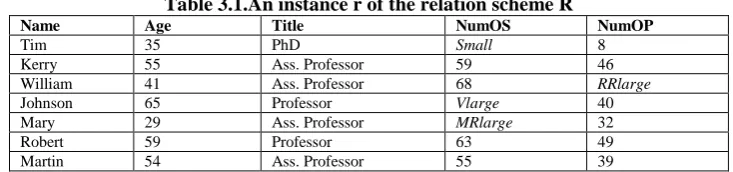
www.ijres.org 60 | Page Table 3.1.An instance r of the relation scheme R
Name Age Title NumOS NumOP
Tim 35 PhD Small 8
Kerry 55 Ass. Professor 59 46
William 41 Ass. Professor 68 RRlarge
Johnson 65 Professor Vlarge 40
Mary 29 Ass. Professor MRlarge 32
Robert 59 Professor 63 49
Martin 54 Ass. Professor 55 39
Example 3.2. Let us consider a relation scheme R = {NAME, AGE, TITLE, NumOS, NumOP}, where NAME, AGE, TITLE, NumOS and NumOP stand for Name, Age, Academic Title, Number of Scientific Works and Number of post graduate students which have defended their Master or Doctoral thesis successfully. This relation scheme may be called TEACHER-ABILITY. Assume an instance r of R given in Table 3.1.
For manipulating the linguistic data in such a database, the database system will calculate the quantitative semantics of the linguistic data. Let be given that DAGE = [0, 120], DNumOS = [0, 75] and DNumOP = [0,
50] and that the fuzziness parameters of SQM assigned to AGE are the same as in the Example3.1, while the ones for NumOS and NumOP are the same and given as follows: = fm(c) = 0.40, Less) = 0.25, (Rather) = 0.30, (More) = 25 (Very) = 0.20. Then, the system will calculate the pre-established data for the relation scheme R. To exemplify, we calculate some of them:
1) For the attribute AGE, we will calculate some neighbourhoods of young and the quantitative semantic values of y, MRy and VRy, which stand for young, More Rather young and Very Rather young, as follows. Firstly, as calculated in Example 3.1, we have:
A,r(young) = 25.92; A,r(Ryoung) = 34.2144 ; A,r(MRyoung) = 31.51872; A,r(VRyoung) = 27.412992 and A,r(Vyoung) = 4.6656.
Now, we calculate some similarity intervals of 2- and 3-partition of the domain of the attribute AGE:
2,AGE(y) = AGE(My) AGE(Ry) = (A(My),A(Ry)] = (25.92 0.300.45120, 25.92 + 0.320.45120]=
(9.72, 43.2]. As computed in Example 3.1, we have3,AGE(y)= 3(LMy)3(VPy) = (22.68, 29.0304].
2) Now, we compute some equivalence classes of 2- and 3-partition for the attributes NumOS. Firstly, we compute the representatives of l and s, where l and s stand for large and small, respectively:
W,r(l)= [+fm(l)]75 = [0.40 + (0.30 + 0.25)0.60]75= 54.75;
W,r(Rl) = W,r(l) + (–1)[(R)fm(l) – (R)fm(l)]75 = 54.75 – 0.450.300.6075= 48.675;
W,r(MRl) = W,r(Rl) + (+1)[(M)(R)fm(l) – (M)(R)fm(l))]75 = 48.675 +
0.550.250.300.6075= 50.53125 ;
W,r(Vl) = W,r(l) + (+1)[((M) + (V))fm(l) – (V)fm(l))]75 = 54.75 + [0.450.60 –
0.450.200.60]75 = 70.95.
By Definition 3.2 of k-partition, we have :
SW,2,r(Rl) = SW,2(l) = r(Rl) r(Ml) = (W,r(Rl),W,r(Ml)]= (54.75 – 0.300.6075, 54.75 +
0.250.6075] = (41.25, 66.00];
SW,3,r(Rl) = r(RRl)r(MRl) = (W,r(RRl),W,r(MRl)]= (48.675 – 0.300.300.6075, 48.675 +
0.250.300.6075]= (44.625, 52.05]; SW,2,r(MRl) = SW,2,r(Rl); SW,3,r(MRl) = SW,3,r(Rl);
SW,2,r(Vl) = 2,r(Vl) = (W,r(Vl),W,r(Vl)] = (54.75 + (+1)0.250.675, 54.75 + (+1)[0.25 +
0.20]0.6075= (66, 75];
SW,3,r(Vl) = r(RVl) r(MVl) = (W,r(RVl),W,r(MVl)]= (70.95 – 0.300.200.6075, 70.95 +
0.250.200.6075]= (68.25, 73.20].
IV. CONCLUSION
In this paper, a relational model of databases with linguistic data is introduced in which the semantics of the linguistic data will be defined and manipulated based on the semantic-order-based structure of term-domains, called hedge algebras.
hedge-algebra-based semantics of linguistic data may reflect faithfully the natural meaning of terms in natural languages. As a consequence, this nature may bring many advantages in representing and handling data semantics in databases with linguistic data.
Taking these advantages, the semantics of linguistic data can be represented by a structure of fuzziness intervals of real domains of linguistic attributes of a database and, in data manipulation, linguistic data can be represented by their representatives (semantic values) in the respective real domains. Both kinds of data, intervals and values, are two components for representing the semantics of the linguistic data. Outward they are classical real data, however, different from the classical data they may be changed, because they depend on the fuzziness parameters which are subjective and in principle can be changed in the life cycle of the database. In spite of this, we have a basis to construct a method for manipulating the real data as well as the linguistic data in a unified way. Therefore, it is shown for example that queries related with linguistic data can be converted into certain classical ones. This of course is one considerable reason for simplifying the data manipulation tasks in management of the linguistic databases in comparison with that of fuzzy databases. The second reason for this is that on’ce given the fuzziness parameters, the data set for manipulating the linguistic data in databases can be pre-established. This speeds up the data manipulation process in the linguistic databases.
REFERENCES
[1]. L.V.T.Lan, N.M.Han, N.C.Hao, Algorithm to build fuzzy decision tree for data classification problem based on fuzziness intervals matching, Journal of Computer sciences and Cybernetics, Vol 32, No 4 (2016), 367-380.
[2]. L.V.T.Lan, Han.N.M, Hao.N.C, A novel method to build a fuzzy decision tree based on hedge algebras, International Journal of Research in Engineering and Science, Vol 4, No 4 (2016), 16-24.
[3]. Nguyen Cong Hao, Truong Thi My Le, Fuzzy object-oriented database model based on hedge algebra, Journal of Computer Science & Cybernetics, Vol 20, No 3 (2012), 129-140.
[4]. Nguyen Cong Hao, Truong Thi My Le, Data dependencies in fuzzy object oriented databases model based on hedge algebras,
Annales Univ. Sci Budapest., Sect. Comp. 44 (2015), 165-182.
[5]. Nguyen Cong Hao, Fuzzy functional dependencies based on hedge algebras, International Journal of Computer Technology and Applications, Vol 6, No 6 (2015), 1052-1059.
[6]. Nguyen Cat Ho, Le Xuan Vinh, Nguyen Cong Hao, Unify data and establish similarity relation in linguistic databases base on hedge algebra, Journal of Computer Science & Cybernetics, Vol 25, No 4 (2009), 314-332.
[7]. N.C. Ho, A Topological Completion of Refined Hedge Algebras and a Model of Fuzziness of Linguistic terms, Fuzzy Sets and Systems 158(4) (2007) 436-451.
[8]. N.C. Ho, N.V. Long, Fuzziness Measure on Complete Hedge Algebras and Quantitative Semantics of Terms in Linear Hedge Algebras, Fuzzy Sets and Systems 158 (4) (2007) 452-471.
[9]. N.C. Ho, Quantifying Hedge Algebras and Interpolation Methods in Approximate Reasoning, Proc. of the 5th Inter. Conf. on Fuzzy
Information Processing, Beijing, March 1-4 (2003), 105-112.
[10]. Jyothi S, Babu M.S, Multivalued dependencies in fuzzy relational database and lossless join decomposition, Fuzzy sets and systems
88 (1997), 315-332.
[11]. Mustafa LLKerSozat, Adnan Yazici, A complete axiomatization for fuzzy functional and multivalued dependencies in fuzzy database relations, Fuzzy Set and Systems 117 (2001), 161-181.
[12]. Raju K.V.S.V.N, Majumdar A.K 1998, Fuzzy functional dependencies and lossless join decomposition of fuzzy relational database systems, ACM TODS 13 (4), 129-166.
[13]. Umano, M., &Fukami, S. (1994). Fuzzy relational algebra for possibility distribution-fuzzy-relation model of fuzzy data.Journal of Intelligent Information Systems, 3, 7-28.
[14]. Wei-Yi Liu, Fuzzy data dependencies and implication of fuzzy data dependencies, Fuzzy sets and systems, Vol 92 (1997), 341-348.