PERFORMANCE ANALYSIS OF ZIGBEE AND
WiMAX BASED ON QOS
Rupali, Harmandar Kaur
Student of ECE Department, GNDU R.C., Jalandhar, INDIA.
Assistant Professor of ECE Department, GNDU R.C., Jalandhar, INDIA
ABSTRACT: In this paper, the performance of Zigbee and WiMAX are presented through measurements of three different Quality Of Service parameters such as Throughput, Delay and Packet Delivery ratio with respect to AODV protocol using NS2. The Zigbee technology based on standard 802.15.4 which is designed to meet the needs for simple, low power and low cost WPAN (Wireless Personal Area Network). In parallel, the WiMAX technology based on standard 802.16 which offers higher capacity and wider coverage area than cellular network. The results shows the comparative analysis for Wireless Sensor Network based technologies Zigbee and WiMAX on three different number of nodes scenario ie 100 (10*10), 49 (7*7), 169 (13*13).
Keywords: Zigbee, WiMAX, WPAN, AODV, WSN.
1. INTRODUCTION
Zigbee is derived from the bees zigzag dance, that enables them to share information. Zigbee is having a cost, low-power and wireless mesh networking standard. The low cost which allows the technology to be extremely deployed in wireless control and wireless monitoring applications, the lowest power-usage allows longer life with the smaller batteries, and the mesh networking provides the high reliability and the larger range. It offers green and global wireless standards connecting the widest range of device to work together intelligently and help you control your world [1]. The IEEE 802.15.4 [2] defines the Phy and Data link layer for low rate wireless personal area network (LR-WPAN). In IEEE 802.15.4 energy saving is a critical design issue because devices in such networks having less communication capabilities and limited power but they can operate for a longer period of time. LR-WPAN are classified in two devices: FFD (Full Function Devices) and RFD(Reduced Function Devices). FFD can operate in three modes: Personal area network (PAN) coordinator, a coordinator or a end device, which is responsible for maintaining the network and manages the other devices. FFD is acting as the network coordinators will have the ability to send beacons and offer synchronization, communication and network join services Where as RFD can operate in a mode serving end device and are equiped with sensors/actuators like transducers light switches, lamps, etc. All devices operating on a network shall have unique 64-bit extended address. This address can be used for direct communication in the PAN. An associated device can use a 16-bit short address, which is allocated by the PAN coordinator when the device associates.[3]. WiMAX may be attainable renewal candidate of mobile automation like global s/m for mobile communication & code division multiple access & also it is used as gateway in order to extend capability. Moreover other wireless automation is thought about 2G, 3G, 4G nexus in each prosper & prospering nation. Juxtaposition & skepticism between WIMAX & Wi-Fi is perennial both are starting with same letter i.e. Wi-Fi & WIMAX both are IEEE standard starting with 802 & both are recently work on wireless linking & the net in spite of these two automations has separate requisition [3].
The automation is long range system that topping with enlarge kilometers that is used licensed spectrum to
shipping a peer to peer connection to net from ISP to destination user separate standard prevail separate access & requisition from a cell to fixed locality.
The wireless fidelity is shorter range system that topping with a few hundred of meter that is used unlawful spectrum to approach to nexus, sheathing only the nexus operator with own description & requisition [4]. Archetypal Wi-Fi is used by destination user to access their nexus which may be or may not be link to net. If WIMAX automation prevailing services & cognate to cell phone, wireless fidelity is more cognate to cordless phone.
Wireless fidelity & WIMAX have contrasting quality of service appliances. The metropolitan access use appliances based on linking b/w base station & user contrivance .Each linking is depend on specific organize algorithm which mean that quality of service guideline can be granted. Wireless fidelity has made known QOS appliances alike steady Ethernet, each message arrive at different preferences depend on their tag. It mean quality of service is relation between message & guarantee
Wireless microwave is scalable from remote station to multi sector scale depend on management assignment & cell handoff task & it is consider antenna subsist [5].
WIMAX is a composition of microwave access .WIMAX is broadband FWA system with main aim of shipping a message which is on miles of distance at steady distance, transportable, pastoral on a metropolitan scale. It is delineate for point to point operation b/w base station subscriber station .It prevail peculiar for fixed line of sight have range 10-66Ghz & steady , manageable , non-line of sight have range 2-11 Ghz.
Microwave access is not new; fairly it is distinctive because it was bottom-up design for shipping maximum turn out to maximum distance with 99.999% authenticity.
2.
AODV PROTOCOL
have now been explored. It gives unicast, broadcast and multicast communication in an ad-hoc mobile networks. Routes are maintained which provided that they are needed by the source node. AODV nodes are maintain a route table by which next hop routing information for the destination nodes is stored. Whenever a source node desires to send the data to the destination node and no route information is available, a path exploration process which obtain the destination node takes place. It also broadcasts a route request (RREQ) packet to adjacent nodes, which in turn, forward the request with their adjacent nodes, and so on, before destination node is found. Each node maintains the routine number and the broadcast ID. The broadcast ID is then incremented for every generated RREQ. The RREQ packet includes the node sequence number, the broadcast ID and the most recent sequence number it is for the destination node. Only those nodes answer the RREQ which have their sequence numbers either greater than or equally compared to that contained in the RREQ [8]. In parallel, Zigbee routing layer is said in the first place the well-studied public domain algorithm Ad hoc On Demand Distance Vector (AODV) [7] is a routing protocol for MANETs (Mobile Ad hoc Networks) and the other wireless ad-hoc networks. It is really a reactive routing protocol, meaning so it establishes a approach to a destination only on demand. In comparison, the most frequent routing protocols of the Internet are proactive, meaning that they find routing paths independently for use of the paths. AODV is, because the name indicates, a distance-vector routing protocol. It avoids the counting-to-infinity problem of the other distance-vector protocols by using sequence numbers on the route updates, a technique pioneered by DSDV. AODV is effective at both unicast and multicast routing. AODV builds routes utilizing a route request / route reply query cycle.
3.
QUALITY OF SERVICE
Quality of service is overall network performance. It does not refer to single parameter. Quality of Service is an indispensable element to determine the outcome and activity of a network. We are working on three parameters they are: Throughput, Delay and PDR. Same parameters are taken for both technologies for proper comparison.The term Quality is hitched as the phase to which prescribed integral features performs and satisfy several conditions. The phrase Quality of service pertains to the liability of the communication network gathering a prescribed traffic bond. In the area of networking it can be stated as the liability of a packet prosperously curtains between two points in the network. QOS verily is the capability of network component of having a degree of conviction that the traffic and demanded conditions would be satiate [3].
3.1.1 Throughput
Throughput defined as the number of bits passed through a network within one second. It also measures how fast the data can pass through an entity (either a point or a network) [1]. The throughput of a node is measured by first total number of data packets received successfully at the node and computing the number of bits received, which is finally divided by the total simulation runtime. The average of the throughput of all nodes involved in data transmission is
known as throughput of a network. Therefore, throughput can be stated as:
Tn=Tbr/Sr (1)
Where,
Tn = Node Throughput Tbr = Total Data Bits Received Sr = Runtime Simulation
Similarly, the throughput for the network can be defined as: Tnn=∑Tn/Nn (2) Where
Tnn=Network Throughput
∑Tn/Nn= Sum of Throughput of Nodes Involved in Data Trans
Nn=Number of Nodes
3.1.2 Delay
Delay or latency could be defined as the time taken by the packets to reach from source to destination. The main sources of delay can be categorized into: propagation delay, source processing delay, network delay and destination processing delay. Here we have calculated end to end delay which is a measure of elapsed time taken during modulation of the signal and the time taken by the packets to reach from source to destination. Here the packet losses some energy as well in the form of noise which is also taken into consideration. End to end delay could be measured as the difference of Packet arrival and packet start time . Equation 3 shows the calculation of average end to end delay [9].
DELAY= 𝑛𝑖=0𝑃𝑎𝑐𝑘𝑒𝑡 𝐴𝑟𝑟𝑖𝑣𝑎𝑙 − 𝑃𝑎𝑐𝑘𝑒𝑡 𝑆𝑡𝑎𝑟𝑡 (3)
3.1.3 Packet Delivery Ratio (PDR)
The ratio of the number of packet data delivered to the destination is known as the Packet Delivery Ratio. [9]. Eq (4) shows the level of delivered data to the destination. PDR=∑ Number of packet receive / ∑ Number of packet send (4)
4.
RESULTS AND OUTCOMES
In this paper, the evaluation of performance of ZIGBEE and WIMAX by comparing on the basis of every Quality Of Service parameters with respect to AODV protocol are deployed in the field of concern and grid deployment of 100 nodes (10*10) , 49 nodes (7*7) and 169 nodes (13*13) for both cases are considered.
4.1 Outcomes of 100 nodes
After deployment of nodes in both i.e. Zigbee and WiMAX, simulation is done. And output is taken in graph form for calculation of Quality of service parameter with respect to AODV and number of nodes are 100.
4.1.1 Comparative Analysis on the basis of AODV protocol
number of packets sent, number of packets received, cbr traffic, start and stop time.
Table 4.1: AODV awk Parameters
Sr. no/ awk parameter ZIGBEE WIMAX
1. 100 Nodes 1.Delivery Cbr traffic S=27691 R= 8682 r/s= 0.3135 f=9086 Cbr traffic S=28653 R=6392 r/s= 0.2231 f= 9912 2. Average Throughput Average throughput= -0.00
Start time= 1.00 Stop time= 0.00
Average throughput=
264.81 Start time= 1.00 Stop time=99.99 3.Parameter Generated packets=27692 Received packets=8682 PDR=31.35 Total Dropped packets=18968 Generated packets=28653 Received packets=6392 PDR=22.3083 Total Dropped packet=22229 2. 49 Nodes 1.Delivery Cbr traffic S=27941 R=225 r/s=0.0081 f=366 Cbr traffic S=30231 R=8123 r/s=0.2687 f=8148 2. Average Throughput Average throughput= -0.00
Start time= 1.00 Stop time=0.00
Average throughput=
336.64 Start time= 1.00 Stop time=99.97 3.Parameter Generated packets=27941 Received packets=225 PDR=0.805268 Total Dropped packet=27558 Generated packets=30231 Received packets=8123 PDR=26.8698 Total Dropped packet=22048 3. 169 Nodes 1.Delivery Cbr Traffic S=27725 R=24 r/s=0.0009 f=128 Cbr traffic S=27691 R=10707 r/s=0.3867 f=5692 2. Average Throughput Average throughput= -0.00
Start time= 1.00 Stop time=0.00
Average throughput=
443.03 Start time= 1.00 Stop time=99.99 3.Parameter Generated packets=27725 Received packets=24 PDR=0.0865645 Total Dropped packet=27558 Generated packets=27691 Received packets=10707 PDR=38.666 Total Dropped packet=16976
AODV Throughput
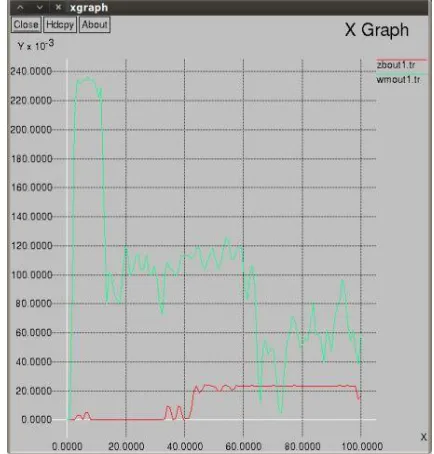
Throughput is calculated by division of total number of bits to total delay. Fig 4.1 shows the comparative study of ZIGBEE and WIMAX on the basis of throughput parameter. X-axis represents the time intervals and Y-axis represents the throughput.
Fig 4.1 : AODV Throughput (100 nodes)
AODV Packet Delay
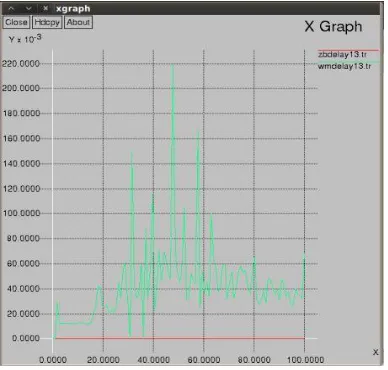
Figure 4.2 shows the comparison on the basis of Delay parameter. X-axis represents the Time Intervalsand Y-axis represents the Delay intervals
Fig 4.2: AODV Delay (100 nodes)
AODV Packet Loss
Fig 4.3: AODV PDR (100 nodes)
4.2 Outcomes of 49 nodes
After deployment of nodes in both i.e. Zigbee and WiMAX, simulation is done. And output is taken in graph form for calculation of Quality of service parameter with respect to AODV and number of nodes are 49 (7*7).
AODV Throughput
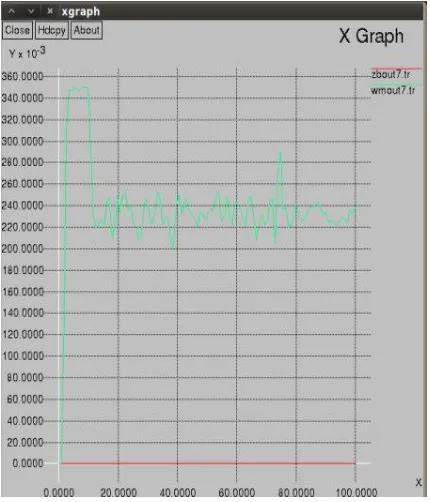
Figure 4.4 shows the comparison on the basis of AODV with throughput parameter. X-axis represents the Time Interval. Y-axis represents the throughput.
Fig 4.4: AODV throughput (49 nodes)
AODV Packet Loss
Figure 4.5 shows the comparison on the basis of AODV with PDR parameter. X-axis represents the Time Interval. Y-axis represents the loss intervals.
Fig 4.5: AODV PDR (49 nodes)
AODV Delay
Figure 4.6 shows the comparison on the basis of AODV with delay parameter. X-axis represents the Time Interval. Y-axis represents the delay
Fig 4.6 AODV Delay (49 nodes)
4.3 Outcomes of 169 nodes
After deployment of nodes in both i.e. Zigbee and WiMAX, simulation is done. And output is taken in graph form for calculation of Quality of service parameter with respect to AODV and number of nodes are 169 (13*13).
4.3.1 Comparative analysis of AODV Protocol
The comparison analysis of Zigbee and WiMAX on the basis of Protocol with 169 number of nodes on three different Quality of Service parameter like Throughput, Delay and PDR.
AODV Throughput
Fig 4.7: AODV Throughput (169 nodes)
AODV Packet Loss
Figure 4.8 shows the comparison on the basis of AODV with PDR parameter. X-axis represents the Time Interval. Y-axis represents the loss intervals.
Fig 4.8 AODV PDR (169 nodes)
AODV Delay
Figure 4.9 shows the comparison on the basis of AODV with delay parameter. X-axis represents the Time Interval. Y-axis represents the delay.
Fig 4.9: AODV delay (169 nodes)
5.
CONCLUSION
Wireless Sensor Network technologies are gaining momentous acceptance and widespread deployment, because of their numerous merits. Zigbee (IEEE 802.15.4) and WiMAX (IEEE 802.16) are WSN based technologies which have a large scope for enhancing performance and need to be researched. The Quality Of Service parameters are throughput, Delay and PDR influence the performance and are considered in this paper, along with the Protocols AODV in different node number scenario ie 100, 49 and 169. The outcome is considering at AODV protocol the performance in terms of throughput is better for WiMAX as compared nodes deployed in all three cases. But in the case of Delay and Packet Delivery Ratio, WiMAX is far better than Zigbee when the number of nodes deployed are 100. On the otherhand, in the case of Delay and Packet Delivery Ratio, Zigbee is better than WiMAX when the number of nodes deployed are 169 and 49.
6.
FUTURE SCOPE
Experiments are carried out to adjudge the optimum valuation of IEEE 802.15.4 and IEEE 802.16. In future, we will further comprehend the simulation for Network layers. We will also enhance the more protocol to compare the energy consumption on the basis of both ZIGBEE and WIMAX with more quality of service parameters.
7.
ACKNOWLEDGEMENTS
8.
REFERENCES
[1] Gurjit Kaur, kiran ahuja (2011) “Qos Measurement of Zigbee Home Automation Network using Various Routing Protocols”, International Journal of Computer Applications (0975 – 8887) Volume 13– No.2.
[2] Meng-Shiuan Pan and Yu-Chee Tseng, “Zigbee Wireless Sensor Networks and Their Applications” book
[3] Sidhu, B., Singh, H., & Chhabra, A. (2007). “Emerging Wireless Standards - WiFi, Zigbee and WiMAX”, World Academy of Science, Engineering and Technology 25.
[4] Kamali, B., Bennett, R. A., & Cox, D. C (2012),” Understanding WiMAX: An IEEE-802.16 Standard-Based Wireless Technology”, Potentials, IEEE doi:10.1109/MPOT.2012. 2195220.
[5] Ahmed, S. (2014). “Performance analaysis of Mobile WiMAX Technology”, Computing for Sustainable Global Development (INDIACom), 2014 International Conference on. doi:10.1109/IndiaCom.2014.6828106.
[6] Stuti Shrivastava, Prof.Ashok Verma, Prof.Ajay Lala, Prof.Ashish Chaurasia (2014),” A Study and Comparsion of Various Routing Protocol in WiMAX Network”, International Journal of Emerging Trends & Technology in Computer Science (IJETTCS), Volume 3, Issue 3, May-June 2014.
[7] Ms. Swati V. Birje Mr. Mahesh Kumbhar Mr. Raviraj S. Patkar, “ Performance Analysis of IEEE 802.15.4”, International Journal of Advanced Research in Computer Science and Software Engineering, Volume 3, Issue 3, March 2013 ISSN: 2277 128X (2013).
[8]Rahul Malhotra, Sumanpreet Kaur (2011), “Comparative Analysis of AODV and DSR Protocols for Mobile Adhoc Networks”, IJCSET | July 2011 | Vol 1, Issue 6,330-335330.