e-ISSN: 2278-067X, p-ISSN: 2278-800X, www.ijerd.com Volume 7, Issue 3 (May 2013), PP. 16-20
Design and Implementation of a Zigbee-Based Theft
Monitoring System
N.Gokul Raj
1,S.Rajaram
2 1Assistant Engineer, India.
2
Assistant Professor, India.
Abstract:- ZigBee is a new global standard for wireless communications with the characteristics of low-cost, low power consumption, and low data rate. The design and implementation of a ZigBee-based wireless theft monitoring are proposed in this paper. The experimental results show that the design can meet the basic needs of automatic theft monitoring and expansibility. It can act as a platform of wireless monitor system and supplies a new hardware design approach for wireless ZigBee networks. In here the theft can be identified and also send message though GSM and capture the camera at the same time of theft deduction.
Keywords:- ZigBee , GSM, Video Camera, Pic Microcontroller.
I. INTRODUCTION
Wires are more complex system to manipulate any hide of circuit design. So now a day mostly every one use wireless system. In our system we are using zigbee module for data transfer system, also used GSM and video camera. The main application of zigbee Its main application areas include industrial controls, consumer electronics, car automation, agricultural automation, and medical equipment control.In the above automation system the main application area is theft monitoring system. In previously theft monitoring system has to be established, when lock is open then automatically message send through GSM modem to owner mobile number, video recording at all the time in the building.
In GSM based automation system , when the sensor has detect the signal that time GSM modem has to send the data to the particular mobile number but the drawback of this system when the mobile is out of range then there is no message received. In video camera automation system the camera capture the video all the time. So when the theft is occurs we rewind the data and monitor the particular time but we don’t know the time. So the above two method has the problems. Instant of two eliminate this problem we have to go for ZigBee transmission method . In here the data are transmitted only in wireless connection, automated message sending and capture the video at the same time. So if it is mobile is out of range then the video capture data are available. If a fault occurs, only check wireless data module for causes quickly, and then restore the system back to normal operation[1].
II. ZIGBEE WIRELESS SENSOR DATA TRANSFER SYSTEM
ZigBee technology is a bi-directional wireless communication technology of short distance, low complexity, low cost, low power consumption, and low data rate, mainly used in automatic control. It mainly works on 2.4GHz ISM band with 20~250kbit/s data rate, 100m~1.5km maximum transmission range, and a typical 100m distance [4].
Features of ZigBee
ZigBee provides data integrity check and Authentication. It uses collision avoidance mechanism, and at the same time it reserves a dedicated time slot to require a fixed bandwidth of the communication service. Transmitting and receiving information has lower power consumption. ZigBee network can accommodate a maximum of 65536 devices. Typical device search delay is 30ms. Main applications of ZigBee are within short range and data transfer rate among the various electronic equipments is not high. The performance and comparison of other transmitting systems are given below the table.
TABLE 1. PERFORMANCE COMPARISON OF ZIGBEE, BLUETOOTH, AND WI-FI
Features of Pic Controller 16f877a
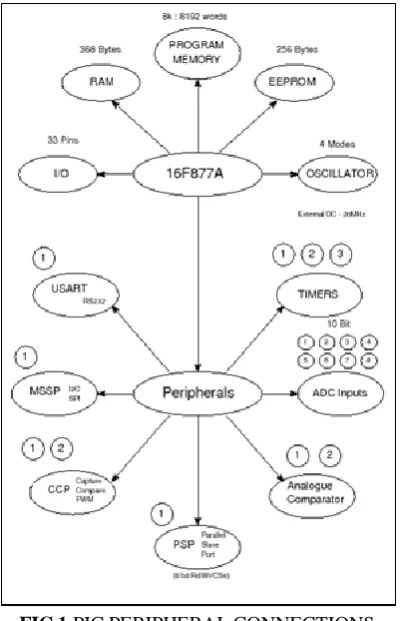
This powerful (200 nanosecond instruction execution) yet easy-to-program (only 35 single word instructions) CMOS FLASH-based 8-bit microcontroller packs Microchip's powerful PIC® architecture into an 40- or 44-pin package and is upwards compatible with the PIC16C5X, PIC12CXXX and PIC16C7X devices. The PIC16F877A features 256 bytes of EEPROM data memory, self programming, an ICD, 2 Comparators, 8 channels of 10-bit Analog-to-Digital (A/D) converter, 2 capture/compare/PWM functions, the synchronous serial port can be configured as either 3-wire Serial Peripheral Interface (SPI™) or the 2-wire Inter-Integrated Circuit (I²C™) bus and a Universal Asynchronous Receiver Transmitter (USART). All of these features make it ideal for more advanced level A/D applications in automotive, industrial, appliances and consumer applications.
FIG.1.PIC PERIPHERAL CONNECTIONS
Feature of GSM
The GSM standard was developed as a replacement for first generation (1G) analog cellular networks, and originally described a digital, circuit switched network optimized for full duplex voice telephony. This was expanded over time to include data communications, first by circuit switched transport, then packet data transport via GPRS.
III. SYSTEM ARCHITECTURE
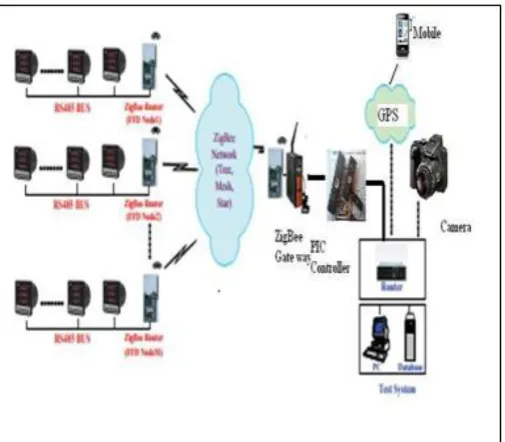
The wireless automatic theft monitoring system described, when the object has to detected in IR sensor then it transmit the data to ZigBee network. In ZigBee network receive the data and it will connected to PIC Microcontroller ,The output of PIC controller send the personal computer through RS232 communication. The PC detect in which area network has send the signal and detect the particular area authentication from the database. Here after the message has to send that particular authorized person and also capture the video on that area.
FIG.2.SYSTEM ARCHITECTURE OF WIRELESS AUTOMATIC THEFT CONTROLLER SYSTEM
Figure 2 shows the system architecture of theft monitoring system.
Protocols above network layer are defined by ZigBee Alliance, and IEEE 802.15.4 is responsible for the physical layer and link layer standards [5-10].
FIG.3. ZIGBEE PROTOCOL STACK
The physical layer defines the access between wireless physical channels and MAC sub-layer, and provides physical layer data service and physical layer management service. Main functions of a physical layer data service are: wake/sleep of RF transceiver devices, energy tests on the current channel, link quality instruction, carrier sense multiple access with collision avoidance (CSMA-CA) for assessment of spatial channel, channel selection, data transmission and reception.
IV. SYSTEM SOFTWARE DESIGN
In this automation system the main think in which area ZigBee send the signal to pic controller that data send to Personal computer through PIC controller. The personal computer identify the data where it to send that particular camera will on and send the message to particular person. So the PC get the main module in this automation system. For this theft monitoring system we use the software as VB.net and Microsoft access database.VB.net code to receive the data from RS232 connection and to verify the data from stored database and control the camera as well as GSM modem in which time is processing. When the data has to receive in the PC then to detect which area ZigBee network has theft occur and from the database to retrieve the authorized person mobile number and send SMS to that person. In same time that particular area Video Camera are capture the videos. So we find the robber at alert everyone. Figure 4 shows the program flow chart of our system.
FIG.4. PROGRAM FLOWCHART OF ZIGBEE END PC DATA BASE
The theft can measured data to ZigBee Concentrator via RS-485 to RS-232 communication ports and to ZigBee/GPRS Gateway via wireless communications network, then to a terminal node via GPRS and back to PC in RS-232 communication format to complete the automatically wireless meter system, as shown in Fig. 5.
FIG.5. WIRELESS AUTOMATIC THEFT MONITORING SYSTEM
V. EXPERIMENT RESULTS
This article is to verify the feasibility of wireless automatic meter reading system based on ZigBee by implementing a wireless automatic theft monitoring system as shown in fig 5.In this network over 100 ZigBee module has connected and verify the result is quick process. In feature this network gas to established in big city and find the theft.
VI. CONCLUSION
scalability compared to a wired system. If a fault occurs, simply checking wireless data module can quickly find it out and restore the system in normal operation.
REFERENCES
[1]. Safaric S., Malaric K., ZigBee Wireless Standard, Proc. of the 48th International Symposium ELMAR-2006, Zadar Croatia, 1 (2006), 259-262
[2]. Primicanta, A.H., Nayan, M.Y., Awan, M., ZigBee-GSM based Automatic Meter Reading system, 2010 International Conference on Intelligent and Advanced Systems (ICIAS), Kuala Lumpur, Malaysia, 1 (2010), 1-5
[3]. Tatsiopoulos, C., Ktena, A., A Smart ZIGBEE Based Wireless Sensor Meter System, 16th International Conference on Systems, Signals and Image Processing (IWSSIP), Chalkida, Greece, 1 (2009), 1-4 [4]. Lee J.D., Nam K.Y., Jeong S.H., Choi S.B., Ryoo H.S., Kim D.K., Development of ZigBee Based
Street Light Control System, Proc. of the Power System Conference and Exposition, Atlanta GA, 3 (2006), 2236-2240
[5]. IEEE 802.15 WPAN Task Group 1 (TG1), http://www.ieee802.org/15/pub/TG1.html [6]. IEEE 802.15 WPAN Task Group 2 (TG2),http://www.ieee802.org/15/pub/TG2.html [7]. IEEE 802.15 WPAN Task Group 3 (TG3),http://www.ieee802.org/15/pub/TG3.html [8]. IEEE 802.15 WPAN Task Group 4 (TG4), http://www.ieee802.org/15/pub/TG4.html
[9]. Chen Z., Lin C., Wen H., Yin H., An Analytical Model for Evaluating IEEE 802.15.4 CSMA/CA Protocol in Low-Rate Wireless Application, Proc. of the 21st International Conference on Advanced Information Networking and Applications Workshops, 2 (2007), 899-904
[10]. JENNIC JN5121 Hardware Peripheral API Reference Manual, Revision 0.7, (2005) [11]. JENNIC JN5121-EK000 Board Hardware API Reference Manual, Revision 0.4, (2005) [12]. JENNIC JEK01 Demonstration Application Code description, Revision 0.5, (2005) [13]. JENNIC 802.15.4 MAC Software Reference Manual, Revision 0.7, (2005)
[14]. JENNIC JN5121-EK000 Demonstration Application User Guide, Revision 0.4, (2005) [15]. JENNIC Software Developers KIT installation Guide, Revision 0.2, (2005)
[16]. JENNIC Debugging with DDD, Revision 3.3.9, (2004)
AUTHOR
N.Gokul Raj received B.E Degree in Electronics and Communication Engineering from Madras University, Chennai India in 2000, He has finished M.E degree in Applied Electronics from Anna University in 2008. Currently working as a Assistant Engineer , in AGS Consultancy. His research interests include Signal and Image Processing.