Buckling Capacity Optimization of Stiffened
Rectangular Plate under Uniform Normal
Compression
Haifeng Fanga,b, Lihua Caia,ba Mechatronics & Automotive Engineering School, Jiangsu University of Science & Technology,
Zhangjiagang 215600, Jiangsu, China
b Suzhou Institute of Technology, Zhangjiagang 215600, Jiangsu, China
Email: [email protected]
Abstract—The stiffened rectangular plate was usually adopted in the blast airtight doors. In order to improve the buckling capacity of stiffened rectangular plate under uniform normal compression, the optimization model of stiffened rectangular plate was set up based on APDL and ANSYS commands, and the sequential linear programming method was executed to optimize the thickness of plate and the sizes of stiffeners. Moreover, we compared the mechanical property of the optimized stiffened rectangular plate with the theoretical value of no-stiffener plate with equal volume, and obtained the reasonable stiffener distribution based on the optimization results of five different longitudinal and transverse stiffener patterns. The results showed that the buckling capacity of stiffened rectangular plate under uniform normal compression could be improved by approximately 50% on the condition of reasonable stiffeners distribution.
Index Terms—buckling; normal compression; stiffened rectangular plate; optimization
I. INTRODUCTION
The stiffened rectangular plate was usually adopted in the blast airtight doors of coal mine refuge chambers. Usually, the stiffened plates have bigger buckling capacity than the no-stiffener plates with equal quality, which can reach the stress level at 40% to 50% of the material’s yield stress. Meanwhile, it has become a prominent problem that how to distribute the stiffeners to improve the buckling capacity of plate structures under normal compression according to the plate structures and load characteristics.
The theoretical and experimental research on buckling of thin plates and shells was studied relatively early. And the rectangular plate limit condition only suffering the film stress has been applied to solve the ultimate load problems [1]. The overall deformation process of elastic thin rectangular plate under symmetrical normal compression has been studied. And the buckling stress
empirical formula for rectangular plate suffering normal compression at the axes has been suggested [2-5]. Recently, Some researchers have studied the plastic buckling and post-buckling of thin plate and shell under normal compression. Moreover, the elastoplastic numerical solution of thin plate’s buckling and post-buckling has been obtained [6]. Furthermore, based on the research of the buckling deformation pattern of this structure on combined load, the most important influence factor in stiffened plate and plate has been obtained [7,8].
Recently, lots of researchers have adopted different methods in the plate structure optimization, such as energy principle method, flexible tolerance polyhedron method, and full-stress standard method [9-14].
In view of the above, we have a lot of work to do to improve the buckling capacity of stiffened rectangular plate in the field of plate structure optimization [15,16]. The author has studied the buckling capacity optimization of stiffened cylindrical shell under uniform axial compression [17]. In this paper, we set up the optimization model of stiffened rectangular plate based on APDL and ANSYS commands, and executed the serial linear programming optimization procedure to optimize the plate structure.
II. MATHEMATICAL MODEL
With the research on the structure optimization deepening, structure optimization softwares have developed greatly. Moreover, the ANSYS software has been the most outstanding finite element analysis software of structure optimization [18], the whole parameterized options of which can be chosen as the optimize parameters. And APDL (ANSYS Parametric Design Language) is an indispensable important technology of ANSYS software, which can realize the parameterized finite element analysis, batched analysis, secondary development and optimization design.
The process of optimization design based on APDL is as follows. And the parameter analysis file is built for optimal circulation based on APDL and ANSYS commands, then the analysis processing is executed in OPT and the serials of optimal design is checked up. This paper is supported by Youth Science Fund of Jiangsu
University of Science &Technology and Youth Science Fund of Zhangjiagang Campus.
In this paper, finite element analysis software ANSYS was employed and secondarily the optimization model was set up with APDL. Fig.1 shown that the rectangular plate with J longitudinal stiffeners and K transverse stiffeners under uniform normal compression q(t), where a is the length of plate, b is the width of plate, h is the thickness of plate, t1 isthe width of stiffeners and h1 is the
height of stiffeners. In addition, the low alloy steel (Q345R) was adopted in the rectangular plate structure model, which could be assumed as perfect elastic material. In the optimization analysis, it was assumed that the rectangular plate was supported simply on four sides. And the length a was chosen as 1200 mm and the width was chosen as 600 mm. According to engineering experiment, the thickness was chosen as 10 mm. The sections of longitudinal stiffeners and transverse stiffeners were both rectangle and the same to each other, whose width and height were 5 mm and 20 mm respectively.
Taking the thickness of rectangular plate h, the width of stiffeners t1 and the height of stiffeners h1 as
optimization design variables, the optimization model was built as following forms:
max 0 ( 1 1( )1,0 ) ( )
2 2 2,0 3 3 3,0
s.t. 1 2 3 2 3 0
qcr q C x x
C x x C x x
abx Jbx x Kax x V
= + − +
− + −
+ + ≤
⎧ ⎪⎪ ⎨ ⎪ ⎪⎩
(1)
where x1,0-x3,0 are the initial value of h, t1, h1,
respectively; qcr is optimization object; q0 is the initial
value of the buckling load; C1-C3 are the undetermined
coefficients which can be obtained by fitting the software analysis results; V0 is the volume of rectangular plate
before optimization; K is the quantity of transverse stiffeners; J is the quantity of longitudinal stiffeners.
III.OPTIMIZATION RESULT ANALYSIS
There are two instability patterns of thin stiffened rectangular plate under normal compression, which are global instability and local instability surrounded by stiffeners. For the rectangular plate with overcrowded stiffeners, because the area surrounded by stiffeners is small, the global instability takes place easily rather than the local instability firstly. For the rectangular plate with sparse stiffeners, due to the bigger area surrounded by stiffeners, the local instability of thin plate happens more easily than the global instability. In this situation, the reinforce effect of stiffeners is not obvious [17]. In this paper, the optimization limits of h, t1, h1 were
0.001mm≤ ≤h 25mm , 0.001mm≤ ≤t1 60mm ,
0.001mm≤h1≤60mm , respectively; The initial
optimization value of h, t1, h1 was 10 mm, 5 mm, 20 mm,
respectively.
A. 3 Longitudinal Stiffeners, 1 Transverse Stiffeners The 3 longitudinal stiffeners and 1 transverse stiffeners were arranged on the back of rectangular plate. The geometrical properties before and after optimization were shown in Table I and the variation processes of variables and objective were shown in Fig.2. Based on the optimization results analysis, the buckling capacity of stiffened rectangular plate under uniform normal compression was improved rarely. The variables t1, h1
converged to the lower limits of the dimensional constraints, while the variable h increased correspondingly. The local instability took place in the thin plate firstly due to the too sparse stiffeners. Furthermore, the result was to make the structure as a no-stiffener plate.
TABLEI.
COMPARISON OF MECHANICS PROPERTY OF RECTANGULAR PLATE WITH 3 LONGITUDINAL STIFFENERS AND 1 TRANSVERSE STIFFENERS BEFORE AND AFTER OPTIMIZATION WITH NO-STIFFENER PLATE
Items Thickness of plate h/ mm Width of stiffener t
1/ mm
Height of stiffener h1/ mm
Buckling load qcr/ MPa
Before optimization 10.000 5.000 20.000 6.482
After optimization 10.400 0.001 0.001 6.862
Theoretical value* 10.410 - - 6.892
*The theoretical value of no-stiffener plate in the same volume which can be looked up in the tables of the Reference 2. The same as in the following tables.
0 10 20 30
0 5 10 15 20
va
lue
s /m
m
times
h
t1
h1
0 10 20 30
6.4 6.6 6.8 7.0
qcr
/M
Pa
times
a) Variation processes of variables b) Variation processes of objective Fig.2 Variation process of variables and objective of rectangular plate with 3 longitudinal stiffeners and 1 transverse stiffeners
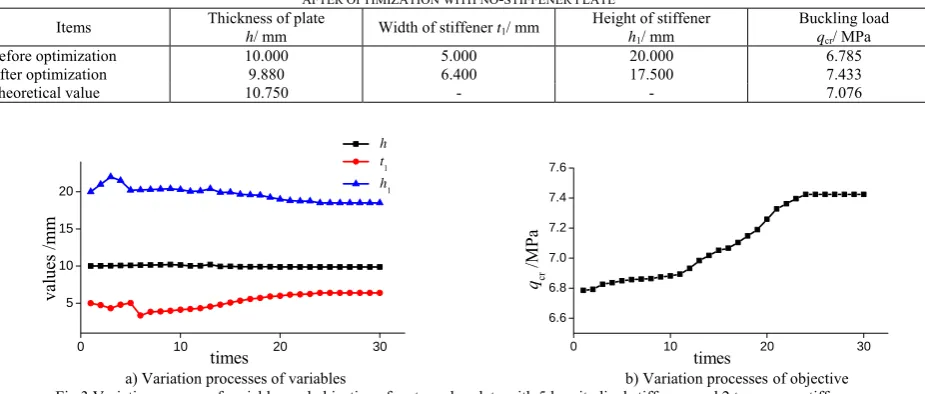
B. 5 Longitudinal Stiffeners, 2 Transverse Stiffeners The 5 longitudinal stiffeners and 2 transverse stiffeners were arranged uniformly on the back of rectangular plate, and the variation processes of variables and objective were presented in Fig.3, and the geometrical properties before and after optimization were shown in Table II. Through analysis of the optimization results, the buckling capacity of stiffened rectangular plate under uniform
normal compression was improved evidently. The variables h, t1, h1 converged to certain value within the
dimensional constraints, and the density of longitudinal stiffeners was bigger than that of transverse stiffeners. And the ratio of the height to the width of the stiffener was about 2.5. Meanwhile, the global instability took place under the normal compression and the reinforce effect of stiffeners was obvious.
TABLE II.
COMPARISON OF MECHANICS PROPERTY OF RECTANGULAR PLATE OF 5 LONGITUDINAL STIFFENERS AND 2 TRANSVERSE STIFFENERS BEFORE AND AFTER OPTIMIZATION WITH NO-STIFFENER PLATE
Items Thickness of plate h/ mm Width of stiffener t1/ mm Height of stiffener h 1/ mm
Buckling load qcr/ MPa
Before optimization 10.000 5.000 20.000 6.785
After optimization 9.880 6.400 17.500 7.433
Theoretical value 10.750 - - 7.076
0 10 20 30
5 10 15 20
value
s /mm
times
h
t1
h1
0 10 20 30
6.6 6.8 7.0 7.2 7.4 7.6
qcr
/MPa
times
a) Variation processes of variables b) Variation processes of objective Fig.3 Variation process of variables and objective of rectangular plate with 5 longitudinal stiffeners and 2 transverse stiffeners
C. 7 Longitudinal Stiffeners, 3 Transverse Stiffeners The 7 longitudinal stiffeners and 3 transverse stiffeners were arranged uniformly on the back of rectangular plate, and the variation processes of variables and objective were presented in Fig.4. Through analysis of the optimization results shown in Table Ⅲ, the buckling capacity of stiffened rectangular plate under uniform normal compression was improved greatly. The variables h, t1, h1 converged to certain value within the dimensional
constraints, while the variable h got much smaller. And the densities of longitudinal stiffeners and transverse stiffeners were similar. In the meantime, the stiffener frame was nearly square, which made the vertical and horizontal non-deformability corresponding and was supportive to improve buckling capacity under normal compression. And the ratio of the height to the width of the stiffener was about 2.5.Therefore, the reinforce effect was remarkable.
TABLE III.
COMPARISON OF MECHANICS PROPERTY OF RECTANGULAR PLATE OF 7 LONGITUDINAL STIFFENERS AND 3 TRANSVERSE STIFFENERS BEFORE AND AFTER OPTIMIZATION WITH NO-STIFFENER PLATE
Items Thickness of plate h/ mm Width of stiffener t1/ mm Height of stiffener h 1/ mm
Buckling load qcr/ MPa
Before optimization 10.000 5.000 20.000 6.936
After optimization 4.367 15.500 40.000 10.253
Theoretical value 11.080 - - 7.159
0 10 20 30 40
10 20 30 40
value
s /m
m
times
h
t1
h1
0 10 20 30 40
7 8 9 10 11
qcr
/M
Pa
D. 7 Longitudinal Stiffeners, 5 Transverse Stiffeners The 7 longitudinal stiffeners and 5 transverse stiffeners were arranged uniformly on the back of rectangular plate, and the variation processes of variables and objective were presented in Fig.5. Through analysis of the optimization results shown in Table Ⅳ, the buckling capacity of stiffened rectangular plate under uniform
normal compression was also improved obviously. The variables h, t1, h1 converged to certain value within the
dimensional constraints, while h also got much smaller. And the densities of longitudinal stiffeners and transverse stiffeners were similar and suitable. Hence, the reinforce effect of stiffeners was remarkable.
TABLE IV.
COMPARISON OF MECHANICS PROPERTY OF RECTANGULAR PLATE OF 7 LONGITUDINAL STIFFENERS AND 5 TRANSVERSE STIFFENERS BEFORE AND AFTER OPTIMIZATION WITH NO-STIFFENER PLATE
Items Thickness of plate h/ mm Width of stiffener t1/ mm Height of stiffener h 1/ mm
Buckling load qcr/ MPa
Before optimization 10.000 5.000 20.000 7.003
After optimization 5.700 12.300 32.800 9.367
Theoretical value 11.420 - - 7.236
0 10 20 30 40
10 20 30
values
/mm
times
h
t1
h1
0 10 20 30 40 7
8 9 10
q cr
/MP
a
times
a) Variation processes of variables b) Variation processes of objective Fig.5 Variation process of variables and objective of rectangular plate with 7 longitudinal stiffeners and 5 transverse stiffeners
E. 11 Longitudinal Stiffeners, 5 Transverse Stiffeners The 11 longitudinal stiffeners and 5 transverse stiffeners were arranged uniformly on the back of rectangular plate, and the variation processes of variables and objective were presented in Fig.6. Through analysis of the optimization results shown in Table Ⅴ, the buckling capacity was improved a little. The variables t1,
h1 converged to the lower limits of the dimensional
constraints, while h increased correspondingly. And the result was to make the volume of stiffeners decrease but the thickness of the plate increase, leading the structure to be a rectangular plate without stiffeners. Consequently, for the too overcrowded stiffeners, the reinforce effect of stiffeners was not remarkable.
TABLE V.
COMPARISON OF MECHANICS PROPERTY OF RECTANGULAR PLATE OF 11 LONGITUDINAL STIFFENERS AND 5 TRANSVERSE STIFFENERS BEFORE AND AFTER OPTIMIZATION WITH NO-STIFFENER PLATE
Items Thickness of plate h/ mm Width of stiffener t1/ mm Height of stiffener h 1/ mm
Buckling load qcr/ MPa
Before optimization 10.000 5.000 20.000 7.086
After optimization 11.740 0.001 0.001 7.293
Theoretical value 11.75 - - 7.302
0 10 20 30 40
0 5 10 15 20
va
lues
/mm
times
h
t
1
h1
0 10 20 30 40 7.05
7.10 7.15 7.20 7.25 7.30
qcr
/MPa
times
a) Variation processes of variables b) Variation processes of objective Fig.6 Variation process of variables and objective of rectangular plate with 11 longitudinal stiffeners and 5 transverse stiffeners
IV. CONCLUSION
Based on APDL and ANSYS commands, we set up the optimization model of stiffened rectangular plate, and executed the serial linear programming optimization
rectangular plate will be significantly improved after optimization. While the stiffener frame is nearly square, it will make the vertical and horizontal non-deformability corresponding, which will be supportive to improve buckling capacity under normal compression. As a result, for the rectangular plate with determined structure sizes, the density of stiffeners should be regulated in a reasonable scope.
Moreover, changing the dimensional constraints of stiffeners has no influence on optimization results. And the ratio of the height to the width of the stiffener should be about 2.5, which could improve the normal buckling capacity of stiffened rectangular plate.
ACKNOWLEDGEMENTS
The financial supports from Youth Science Fund of Jiangsu University of Science & Technology and Youth Science Fund of Zhangjiagang Campus are greatly appreciated.
REFERENCES
[1] HUANG Ke-zhi, “Limit equilibrium of thin cylindrical
shell with stiffeners”,Chinese Journal of Theoretical and
Applied Mechanics, 7, pp. 91-108, (1964).
[2] C. R. Calladine, “Thoery of Shell Structures”, Cambridge:
Cambridge University Press, pp. 473-542(1983).
[3] ZHU En-chun, C. R. Calladine, “Buckling of thin cylindrical shells under locally normal compression”,
Engineering Mechanics, 20, pp. 168-170, (2003).
[4] ZHU En-chun, C. R. Calladine, “Buckling of thin cylindrical shells under uniform normal compression”, Journal of Harbin University of Civil Engineering and
Architecture, 33, pp. 12-15, (2000).
[5] ZHU En-chun, P. Mandal, C. R. Calladine, “Analysis of buckling of thin cylindrical shells under normal
compression”, China Civil Engineering Journal, 34, pp.
18-22, (2001).
[6] L. G. Philippe, L. V. Anh, “Elastoplastic bifurcation and collapse of normally loaded cylindrical shells”,
International Journal of Solids and Structures, 45, pp.
64-86, (2008).
[7] N. E. Shanmugam, M. Arockiasamy, “Local buckling of
stiffened shells in offshore structures”, Construct Steel
Res, 38, pp. 41-59, (1996).
[8] I. A. Sheikh, A. E. Elwi, G. Y. Grondin, “Stiffened steel shells under combined compression and bending”,
Journal of Constrctional Steel Research, 59, pp. 911-930,
(2003)
[9] SUI Yun-kang, ZHANG Wei, DU Jia-zheng, “Sectional area optimization subjected to strength constraints for
structures combined by multiple elements”, Journal of
Beijing University of Technology, 33, pp. 112-118, (2007).
[10] WANG De-yu, LI Dong-sheng, “Optimum design of
reinforced cylindrical shell on buckling”, China Offshore
Platform, 14, pp. 15-17, (1999).
[11] LIANG Bin, YUE Jin-chao, “Optimum design of
cylindrical shell on stability”, Journal of Mechanical
Strength, 24, pp. 463-465, (2002).
[12] M. M. Alinia, “A study into optimization of stiffeners in
shells subjected to shear loading”, Thin-Walled Structures,
43, pp. 845-860, (2005).
[13] Li Xue-jun, Jiang Shou-bo, Zeng Qing-liang, “Optimization of Two-Stage Cylindrical Gear Reducer with Adaptive Boundary Constraints”, Journal of Software , 8, pp.2052-2057,(2013).
[14] Yang Yong, Zhang Wei-min, Xie Hong-lei, “A Self-adaptive Optimization Removal Algorithm for Continuum Evolutionary Structural Topology”, Journal of Software , 7, pp.1129-1135,(2012).
[15] V. L. Krasovsky, V. V. Kostyrko, “Experimental studying of buckling of stringer cylindrical shells under
normal compression”, Thin-Walled Structures, 45, pp.
877-882, (2007)
[16] N. D. Lagaros, F. Michalis, P. Manolis, “Optimum design of shell structures with stiffened beams”, AIAA Journal, 42, pp. 175-184, (2004).
[17] FANG Hai-feng, GE Shi-rong, CAI Li-hua, et al. “Buckling capacity optimization of coal mine refuge chamber’s shell under uniform axial compression”,
ICMTMA.2011, 165, pp. 649-653, (2011).
[18] Li Xue-jun, Wang Ke, Jiang Ling-li, “Rotor Crack Detection by Using Multi-vibration Signal from The
Basement”,Journal of Software , 7, pp.959-965,(2012).
Haifeng Fang was born in 1984, he received the Ph.D. degree from the School of Mechanical Engineering at China University of Mining and Technology, Xuzhou, China, in 2012. He has been a faculty member of Jiangsu University of Science & Technology.He is actively engaged in the area of technology and equipment of coal mine safety.