Page 312 www.ijiras.com | Email: [email protected]
Application Of Multi Criteria Decision Making For Inventory
Classification
A. Muthu Kumar
ME, Industrial Engineering, PSG College of Technology Coimbatore, India
T. Karthik
D. Rajenthira Kumar
Assistant Professor, Department Of Mechanical Engineering, PSG College of Technology, Coimbatore,
India
I. INTRODUCTION
For the successful inventory management, it is mandatory to analyse the inventory. There are many types of inventory analysis have been used for effective inventory management. Inventory classification using ABC analysis is one of the most widely employed techniques in organizations. This classification is based on the Pareto principle. The ABC analysis is a business term used to define an inventory categorization technique often used in material management. It is also known as Selective Inventory Control. It stands for Always Better Control.ABC analysis is easy to use and simple to understand by an average materials manager. Normally, the items are classified based on the annual use value, which is the product of annual demand and average unit price.
The ABC analysis suggests that inventories of an organization are not of equal value. Thus, the inventory is grouped into three categories (A, B, and C) in order of their estimated importance.
'A' items are very important for an organization. Because of the high value of these „A‟ items, frequent value analysis is required.
'B' items are important, but of course less important than „A‟ items and more important than „C‟ items. Therefore „B‟ items are intergroup items.
'C' items are marginally important
ABC Analysis Categories
There is no fixed threshold for each class, different proportion can be applied based on objective and criteria. ABC Analysis is similar to the Pareto Principle in that the 'A' items will typically account for a large proportion of the overall value but a small percentage of number of items.
Example of ABC class is
„A‟ items - 20% of the items accounts for 70% of the annual consumption value of the items.
„B‟ items - 30% of the items accounts for 25% of the annual consumption value of the items.
„C‟ items - 50% of the items accounts for 5% of the annual consumption value of the items.
Another recommended breakdown of ABC classes:
„A‟ items - 10% of the items accounts for 70% of the annual consumption value of the items.
Abstract: ABC analysis is one of the most widely employed inventory classification techniques in organizations.
However, ABC analysis is based on only single measurement called annual usage value, it has been recognized that other criteria are also important in inventory classification. Multi Criteria Decision making methods can be used to classify the inventory using multiple criteria. In this paper, three Multi Criteria Decision making methods such as SAW (Simple Additive Weighing method), TOPSIS (Technique of Order Preference by Similarity to an Ideal Solution) and Compromise programming are used to classify the inventory. And the results of each method are integrated using group decision making to get a single effective inventory classification result.
Keywords: Multi Criteria Decision making, SAW, TOPSIS, Compromise Programming, Group Decision Making.
Page 313 www.ijiras.com | Email: [email protected] „B‟ items - 20% of the items accounts for 20% of the
annual consumption value of the items.
„C‟ items - 70% of the items accounts for 10% of the annual consumption value of the items.
MULTIPLE CRITERIA DECISION MAKING
Multiple criteria decision making (MCDM) refers to making decisions in the presence of multiple, usually conflicting, criteria. MCDM problems are common in everyday life. In personal context, a house or a car one buys may be characterised in terms of price, size, style, safety, comfort, etc. In business context, MCDM problems are more complicated and usually of large scale.
MULTI CRITERIA INVENTORY CLASSIFICATION
In practice, an organization of even moderate size has to control thousands of inventory items and they need not be very homogeneous. As more and more customers demand a wide range of products, the need to increase the variety of inventory items is also increasing. Thus, it has been generally recognized that the traditional ABC analysis may not be able to provide a good classification of inventory items in practice. There are many instances when other criteria, other than the annual use value, become important in deciding the importance of an inventory item. Some of the criteria considered in the literature include inventory cost, part criticality, lead time, commonality, obsolescence, substitutability, number of requests for the item in a year, scarcity, durability, substitutability, repairability, order size requirement, stockability, demand distribution, and stock-out penalty cost.
II. LITERATURE REVIEW
For the efficient control of inventory, ABC classification technique has been used in organizations. Traditional ABC analysis is based on only single measurement called annual usage value. [6]In practice, as more and more customers demand a wide range of products, the need to increase the variety of inventory items is also increasing. Thus, it has been generally recognized that the traditional ABC analysis may not be able to provide a good classification of inventory items in practice. [7]It has been recognized that other criteria, such as inventory cost, part criticality, lead time, commonality, obsolescence, substitutability, number of request per year, scarcity, durability, reparability, order size requirement, stock-ability, demand distribution and stock-out penalty, are also important in inventory classification
It has been suggested by Flores and Whybark that ABC classification considering multiple criteria, such as Lead time, Criticality, Commonality, Obsolescence and Substitubality can provide a more comprehensive managerial control. To tackle the difficulties of using only one Criterion, by Flores et al. and Whybark have proposed the use of joint criteria matrix for two criteria. The fundamental scale for the comparison of the importance level of the criteria has been given by Thomas L. Saaty[3]. Analytic Hierarchy Process (AHP), since its
invention, has been a tool at the hands of decision makers and researchers; and it is one of the most widely used multiple criteria decision-making tools.
Research has shown that, lot of multi criteria decision making methods has been proposed in the past 30 years. Some of the multi criteria decision making methods have been used to classify the inventory using multiple criteria. By using different multi criteria decision making method, the result of the each method will be varying slightly. So it is difficult for the inventory manager to identify which classification result to use.
[9]Group decision making is a concept of integrating the results of different multi criteria decision making methods. Using group decision making concept, effective inventory classification result can be obtained by integrating the results of the different multi criteria inventory classification methods.
III. CRITERIA SELECTION
The data are collected from the tractor spare parts distribution company. One year spare parts sales data from the company is collected. Totally 553 number of parts are in inventory in the company. Six criteria has identified as important to classify the company‟s inventory. The criteria identified are Criticality, Commonality, Substitutability, Quantity sold, Unit cost and Product Size.
CRITICALITY
Values of 1 or 0.50 or 0.01 should be assigned for each part according to the Critical level of the each part. The critical level is based on how much the part affects the running of the tractor. 1 represents more critical, 0.50 represents the moderate critical and 0.01 represents less critical.
COMMONALITY
There are almost five different models of tractors are available in the company. Spare parts will be varying for each model. But some spare parts are common for some of the models. Values of 1 or 0.50 or 0.01 should be assigned for each part according to the Commonality level. 1 represents common for more than two models, 0.50 represents common for two models and 0.01 represents no commonality.
SUBSTITUTABILITY
For some of the items, local parts are available in the less cost, so it is also an important criteria to be considered. Values of 1 or 0.01 should be assigned for each part according to the substitutability level. 1 represents the part is having substitute and 0.01 represents the part is not having the substitute.
QUANTITY SOLD
Page 314 www.ijiras.com | Email: [email protected] UNIT COST
Unit cost is also one of the important criterion for the inventory classification. Unit cost of all the items are collected from the company
PRODUCT SIZE
Values of 0.01 or 0.25 or 0.50 or 0.75 or 1 should be assigned for each part according to the size of the product. The value 1 represents the product is big and 0.01 represents the product is very small.
IV. NORMALIZATION
Normalization is the process by which values of the various criterions can be transformed to lie between 0 and 1, so that the criteria of different units fall within a same range. This process also helps to ensure that the criterion of larger range cannot dominate the criterion with smaller range.
NORMALIZATION METHODS
There are four normalization methods have been proposed by Pomerol and Romero (2000). Normalization method 1proposed by Pomerol and Romero is used in this paper for converting the criterion values into 0 to 1.The formula for normalization is
Where,
- Normalized value of criterion „j‟ for the alternative „a‟
- Value of the criterion „j‟ for alternative „a‟ - Minimum values of criterion „j‟ in the set „N‟ The values of the criterion Criticality, Commonality, Substitutability and Product Size are in the range between 0 to 1. But the values of the criterion, unit cost ranges from 1 to 20,849 and the values of the criterion, quantity sold ranges from 1 to 646. So these two criterion values are normalized using first method of Normalization.
V. TRADITIONAL ABC CLASSIFICATION METHOD
The items are classified based on the annual usage value, which is the product of annual demand and average unit price. The ABC analysis is a business term used to define an inventory categorization technique often used in material management. It is also known as Selective Inventory Control. It stands for Always Better Control. For any inventory situation, Pareto's principle can be applied to classify maintenance spares based on consumption value.
One year sales data from the company is collected from the company and the number of quantity sold for one year is termed as the annual demand. Percentage of annual usage is found out using the annual demand value.
Second recommended breakdown of ABC classes is used to get the ABC classification result. The inventory is grouped
into three categories (A, B, and C) in order of their estimated importance. The result of Traditional ABC classification is shown in the table 1.
Table 1: ABC Classification Result
VI. CALCULATION OF WEIGHTS
Weights of the criteria can be calculated using several methods. In this paper three methods such as rating method, entropy method and analytical hierarchy process has been used to calculate the weights of the criteria.
RATING METHOD
Decision maker express all the criterion weights on a numerical Scale. A higher value for a given criteria represents its relative importance over the other criteria. This method is simple and advantageous when there is small number of criteria. Rating was done by the company‟s spare parts manager.
ENTROPY METHOD
Entropy method estimates the Weights of the various criteria from the given payoff matrix and it is independent of the views of the decision-maker. If the entropy value is high, the uncertainty contained in the criterion vector is high, Diversification of the information is low and correspondingly the criterion is less important.
for j=1,….,j for j=1,…..,j
Where, - Entropy
- Degree of diversification - Normalized weight
ANALYTICAL HIERARCHY PROCESS
Analytical Hierarchy Process (AHP) is a multi criterion decision making method based on priority theory. Eigen vector approach is used to compute the weights of the criteria for the given pairwise comparison matrix. The eigenvector corresponding to the maximum eigen value (λmax) is required
to be computed to determine the weight vectors of the criteria. Small changes in the elements of pairwise comparison matrix imply a small change in (λmax) and the deviation of (λmax) from
N is a deviation of consistency. This is represented by consistency index. Random Index (RI) is the consistency index for a randomly-filled matrix of size N. RI value for matrix size 6 is 1.24. Consistency Ratio (CR) is the ratio of CI
Class Number of items
Percentage of items
Percentage of annual usage
A 54 9.76 70.23
B 109 19.71 20.02
Page 315 www.ijiras.com | Email: [email protected] to average RI for the same size matrix. A CR value of 0.1 or
less is considered as acceptable. AHP (Analytic Hierarchy Process) Calculation software is used to calculate the weights and consistency index. Saaty‟s nine point scale for relative importance is used to compare the criteria in pairwise comparison matrix.
Stage of scale
Definition Characteristics
1 Equal importance Two activities contribute equally
3 Moderate importance of one over another
Experience and judgment moderately favour one
activity over another 5 Essential or Strong
Importance
Experience and judgment strongly favour one activity over another
7 Very strong
importance
An activity is strongly favoured and its dominance demonstrated
in practice 9 Extreme importance The evidence favouring
one activity over another is of the highest possible
order of affirmation 2,4,6,8 Intermediate values
between the two adjacent judgments
When compromise is needed
Table 2: Saaty’s nine point scale for relative importance
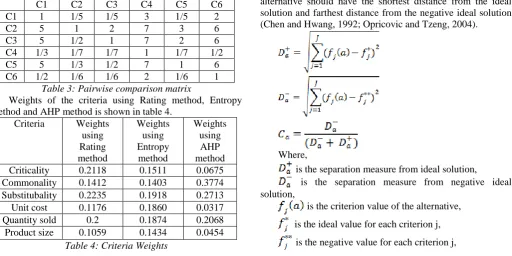
The criteria are termed as Commonality (C1), Substitutability (C2), Criticality (C3), Product Size (C4), Quantity sold (C5) and Unit cost (C6).Pairwise comparison is used to compare the criteria.It allows one to determine the relative order (ranking) of a group of items. Pairwise comparison is a kind of divide-and-conquer problem-solving method. Saaty‟s nine point scale for relative importance is used for pairwise comparison. The pairwise comparison matrix is shown in the table 3.
C1 C2 C3 C4 C5 C6
C1 1 1/5 1/5 3 1/5 2
C2 5 1 2 7 3 6
C3 5 1/2 1 7 2 6
C4 1/3 1/7 1/7 1 1/7 1/2
C5 5 1/3 1/2 7 1 6
C6 1/2 1/6 1/6 2 1/6 1
Table 3: Pairwise comparison matrix
Weights of the criteria using Rating method, Entropy method and AHP method is shown in table 4.
Criteria Weights using Rating method
Weights using Entropy
method
Weights using AHP method Criticality 0.2118 0.1511 0.0675
Commonality 0.1412 0.1403 0.3774
Substitubality 0.2235 0.1918 0.2713
Unit cost 0.1176 0.1860 0.0317
Quantity sold 0.2 0.1874 0.2068
Product size 0.1059 0.1434 0.0454
Table 4: Criteria Weights
VII. MULTI CRIETRIA INVENTORY CLASSIFICATION
Lot of multi criteria decision making methods has been proposed in the last 30 years. Some of these methods will be useful to classify the inventory using multi criteria. AHP is the most widely used multi criterion decision making method. In this paper three multi criteria decision making methods such as SAW (Simple Additive Weighing method), TOPSIS (Technique of Order Preference by Similarity to an Ideal Solution) and Compromise Programming have been used to classify the inventory.
SIMPLE ADDITIVE WEIGHING METHOD
This method is also called Weighted Sum Method. All the elements of the decision table are normalized, and then SAW can be used for any type and any number of attributes.
Where,
is the normalized value of is the ranking of the alternative.
Rank the alternative by arranging the values in the descending order. Then classify the inventory by considering first 54 items as A class, next 109 items as B class and last 390 items as C class.
SAW method is done for three different criteria weights calculated through rating method, entropy method and AHP method. So three different classification results have found through SAW method.
TOPSIS (TECHNIQUE OF ORDER PREFERENCE BY SIMILARITY TO AN IDEAL SOLUTION)
TOPSIS (Technique of Order Preference by Similarity to an Ideal Solution) is based on the principle that the chosen alternative should have the shortest distance from the ideal solution and farthest distance from the negative ideal solution (Chen and Hwang, 1992; Opricovic and Tzeng, 2004).
Where,
is the separation measure from ideal solution,
is the separation measure from negative ideal solution,
is the criterion value of the alternative, is the ideal value for each criterion j,
Page 316 www.ijiras.com | Email: [email protected] is the relative closeness value
Rank of the alternatives based on the values. The higher the value, the better the alternative. Using traditional ABC classification number of items in A class is 54, B is 109 and C is 390. Rank the alternative by arranging the values in the descending order. Then classify the inventory by considering first 54 items as A class, next 109 items as B class and last 390 items as C class.
TOPSIS method is done for three different criteria weights calculated through rating method, entropy method and AHP method. So three different classification results have found through TOPSIS method
COMPROMISE PROGRAMMING
Compromise programming (CP) defines the best /suitable solution as the one in the set of efficient solutions whose point is at the least distance from an ideal point (Zeleny, 1982; Gershon and Duckstein et al., 1994). The objective is to obtain the solution that is as „close‟ as possible to some „ideal‟ solution. The distance measure used in compromise programming is the family –metrics and expressed as
Where,
is the -metric for alternative a, is the value of criterion j for alternative a, is the maximum value of criterion j in set N, is the minimum value of criterion j in set N, is the ideal value of criterion j,
is the weight assigned to the criterion j, p is the parameter/balancing factor.
Balancing factor reflecting the attitude of the decision maker with respect to compensation between deviations. For p=1, all deviations from are taken into account in direct proportion to their magnitudes. For p=∞, the largest deviation is the only one taken into account corresponding to zero compensation between deviations. In this p value is assumed as 1.
Rank the alternative by arranging the values in the ascending order. Then classify the inventory by considering first 54 items as A class, next 109 items as B class and last 390 items as C class.
Compromise programming method is done for three different criteria weights calculated through rating method, entropy method and AHP method. So three different classification results have found through compromise programming method.
VIII. GROUP DECISION MAKING
In the case of individual decision making (single decision-maker situation), the best alternative can be easily determined in accordance with the preference of the decision maker.
However, when the decision is particularly complex in nature, with personal interests and conflicting preferences among the good number of decision-makers involved, it may lead to an unsatisfactory conclusion and sometimes may be even erroneous. In this regard, effective group decision making can be viewed as a process in which different individual interests are reduced and integrated so as to form a single group preference or consensus (Liu and Wei, 2000; Kwok et al., 2002). In this paper group decision making is used to integrate the different inventory classification results. Additive ranking rule is used to integrate the results.
Where,
M is the number of methods used,
is the relative influence of each method,
is the rank obtained for each alternative a by each method,
is the rank obtained by the alternative a by group decision making
Rank the alternative by arranging the values in the descending order. Then classify the inventory by considering first 54 items as A class, next 109 items as B class and last 390 items as C class.
IX. RESULTS AND DISCUSSION
Inventory is classified using both traditional ABC classification method and multi criteria decision making methods.
Using traditional ABC classification method brake shoe spring is coming under C class because of low unit price. But the part is more critical, common for all models and having less substitute. These factors are considered in the multi criteria decision making methods and the part is coming under A class in all the multi criteria decision making methods.
Using traditional ABC classification method brake pedal shaft assembly is comes under C class because of less annual demand, but the part is more critical, so it comes under A and B class through multi criteria decision making methods.
Above results clearly shows that multi criteria inventory classification is more effective than traditional ABC classification for classifying the inventory.
Although multi criteria inventory classification is more effective than traditional ABC classification, the results obtained from the three multi criteria decision making methods are varying slightly. So it is difficult to identify which classification result is suitable for the particular inventory. By using group decision making concept, all the obtained multi criteria inventory classification results are integrated, and a single effective classification result is obtained.
X. CONCLUSION
Page 317 www.ijiras.com | Email: [email protected] traditional ABC classification method. Even though, multi
criteria decision making method gives effective result, different classification results were obtained by using three different multi criteria decision making methods. So using of group decision making concept to integrate the results of three multi criteria decision making methods will give single effective inventory classification.
REFERENCES
[1] L. Ustinovichius., E.K. Zavadskas and V. Podvezko,” Application of a quantitative multiple criteria decision making (MCDM-1) approach to the analysis of investments in construction”, Control and Cybernetics (2006) vol. 36 No. 1
[2] S. R. Gangurde, M. M. Akarte., (2011),” Ranking of Product Design Alternatives using Multi-criteria Decision Making Methods”.
[3] Thomas L Saaty,”How to make a decision: The Analytical Hierarchy Process”, European Journal of Operational Research (1990) 48, 9-26.
[4] Omkarprasad S. Vaidya, Sushil Kumar, “Analytic hierarchy process: An overview of applications”, European Journal of Operational Research (2006) 169, 1– 29.
[5] H. Altay Guvenir and Erdal Erel., “Multi Criteria Inventory classification using a Genetic Algorithm”. [6] Ramakrishnan Ramanathan, “ABC inventory
classification with multiple-criteria using weighted linear optimization”, Computers & Operations Research 33(2006), 695–700.
[7] Wan Lung Ng,”A simple classifier for multiple criteria ABC analysis”, European Journal of Operational Research 177(2007), 344–353.
[8] A. Hadi-Vencheh,” An improvement to multiple criteria ABC inventory classification”, European Journal of Operational Research 201(2010), 962–965.