Blog Share And Filter
Meghana Raghuwanshi Dipika Siraskar
Student Student
Department of Computer & Science Engineering Department of Computer & Science Engineering PRMIT & R, Badnera, India PRMIT & R, Badnera, India
Monika Athavale Prajakta Sukhadeve
Student Student
Department of Computer & Science Engineering Department of Computer & Science Engineering PRMIT & R, Badnera, India PRMIT & R, Badnera, India
Arpit Chaudhari
Assistant Professor
Department of Computer & Science Engineering PRMIT & R, Badnera, India
Abstract
In the present day scenario online social networks (OSN) are very trendy and one of the most interactive medium to share, communicate and exchange different kinds of information like text, image, audio, video etc. The OSN users are provided with a privilege to have a direct control on posting or commenting certain stuff on their walls with the help of information filtering. This can be achieved through text pattern matching system, that allows the user to filter their open space (wall) and a privilege to add new words treated as unwanted. To provide a healthy environment to the user to interact, pattern matching of texts are done with the blacklisted vocabulary. If the posted content is verified as ethical and not spam , it is then allowed to be posted on someone’s wall, otherwise the posted text will be blurred or encoded with special symbols or would be placed into blacklisted words. This can be achieved through a flexible rule-based system, which allows the users to customize the refining criteria to be applied to their walls, and a Machine Learning-based classifier automatically classifies the messages in content-based filtering.
Keywords: online social networks(OSN); posts; message filtering; pattern matching; filtered walls ;Machine Learning(ML) ;Filtering Rules(FR); Text Categorization, Filtering Rules(FW)
________________________________________________________________________________________________________
I. INTRODUCTION
Social networking sites are one of the most efficient and effective medium of interaction. In today’s society, we can’t find a person who is not having a mobile phone neither with an account in social networking sites like Twitter, Facebook etc., through the help of many existing surveys, we came to know that within the world we are having more number of mobile phone users rather than social sites users. A social network or community is a theoretical assembly used to sort relationships between individuals. We have matched a sample user text pattern with predefined text pattern. If any new text pattern user wants to make template for future matching, system allows user to do so. The whole text, need to be filtered, will be scanned and matched text pattern will be replaced with some special symbols. We will mostly filter only exact matching of a text. If this text is a part of one complete word, it won’t be filtered and replaced. But the admin can register any abusive word if it is not added already.
The Filtering rules defines what contents should be accepted or rejected also there is a list of users that are temporarily or permanently prevented from posting any stuff on the author's wall and this list is known as Blacklist. The unwanted messages are filtered from Online Social Networks (OSN) walls on the basis of both message content and the message creator relationship and character.
Sum up of the performed work includes.
The system automatically filters post messages in OSN.
The system creates a rule based Filtering Method that allow users to customize filter by applying filtering criteria. The system experimentally evaluate an automated system, called Filtered Wall (FW)
The system filters unwanted messages from OSN user space.
A networking service is a platform to make interaction among people for example shares ideas, posts, interests, activities in network. A network service consists of a representation of each user (often a profile), his/her social links, and a variety of additional services. The social networks have the possibility of posting some unwanted messages on other user’s wall. It is suggested to avoid the displaying of unwanted words on user’s space. This is achieved by using Rule Based Filtering System. By using all this spam and unwanted content can be removed and the user can be blacklisted.
II. LITERATURE SURVEY
N.Thilagavathi, R.Taarika "Content Based Filtering in Online Social Network using Inference Algorithm", 2014
Information filtering is the process of providing appropriate information to the people who need it. It significantly searches for what actually concerns the textual document, specifically web contents, and offers a user with classification mechanism to avoid the unnecessary information. This information filtering process is used in the online social network for insightful objective. To facilitate the content based filtering, this article introduces the filtered wall architecture. It will filter the incoming post based on the content. The main goal of this system is to provide customizable content based message filtering for online social networks, based on machine learning techniques. Information Filtering Systems are designed to categorize the information which are generated dynamically and offer the information to the user fulfil their requirement. In the content Based Filtering system, each user is assumed to operate separately. So the filtering system selects the information based on the correlation between the content of the items and user preferences. In this system, Machine Learning based text categorization techniques are used to automatically allot each short text message with set of categories based on the content. Short Text Classifier is built to accurate extraction and set of discriminating feature in the message. The system also supports the user defined Blacklists (BL) that is, list of users that are temporarily blocked to post messages on the user wall.[4]
K. Babu, P.Charles, "A System to Filter Unwanted Words Using Black List in Social Networks", International Journal of Computer Science and Information Technologies (IJCSIT), Vol. 5(2), 2014
A system to prevent the indecent messages from the Social Networking site walls has been presented. The Usage of Machine Learning has given higher results to the system to trace the messages and the users to distinguish between the good and bad messages and the authorized and unauthorized users in the Social Networking User Profiles automatically. Machine Learning Technique plays a vital role in this paper in order to generate the blacklist of the bad words and the unauthorized users. The user has to update his privacy setting in his account in order to add this method to prevent the obscenity in his public profile. Machine Learning is a system which can learn from the data and take decisions based on the learned data. A further component of our system is a Blacklist (BL) mechanism to avoid messages from undesired creators, independent from their contents. BL is directly managed by the system, which should be able to determine who are the users to be inserted in the BL and decide when users retention in the BL is finished. A system automatically filters unwanted messages using the blacklists on the basis of both message content and the message creator relationships and characteristics.
J.Anishva Rose, A. Pravin, "Machine Learning Text Categorization in OSN to Filter Unwanted Messages", International Journal of Computer Science and Information Technology Vol. 5 (1) , 2014.
Disadvantages of Existing System
Existing system do not provide content wise filtering and any information can be posted without verifying the user did not have the access to delete the comments.
Mostly wall messages are composed of short texts. As short length texts uniquely occurs and they bear unusual content which cannot be classified with traditional classification methods.
III. PROPOSED METHODOLOGY
Firstly a moderator is added to verify if the blog and article deserves enough to get published. In the newly proposed system the moderator has the right to delete the comments of the users and to block the users, however before blocking the user, a message will be sent to the user that a nonsense blog has been written by him. The users will create and manage their own “groups” in Blogshare. Each group has a homepage that provides a place for subscribers to post and share (by posting blogs, articles and images, etc.) and block the user that provides basic information about the group. Users can also enable additional features in their owned page like view friends list and add friends by using friend’s requests as well as share their images with selected group’s members. The status of their friends’ requests should also be updated here. Secondly summary is included in which the statistics of blocked content i.e. the comments which are deleted ,the abusive words which are rejected are shown .The articles are suggested a category based on the number of technical words present in that blog.
Filtering Process
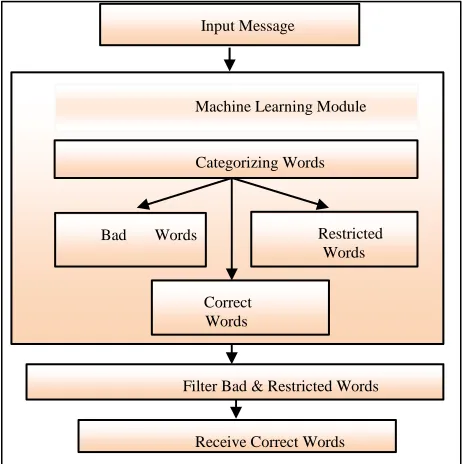
In defining the language for Filtering rules (FRS) specification, we consider three main issues that, in our opinion, we can affect a message filtering decision. First, in OSNs like in everyday life, the same message may have different meanings and relevance based on who writes it. As a consequence, FRs should allow users to state constraints on message creators. Creators on which a FR applies can be selected on the basis of several different criteria; one of the most relevant is by imposing conditions on their profile’s attributes. The problem of setting thresholds to filter rules is also addressed, by conceiving and implementing within FW, an Online Setup Assistant (OSA) procedure. For each message, the user tells the system, the decision to accept or reject the message.
The collection and processing of user decisions on an adequate set of messages distributed over all the classes allows computing customized thresholds representing the user attitude in accepting or rejecting certain contents. Such messages are selected according to the following process. A certain amount of non-neutral messages taken from a fraction of the dataset and not belonging to the training tests, are classified by the ML in order to have, for each message, the second level class membership values
Fig. 1: filtering process
Blacklisting
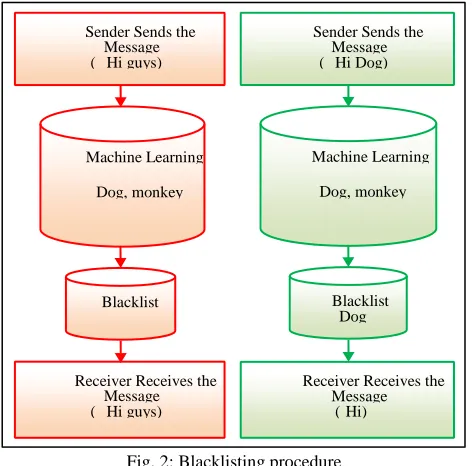
A further component of our system is a Blacklist (BL) mechanism to avoid messages from undesired creators, independent from their contents. BL is directly managed by the system that should be able to determine, who are the users to be inserted in the BL
Input Message
Machine Learning Module
Categorizing Words
Bad Words
Correct Words
Restricted Words
Filter Bad & Restricted Words
Fig. 2: Blacklisting procedure
Each unwanted message has an alert from admin that provides a place for post and share for the respective user walls. And admin can see blocked message from the users and also that provides information about the user who used the blocked message.
IV. SYSTEM DESIGN
Nature of Work
Machine learning (ML) is used as text categorization techniques to automatically assign each short text message with in a set of categories based on its content. The major efforts in building a robust Short Text Classifier (STC) concentrate in the extraction and selection of a set characterizing and discriminating features. Here, a database of the categorized words is built and it is used to check the words if it has any indecent words. If the message consists of any vulgar words, then they will be sent to the Blacklists to filter out those words from the message. Finally, the message without the indecent words will be posted in the user’s wall on the result of the content-based-filtering technique.
Working Modules
Filtering rules
The powerful rule based layer provides a system where user can specify a filtering rule (FR) where the user can select what content should be displayed on his/her wall.
Data base Check Using Natural Language Processing(NLP).
The system includes checking criteria where the data base is checked for the words which resemble the same meaning as that of the vulgar meaning, or any undesired meaning using the ontology based classification algorithm.
Blacklists
The Blacklist (BL) are the extra add–on feature given to the user for blocking the person who is trying to again and again post any unwanted /vulgar message on users wall. The system automatically blocks such user if the person many times tries to post undesirable message on user wall.
V. CONCLUSION AND FUTURE WORK
A system is presented to filter out unwanted messages from OSN user walls. The system provides to enforce customizable content depended filtering rules. We plan to enhance our filtering rule system, with a more sophisticated approach to manage those messages caught just for the tolerance and to decide when a user should be inserted into a BL. We proposed a system with rules to filter the unwanted messages posted on user wall. As the future work and our contribution we are going to implement a system to prevent undesirable messages from OSN walls. It makes OSN more reliable, secure, trustworthy and comfortable for the user.
Sender Sends the Message ( Hi guys)
Blacklist
Receiver Receives the Message ( Hi guys) Machine Learning
Dog, monkey
Sender Sends the Message ( Hi Dog)
Blacklist Dog
Receiver Receives the Message
( Hi) Machine Learning
ACKNOWLEDGMENT
I am profoundly grateful to Prof. Arpit Chaudhari, and for their expert guidance and continuous encouragement throughout to see that this paper rights its target since its commencement to its completion. At last I must express my sincere heartfelt gratitude to all people who helped me directly or indirectly during this course of work.
REFERENCES
[1] Marco Vanetti, Elisabetta Binaghi, Elena Ferrari, Barbara Carminati, and Moreno Carullo, “A System to Filter Unwanted Messages from OSN User Walls,” IEEE Transaction on Knowledge and Data Engineering, vol. 25, 2013.
[2] N. Thilagavathi, R. Taarika “Content Based Filtering in Online Social Network using Inference Algorithm", 2014 International Conference on Circuit, Power and Computing Technologies [ICCPCT].
[3] K.Babu ,P.Charles “A System to Filter Unwanted Words Using Blacklists in Social Networks", (IJCSIT) International Journal of Computer Science and Information Technologies, Vol. 5 (2) , 2014.
[4] Facebook development platform. http://developers.facebook.com
[5] M. Chau and H. Chen, “A Machine Learning Approach to Web Page Filtering Using Content and Structure Analysis,” Decision Support Systems, vol. 44, no. 2, pp. 482-494, 2008.
[6] Dipali D. Vidhate, Ajay P. Thakare,”To Avoid Unwanted Messages from OSN User Wall: Content Based Filtering Approach”, IJCSMC, vol.3, Issue.4, April 2014.