(PLATES
77-90)
T
HIS ARTICLE continues the publication of fragments of Attic red figure found at
Corinth in the excavations of the American School of Classical Studies.' The
fragments in question come from the School's early excavations on the site2 and are
with few exceptions scattered single finds. It is largely for this reason that they have so
long remained adespota.
Those treated here date from the late 6th century to the end of the 5th or possibly
the early 4th. They comprise the more substantial pieces that remain unpublished,
including all that had been attributed by Sir John Beazley, to whom all the fragments
were known, either at first hand or through photographs. In addition to those treated
here, there are many smaller fragments, which, though they offer scant opportunity for
discussion of subject or style, obviously represent work of high quality. The fact is of
some interest in respect to the distribution of Attic red figure on the Greek mainland in
contrast to that in Campania and Etruria. It is scarcely to be accounted for solely
through the activity of returning travelers.3
The fragments are arranged in roughly chronological order. Most come from
kraters,4
though some smaller shapes are also represented, including tantalizingly scanty
I C. G. Boulter, "The Berlin Painter at Corinth," Hesperia 35, 1966, pp. 310-319, pls. 73-76; I. D. McPhee, "Attic Red Figure of the Late 5th and 4th Centuries from Corinth," Hesperia 45, 1976, pp. 380-396, pls. 85-92. In the preparation of the present article the authors have benefited from help freely given by the Director of the Corinth Excavations, Charles K. Williams, II, and by D. A. Amyx, Judith Binder, Nancy Bookidis, Mark I. Davies, Sharon Herbert, Henry R. Immerwahr, Donna C. Kurtz, Mary B. Moore, Catherine S. Pearson and Jocelyn Penny Small. The photographs for the most part were taken by James M. Heyle. The drawings were made by Helen H. Townsend (Figs. 1 and 2) and David Lewis (Fig. 3).
The following abbreviations are used in this article:
Agora XII B. A. Sparkes and L. Talcott, The Athenian Agora, XII, Black and Plain Pottery of the 6th, 5th and 4th Centuiries B.C., Princeton 1970.
AR V2 J. D. Beazley, Attic Red-Figure Vase-painters, 2nd ed., Oxford 1963.
C-B L. D. Caskey and J. D. Beazley, Attic Vase Paintings in the Muselum of Fine Arts, Boston, London 1931-63.
Para J. D. Beazley, Paralipomena, Oxford 1970.
2 Add now the joining fragments found in 1978-1979, for which see 17, 22 and the addendum, pp. 307-308.
'T. B. L. Webster's comment (Potter and Patron in Classical Athens, London 1972, p. 286) on Attic red- figured vases at Corinth is somewhat misleading: "none of them is more than second class, and none of them is more than a stock vase." It is true that he was referring to the contents of a single deposit, but the passage implies that the deposit is representative of the state of things generally. Nor is the situation so bleak as it appeared to S. B. Luce in 1930 (A.JA 34, 1930, p. 334). See also H. Palmer, Corinth, XIII, The North Cemetery, Princeton 1964, pp. 152-153; D. Kurtz, Athenian White Lekythoi, Oxford 1975, p. 138; S. Herbert, Corinith, VII, iv, The Red-figure Pottery, Princeton 1977, p. 3.
True also of the 4th-century fragments published by McPhee (see footnote 1 above), pp. 380-381. It may simply testify to the greater durability of thicker-walled vessels.
Hesperia 49, 4
American School of Classical Studies at Athens is collaborating with JSTOR to digitize, preserve, and extend access to Hesperia
pieces of a round aryballos (1) of exquisite make by the Epidromos Painter and better
preserved portions of a cup (21) in the manner of the Pistoxenos Painter. The presence
of four fragments (11-14) attributed to the Leningrad Painter or his manner will recall
the discovery in the North Cemetery at Corinth of fragments of a hydria by this
painter.5
In the strict sense it is true that the fragments are without context, but it may be
worth noting that several were found in the area of the South Stoa, six of them from its
Shop XXXII (4, 7, 17, 21, 22, 29), and worth referring also to McPhee's remarks in
this connection on the 4th-century fragments.6
Like the aryballos by the Epidromos Painter with which the catalogue begins, the
last entry, 36, is also tantalizingly incomplete, presenting questions to which the writer
has been able to give no satisfactory answer.
1. Round aryballos. P1. 77
C-31-77 a, b.
a) H. pres. 0.032; D. base 0.029 m. Four joining fragments preserve the base and part of the wall. The base is flat and on its reserved undersurface bears black concentric circles with a dot at the center. It is set off from the body by a small base ring bounded above by a narrow reserved band.
Parts of several figures are preserved from what must have been a crowded scene of athletes and trainer(s). A boxer sits on a low mound, his body and left leg frontal, his right leg flexed, the right foot behind the left. Part of his right forearm and hand is also preserved (just above his navel). A red cord passes from beneath his right wrist across his right thigh and lower leg, accompanied in this crossing by a relief line. Presumably he is binding his hands and wrists.
To the left stands a trainer, in dotted himation, leaning left on a staff. A pair of halteres rests at his feet. An acontion crosses his staff diagonally, its lower end concealed behind his feet and ankles. Traces of the acontist's fingers (or of the thong) are visible at the break. At ground level, beside the end of the staff, are remains of two feet: in front, the heel of a foot to left; beyond it the toes of a foot to right.
To the right of the boxer was a standing figure, with right foot to left and left foot frontal. Behind the left foot can be seen the toes of another foot, which, with the adjacent remains, possibly belongs to a kneeling figure.
b) Max. dim. 0.025 m. A single non-joining fragment preserves the upper part of a boxer bind- ing his wrists. His body is frontal, his head to left. He is drawn on a smaller scale than the boxer on a, and so was perhaps shown standing rather than seated. The cord is here rendered in black. The transverse divisions of the rectus abdominis are in dilute glaze. His left hand is drawn with only three fingers.
On both a and b all contours are in relief except for b's hair, which is reserved. The fabric is ex- traordinarily thin (0.0025 m.).
Attributed to the Epidromos Painter by Beazley (AR V2, p. 118, no. 15). About 510-500 B.C.
Another seated boxer by the Epidromos Painter is preserved intact on the interior of a cup for- merly in the collection of Ray W. Smith and now at Dartmouth College (ARV2, p. 117, no. 6; D. M. Buitron, Attic Vase Painting in New England Collections, Cambridge, Mass. 1972, p. 79; here P1. 77:c).7 Again the composition is somewhat crowded. The exergual space is unusually large, and so also is the discus. Among the other athletic
5 AR V2, p. 571, no. 74; J. D. Beazley, Hesperia 24, 1955, pp. 305-319.
6 Op. cit. (footnote 1 above), pp. 381-382. Note also the provenience of the newly found fragments of the Berlin Painter lekythos (CP-884), below, p. 307.
7 For the photograph and permission to publish I am indebted to the kindness of Professor Matthew I.
equipment and accessories is a pair of halteres, here in silhouette, and a round-bottomed arybal- los, its side decorated as is the bottom of the Corinth aryballos, with circle and dot. The boxer sits with legs spread wide apart; the pose of the Corinth boxer is matched more closely by a boxer on a psykter from the Pezzino Group (ARV2, p.
1621; K. Schauenburg, JdI 76, 1961, p. 56, fig. 9). "The Epidromos Painter is so close to Apollo- doros that it must be considered whether they are not the same: the Epidromos Painter would be early Apollodoros. The works of the Kleomelos Painter and the Elpinikos Painter are very close to each other, and to the Epidromos Painter and Apollodoros: to be considered whether these two groups also are not merely phases of Apollodoros" (ARV2, p. 117). This statement of Beazley's has been frequently discussed in recent years, and with varying views.8 The Corinth fragments are unfortunately too small to help much toward a resolution of the problem.
On the shape see Beazley in BSA 29, 1927/28, pp. 187-215; Agora XII, p. 152, note 10.
2. Cup fragment. P1. 78
C-31-02. Max. dim. 0.062 m. A single fragment preserves the center of the tondo and the top of the stem, which bears a rounded fillet.
A naked girl reclines on her left elbow on couch and pillow, her legs and body to left, her head turned back right. She is perhaps emptying the contents of a cup she holds in her right hand into another held in her left. A sash shaded with dilute glaze hangs over her left forearm. There is a brown cord about her neck; it bears a single black bead. The pubic hair is also in dilute glaze. Relief contours throughout. Fine black glaze inside and out; what remains of the exterior is undecorated. The inside of the stem is black except at the top.
Unattributed. About 500 B.C.
The figure is an excerpt from a symposion, per- haps like that on the psykter by Euphronios in Leningrad (AR V2, p. 16, no. 15; A. A. Peredol-
skaya, Krasnqfigurnye attischeskie vazy v Ermitazhe, Leningrad 1967, pls. 14, 15), with which, at any rate, it is more or less contemporary. There too the women appear to be lodged somewhat precari- ously on their couches. The woman on the Cor- inth fragment could be resting on a pillow like that behind the flute player in a cup tondo by the Brygos Painter in the Vatican (ARV2, p. 369, no. 6; A. Cambitoglou, The Brygos Painter, Sydney 1968, pl. 11:2), with stripes lengthwise rather than transverse. In the Brygan scene too the pillows appear to be well over the edge of the couch. The cup the Corinth figure holds in her left hand has a shape which was perhaps out of fashion at the end of the 6th century.
3. Fragment of a kalpis. P1. 78
C-30-53. Max. dim. 0.083 m. A single fragment from the shoulder.
A youth seated to right on a rock or mound. His legs are preserved, his left hand, and two fingers of his right. Opposite him sat or stood another figure, of whom only the right foot and part of the lower leg survive. The seated youth holds a lyre with his left hand and a drinking horn with his right. His left hand is clumsily rendered: it apparently is meant to be thought of as resting against the strings of the lyre, but no strings are represented. Net border below, bounded each side by double lines. Relief contours generally, but in- distinctly rendered. The reserved areas have a pe- culiar color, and the black glaze is brownish and smudgy.
Attributed to the Nikoxenos Painter by Beazley (AR V2, p. 222, no. 27).
About 500 B.C.
4. Cup, Type C. Fig. 1, P1. 78
C-33-228. H. pres. 0.05; max. dim. 0.115 m. Several joining fragments preserve most of the foot, the stem, and the central part of the bowl, including one handle-start. South Stoa, Shop XXXII.
The exterior is undecorated. There are two tooled and reserved grooves (a pseudo-fillet) at the base of the stem. The outer edge of the foot is reserved, as is also its resting surface; the remain- der of the underside is black except at the top of the conoid interior of the stem. For the graffito on the underside, see Figure 1.
In the tondo, "symposion: a youth reclining, naked, kidaris on head, seen from behind, to left, looking round to right."
Attributed to the Pithos Painter (Para, p. 334), on whom see AR V2, pp. 139-141, from which the description of the tondo is taken. See also Beaz- ley's remarks on examples of the Pithos Group found at Al Mina (JHS 59, 1939, pp. 2-4). Two more cups (CP-778 and CP-800), by the same painter and with the same subject, were found at Corinth in unpublished graves of the North Cem- etery, and still another, now Athens N.M. 12268 (AR V2, p. 140, no. 36), hails from Corinth.
About 500 B.C.
FIG. 1. Graffito on Type C cup 4.
5. Fragment. P1. 78
C-37-2313. Max. dim. 0.07 m. A single frag- ment from the shoulder of a closed vessel (am- phora?). Agora, South Center.
Upper part of satyr's head to right; he wears a wreath in added white: the fillet has faded but the berries are largely unimpaired. Relief contour for forehead-nose. Thin black glaze, mottled red; un- glazed inside except for a bit of good black glaze at top of sherd, i.e. at the beginning of the neck.
Unattributed.
About 490-480 B.C.
6. Fragment of a calyx-krater. P1. 78
CP-1676. Max. dim. 0.068 m.
A small part of the head of a female figure, to left; what survives of her headdress is largely black, with two dots in added red, bordered above by a narrow reserved strip and at the side by the same; two pointed leaves project obliquely for- ward. Above, a reserved border which extends into the lower edge of the rim, and above this, slanting opposed palmettes. Relief contours throughout except for the inside edge of the spi- rals and their inner ends. Excellent black glaze inside and out; a reserved line inside at mid-level of pattern band.
Unattributed. About 480 B.C.
This fragment, eloquent despite its small size, offers further evidence that Corinth imported At- tic pots of the highest quality. It came from a calyx-krater that very probably ranked with that krater of the Berlin Painter the fragments of which
were published by the writer in Hesperia 35, 1966,
pp. 310ff. On the chance that someone may ob- serve that 6 bears an inventory number (1676) consecutive with that (1675) of no. 3 of the Berlin Painter fragments (ibid., p. 315, note 30), it should be stated positively that the two sherds are
not from the same vase.
7. Fragments of a krater. P1. 79
C-46-102. Max. dim. 0.078 m. Two joining frag- ments. South Stoa, Shop XXXII.
Male head to right, wearing a wreath of laurel or myrtle. To left, part of staff (scepter or tri- dent?). Relief contour for forehead-nose and staff; dilute glaze for fringe of hair. Rather dull black glaze outside, better within; reserved band inside at level of forehead.
Unattributed.
About 480-470 B.C. Probably a god, possibly Zeus or Poseidon.
8. Fragments of a krater. P1. 79
CP-997. Max. dim. 0.083 m.
his wrists, part of a vine(?). Dense black beard, with a fine fringe of relief lines; dilute glaze for ends of hair over neck, the nipple, the rib cage and abdominal details, also for a muscle line on the animal's neck. Relief contours throughout.
Unattributed.
About 480-470 B.C. Perhaps from a return of Hephaistos.
I am indebted to Mary B. Moore for helpful observations on this fragment.
9. Fragment of a column-krater(?). P1. 79
C-32-71. Max. dim. 0.069 m. Temple E.
A single sherd from the shoulder of the vase preserves a bearded male head to left, along with some folds of a garment over the left shoulder. Space is left for the ear, but the ear itself is not drawn. There is a fillet executed in a very fine, light black line. No relief contour. The interior is unglazed. On the outside the glaze has mostly fired reddish brown (thus most of the hair, but not the beard).
Unattributed. About 480-470 B.C.
10. Fragment of a krater. P1. 79
CP-996. Max. dim. 0.135 m.
Head and chest of horse to right; part of right leg and chitoniskos of rider, who apparently held two spears. Dilute glaze for hair of forelock and added white for that part of the rein which runs from bridle to chest. Also preserved, on the right, a hand raised in greeting, with three horizontal lines on the wrist. Part of the edge- of the draped body is also visible. Relief contours throughout; lustrous black glaze, less bright on the interior, where there is a reserved band at the level of the fingertips. Ample remains of preliminary sketch: inside the horse's neck, across its chest, and at the rider's knee; this last, in the sketch, is somewhat higher and farther back than it was actually drawn.
Unattributed. About 470 B.C.
11. Fragments of a column-krater. P1. 80
C-36-530. Max. dim. 0.11 m. South Basilica.
Several joining fragments preserve the head and upper part of the body of a satyr who faces right,
holding a wineskin. His head is bound with a wreath in added red. Relief contour for back, left arm and wineskin; dilute glaze for lips, nose and fringe of hair and beard. Good black glaze out- side, apart from several blisters; dull glaze inside. Preliminary sketch on arms, back and wineskin. Remains of a dipinto behind the satyr's back:
---* v )
Attributed to the Leningrad Painter by Beazley (Para, p. 391, no. 93, where it is entered as Shape Uncertain. Beazley, however, had seen only a pho- tograph of the fragments, and had not handled them. Careful examination makes it certain that they belong to a column-krater.).
About 470-460 B.C.
Our satyr may have been a member of a group (satyrs making wine) like that depicted on another column-krater by the Leningrad Painter, now in Lecce (AR V2, p. 569, no. 39; M. Bernardini, I vasi attici del Al/Iseo Provinciale di Lecce, Bari 1965, pp. 84-85). On Attic vintagers on vases see B. A. Sparkes, "Treading the Grapes," BABesch 51, 1976, pp. 47-64.
12. Fragment of a column-krater. P1. 80
C-32-72. H. pres. 0.045; max. dim. 0.074 m. Temple E.
The fragment preserves the head and shoulders of Dionysos to left, and a trace of the upper bor- der (bits of two lines that separate tongues). The god's right arm was extended, and may have held the kantharos shown on 13 (see next entry). Re- lief contour for face and arm. The god wears a wreath of ivy leaves in added red, now faded. Dilute glaze for folds of chiton, with a border of three relief lines at the neck. Fair black glaze outside, and thin to none inside.
Attributed to the Leningrad Painter by Beazley (AR V2, p. 568, no. 34) and associated by him with 13. Both 12 and 13 were found in the excava- tion of Temple E.
About 470-460 B.C.
13. Fragment of a column-krater. P1. 80
As Beazley suggested, the fragment may well belong to the same column-krater as does 12 (ARV2, p. 568, no. 34, where for "C 32.165" read "C-32-161"; cf. Para, p. 390, no. 34).
About 470-460 B.C.
14. Fragment of a column-krater(?). P1. 80
CP-998. Max. dim. 0.056 m. A single fragment, from the shoulder; unglazed inside except at the lower edge.
Part of the head and right shoulder of an "Ana- creontic" komast, facing right and looking up. He wears chiton, himation and mitra, with a fillet in added red. Dilute glaze for the horizontal folds on the chiton sleeve, and for the hair on the neck below the edge of the mitra.
Attributed to the manner of the Leningrad Painter by Beazley (AR V2, p. 573, no. 14, where for "hand and shoulders" read "head and shoul- ders").
About 470-460 B.C.
On "Anacreontic" komasts see Beazley in C-B ii, pp. 55-61; K. DeVries, Expedition 15, no. 4, 1972/73, pp. 32-39; J. Boardman, AA (Jdl 91) 1976, p. 284; and on their headdress, H. Branden- burg, Stuidien zur Mitra, Miinster 1966, pp. 76-86.
15. Fragment of a column-krater. P1. 80
CP-2635. Max. dim. 0.097 m. A single fragment from the shoulder.
"Upper half of a youth in a chlamys moving to right, looking round." Fillet in added red. A peta- sos hangs over his left shoulder. Dilute glaze for fringe of hair and sideburn. Relief contours throughout. A bit of the upper border (tongues) is preserved. Dull black glaze outside, and duller within, thinning as it approaches the shoulder.
Attributed to the Earlier Mannerists (Undeter- mined) by Beazley (AR V2, p. 584, no. l9ter).
About 470-460 B.C.
16. Fragments of a column-krater. Pls. 81, 82
C-32-73 (includes fragments originally invento- ried as CP-1690, CP-1713, (nd C-32-150 a-k: see Pls. 81, 82). Temple E.
Side A. a) Max. dim. 0.148 m.; part of the shoulder: below a border of black tongues, two relief lines separating them from panel, the head of Dionysos, to left (P1. 81). He wears a fillet over
a wreath of ivy leaves, and holds a thyrsos in his left hand (part of his thumb is visible at the break). Behind Dionysos, also facing left, the head of a maenad, wearing a wreath of ivy leaves. She held a torch, the flames of which may be seen rising beyond Dionysos' shoulder. A bit of the lateral border at the upper right. b) Max. dim. 0.14 m.; three joining fragments: part of mid-sec- tion of Dionysos, clothed in chiton and himation, with extended right arm holding kantharos (P1. 81). At the lower left, a bit of drapery, and be- tween it and the kantharos, a spray of ivy leaves. c) Max. dim. 0.113 m.; three joining sherds: some of the right border, part of the mnaenad's skirt, and of the thyrsos, which is crossed obliquely at the break by the lower end of the torch (P1. 81). d) Max. dim. 0.083 m.; two joining sherds: part of the left border (double row of black dots), and some of the himation and the skirt of a female figure to right, perhaps a second maenad, who holds the ivy spray seen on b (P1. 82).
Side B. e) Max. dim. 0.153 m.; five joining sherds from the shoulder: an upper border of the same crudely painted tongues as on A, but here only one relief line below; two draped youths to left, head and shoulders of one, and of the other, head and right hand grasping a staff (P1. 81). Some of the right-hand border survives at the break. f) Max. dim. 0.10 m.; two joining sherds: remains of draped standing figure to left, pre- served from just below waist to near ankles; one heavy black fold ends in a loop (P1. 82). Probably part of left-hand figure in e. g) Max. dim. 0.067 m.; two joining sherds: mid-section of draped fig- ure to right, perhaps from a third youth who stood at left of panel (P1. 82).
Other small bits of drapery and border are pre- served, but not illustrated. No relief contours. Much use of dilute glaze, as on the chiton and himation of Dionysos, and also for his lips. Red wash is applied to the flame of the torch.
Attributed to the Mykonos Painter by Beazley (AR V2, p. 515, no. 5, under the inventory num- ber C-32-93; see Para, p. 382, no. 5).
About 470-460 B.C.
17. Fragments of a krater. Pls. 82, 83
A pursuit scene with five figures. On the left a bearded male faces Athena; her back is turned on a youth whose left arm is extended toward a woman who flees right but looks back left. A bearded male figure in himation gazes at the scene, raising his right hand and holding a staff in his left. The other bearded figure also holds a staff, the rounded end of which is preserved (P1. 83:c). The youth wears chlamys and petasos, and has a pair of spears in his right hand (P1. 83:a). The woman wears chiton and himation, and holds her right hand to her head (P1. 83:b). There is a reserved fillet, with stylized leaves, about her hair, with the end looped over at the back and hanging down on her shoulder. The other figures also wear fillets, plain for the males, Athena's with a row of black dots between lines and washed with dilute glaze. Athena wears an aegis and holds a spear in her left hand; her right hand is raised, but the meaning of her gesture is uncertain (P1. 83:d). Above the picture, a band of lotus blossoms and palmettes; all the leaves are ribbed. Relief con- tours throughout except for the outline of the hair, which is reserved. Good black glaze inside and out; a reserved band at the inner edge of the rim and another at the level of the top of the picture.
Attributed to the Altamura Painter by Beazley (ARV2, p. 592, no. 29): "youth with spears (The- seus?), pursuing a woman; Athena and a man look on." In 1979 another joining fragment was discovered in fill dumped over Building IV, before construction of the South Stoa; it adds a fifth figure, the spectator at the right (P1. 82).
About 470-460 B.C.
The drawing of the faces reminds one of Beaz- ley's comment: "the Altamura Painter is not a subtle artist" (C-B iii, p. 65).
18. Fragment of a bell-krater. P1. 82
CP-999. Max. dim. 0.082 m. A bit of the han- dle-start is preserved at the left edge of the fragment. Northwest Shops.
Male to right, himation draped over left shoul- der; he holds the curved end of a staff(?) in his right hand and in his left a stalk that passes over his left shoulder. In front of him, the rail of a chariot. Relief contours throughout, except for the edge of the himation from left shoulder to left
wrist; inner markings in dilute glaze. Traces of preliminary sketch. The glaze on the interior is as good as, or better than, that on the outside.
Unattributed.
Second quarter of 5th century B.C.
19. Fragment of a krater. P1. 86
CP-1000. Max. dim. 0.06 m.
Partly draped male figure moving right. Next him, part of a draped female, frontal, holding dol- phin in left hand. Relief contours; dilute glaze for inner folds of chiton sleeve of second figure. A border of tongues above. Thin black glaze on inte-
rior.
Unattributed. The complete scene may have been the struggle of Peleus and Thetis.
Second quarter of 5th century B.C.
20. Fragments of a bell-krater. Fig. 2, P1. 84
C-32-74. Est. D. rim 0.49 m. Most of the frag- ments (some joining, some not) come from the rim and the adjacent parts of the wall. The larg- est section (H. pres. 0.115 m.) includes almost half the circumference, from the right of side A through the handle area to the left of side B (P1. 84:a).
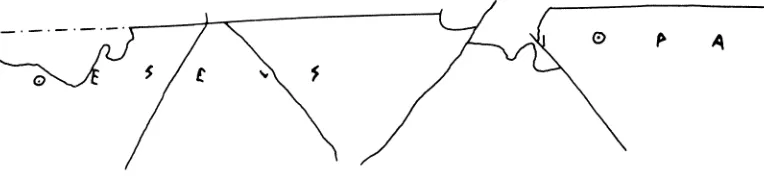
The head of Aithra is preserved on A, her name painted above in white (P1. 84:c). She faces left toward Theseus, now missing, his name alone remaining (for the names, see Fig. 2). Aithra wears an earring and a fillet with pointed leaves. Relief contour for face and leaves. The handle- starts are preserved between A and B. On B are the head and shoulders of a draped youth (1), to right, his left hand resting on a staff, his right on his hip(?) (P1. 84:e). His face and neck are badly pitted. Farther along is a small bit of the head of the central figure (2), the hair outlined in reserve. A single sherd from side B (max. dim. 0.057 m.) preserves the face, left shoulder and part of the staff of 3 (Pl. 84:b). The hair is outlined in reserve.
FIG. 2. Names_on bell-krater 20.
FIG. 2. Names on bell-krater 20.
one heel (relief contour) of a female figure mov- ing right, also two and a half squares of meander border.
The upper border consists of slanting opposed palmettes, with relief contour for the central leaf of each palmette and for the connecting scrolls; a narrow reserved band above and below. Below B there is stopped meander in groups of three punc- tuated by dotted cross squares. The interior is fully glazed, with a reserved band at the inner edge of the rim, and another at the level of the top of the picture outside.
Attributed to the Villa Giulia Painter by Beazley (AR V2, p. 619, no. 14: "A, Theseus leaving home. B, athlete and youths").
About 460-450 B.C.
One might wonder why none of Theseus' head is visible, given the amount of empty space be- neath his name, and he was perhaps seated. The Villa Giulia Painter treated the same subject on a pelike, Syracuse 22177 (AR V2, p. 622, no. 48; CVA, Syracuse 1 [Italy 17], III I 3 [817]). There Theseus stands between Aithra (left) and Ariadne (right), and his name is written just above his petasos. The head of Ariadne matches that of Aithra on the krater in Corinth. There is a similar match with heads of Leto, on a bell-krater by the Villa Giulia Painter in the Metropolitan Museum of Art (AR V2, p. 619, no. 17; G. M. A. Richter and L. F. Hall, Red-figured Athenian Vases in the Metropolitan Muiseum of Art, New Haven 1936, pl. 101), and on a pelike by him in Aachen (Para, p. 399, no. 48bis; R. Lullies, Griechische Kunstwerke. Samnlhing Luidwig, Aachen. Aachener Kunstblitter 37, Dusseldorf 1968, p. 105).
21. Fragments of a cup. P1. 85
C-33-140. South Stoa, Shop XXXII.
D. rim estimated 0.24 m. Three joining frag- ments preserve much of the tondo and part of one side, here designated A, as well as the profile from stem to rim.
Interior. A bald satyr dances right and looks back left (P1. 85:d). His hands also tend leftward, the right arm outstretched, the left flexed, the forearm across his chest. His tail switches leftward as well. He wears a wreath in added red, and there are red strokes in the field, doubtless mock let- ters. No relief contour. Dilute glaze for the trans- verse divisions of the rectus abdominis, ribs, and muscles of arms and thighs. The navel is a circle in relief. Meander, broken and stopped, for the border. A reserved band just inside the rim.
Side A. A maenad (P1. 85:a) wearing chiton, himation and sakkos reclines with her left elbow on a folded cushion (broad black stripes alternate with thin brown ones). She holds a stemless cup in her left hand; her right arm is flexed. Remains of something or someone at lower left edge. Be- hind her, the legs of a satyr(?) to left, a stemmed kantharos (type Al) held in his extended right hand. Dilute glaze for leg muscles; these render- ings and those of knees and ankles vary according to the posture of the leg. Relief contour for the maenad's forehead and nose, and for the object in front of her. Two red strokes high above her head. A ground line and reserved band for the lower border.
the tondo there is only part of the meander bor- der. On the outside, next the handle, a bald satyr dances left, a drinking horn in his right hand (P1. 85:b). He wears a wreath in added red, and again there are a few red strokes for mock letters. No relief contour; the patella and quadriceps are in dilute glaze. The handle space and the inside of the handles are reserved.
Max. dim. 0.063 m. Also from side B is a single non-joining fragment preserving torso and thighs of a satyr running right, his abdomen rendered in three-quarter view (P1. 85:c). Dilute glaze for de- tails of the stomach, including the navel, and also for thighs; no relief contour. Of the tondo there is again only some of the border. Neither this satyr nor that of the tondo is ithyphallic.
Max. dim. 0.06 m. Two joining fragments from the rim come from the area of the missing handle, and preserve nothing of the figured scene (P1. 85:a).
Attributed to the manner of the Pistoxenos Painter by Beazley (AR V2, p. 863, no. 1).
About 460 B.C.
A cup by the Pistoxenos Painter now divided between Leipzig and Vienna (AR V2, p. 861, no. 18) shows maenads and satyrs reclining at a sympo- sion. Aspects of this improbable behavior have been discussed and illustrated by K. Schauenburg in "Silene beim Symposion" (Jdl 88, 1973, pp. 1- 26). On a related cup by the Pistoxenos Painter from Spina satyrs appear at a symposion but as ser- vants of Dionysos and Hermes (AR V2, p. 861, no. 19; S. Aurigemma, Scavi di Spina I, ii, Rome 1965, pls. 127, 128). The mood of the satyrs on the Cor- inth cup can be felt clearly on still another cup by the painter, once in the collection of Charles K. Williams, II, and now at Bryn Mawr College (Hes- peria Art Btulletin 11, no. 8; ARV2, p. 861, no. 20). They serve perfectly to exemplify a remark of Beazley's: "Satyrs are both forward and timorous"
(C-B ii, p. 95). The face of the Corinth maenad, the hair over her forehead and her sakkos, though all of modest execution, are none the less unmis- takably related to a masterpiece by the painter him- self, the Aphrodite of the white-ground cup tondo in the British Museum (AR V2, p. 862, no. 22).
22. Fragments of a krater. P1. 86
C-33-141. H. pres. 0.117 m. South Stoa, Shop XXXII.
A woman wearing chiton and himation stands in front view, her head to left, her left hand out- stretched. In her right she holds a trefoil oino- choe, the mouth nicely foreshortened, from which she pours into a phiale held by a second figure whose hand alone is visible. The woman's ear is indicated in relief lines though it is covered by black glaze. Relief contours for face, neck, right arm, part of left thumb, hand of second figure, oinochoe and phiale. There are two relief lines on the phiale near its rim. The woman's left hand is awkwardly drawn; the divisions between the fin- gers are indicated in dilute glaze. Good black glaze inside and out; a reserved band inside at the level of the woman's chin.
There are two joining fragments, the smaller of which, found in 1979, adds the lower border of the himation and the skirt of the chiton.
Attributed to the manner of the Niobid Painter by Beazley (AR V2, p. 609, no. 8).
About 450 B.C.
23. Fragmentary squat lekythos. PI. 86
C-39-257 a. H. pres. 0.035; D. 0.064 m. Three joining fragments preserve the shoulder.
Nike moving right, her right hand extended; she wears chiton, himation and sakkos. No relief contour; dull black glaze.
Attributed to the Group of Copenhagen 6442 by Beazley (ARV2, p. 707, no. 11).
Mid-5th century B.C.
24. Fragment of a squat lekythos. P1. 86
C-46-103. Max. dim. 0.037 m. South Stoa, Shop
xxx.
Head and shoulders of draped female figure, to right. Narrow curving band at right edge of frag- ment. The ear is abbreviated to a single curved relief line (fillet indicated in reserve ?). No relief contours; good black glaze.
Unattributed. Mid-5th century B.C.
25. Fragment. P1. 86
C-36-117. Max. dim. 0.042 m. The fragment comes from the shoulder of a small closed vase, probably an oinochoe.
There is a drinking horn on the ground between his body and his left hand, and some of a palmette circumscribed by a tendril at the upper right. Ze- toid pattern at junction of shoulder and body. Re- lief contours for face, back and right arm; brown for details of abdomen (except navel) and rib cage, and for pubic hair but not for genitals.
Unattributed. Mid-5th century B.C.
26. Fragments of a stemless cup. P1. 87: a-c
CP-903 a-c. Three non-joining fragments; not only style and subject but correspondence of glaze and fabric suggest that all three are from the same cup.
a) Max. dim. 0.05 m. Part of head, shoulders and chest of satyr to left, his left arm outstretched (P1. 87:b). Behind him, a palmette, inclined left- wards and circumscribed by a tendril. Relief con- tour for the satyr's back and for the palmette, except for the inner arc (whose presence is per- haps worth noting) of the core and the end of the volute. The start of the lip is preserved on the inside.
b) H. pres. 0.032 m. A reserved band at the angle of lip and body; the lip is concave outside. Below, part of head, chest and right arm of satyr to right (P1. 87:c). A raised left hand at the right edge of the sherd. Relief contours (rather thin) except for the back of the satyr's head.
c) Max. dim. 0.036 m. The right foot and part of the skirt of a maenad moving right (P1. 87:a). Contours in relief.
Unattributed. About 440-430 B.C.
A drawing of a was published by S. B. Luce (AJA 34, 1930, p. 335, fig. 1:c), but the date there implied is too early. The fragments convey a sense of lively motion. The drawing itself seems to have been done rapidly, but with sure and skillful hand. In spirit, as perhaps also in date, the figures are near the satyrs and maenads on a cup by the Eretria Painter in Warsaw (AR V2, p. 1253, no. 58; J. D. Beazley, Greek Vases in Poland, Oxford 1928, pl. 29:2 and pl. 30).
27. Fragments of a column-krater. P1. 87
CP-2621. H. pres. 0.125 m. Several joining frag- ments preserve part of the wall.
A male figure to left, leaping, his legs doubled up behind him. Before him is an upright post, with a vertical line in dilute glaze down its middle, dividing into two branches near the break. No relief contour; some details in dilute glaze on the stomach.
Unattributed.
Third quarter of 5th century B.C.
The post suggests an athletic field, and the fig- ure is probably a jumper, but the lower legs are drawn up unusually far. Compare the jumper on a cup by Douris in the Kappeli collection (AR V2, p. 430, no. 31 and Para, p. 374, no. 31; Kunstwelke der Antike. Kunstmuseum Luzern, Sammiung Robert Kappeli, Sonderausstellung 11 Alugust bis 27 Oktober 1963, D1I) or those on a pelike in Boston (M. Robertson, The Burlington AlIagazine 119, February 1977, pp. 78-86). The pose might suit that of an acrobat turning a somersault, perhaps having leaped from a springboard. Compare the acrobats performing such feats (with shields) on a cup in Wurzburg (E. Langlotz, Gr-iechische Vasen in Wiirz- burg, Munich 1932, pls. 112, 113, no. 428); see also D. von Bothmer, Ancient Art from New York Private Collections, New York 1961, no. 248 and J. D. Beazley, BABesch 14, no. 1, 1939, pp. 11-12. I owe these references Mark Davies.
28. Fragment of a krater. P1. 87
C-32-158. Max. dim. 0.043 m. Temple E.
Upper part of satyr's head to left. He has a high bald forehead and wears a dotted chaplet with a white sprig in front, now faded. Relief contour for face and chaplet. Good black glaze outside, pale and rust colored within, where there is a reserved band well above the level of the satyr's head.
Unattributed.
Third quarter of 5th century B.C.
29. Fragment of a bell-krater. P1. 88
C-33-127. Max. dim. 0.075 m. South Stoa, Shop XXXII.
Attributed to Polygnotos by Beazley (AR V2, p. 1029, no. 27).
About 440-430 B.C.
30. Fragment of a stemless cup. P1. 88
CP-1531. Max. dim. 0.068 m. A single sherd from the rim.
The head and right hand of a youth to left; above his hand an oinochoe. Relief contour for forehead-nose and for lower lip and chin. In the illustration the junction of lip and body appears to be reserved, but is actually scraped. Excellent black glaze in and out.
Attributed to the Marlay Painter by Beazley (AR V2, p. 1279, no. 42).
About 440-430 B.C.
The youth was a member of a symposion like those on several intact cups by the Marlay Painter. See, for example, three in Vienna (AR V2, p. 1278, nos. 36-38; CVA, Vienna 1 [Austria], 23, 24).
31. Fragment of a bell-krater. P1. 89
C-28-48. Max. dim. 0.09 m. Odeion.
Head and shoulders of youth in himation, to left. All lines have fired reddish brown, the eye included; only the hair is black. Good black glaze in and out; a reserved band inside at the top.
Described as near the Painter of the Louvre Centauromachy by Beazley (AR V2, p. 1095, no. 8).
About 430 B.C.
32. Fragments of a bell-krater. P1. 88
C-34-371. Max. dim. 0.145 m. Two joining frag- ments. Agora Southwest.
Upper half of partly draped youth, head to left. The top of his staff may be visible at the right edge. On the left a hand grasping the top of a staff. No relief contour.
Described as near the Painter of the Louvre Centauromachy by Beazley (ARV2, p. 1095, no.
9).
About 430 B.C.
33. Krater fragment. P1. 88
C-31-301. Max. dim. 0.09 m.
Head and shoulders of draped youth to right, his head bowed. Behind him, part of the shoulder and the left hand of another man, who grasps a stick. Relief contour at lips and nostril. A reserved line on the inside just above the level of the youth's head. Traces of preliminary sketch.
Attributed to the Painter of Munich 2335 by Beazley (Para, p. 459, no. 67bis), who thought the subject might be a komos.
About 430 B.C.
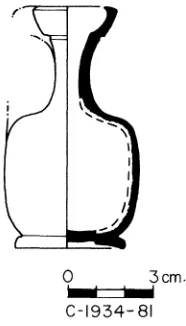
o
3cm.C-1934-81
FIG. 3. Squat lekythos 34.
34. Squat lekythos. Fig. 3, P1. 89
C-34-81. H. 0.085 m.; D. body 0.047 m. Broken and repaired; missing handle and part of body.
Female head left, on broad reserved ground line. The figure wears sakkos and earring. The sakkos is decorated in dilute glaze and bears as well a black dot; the earring is also a black dot. No relief contour except for upper border of ground line. The underside of the foot is re- served; for its profile see Figure 3, and on the shape generally see W. Rudolph, Die Balichleky-
thos, Bloomington, Indiana 1971. Unattributed.
Philippaki, Hesperia, Suppl. X, Small Objects,from the Pnyx: II, Princeton 1956, pp. 23-24, on no. 64.
35. Krater fragment. P1. 89
C-29-153. Max. dim. 0.068 m.
Female head, left, wearing white earring and checkered headband with four pointed leaves. Re- mains of faded white letters(?) above. Opposite, on the left edge of the sherd, a hand, perhaps holding a staff. Relief contours for fingers, face, headband and leaves. Dilute glaze for the ends of hair in the krobylos and for the thin strand that runs in a scalloped line across the forehead to the ear. The figure was probably seated. Good black glaze inside and out, with a narrow reserved band about midway inside.
Attributed to the Meidias Painter (Para, p. 477, no. 7bis).
About 410-400 B.C.
36. Fragments of a pelike. P1. 89
C-38-653. H. pres. 0.105; max. dim. 0.155 m. Two joining fragments. South Stoa (west).
A male head, three-quarters left, right hand resting against furrowed brow. The right elbow possibly leaned upon the tree (laurel or olive) whose trunk and branches are visible above and to the left. A stubbly beard leaves no doubt that the figure is male. He might be thought to wear a wreath, but is in fact being transformed into a tree, whose foliage is like that of the tree beside him. To the right a hand holds an oinochoe in position to pour. The hand also holds a tendril
with ivy leaves (reserved) and white berries. There are white berries also on the tree and be- tween the tips of the leaves above the figure's head. At the lower right edge is part of an uniden- tified object. What remains is the end of an ellipse that bears four small circles drawn in relief. At the base of each is a dark patch that suggests the circles represent raised objects (studs or buttons) casting shadows. It belongs perhaps to the flap of a quiver or the appendage of some elaborate (Orien- tal?) costume. Relief contours throughout, except for the ivy leaves. The scene is bounded above by alternating lotus-blossoms and palmettes. There is shading in dilute glaze on the oinochoe, on the unidentified object, and occasionally on the vo- lutes at the base of the floral border. Good black glaze inside and out; reserved band inside.
Unattributed.
Late 5th or early 4th century B.C.
I can offer no adequate explanation of the sub- ject. There are numerous instances of metamor- phosis in ancient art and literature, but it is not easy to find one for which the remnants of this scene are suitable. The figure's age, sex and ap- parent distress would be appropriate to Kyparissos, even if the foliage is not, but the subject is known chiefly from Latin literature and Pompeian wall- paintings (see A. Rumpf, JdI 63-64, 1948-49, pp. 83-90). To my knowledge it is not represented on Greek vases, and I put the suggestion forward without much conviction. One is left wishing for the poet's license:
The story shall be changed: Apollo flies and Daphne holds the chase.
CEDRIC G. BOULTER
UNIVERSITY OF CINCINNATI
ADDENDUM:
NEW FRAGMENTS OF THE BERLIN PAINTER LEKYTHOS
The excavation campaigns of 1978 and 1979 at ancient Corinth brought to light several new fragments of the long-known lekythos by the Berlin Painter (P1. 90).9 All the fragments come from dumped fills between Piers 33 and 34 of the South Stoa, directly above Building IV. The original fragment with the head and chest of Athena, discovered in 1904, was also found near Pier 34 and not, as reported by Luce,10 in the Lechaion Road area.
a) Max. H. 0.102; W. 0.120 m. Five joining wall fragments now are added to the previously known fragment of the shoulder and upper wall of the vase, with the head and chest of Athena (P1. 90:a).
The new fragments complete the border of the aegis, Athena's left arm, and part of her chiton, himation and spear. Her hand grasps the spear just below the aegis. The full sleeve of the chiton, with crinkly folds of dilute glaze and a scalloped border, hangs from the arm, out- lining the elbow. Near the lower edge of the sleeve is an accidental smear of black glaze. Athena wears a snake bracelet of added red above her wrist. The aegis hangs down her back, its undeco- rated underside visible below the arm until obscured by the himation. This oblique line of the himation as it crosses the aegis may indicate that Athena's left leg was extended back, with all her weight forward.
Relief contour is used throughout, except for the chiton sleeve. The preliminary sketch line from the right shoulder across the breast continues down the body, while the sketch line from the back of the neck across the aegis continues down the right side of the himation.11 These sketches may have outlined the position of Athena's draped left leg. There is also a sketch line for the scalloped border of the chiton, and on either side of the arm.
b) Max. H. 0.074; W. 0.123 m. Four joining fragments from the lower wall of the lekythos (P1. 90:b).
The figure of Herakles wearing the lion skin is preserved from mid-thigh to mid-calf. He stands to right, facing Athena, the left leg slightly advanced. The musculature is in dilute glaze: three lines for the calf and shin, two for the thigh, and two for the kneecap. The lion skin has a streaky wash of dilute glaze. Only its inner surface, visible between the legs as it hangs behind Herakles, is plain, like the aegis. In front of Herakles is the knotted wooden club, and at the right side of the fragment is the shaft of Athena's spear. Below, one pendent saltire square and traces of the flanking meanders are preserved from the lower border, showing that it was prob- ably a mirror image of the upper.
Relief line is used for the knots of the club, the legs, and the lion skin, except for the left side of the tail and the left side of the skin where it does not cross the thigh. Just right of the club, two sketch lines at a slightly different angle are visible through the fine black glaze. There are also sketch lines for the legs and muscles.
" CP-884; Boulter, op. cit. (footnote 1 above). '? Op. cit. (footnote 3 above), p. 334.
c) Max. H. 0.025; W. 0.034 m. Three joining fragments from the wall of the vase (P1. 90:c). Part of Herakles' upper right arm is preserved. The muscles are shown by half ovals of dilute glaze. Relief contour above. Preliminary sketch lines are visible at the side of the arm. The wheel marks on the back of the sherd show that the arm must have been positioned like that of the satyr on the Berlin Painter's Panathenaic amphora in Munich (AR V2, p. 197, no. 9;
CVA, Munich 4 [Germany 121, 195 [5731:1).
d) Max. dim. 0.069 m. A single fragment of the upper wall which joins a previously known fragment of the shoulder preserving part of the reserved outline of a head (P1. 90:d).
The new fragment has part of a meander from the upper border and a dipinto in added red running down in front of the head. The first two letters and traces of the third are visible: AAK. The most likely restoration for the dipinto is "'AXKpEovO KaXo'." Though the Berlin Painter rarely uses kalos names, Alkmeon is praised on an early oinochoe of his (AR V2, p. 1635, no. 185bis), and on a cup of about the same period by the Brygos Painter (AR V2, p. 384, no. 210).
e) Max. H. 0.109; W. 0.069 m. Five joining fragments from the wall of the vase up to the shoulder (not illustrated).
The fragment is not decorated except for the upper border, of which a saltire square and a meander are preserved. Enough traces remain to let one see that there is another meander to the left of the first, rather than the usual black cross. The cross was probably omitted at this point to make the border pattern fit the circumference of the shoulder. This may mean that the fragment comes from the center back, below the handle.
Athena and Herakles occupy the front half of the vase, opposite the handle. The
butt of Athena's spear on b allows one to establish the relative positions of the two
fragments. Since traces of both the upper and lower borders remain, one can estimate
the height of the figured field as 0.115 m. Projecting the pattern of the upper border
from a allows one to put d in its original position, directly above the legs on b. This also
puts the piece of bud12 on d in the correct position for a symmetrical reconstruction of
the shoulder design.
This is the only one of the Berlin Painter's many lekythoi with a two-figured com-
position. Athena and Herakles, though both on the front of the vessel, could not "see"
one another: seen from above, they occupy different quadrants of the circumference.
The helmet which Athena holds out, the downward tilt of Athena's and perhaps Hera-
kles' head, and the V of the spear and club bind the two figures into a single composi-
tion. The backward
extension of Herakles' right leg and, perhaps, Athena's left leg are
particularly
suited to this shape, serving to wrap the composition around the surface of
the vase. Though differing in details, the composition is reminiscent of the Berlin Paint-
er's belly amphora in Basel
(Para,p. 342, no.
Ibis).JULIE L. BENTZ
AMERICAN SCIIOOL OF CLASSICAL STUDIES ATHENS
a.C3-7 cl .C3-7 cl
_~~~~~~~~~~~~~~~~
.~ ~~.Cpb h pdoosPitr atot olg
2 C-31-02 Scale 5:4 3 C-30-53 Scale 9:10
5 C-37-2313 Scale 1:1
4 C-33-228 Scale 2:3
6 CP-1676 Scale 5:4
8 CP-997 Scale 9:8
9 C-32-71 Scale 4:3
10 CP-996 Scale 5:8
11 C-36-530
14 CP-998 Scale 3:2 15 CP-2635 13 C-32-161
16e C-32-73
16b C-32-150b + CP-1690 + C-32-15ok Scale 7:10 16c C-32-150c Scale 4:5
18 CP-999 Scale ca. 1:1
17 C-33-129 Scale 1:2
c. d.r
Details of 17
20 C-32-74
c. Side A: Aithra
b. Side B: Figure 3 Scale 4:3
d. Figures 2 and 3 e. Figures land 2
b. Side B a.
21 C-33-140
C. Side B
d. Interior
19 CP-1000 Scale 5:4
22 C-33-141 Scale 1:1
23 C-39-257a Scale ca. 1: 1
24 C-46-103 Scale 7:3
25 C-36-117 Scale 5 :3
26 b. CP-903 a
c. CP-903 b
27 CP-2621 28 C-32-158Scaleca.2:1
30 CP-1531 Scale 5:4
29 C-33-127 Scale 1:1
32 C-34-371 Scale 5:8 33 C-31-301 Scale 4:5
31 C-28-48 Scale ca. 1 I
34 C-34-81 Scale 1:1
35 C-29-153 Scale 1:1
36 C-38-483 Scalera 1:1|
CEDRIC G. BOULTER AND JULIE
L~~~~~~~~~~. BNZ IFHCNUR TI
c. w~~~~~~~~~~~~~~~~~~~~~b
d.~~~~~~~~~~~~~~~~~~~~~~~~a