9
Volume 6, 2008
FUTURE FOR SCIENCE AND
ENgINEERINg EDUCATION
Boris aberšek
University of maribor, Slovenia E-mail: [email protected]
abstract
School educational systems on the threshold of millennium all over the Europe are experiencing radical changes. Deliberation, which generates this changes, is mostly oriented into balancing which competences (capabilities) should educational system develop with the students, so they can successfully perform roles, that can be expected during their life, and therefore to create their own prosperity.
In this context it is exceedingly important to see curriculum aims •
as global (and not as it happened at previous renovation; subjects dispersion). We have to think about a •
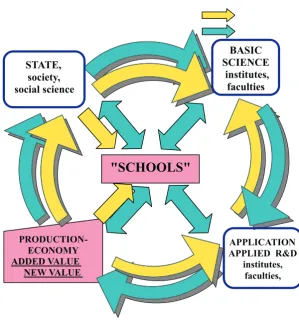
correlation of knowledge between the humanities, social sciences, natural sciences and technical fields and also their role (dimension) at forming entire personality for future grown. It is not possible to deny, that humanities, social sciences, natural sciences and their application: techniques are inseparable connected, because things are getting their practicability value (become logical) only in the field of application. (Foreign language, when or if we meet foreigner, mathematics, when we want to calculate something…). Natural science knowledge gets its meaning in application (techniques), and therefore gets its market value – that can led up to rise social welfare (prosperity). That however reflexively generates new impetus of society: art, culture, humanism…The circle is joined or even better, a vertical spiral is released (Picture 1).
it is highly important to use in this process methods, that’s support such curriculum aims. In our research •
we proposed Problem-Based Learning (PBS). PBS was first established as part of the education of phy
-sicians in medical school over 40 years ago. Developed by Howard Barrows, this strategy has grown into an instructional approach which is finding success in elementary through high school. PBL is now a prominent strategy in many elementary schools through high schools.
Key words: curriculum design, science and enginnering, problem base learning, constructivism, educational research.
Introduction
If we take into consideration that our thinking is correct and think of actual school system, we will find out that we made several mistakes in the last decade (The Education system 2000, White
Paper 1996).
First of all, in desire to teach the children as much as we can, and in search of the right •
10 the interest that is interesting to make something, and the cognition that if we want to do something, to solve the problem, we also have to know something (See Appendix). Even greater mistake was tearing apart above described circle and the elimination of •
technical knowledge out of educational system half of the population. When we have allowed to crossed the technics out of high school curriculum, half of the population does no know what is the use of knowledge, why do they have to learn and what do they learn. In their horizon the circle from knowledge to its application is not connected, an essential element is missing. The most critical point is, that precisely that half of the population is the one that carries out the responsibilities for creating social wellfare (prosperity). The consequences can already be seen and are creating new social problems: not only that there is only a small part of young people who decide for natural sience and technical studies, even the ones who except this decision and conguer natural science and technical knowledge on the highest possible school level (degree, doctorate), can not find the way how to use this knowledge on the application level, to make it reasonable for solving problems (e.g. in economy), for developing new products…
Figure 1. social developmental circle.
In this context is more than calmly to observe the activities of Ministry of Higher Education in connection with the strategy of development in Slovenia (Strategy of development in Slovenia, 2005), which are connected with the guidance of interest with future students of nature science and technical studies. All that indicates that delibiration has been already performed where to is devel
-opment in Slovenia directed and what is necessary education for young people so they can lead and accomplish such development in the right direction.
At this point we have to emphasize, that the excessive interest which youth has for humanities and social study programmes, it is not something that could be solved permanently with the actions of vocational counseling and other activities at the end of secondary school. We need to solve this problem long before that – on the level of primary and secondary school education.
11
IN THE 21 CENTURY Volume 6, 2008
role and the meaning of secondary school and vocational education on minimum, but we have in
-troduced vocational high schools and even there is not enough hours of technics. The interest for technical high shcools is relatively small, from year to year smaller. As already told, more than half of the generation continues their education at classical (general) high school programms, where they do not hear anything about technics, the result is, that a part of the population which carries out the responsibilities for creating social wellfare (prosperity) after the last year at primary school does not have any technical education – and there is no possibility to be interested in such education.
Proposed changes
First proposal
How to solve the educational problems of young generations with technical and nature science knowledge. In this article we will hand out the concrete activities, that will indicate solutions above for mentioned problems, namely: the ones based on existent situation in Slovenia in the field of technics and natural science and also comparison of international succesful systems and economics. We are prepared:
Suggestions for completions and changes for primary school curriculum with knowledges 1.
methodology and contents, which are necessary for economic succesful society in the
near future and
Suggestion for completions and changes for secondary school population with emphasis 2.
on general high scool programms, which are and have to be the foundation for Bologna renovations of higher educational studies.
We have to take into consideration two key principles:
With developing technical capability (competence) we will have to connect (become •
more logical) with natural science knowledge, which at the same time (or before that) is intervened by primary school curriculum or high school curriculum.
At the same time we will have to define aims, contents and activities in curriculum in •
the way, so that would be possible in didactic process of developing technical compe
-tence, to develop key european competences: information compe-tence, communication competence and above all, “how to learn” competence.
Second proposal
We must use methods which enable students to actively participate in educational process while acquiring skills necessary to function in tomorrow’s world, especially tomorrow technological society. It will be mentioned only two the most important methods used in science and engineering studies, namely Problem based learning and Constructivism.
Problem-based learning
Problem-based learning and engaged learning enable students to actively participate in their learning while acquiring skills necessary to function in tomorrow’s technological society. The teacher provides importance guidance throughout the study. Problem-based learning requires an artful com
-bination of a skilled teacher/facilitator who recognizes the value of each step and who takes the time for proper preparation, assimilation, development and involvement. As a result students will:
Engage
• - Define and investigate a research question or problem. Inquire and Investigate
• - Access, process, and apply information through a variety of resources including the use of current technology, i.e., Internet.
Evaluate and Justify
• - Interpret results; develop solutions for real-world application. Communicate
12 Myers (1995) state that “problem-based learning is a curriculum development and instructional system that simultaneously develops both problem solving strategies and disciplinary knowledge bases and skills by placing students in the active role of problem solvers confronted with an ill-structured problem that mirrors real-world problems”.
Goals of Problem-Based Learning
PBL is used to engage students in learning. This is based on several theories in cognitive theory. Two prominent ones are that students work on problems perceived as meaningful or relevant and that people try to fill in the gaps when presented with a situation they do not readily understand. Teach
-ers present students with a problem set, then student work-groups analyze the problem, research, discuss, analyze, and produce tentative explanations, solutions, or recommendations. It is essential to PBL that students do not possess sufficient prior knowledge to address the problem. In the initial discussion, students develop a set of questions that need to be addressed.
Norman and Schmidt (1992) state there are three roles for PBL. The first is the acquisition of factual knowledge, the second is the mastery of general principles or concepts that can be transferred to solve similar problems, and third, the acquisition of prior examples that can be used in future problem solving situations of a similar nature.
Problem-Based Learning - What Are the Benefits?
Using PBL as a strategic tool in the classroom entails the development of the teacher as facilitator of learning, the class as strategic learners and problem solvers, and the district as an innovator and embracer of productive, progressive education. Effective PBL strategies will result in the following benefits for the teacher, the classroom, and the society:
Problems encountered resemble the nature of problems encountered in the real world. •
Problems provide clues, context, and motivation; they are the maps which guide learners to useful facts and concepts.
Since the problem cannot be clearly approached on the first encounter, it becomes a chal
-•
lenge, promoting creative thinking and developing organizational skills.
Prior knowledge provides a foundation for establishing a framework for extending learn
-•
ing opportunities for all parties involved in the process.
Misconceptions about teaching and learning, curriculum, math and science instruction, •
and learner content level understandings are revealed.
The legitimacy of the group’s as well as the individual’s learning goals are established. •
The process empowers the group (student and educator alike at their own level) to assume •
responsibility for directing learning, defining and analyzing problems, and constructing solutions.
Transfer of knowledge and skills is enhanced through the use of multiple tasks and •
problem concepts to help form functional abstractions.
Participants are instructed in becoming responsible members of a learning community •
by active participation in the PBL process.
The PBL process models a strategy that can become a foundation for a life skill- voca
-•
tional training for future problem solvers.
Common understandings and unexamined assumptions are articulated district-wide as •
the PBL process is employed - providing direction and opportunities for staff develop
-ment activities for the future.
Constructivism
13
IN THE 21 CENTURY Volume 6, 2008
experiencing things and reflecting on those experiences. When we encounter something new, we have to reconcile it with our previous ideas and experience, maybe changing what we believe, or maybe discarding the new information as irrelevant. In any case, we are active creators of our own knowledge. To do this, we must ask questions, explore, and assess what we know (Brooks, 1999).
In the classroom, the constructivist view of learning can point towards a number of different teaching practices. In the most general sense, it usually means encouraging students to use active techniques (experiments, real-world problem solving) to create more knowledge and then to reflect on and talk about what they are doing and how their understanding is changing. The teacher makes sure she understands the students’ preexisting conceptions, and guides the activity to address them and then build on them. You might look at it as a spiral. When they continuously reflect on their ex
-periences, students find their ideas gaining in complexity and power, and they develop increasingly strong abilities to integrate new information. One of the teacher’s main roles becomes to encourage this learning and reflection process.
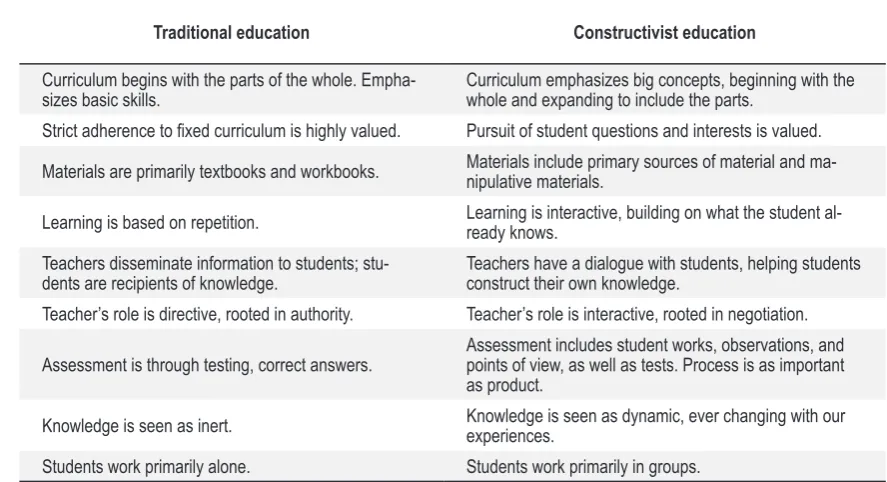
The differences between Traditional and Constructivist class room are indicated in the Table 1.
Results of Research
And now, back to our main problem in Slovenia (and EU too):
We must realize analysis of existant situation in Slovenia and abroad. We must also real
-1.
ize international comparison of primary and secondary school curriculums, along that we will not just realize a paper comparison, but with help of our partners we can also evaluate their experiences and practise and compare their visions, guidelines of develop
-ment in researching field (study cases of good comparable practise (in our region) (See Appendix).
Let us brighten actual situation of technics, technical education in primary school and second
-ary school education.
While there was only 3.2% hours of technical education meant in eight year primary •
school, there are only 1.7% hours remained in nine year primary school.
It is possible to compare that in the international context: a share of technical education •
in Austrian primary school curriculum is 4%+2%, in France 6%, in Finnland 6% and in Italy 10%, e.g. (Source: Comparative analysis of curriculums in the field of technics and tehnology, 1997). This source was a part of renovated documentation.
table 1. traditional education versus constructivist education.
Traditional education Constructivist education
Curriculum begins with the parts of the whole.
Empha-sizes basic skills. Curriculum emphasizes big concepts, beginning with the whole and expanding to include the parts. Strict adherence to fixed curriculum is highly valued. Pursuit of student questions and interests is valued. Materials are primarily textbooks and workbooks. Materials include primary sources of material and manipulative materials.
-Learning is based on repetition. Learning is interactive, building on what the student already knows. -Teachers disseminate information to students;
stu-dents are recipients of knowledge. Teachers have a dialogue with students, helping students construct their own knowledge. Teacher’s role is directive, rooted in authority. Teacher’s role is interactive, rooted in negotiation.
Assessment is through testing, correct answers. Assessment includes student works, observations, and points of view, as well as tests. Process is as important as product.
14 2. We will realize evaluation of existant curriculom for technics and tecnology in connection with natural science in primary school and we will also suggest changes and completions of entire curriculum for primary school – content, aim and methodical renovation. We will aslo develop the proposal of curriculum for general (high school) education. We 3.
will try to introduce modern approches to secondary school students, technical vocation
-als as visions and guidelines of development in this field in the future (Computer based construction and modelling, computer based and integrate productions, automation and robatization, virtual simulation, bionika, nano technology, e.g.) We will include experi
-enced experts, high shcool teachers and we will aslo closely collaborate with them. Their willingness to collaborate can be seen from the enclosure, where we have collected their statements about collaboration.
Methodology
We have to analyse and search for causally conseguent connections of knowledge in natural science and technical field in entire life vertical from basic education to secondary school education, faculty (collage) education to final, lifetime education, informal adult education, with emphasis on economy education for people. Based on that we can organize and develop suitable curriculums and study technologies which can be comparable with different methods and forms of work, that are already realized all over the world, but with that we must also emphasize our experiences and needs.
With an analysis of trends and needs of economy development in Slovenia, we can get neccesary input informations.We must concentrate on human resources and neccesary knowledge of this cadres in the field of natural science and technical branches. We will have to include these congnitions into develompment of curriculums and study enviroment, that will enable and encourage selfstudying, reduce educational time and work absence and will also increase quality. These instruments will enable transition from passive to active forms of teaching, educating and qualifying.
Based on this analysis and suggested innovatory process we can increase quality and quantity of informations, along that we will effectively modify vocational profiles and competences, and with this we will also contribute towards solving problems in fast changing working situations, and enviromentals nature science and technical profiles, that are extra subjected to these changes.
On the bases of knowledge and cognitions of previous researches we have collected more for our research: Germany, France, Great Britain, Greece and Czech. All these countries reflect almost entire range of differences in systems within EU. Worldwide researces in the field of vocational education and qualification are reflecting neccesety to project curriculum, that enables vocational flexibility and conformism of needs in the market of manpower.
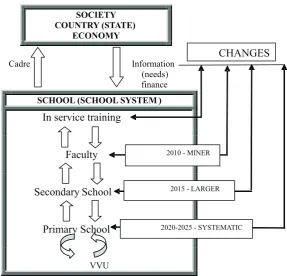
Reforms, in the field of technical and nature science education, are because of pressures from the market of manpower reflecting with time and content frames, study enviroment, and specially with the usage of new informational technologies. With the help of those we can really represent complex authentic situations. We can brighten them up from different sights of angles, what even more magnifisize the quality of education and with that also reduces neccesary time for that. Let us explain all together clearly on the scheme on Picture 2. We have planed this activities in three parts, three phases. We will have to focus mostly on technics and nature science and their connection with society (social competences).
PHASE:
1. Analysis of home situation -in Slovenia. We will perform
- literature anaysis and or acts, as e.g. Strategy of development in Slovenia…(Strategy of development in Slovenia,2005)
- analysis with the help of standard and nonstandard questionnaires, - recording situation– conversation, interview…
15
IN THE 21 CENTURY Volume 6, 2008
Figure 2. strategic development of human resources.
PHASE:
2. An international researches oriented mainly within EU and the ones that at least partly consider global area – USA, and also fast developing countries in Asia. With this will perform:
- analysis of existant situation in the field of economy and schooling.
- analysis of trends, guidelines of economy develompment and responses of school systems on changes in economy.
PHASE:
3. Elaboration of changes and completions of curriculum for technics and nature science in a primary school and aslo suggestion for curriculum in general high school programm. We will proceed from some general knownledges and general valid principles:
the cadre, which is produced by our school system, is not any more the cadre, that our a.
economy needs (for encouragement of naturale science and technical studies from the side of Ministry of Higher Education, Science and Technology).
If we want to tacle the problem entirely, we have to be aware that the school system is b.
inseparable integrity, which connects kindergartens, primary school, secondary school and univerities in the lifetime learning system. Every change of individual segment directly influences to all other segments.
With the changes of the individual segment we achieve time connected changes and c.
different intensity of changes. So we find out that:
primary school changes generate long - term, entire, larger changes, results of those •
will be shown in our economy in the year 2020 – 2025,
secondary school changes generate medium – term, larger changes and will be shown •
in our economy after 2015,
Bologne changes are short – term, not systematic, for those we can not be certain if •
they will fulfil local demends and also hardly likely global demands. Results of those will be shown after the year 2010, 2015
lifetime learning, - in service training – satisfys current, short – term needs, and it •
16 d. More than half of secondary school students do not hear anything about technics (and comparison between technics and natural science) after they turn twelve. That means, that everyone who attends high school programms, the ones that are responsible for creat
-ing social welfare (prosperity), do not hear anyth-ing about technics or about connection between technics, natural science and social science. They do not know why do they have to learn. And they also do not know why a person should choose nature science study programm or technics. But the fact is that society needs them; we need technical and science educated people.
On the base of Phase 1 and Phase 2 we will therefore prepare optimal model of completitions and changes of the curriculum for primary school and aslo proposal model of curriculum for general high schools.
THE MAIN AIM OF THIS ACTIVITIES IS: IN ONE SIDE SYSTEMATIC PLANNING OF REQUIRED HUMAN RESOURCES FOR ECONOMY IN LONG – TERM PERIOD AFTER
THE YEAR 2025 AND AT OTHER SIDE INCORPORATION IN SCIENCE AND ENGINEER
-ING STUDIES METHODS OF EDUCATION THAT PRODUCE HIGH LEVEL LONG TERM KNOWLEDGE.
conclusion and disscusion
If we want to change the school system ( universities, secondary schools, primary schools, educational and protectional institutions) to be proceed systematicaly – entirely, because only that kind of approach will gives us complete solutions (Strategy of develop. in Slovenia, 2005), but we have to take into consideration following:
- demands of final user – economy, that considers local demands, local trends of devel
-opment that is based on history facts and actual possibilities (financial, enploymental, developmental…). These demands are usually short - term, and with these they mostly do not consider Slovenian trends of development, not even global trends of development: Europe and the rest of the World, therefore we have to take into consideration also;
- trends of development in the World, that are presenting long - term visions of develop
-ment. With that we should not neglect the danger of only exclusively observation of this problem from global perspective, such kind of outlook does not consider local speciality.
THE ADVANTAGE OF SUGGESTED SOLUTIONS IS MAINLY IN ITS WIDENESS; AND IN CONSIDERATION OF BOTH ABOWE MENTIONED IMPORTANT VIEWPOINTS!
References
The Education system in Slovenia (2000). Ministry of Education and Sport, Eurydice Unit. Ljubljana.
White Paper on Education in the Republic of Slovenia (1996). Ministry of Education and Sport. Ljubljana. Strategy of development in Slovenia (2005). Goverment of RS, Ljubljana
Comparative analysis of curriculums in the field of technics and tehnology (1997). Institut RS for Schools and Sports. Ljubljana.
Myers, R., (1995). Problem-Based Learning and Technology. NASA Classroom of the Future, Wheeling Jesuit
University, Wheeling.
Norman and Schmidt (1992). The psychological basis of problem-based learning: a review of the evidence,
Academic Medicine, Vol. 67, No. 9, pp. 557-565
Brooks, J.G., and Brooks, M.G. (1999). In Search of Understanding: The Case for Constructivist Classroom.
17
IN THE 21 CENTURY Volume 6, 2008
aPPendIX
A share of technological education in compulsory subjects, as it is shown on the table bellow, it presents for most part around 6% of all time. We collected informations that were available.
AUSTRIA 4 % + 2 % manual work + textile / technology
FRANCE 6 % technology
FINLAND 6 % manual work
ITALY (11 - 14 years) 10 % technical education
ISRAEL 6 % manual skills
HUNGARY 6 % technology
HOLLAND 3 % manual work, technological education
NORWAY 9 % art, manual work
SWEDEN 12 % natural science and technology
SLOVENIA (before reform) 3,2 % technical education SLOVENIA (after reform) 1,3 % technics and technology
Country age in years 6 7 8 9 10 11 12 13 14 15
Austria manual work 1 1 2 2 2 2
textile or technology 2 2
France, general technology 2 2 2 2
technological technology 2 2 7 7
Croatia technical culture 1 2 1 1
Germany, Hauptschule work and technics 1 1 4 4 4
Realschule work and technics 1 1 4 - -
-Holland manual work 1 1 1 1 1 1
technological education 180 hours
Slovenia
before reform technical education 1 2 1 2
Slovenia
after reform 2000 nature science and technics 1 1
technics and technology 2 1 1
-Adviced byLaima Railienė, Siauliai University, Lithuania
Boris Aberšek Professor at Faculty of Mechanical Engineering and Faculty of Education, University of Maribor, Koroška 160, 2000 Maribor, Slovenia.
E-mail: [email protected]