Reflection
waves
problem
in
a
generalized
thermoelastic half-space with two temperature and
rotation
S. M. Abo-Dahab
1,2*
and Kh. Lotfy
3and Udai Al-Juboori
41
Department of Mathematics, Faculty of Science, Taif University, Taif 888, Saudi Arabia.
2
Department of Mathematics, Faculty of Science, South Valley University, Qena 83523, Egypt..
3
Department of Mathematics, Faculty of Science, Zagazig University, Zagazig 44519, Egypt.
4
College of Arts and Science, Applied Science University, Kingdom of Bahrain.
Accepted 5 March, 2019
ABSTRACT
The theory of two-temperature generalized thermoelasticity based on the theory of Youssef is used to solve the boundary value problems of two dimensional half-space with heating its boundary with different types of heating. The governing equations are solved using new mathematical methods under the purview of the classical dynamical coupled theory (CD) and Lord-Şhulman theory (LS). The general solution obtained is
applied to a specific problem of a half-space subjected to one types of heating thermal shock type. The normal mode method is used to obtain the exact expressions for the displacement components, force stresses, and temperature distribution for a mode-I crack. The variations of the considered variables through the horizontal distance are illustrated graphically. Comparisons are made with the results between the two theories.
Keywords: Thermoelasticity, A mode-I crack, two temperature, Lord-Şhulman theory, coupled theory. *Corresponding author. E-mail: [email protected].
Nomenclature:
a Two temperature parameter
E
C
Specific heat per unit masse
Cubical dilatationij
e
Components of the strain tensor iF Lorentz force
K
Thermal conductivity P Initial pressureT
Absolute temperature 0T
Temperature of the medium in itsnatural state assumed to be
1
00
T
T
T
i
u
Components of the displacement vectort
α Coefficient of linear thermal expansion
ij
δ
Kronecker delta function 0 Electric permittivity 0 T
Conductive temperature
Initial stress parameter
μ
λ,
Counterparts of Lame’s parameters 0μ Magnetic permeability 0
T T
Thermodynamical temperature
ρ
Density of the mediumij
Components of the stress tensor 0
Thermal relaxation timeAfrican Journal of Engineering Research
Vol. 7(2), pp. 33-44, May 2019 ISSN: 2354-2144
INTRODUCTION
For classical uncoupled and coupled theories of thermoelasticity, the heat conduction equations are of the diffusion types which lead to infinite speeds of propagation for heat waves contrary to physical observations. Wide spread attentions to eliminate this paradox has been given to thermoelasticity theories which admit a finite speed for the propagation of thermal waves. Many authors have formulated generalized theories involve a hyperbolic-type heat equation and are referred to as generalized thermoelasticity. Three generalizations to the coupled theory were introduced. The classical coupled thermoelasticity theory proposed by Biot (1956) with the introduction of the strain-rate term in the Fourier heat conduction equation leads to a parabolic-type heat conduction equation "called the diffusion equation". This theory predicts finite propagation speed for elastic waves because of the physically unrealistic infinite speed for thermal disturbance. To overcome such an absurdity, generalized thermoelasticity theories have been propounded by Lord and Shulman (1967) as well as Green and Lindsay (1972) advocating the existence of finite thermal wave speed in solids.
These theories have been developed by introducing one or two relaxation times in the thermoelastic process, either by modifying Fouriers heat conduction equation or by correcting the energy equation and Neuman-Duhamel relation. Various problems characterizing these theories have been investigated and has revealed some interesting phenomenon. Brief reviews of this topic have been reported by Chandrasekharaiah and Srinath (1998), and Chandrasekharaiah and Murthy, (1991). The interplay of the Maxwell electromagnetic field with the motion of deformable solids is largely being undertaken by many investigators owing to the possibility of its application to geophysical problems and certain topics in optics and acoustics. Moreover, the earth is subject to its own magnetic field and the material of the earth may be electrically conducting. Thus, the magneto-elastic nature of the earth's material may affect the propagation of waves. A comprehensive review of the earlier contributions to the subject can be found in the study by Puri (1972). Nayfeh and Nemat-Nasser (1972) considered the generalized magneto-thermoelastic equations who studied the propagation of plane waves in a solid under the influence of an electromagnetic field. They have obtained the governing equations in the general case and the solution for some particular cases. Choudhuri and Mukhopdhyay (2000) extended these results to rotating media. Ezzat and Othman (2000) has studied the problem of generation of generalized magneto-thermoelastic waves by thermal shock in a perfectly conducting half-space. Ezzat et al. (2001) have established the model of two dimensional equations of generalized magneto-thermoelasticity. In dealing with classical or generalized thermoelastic problems in most
situations, the displacement potential function approach is used. However Bahar and Hetnarski (1977a, 1977b) outlined several disadvantages of the potential function approach. These may be summarized in the fact that the boundary and initial conditions of the problem are not related directly to the potential function, as it has no physical meaning explicitly.
Secondly, more stringent assumptions must be made on the behaviour of potential functions than on the actual physical quantities. Last of all, it was found that many integral representations of physical quantities are convergent in the classical sense while their potential function representations only converge in the mean. To get rid of these difficulties, Bahar and Hetnarski (1978) introduced the state space formulation in thermoelastic problems. This state space approach has been further developed in Sherief (1993) to include the effect of heat sources. Sherief and Anwar (1994) surveyed a two-dimensional thermal shock problem for a semi-infinite piezoelectric rod using state space approach. Youssef and El-bary (2006) put forward an analysis for a generalized thermoelastic infinite layer problem under three theories using state space approach. State space formulation to the vibration of gold nano-beam in femto-seconds scale was done by Elsibai and Youssef (2011).
The theory of heat conduction in a deformable body, formulated by Chen and Gurtin (1968) and Chen et al. (1968; 1969) depends on two different temperatures the conductive temperature and the thermo dynamical temperature. Chen et al. (2004) have suggested that the difference between these two temperatures is proportional to heat supply. In absence of heat supply, these two temperatures are identical for time independent situation. However, for time dependent cases, particularly for problems related to wave propagation, the two temperatures are in general different, regardless of heat supply. The two temperature thermoelasticity theory has gained much attention of the researchers in the recent years. The existence, structural stability, convergence and spatial behaviour of two temperature thermoelasticity have been provided by Quintanilla and Tien (1993). Youssef (2006) has developed a new model of generalized thermoelasticity that depends on two temperatures
T
and
, where the difference between the two temperatures is proportional to heat supply,ii
with a non-negative constant a (length2). Youssef
and Al-Lehaibi (2007) and Misra et al. (1987) investigated various problems on the basis of two temperature thermoelasticity with relaxation times and showed that the obtained results are qualitatively different as compared to those in case of one temperature thermoelasticity.
Song (2008) studied the effect of rotation in a micropolar generalized thermoelastic and thermo-viscoelasticity half space under different theories. The propagation of plane harmonic waves in a rotating elastic medium without thermal field has been studied. It was shown there that the rotation causes the elastic medium to be dispersive and an isotropic. These problems are based on more realistic elastic model since earth; moon and other plants have angular velocity.
Owing to the mathematical difficulties encountered in two and three dimensional multi-field coupled generalized heat conduction problems, the problems become too complicated to obtain an analytical solution. Instead of analytical methods, several authors have applied numerical methods such as finite difference method, finite element method and boundary value method etc. for solving such kind of problems. One can find several
two-dimensional works based on the generalized
thermoelasticity by using the normal mode analysis in the literatures Ezzat and Abd Elall (2010), Othman and Lotfy (2010a, b), Lotfy and Othman (2011), Lotfy (2012) and Sarkar and Lahiri (2012). Using the normal mode analysis technique, we will get the solution in the Fourier transformed domain actually. To apply the normal mode analysis, we have to assume that all the relations are sufficiently smooth on the real axis such that the normal mode analysis of all these functions exist. The normal mode analysis (Ezzat and Abd Elall, 2010; Othman and Lotfy, 2010a; Othman and Lotfy, 2010b; Lotfy and Othman, 2011) was used to obtain the exact expression for the temperature distribution, thermal stresses, and the
displacement components.
In the recent years, considerable efforts have been devoted the study of failure and cracks in solids. This is due to the application of the latter generally in industry and particularly in the fabrication of electronic components. Most of the studies of dynamical crack problem are done using the equations of coupled or even uncoupled theories of thermoelasticity (Dhaliwal, 1980; Hasanyan et al., 2005; Ueda, 2003; Elfalaky and Abdel-Halim, 2006). This is suitable for most situations where long time effects are sought. However, when short time are important, as in many practical situations, the full system of generalized thermoelastic equations must be used (Lord and Shulman, 1967). Some contribution taking into account rotation, initial stress are discussed (Abd-Alla et al., 2003; Abo-Dahab and Mohamed, 2010; Abo-Dahab et al., 2011a; Abo-Dahab, 2011; Abo-Dahab et al., 2011b; Abo-Dahab and Singh, 2013; Othman et al., 2016; Abo-Dahab, 2018). Abo-Dahab (2018) investigated reflection of generalized magneto-thermoelastic waves with two temperatures under influence of thermal shock and initial stress.
The present article is intended to demonstrate the use of the normal mode analysis in analyzing the propagation of thermoelastic waves in two temperature theory of thermoelasticity under the effect of rotation. Normal mode analysis is employed to obtain the exact solution. Numerical values of the field quantities are calculated by considering illustrative examples and their variations with respect to space coordinate are displayed graphically and discussed under a mode I-crack.
FORMULATION OF THE PROBLEM
In the present article, the authors consider the problem of a homogeneous, isotropic, elastic half-space (x ≥ 0). The
surface of the half-space is subjected initially (t = 0) to a thermal shock that is a function of y and t. Thus all the quantities considered in this problem will be functions of the time variable t and coordinates x, y. We can introduce the equations of the problem as following:
The heat conduction equation considering LS theory takes the form (Youssef, 2006):
2
,ii 0 2
(
E 0 i j,)
K
C T
T u
t
t
(1)
The constitutive equation takes the form:
ij ij
ij kk
ij
e
e
T
2
. (2)Since the medium is rotating uniformly with an angular velocity
n
,
wheren
is a unit vector representing the direction of the axis of rotation. The displacement equation of motion in the rotating frame of reference has two additional terms, centripetal acceleration,
(
u)
due to time-varying motion only and the Corioli's acceleration2
u
whereu
is the dynamic displacement vector.Figure 1a. Geometry of the problem.
,[
u
i(
u
)
i(2
u) ]
i ji j,
(i
,
j
1
,
2
,
3
). (3)The relation between the heat conduction and the dynamical heat takes the form
ii
a
T
,
(4)where,
a
> 0 two-temperature parameter, (Youssef, 2006).Now, we will suppose elastic and homogenous half-space
x
0
which obey Equations 1 to 4 and initially quiescent where all the state functions are depend only on the dimension x, y and timet
.The displacement components for one dimension medium have the form:
)
,
,
(
x
y
t
u
u
x
,u
y
v
(
x
,
y
,
t
)
andu
z
0
. (5)The strain component takes the form:
).
(
2
1
, ,j ji i
ij
u
u
e
(6)The heat conduction equation takes the form:
2 2 2 2
0 0 0
2 2 2 E 2
.
u
v
K
C T
T
x
y
t
t
t
t
x
y
(7)
The constitutive law equations can be written as:
T
y
v
x
u
)
2
μ
(
σ
xx
, (8)T
x
u
y
v
)
2
μ
(
σ
yy
, (9)xy
u
v
σ
x
y
Using the summation convection. From (Roy Choudhuri and Mukhopdhyay, 2000; Ezzat and Othman, 2000; Ezzat et al., 2001), we note that the third equation of motion in (3) identically satisfied and first two equations become:
x
x
e
u
v
u
t
u
T
2
2 2 2 2
(11)
T
.
2
2 2 2 2y
y
e
v
u
v
t
v
(12)The relation between the heat conduction and dynamical heat takes the form:
2 2 2 2
(
)
T
a
x
y
(13)To transform the above equations into non-dimensional forms, we define the following non-dimensional variables
1
(
x y u v
,
,
, )
C
( , , , )
x y u v
,( ,
t
0
,
0
)
C
12
( ,
t
0,
0)
,0 0
( , )
( ',
)
T
T
T
,
2
ij ij 2 0c
(14)where,
K
C
E
,
2 2C
andC
122
.Hence, we have (dropping the dashed for convenience)
0
t
)
t
1
(
t
)
t
τ
(1
0 02
e
(15)2 2 2 2
x
y
(16) where EC
and
a C
2 12Assuming the scalar potential functions
( , , )
x y t
and
(
x
,
y
,
t
)
defined by the relations in the non-dimensional form:u
x
y
,v
y
x
. (17)By using (17) and (14) in Eqs. (11) and (12), we obtain.
2 2 2
0
2
2
a
0
t
t
(18) 2 2 21 2 1
2
10
a
a
a
t
t
where
20 1
C
a
, 20 0 0
C
T
a
. (20)The heat condaction Equation 15 becomes
2 2
0 0
1
τ
1
0
t
t
t
t
(21)
We assume now the solution of Eqs. (13)-(15) takes the following form:
, , ,
, , ,T
exp[i
x sin y cos )
it] (22) where,v
.Substitute from Eq. (22) into Eqs. (16), (18), (19) and (21), we get
2
1
(23)2 2 2
0
[
] 2i
a T 0 (24)2 2 2
1 1
[
a (
)] 2i
a 0 (25)2 2
0
o o
i t i t
(26)
where, to 1 i o.
Equations 23 to 26 have a nontrivial solution if and only if the determinant vanished, so
2
2 2 2
0
2 2 2
1 1
2 2
0 0 1 1
2 0
0
2 ( ) 0 0
0
o o
i a
i a a
i t i t
(26)
This yields an algebraic equation on
2 2
2
v
, where, v is the coupled wave velocity.6 4 2
0
A
B
C
D
(27) where,1
o(1
o),
A
i
t
a
1o
(1
0)
o(
o1)
(1
1),
B
i
a t
a
i t
a
a
2 2 2
1 1 0 1 1 1 1
(1
) 4
(
)
,
o o
C
i
t
a
a
a a
a
i
a t
a
2 2 2 2 2
1o
(4
),
Equation 27 indicates that there are three reflected waves; T-, p- and SV-waves.
SOLUTION OF THE PROBLEM
Where, Equation 25 has two roots in
2, there are two coupled wavesT
-wave, p-wave and SV-waves with three different velocities. Assuming that the radiation in vacuum is neglected, when a coupled wave falls on the boundary0
z
from within the thermoelastic medium, it will make an angle
with the negative direction of the z-axis, and three reflected waves that will make angles
and
i(i = 1, 2, 3) with the same direction as shown in Figure 1b.Figure 1b. Geometry of the problem.
The displacement potentials, ,
, and , will take the following forms:
3
0 1
1
exp[
sin
cos )
]
jexp[
jsin
jcos
j)
]
j
A
i
x
y
i t
A
i
x
y
i t
(28)
3
0 1 1
1
exp[
sin
cos )
]
j jexp[
jsin
jcos
j)
]
j
A
i
x
y
i t
A
i
x
y
i t
(29)
3 1 0 1
1
exp[
sin
cos )
]
j jexp[
jsin
jcos
j)
]
j
A
i
x
y
i t
A
i
x
y
i t
(30)
3 1 0 1
1
exp[
sin
cos )
]
j jexp[
jsin
jcos
j)
]
j
A
i
x
y
i t
A
i
x
y
i t
(31)Where
1
2 2
1 2
2
,
,
1, 2,
1
1
(
2
),
j
j j
j j
j j j
o
i
a
j
a
i
a
The ratios of the amplitudes of the reflected waves for the incident p-wave are
0
,
1, 2,3.
j
A
j
A
Also it may be notedthat the angle
,
j (j = 1, 2,3), and the corresponding wave numbers,
j,
j
1, 2, 3,
are to be connected by the following relations according to Snell’s law as follow:1
sin
1sin
1 2sin
2 3sin
3
(33)BOUNDARY CONDITIONS
(1) A mechanical boundary condition that the surface of the half-space is traction free:
( , 0, )
0,
( , 0, )
0
xx
x
t
xyx
t
(34)Substitute from Equations 16 to 19, we get
2 2
1 1 1 0
3
2 2
1
2 (sin sin cos )
2 (sin sin cos ) 0
o
j j j j j o j j
j
T A
T A
(35)
3
2 2
1 1 0
1
(
cos 2
sin 2 )
j(
jcos 2
jsin 2
j)
j0
j
A
A
(36)(2) Assuming that the boundary
z
0
is thermally insulated. This means that the following relation will be:0
on
0
T
y
z
(37)Substitute from Equation 30, we obtain:
3
1 1 0
1
cos
j jcos
j j0
j
A
A
(38)From Equations 35, 36 and 38 we can put them in the following algebraic equation for the incident wave as follows:
3
1 0
1 0
,
j,
1, 2,3,
ij j i j
j
A
a Z
b
Z
j
A
(39)where,
2 2
1j j
2
(s in
j jsin
jco s
j)
o j,
a
T
2
2j j
(
jcos 2
jsin 2
j),
a
3j j j
cos
j,
a
2 2
1 1 1 1
2 2 1 1 3 1 1
2 (sin
sin cos )
,
(
cos 2
sin 2 ),
cos .
o
b
T
b
b
NUMERICAL RESULTS
In order to analyze the above problem numerically, we now consider a numerical example for which computational results are given. The results depict the variation of temperature, displacement and stress fields in the context of two theories. To study the effect of rotation and two temperatures on wave propagation, Crust is taken as the thermoelastic material for which we take the following values of the different physical constants:
10 2
3 10
N m
.
,
1 13
.
.
,
K
W m
K
T
0
300
K
,
g
9.8,
11 1
1.6 10
k
,
2900
kg m
.
3,
C
E
1100 .
J kg
1.
K
1.
The computations were carried out as folows:
Figures 2 to 4: plot magnitude of the amplitudes ratios
Z
1,
Z
2 andZ
3 with respect to the angle of incidence for p-wave with varies values of rotation
, thermal relaxation time
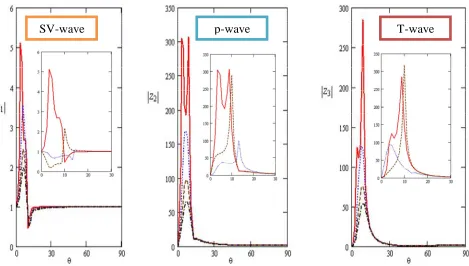
0 due to Lord and Shulman theory and two temperature parameter a. It clear that the magnitudes of all amplitudes ratios decrease with an increasing values of rotation, that physically indicated to the interrupted effect for rotation on all amplitudes of reflected waves due to the p-wave incidence on the interface.Figure 2 shows the variation of the magnitude of amplitudes ratios
Z
1,
Z
2 andZ
3 of reflected of p-wave with respect to the angle of incidence
for different values of rotation
, the magnitude of amplitude ratioZ
1 which displays reflected SV-wave increases from unity at
0
o, arriving to its maximum value and decreases tends to unity90
o
, it appears that the magnitude of amplitudes ratiosZ
2 which displays reflected p-wave andZ
3 which displays reflected T-wave start from zero at
0
o arriving to their maximum values and reduce to zero at
90
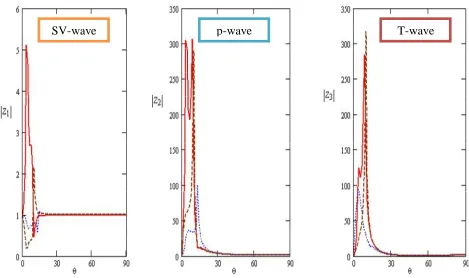
o. From Figure 3, we concluded that relaxation time
0 has strong effect on the magnetudes of amplitudes rations, and has greatest values with the low value of relaxation time.SV-wave
p-wave
T-wave
SV-wave
p-wave
T-wave
Figure 3. Variation magnitudes of reflection coefficients
Z
i,
i
1, 2, 3
with respect of angle of incidence
with varies values of relaxation time
o
0.011___,0.012...,0.013
.SV-wave
p-wave
T-wave
Finally, from Figure 4, we can conclude that the magnitude of reflection coefficients have lowest values in one temperature (i.e., a = 0) comparing with the corresponding values of two temperature (a = 0.011, 0.012).
CONCLUDING REMARKS
Theory of generalized thermoelatsticy with two temperature heat transfer and rotation is a new important branch of research, especially, in Engineering, Geophysics, Acoustics, Physics, and Plasma. In literature, there are only a few numbers of investigations
based on the two temperature generalized
thermoelatsicty.
According to the analysis above, we can conclude the following points:
1. Analytical solutions based upon reflection phenomena considering (LS) theory for themoelastic problem in solids have been developed and utilized.
2. The theory of two-temperature generalize thermoelasticity describes the behavior of the particles of the elastic body more real than the theory of one-temperature generalized thermoelasticity.
3. Magnitudes of all amplitudes ratios decrease with an increasing values of rotation of reflected waves due to the p-wave incidence on the interface.
4. It is clear from all the figures that all the magnitudes of amplitudes ratios start from unity and tends to unity concerns SV-wave, but from to zero concern p- and T-waves.
5. Two temperature has a strong effect on the reflection phenomena comparing with the correspondence one temperature.
6. Physically, it clears that the rotation affect negatively on all magnetudes of the amplitudes ratios indicates to the useful of rotation effect on reflection phenomena, especially, in geophysics, earthquakes and volcanoes.
REFERENCES
Abd-Alla AN, Yahia AA, Abo-Dahab SM (2003). On the reflection of the generalized magneto-thermo-viscoelastic plane waves. Chaos Solitons Fractals, 16(2): 211-231.
Abo-Dahab SM (2011). Reflection of P and SV waves from stress-free surface elastic half-space under influence of magnetic field and hydrostatic initial stress without energy dissipation. J Vib Control, 17(14): 2213-2221.
Abo-Dahab SM (2018). Reflection of generalized magneto-thermoelastic waves with two temperatures under influence of thermal shock and initial stress. J Heat Transfer, 140(10): 102005. Abo-Dahab SM, Mohamed RA (2010). Influence of magnetic field and
hydrostatic initial stress on reflection phenomena of P and SV waves from a generalized thermoelastic solid half-space. J Vib Control, 16: 685-699.
Abo-Dahab SM, Mohamed RA, Abd-Alla AM (2011b). Effect of relaxation times and magnetic field on the reflection of thermoelastic waves from isothermal and insulated boundaries of a half space. Int Rev Phys, 5(5): 247-258.
Abo-Dahab SM, Mohamed RA, Singh B (2011a). Rotation and magnetic field effects on P wave reflection from stress-free surface elastic half-space with voids under one thermal relaxation time. J Vib
Control, 17(12): 1827-1839.
Abo-Dahab SM, Singh B (2013). Rotational and voids effects on the reflection of P waves from stress-free surface of an elastic half-space under magnetic field, initial stress and without energy dissipation. Appl Math Modelling, 37: 8999-9011.
Bahar LY, Hetnarski R (1978). State space approach to thermoelasticity. J Thermal Stresses, 1:135-145.
Bahar LY, Hetnarski RB (1977a). In: Proc. 6th Can. Congr. Appl. Mech. University of British Columbia, Vancouver, BC, Canada. pp: 17–18.
Bahar LY, Hetnarski RB (1977b). In: Proc. 15th Midwest Mech. Conf. University of Illinois, Chicago Circle. 161–163.
Biot MA (1956). Thermoclasticity and irreversible thermodynamics. J Appl Phys, 27: 240-253.
Chandrasekharaiah DS, Murthy HN (1991). Temperature-rate-dependent thermo-elastic interactions due to a line heat source. Acta Mech, 89: 1-12.
Chandrasekharaiah DS, Srinath KS (1998). Thermoelastic interactions without energy dissipation due to a point heat source. J Elasticity, 50: 97-108.
Chen JK, Beraun JE, Tham CL (2004). Ultrafast thermoelasticity for short-pulse laser heating. Int J Eng Sci, 42:793–807.
Chen PJ, Gurtin ME (1968). On a theory of heat conduction involving two temperatures. Zamp, 19: 614–627.
Chen PJ, Gurtin ME, Williams WO (1968). A note on non-simple heat conduction. Zamp, 19: 969-970.
Chen PJ, Gurtin ME, Williams WO (1969). On the thermodynamics of non-simple elastic materials with two temperatures. Zamp, 20:107– 112.
Dhaliwal R (1980). External Crack due to Thermal Effects in an Infinite Elastic Solid with a Cylindrical Inclusion. Thermal Stresses in Server Environments Plenum Press, New York and London. 665-692. Elfalaky A, Abdel-Halim AA (2006). A mode-I crack problem for an
infinite space in thermoelasticity. J Appl Sci, 6: 598-606.
Elsibai KH, Youssef H (2011). State space formulation to the vibration of gold nano-beam induced by ramp type heating without energy dissipation in femtoseconds scale. J Thermal Stresses, 34: 244–263. Ezzat M, Othman MIA, El-Karamany AS (2001). Electromagneto-thermoelastic plane waves with thermal relaxation in a medium of perfect conductivity. J Thermal Stresses, 24: 411-432.
Ezzat MA, Abd Elall MZ (2010). Generalized magneto-thermoelasticity with modified Ohm’s law. Mech Adv Mater Structures, 17: 74-84. Ezzat MA, Othman MIA (2000). Electromagneto-thermoelastic plane
waves with two relaxation times in a medium of perfect conductivity. Int J Eng Sci, 38: 107-120.
Green AE, Lindsay KA (1972). Thermoelasticity. J Elasticity, 2: 1-7. Hasanyan D, Librescu L, Qin Z, Young R (2005). Thermoelastic
cracked plates carrying nonstationary electrical current. J Thermal Stresses, 28: 729-745.
Lord HW, Shulman Y, 1967. A generalized dynamical theory of thermolasticity. J Mech Phys Solids, 15: 299-306.
Lotfy KH (2012). Mode-I crack in a two-dimensional fibre-reinforced generalized thermoelastic problem.Chin Phys B, 21(1): 014209. Lotfy KH, Othman MIA (2011). The effect of rotation on plane waves in
generalized thermo-microstretch elastic solid with one relaxation time for a mode-I crack problem.Chin Phys B, 20(7): 074601.
Misra JC, Kar SB, Samanta SC (1987). The effects of mechanical and thermal relaxations in a heated viscoelastic medium containing a cylindrical hole were studied. Trans CSME, 11: 151.
Nayfeh A, Nemat-Nasser S (1972). Transient thermoelastic waves in half-space with thermal relaxation. ZAMP, 23: 52-68.
Othman M, Lotfy KH (2010b). Generalized thermo-microstretch elastic medium with temperature dependent properties for different theories. Eng Anal Boundary Elements, 34: 229-237.
Othman MIA (2005b). Effect of rotation and relaxation time on thermal shock problem for a half-space in generalized thermovisco-elasticity. Acta Mechanica, 174: 129-143.
Othman MIA, Abo-Dahab SM, Alsebaey ONS (2016). Reflection of plane waves from a rotating thermoelastic medium with two-temperature under the influence of gravity with three theories. J Comput Theor Nanosci, 13(11): 8575-8582.
Othman MIA, Lotfy KH (2010a). On the plane waves in generalized thermo-microstretch elastic half-space. Int Commun Heat Mass Transfer, 37: 192-200.
Othman MIA, Singh B (2007). The effect of rotation on generalized micropolar thermoelasticity for a half-space under five theories. Int J Solids Structures, 44: 2748-2762.
Othman MIA, Song Y (2008). Effect of rotation on plane waves of the generalized electromagneto-thermo-viscoelasticity with two relaxation times. Appl Math Modelling, 32: 811-825.
Puri P (1972). Plane waves in thermoelasticity and magneto-thermoelasticity. Int J Eng Sci, 10: 467-476.
Quintanilla TQ, Tien CL (1993). Heat transfer mechanism during short-pulse laser heating of metals. ASME J Heat Transfer, 115:835–841. Roy Choudhuri SK, Debnath L (1983a). Magneto-thermoelastic plane
waves in a rotating media. Int J Eng Sci, 21: 155-163.
Roy Choudhuri SK, Debnath L (1983b). Magneto-elastic plane waves in infinite rotating media. J Appl Mech, 50: 283-288.
Roy Choudhuri SK, Mukhopdhyay S (2000). Effect of rotation and relaxation on plane waves in generalized thermo-viscoelasticity. Int J Math Math Sci, 23: 479-505.
Sarkar N, Lahiri A (2012). A three-dimensional thermoelastic problem for a half-space without energy dissipation. Int J Eng Sci, 51: 310-325.
Sherief H (1993). State space formulation for generalized thermoelasticity with one relaxation time including heat sources. J Thermal Stresses, 16: 163-176.
Sherief H, Anwar M (1994). A two dimensional generalized thermoelasticity problem for an infinitely long cylinder. J. Thermal Stresses,17:213–227.
Ueda S (2003). Thermally induced fracture of a piezoelectric laminate with a crack normal to interfaces. J Thermal Stresses, 26: 311-323. Youssef HM (2006). Theory of two-temperature-generalized
thermoelasticity. IMA J Appl Math, 71: 383−390.
Youssef HM, Al-Lehaibi EA (2007). State-space approach of two-temperature generalized thermoelasticity of one-dimensional problem. Int J Solids Structures, 44: 1550–1562
Youssef HM, El-Bary AA (2006). Mathematical model for thermal shock problem of a generalized thermoelastic layered composite material with variable thermal conductivity. Com Meth Sci Tech, 12(2): 165- 171.
Citation: Abo-Dahab SM, Lotfy K, Al-Juboori U (2019). Reflection