40
Ewa Bacia, Research Assistant, Technische UniversitätBerlin, Institut für Erziehungswissenschaft, Marchstr. 23, 10587 Berlin.
E-Mail:[email protected]
Angela Ittel, Chair of Educational Psychology, Institute of Educational Science, Technische Universität Berlin. E-Mail:[email protected]
Ewa Bacia, Angela Ittel
Education to Thrive in a Heterogeneous and Democratic Society - A Task for Citizenship and
Character Education? Results of Case Studies in Three Berlin Schools
- Citizenship and character education (CCE) requires constant reflection and engagement in relationships. - These relationships function well if they are based on mutual trust, openness, and respect.
- CCE in the context of heterogeneity in democratic societies implies multidimensional questions.
- The understanding of goals and appropriate means of CCE differs strongly depending on cultural and school context. - Participative action research is an appropriate method to conduct research on CCE.
Purpose: The main goal of this paper is to analyze how the schools and teachers in three high schools dealt with the challenges of heterogeneity in the classroom using methods of citizenship and character education (CCE).
Approach: To achieve this goal we conducted case studies in three high schools in Berlin, using multiple
methodological approaches: observation of lessons, surveys of students, focus group interviews (FGI) and workshops with students, and individual interviews with teachers and with the headmasters of the schools. For the analysis of the data we use the PRIME model developed by Berkowitz and Bier (2014).
Findings: Findings: The results of the case studies provide numerous insights into the issue’s complexity and highlight the need to discuss the goals as well as different models of CCE more broadly. Since the understanding of goals and appropriate means of CCE differs strongly depending on cultural and school context, analyzing CCE in the context of heterogeneity in democratic societies implies multidimensional questions.
Practical implications: Future research needs to include more members of the studied school communities in the process of participatory action research: Deeper insight into the field can be achieved by integrating multiple perspectives. At the same time more members of the school community can reflect on the study outcomes, which might facilitate their direct implementation into practice.
Keywords:
Citizenship education, character, character education, civic character
1 Introduction
Over the last decades German society has become increasingly heterogeneous. Every third child in Germany is raised in a family where at least one parent was born outside Germany. In cities with a population of more than 500,000, up to 46% of children come from families with migration background (Statistisches Bundesamt, 2016). Moreover, the growing heterogeneity of German society stems not only from the diversified nationalities and countries of origin of families but is also a result of the diversified ethnic characteristics within the group of migrants, as well as the host society, where the ethno-cultural identity is only one aspect of multidimensional diversity (Vertovec, 2007). Multiple features are used in the literature to differentiate members of groups and society, including gender, ethnicity and religious convictions, nationality, sexual orientation, mental and physical health, social origin, age, and lifestyle (Georgi, 2015). These features are not mutually exclusive: Every person may belong to a number of coexisting groups and develop a pluralist identity.
The question put forth in this paper concerns the way schools react to the social phenomenon of increasing heterogeneity. According to German educational standards (Bildungsstandards der Kultusministerkonfe-renz, 2005) schools should educate students to be productive members of society in freedom and demo-cracy. Furthermore, schools are expected to foster tolerance, respect for the dignity of humankind and respect for different beliefs and values as well encourage students toward social engagement and political accountability.
However, the standards do not specify how the goals are to be achieved. Instead it is recommended that methods and didactics are supposed to be specified within the statewide school curricula (Rahmenlehrpläne). The curricula are more specific than the German educational standards developed by the Standing Conference of the Ministers of Education and Cultural Affairs of the Länder in the Federal Republic of Germany, but nonetheless do not contain any concrete recommendations. While this is justified by the principle of autonomy of schools and teachers, it implies that a detailed action plan for teachers still needs to be developed.
41
division of Educational Psychology at TechnischeUniversität Berlin in September 2015. The case studies enabled the researchers to identify and analyze many dimensions of citizenship education in schools, such as the institutional dimension, teachers’ and students’ perspective, or the dimension of transmitted values. One of the goals was to identify the possible overlap of methods and goals of citizenship and character education. Some of the research questions that led us through the case studies are the following:
Do teachers attempt to shape the character of their students through citizenship education to prepare them for living in a heterogeneous democracy? Do teachers believe that it is indeed possible to influence character development through citizenship education at school? Do teachers believe that it is right and morally acceptable to teach the children a certain set of values? Is there a common consensus in schools on what kind of values or attitudes should be transmitted? Does the school community reflect on the given values to be transmitted in class?
In the next section following this introduction, we present the state of the art in the research field. First, we define the keywords of the paper such as citizenship education, character, character education, and civic character. In the next step we present the previous research and contributions in the field of citizenship and character education. Subsequently, we introduce a conceptual model of major character education strategies, namely the PRIME model developed by Berkowitz and Bier (2014) that guided the analysis of the case studies. In section three we give an overview of the methods used and argue for the value of introducing participatory active research into the study. Section four presents the results of the research. We first provide a general description of the three case studies and subsequently present the specific results in detail. Afterwards, we compare the results with the model prediction introduced in section two. In the last section, the key results are summarized, the relationship to existing research is outlined and the contribution of the presented study results to the relevant field are specified. Finally, we present the possible implications of our studies as well as their limitations and desirable directions of future work.
2 The state of the art
Citizenship education and character education can be discussed from many different perspectives. As this paper focuses on analyzing results of empirical research, we will not provide a thorough theoretical discussion that can be found in the literature elsewhere (Nucci, Narvaez, & Krettenauer, 2014; Arthur, Davies, & Hahn, 2008), but rather present some terminological definitions essential in conducting this research. Specifically, we will address definitions for citizenship education, character education, and civic character as bases for the common understanding of the terminology used in this paper. Citizenship education refers to the practical and scientific initiatives, policies, programs, and activities which aim at
promoting education for democracy (Fauser, 2007, p. 16–41). In a school context it can be effectively used in a broad set of contents, teaching methods, processes of student learning, and procedures organizing the school life of all members of the learning community (students, teachers, headmasters, parents as well as local communities), with special focus on participation as a basis of democratic citizenship (Edelstein, 2014).
Schools not only in Germany but across Europe are encouraged to support students in the development of three core dimensions of citizenship: civic knowledge, skills, and dispositions, understood here as attitudes and willingness to act in a certain way (European Parliament, 2008; Council of Europe, 2010; Hoskins, Barber, van Nijlen, & Villalba, 2011). The attitudes develop in the course of life, as consequence of life experiences and thus changing motivations, perceptions, and self-competence. Berkowitz (2008, p. 399) calls dispositions “enduring tendencies to act in certain ways”. This way of understanding dispositions, connecting actions with attitudes, motivations, and perceptions aligns the concept of education for citizenship close to the concept of character.
Berkowitz and Bier define the term character as “the composite of those psychological characteristics that impact the child’s capacity and tendency to be an effective moral agent; i.e., to be socially and personally responsible, ethical, and self-managed” (Berkowitz and Bier, 2005, p. 1). Consistently, according to the authors’ claims, character education includes all “school-based attempts to foster the development of that set of psychological characteristics, that is character” (Berkowitz, Althof, & Jones, 2008, pp. 400-401).
42
pp. 508-509). Therefore, citizenship and character education are usually separated in the literature. Nevertheless, in the educational practice in the United States there is a clear trend to combine the two (Althof, & Berkowitz, 2006, pp. 507-508). In this paper, we use the concepts of citizenship and character education to show how they are understood in the studied schools and if they are combined there.
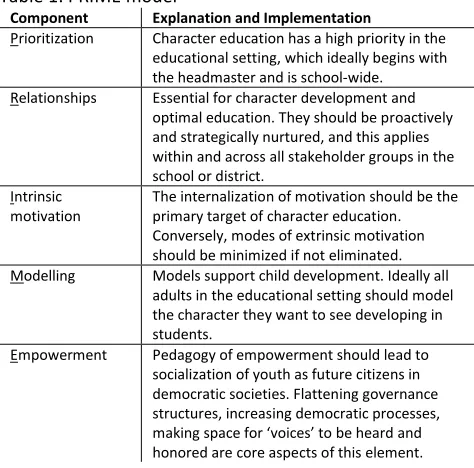
The analysis of the data was conducted in the framework of the PRIME model developed by Berkowitz and Bier (2005). The scientists analyzed 69 research studies about school-based character education to identify certain common features for effective character education programs. Furthermore, they used other meta-analysis and systematic reviews on character (Lovat, Toomey, Dally, & Clement, 2009; Durlak et al., 2011; Berkowitz, 2011) and citizenship education (EPPI, 2005) as well as reviews of academically successfully educational practices by Marzano (2003a, 2003b, 2007) and Hattie (2009). On this basis they developed a conceptual model of major character education strategies, called PRIME. The term refers to five components of optimal character education imple-mentation.
Table 1: PRIME model
Component Explanation and Implementation
Prioritization Character education has a high priority in the educational setting, which ideally begins with the headmaster and is school-wide. Relationships Essential for character development and
optimal education. They should be proactively and strategically nurtured, and this applies within and across all stakeholder groups in the school or district.
Intrinsic motivation
The internalization of motivation should be the primary target of character education. Conversely, modes of extrinsic motivation should be minimized if not eliminated. Modelling Models support child development. Ideally all
adults in the educational setting should model the character they want to see developing in students.
Empowerment Pedagogy of empowerment should lead to socialization of youth as future citizens in democratic societies. Flattening governance structures, increasing democratic processes, making space for ‘voices’ to be heard and honored are core aspects of this element. Source: Berkowitz and Bier (2014).
There are also other dimensions of citizenship and character education to be found in the literature (Nucci, Narvaez, & Krettenauer, 2014; Arthur, Davies, & Hahn, 2008). The PRIME model is explicitly dedicated to character, not to citizenship education. We deliberately decided to use it in our studies, extending its interpretation on citizenship education. Through this approach, it should be determined if the terms used in character education are appropriate in citizenship education, and if the both are combined or even integrated in the studied schools, as it occurs often in the United States.
3 Methods of research
In this paper we present analyses concerning the issue of citizenship and character education in regard to education for thriving in a heterogeneous and democratic society from three Berlin schools. The case studies were conducted using multiple method approaches: observation of lessons, surveys of students, focus group interviews (FGI) and workshops with students, and individual interviews with teachers and with the headmasters of the schools.
One trained researcher visited different classes in the selected schools between November 2015 and July 2016. In schools A and B classes were visited twice a month during half a year during the class council. In school C one class was visited from November 2015 to May 2016 twice a month in the lessons accompanying the service-learning activities of the students. To get a broader view of class and school culture, the researcher visited each class twice in lessons of other school subjects. She was also present during the open-house days and special school events, organized with the students’ participation. The research was conducted with a group of students who were between 12 and 15 years old. In school A students from this age group learn together in joint classes, while school B organizes the education of children enrolled in different grades in separate classes. For that reason, the case study in school A was conducted in one joint class with 26 students. In school B there were two classes visited by the researcher: one class with 23 children age 12-13, as well as one class with 20 students age 14-15. The research in school C focused on the organization of service-learning, which is offered only to students in grade 7, age 12-13. During the research period three groups consisting of seven to eight students were visited regularly. Because the focus of research in school C does not address the formulated research questions as precisely as the other two schools, in this article we only present complementary results of the participating observation from this school.
In schools A and B, after three months of participating observation, recorded through field notes, the first surveys with students were conducted, with the goal to ask them for their opinions on heterogeneity in the society as well as in their school and class. We asked 10 questions with 18 items in both, closed and open format. A number of questions related to the heterogeneity as a social phenomenon while others concerned the atmosphere and the conflict situations as well the ways of solving them in the classes1. The questions were tested in advance in a group of 10 students, age 13-15, enrolled in a school in Berlin, which did not participate in the research. The results of the surveys were presented in the participating classes to reflect and discuss them with the students in the form of a workshop with their active participation. The results of these workshops were used in classes to describe students’ ways of solving problems and improve the atmosphere between students and teachers.
43
research (Chevalier & Buckles, 2013) resulted from thegeneral aim of the project “Learning democracy in schools”, which was depicted as “supporting the proper selection and use of methods for citizenship education in schools and promoting citizenship education among teachers in different school contexts“(Bacia, 2015, p. 1). Since the goal of the project was defined as supporting school communities in the development of citizenship education, it is a necessary step to invite the members of these communities to discuss and reflect upon the results as well as include the participants in finding possible ways of solving the identified problems. The studies conducted with the students were followed by the individual semi-structured interviews with the class teachers as well the headmasters of the studied schools. The questions in the interviews concerned school culture, cooperation among different members of the school community as well as methods used to deal with the heterogeneity in school2.
The data material, in the form of interview transcripts, field notes from observation, protocols from workshops and completed surveys was evaluated by means of a qualitative content analysis according to Mayring (2000).
4 Results
The results of the studies in all three schools are consistently presented according to the following pattern. First, a general description of the school is presented (type of school, number of students, features of students with regard to the heterogeneity). Second, we outline how the school presents itself publicly in regard to heterogeneity: Is it an issue in the school program, what are the public statements of the headmaster as well the teachers? Third, we give examples of the observations in classrooms which show the way the school and its teachers handle difficult situations resulting from the challenges of heterogeneity. Finally, we present statements and opinions of the students and teachers, with whom we discussed the issues as a part of the studies at schools.
4.1 School A
School A is an integrated high school, teaching students from grades 7 to 12 (A-level exam). This private school was founded 10 years before the study by an association connected with the Evangelical Church and organized according to the Church’s Education Act. It is recognized by the state as an Ersatzschule (literally: substitute school), indicating that the school offers degrees recognized statewide. It requests a moderate tuition fee from students and is co-financed from public funds. In the school year 2015/2016, 550 students were enrolled in grades 7 to 12. The high school cooperates directly with a primary school on the same school campus (community school). This means that children from the primary school belonging to the community school may pass to school A without additional conditions, if they wish to. In consequence, there are not many places left for students from other primary schools.
Students from school A are not a very heterogeneous group in regard to the aforementioned criteria of diversity (esp. nationality and religion). Some students grow up with a parent who stems from a country other than Germany, but most if not all speak German at home (information from the interview with the headmaster). Almost all children are of Christian denomination, the majority belonging to the Evangelical Church. In the school year 2015/2016, school A received about 35 refugee children, most of whom were not German-speaking, belonging to the Muslim denomination. The headmaster appreciated the “automatic growth of the heterogeneity among students through the arrival of refugees” (quote from the interview with the headmaster)3.
The process of integrating the refugee students is based on the assumption that the integration will happen automatically with time. The newcomers had first been sent to intensive German language courses organized at the school. After a few weeks they participated in some regular classes with the other children from school A. Two refugee students were present in lessons visited by the researcher. The researcher noticed during the participating observation that the guest students were two or three years older than the oldest students in the host class. They could not follow the lesson because of the insufficient language knowledge. Occasionally children from the host class helped the guests, explaining them in English the course of the lesson. Most of the time the newcomers seemed to be bored and tired, having no real opportunity to participate in the lesson. About 20% of all students are exempt from school fees, due to the very low income of their families (information on the school published by the Bertelsmann Stiftung). In around 15% of all students, psychosocial problems were identified by the special pedagogues. These students receive additional professional help. Other relevant criteria that contribute to the students‘ heterogeneity are, according to the headmaster and interviewed teachers, their different hobbies and dressing styles. Heterogeneity in the understanding of headmaster in school A results from different psychosocial and personal attitudes of the students.
44
week to reflect on their learning process. Tutors areteachers responsible for supervising about ten students. The meetings between students and tutors last about ten minutes, allowing only a limited amount of time to focus on the learning outcomes obtained through the Project Responsibility. Twice a year a teacher who coordinates this project leads a reflection-meeting for all children engaged in the project activities. At the end of the school year the individual student projects are presented in front of the school community. School A attaches great importance to these school events, where student achievements in-school and outside of school are recognized.
Each Friday afternoon all students and teachers meet in a weekly assembly. During these meetings the Christian prayer Pater Noster is read in two languages: in German and another language. The assemblies are prepared in classes. During a lesson, the researcher observed the situation where a refugee student was asked to read the prayer in Arabic. First the student agreed, but then he wanted to know what kind of prayer it was exactly. After it was explained to him, he said that he couldn’t read Pater Noster in public as he is Muslim and this prayer does not belong to his religion. The issue was not reflected on further, either during the lesson or in the weekly assembly of the school community.
The second obligatory part of the assembly is a presentation about important global issues, prepared each week by one class. The researcher participated in three of the weekly school assemblies. Each time the students showed a video on one global issue (human rights, environmental protection, and peace between the world nations). After the short presentation, the issues were neither commented on nor discussed. The assembly was closed and the researcher noticed that the students were pleased to go home.
School A is often presented in public as a best practice model in the field of citizenship education. The headmaster of this school gives lectures to national and international audiences explaining the advantages of the innovative pedagogical approach adopted in school A. One of the pedagogical principles of the school is to discuss with the students current global issues, like human rights and their abuse in different national and cultural contexts. Students are expected to be aware of global problems and prepared to engage for a better world. The in-school and out of school activities are aimed to educate students to thrive in a heterogeneous democratic society.
School A has introduced many learning methods and programs aiming at strengthening the social and democratic competencies of students. However, not all teachers felt prepared to use these methods. A teacher talked about her experiences:
“
When I came to this school, I learned that we should have a class council in our class every week. Unfortunately, nobody explained to me what it is and how it should be done. I had to find out everything on my own. Starting this activity was quite stressful.Regular visits in one class in school A confirm that social and global issues, concerning democracy, social and cultural heterogeneity, human rights, or discrimination, are a recurring element of the learning curricula. The issues were introduced into the lesson of global education, social learning, history, and foreign languages. However, students seemed to be bored when the researcher attempted to discuss with them the issues of heterogeneity or discrimination. They claimed to know everything about this topic and to be convinced that heterogeneity is good and discrimination is bad. From their perspective it made no sense to talk about it again (data taken from students’ statements).
Nevertheless, during the months the researcher accompanied the class, she witnessed many unresolved conflicts and discriminating incidents among students. Here are some examples noted by the researcher:
1) A student insults another student, telling her: “You are so ugly because you don’t eat meat.”
2) A girl is called ‘fat’ by three boys. As soon as they notice that she feels strongly affected, they intensify malicious comments and search for new reasons to make fun of her, such as teasing her about the color of her shoes.
3) A student made angry by another student takes the revenge saying: “Actually, I should forgive you your stupi-dity. It’s not your fault. You are as stupid as all other Catholics.”
In the survey conducted in the class council, the students were asked if they could solve the conflicts occurring in their class. Only two out of 24 persons replied affirmatively. In the open questions concerning the general atmosphere and personal well-being in the class, some students claimed that they do not dare to express their opinion freely in front of the class community, because they are afraid of being abused or ridiculed by some people. Answering the question on the possible reasons to be abused, a student said: “It can be everything. This is the problem of people, not of some special features. These are especially the sensitive persons who are put down. This is a minority who discriminates another minority. But the majority does nothing against it. Eventually, as a discriminated person you are alone.”
45
our class. In the society people are discriminated against.Why should it be different at our school?”
After the workshop the researcher discussed the issue with the tutor and the school headmaster. Both communicated that they needed to pay more attention to shaping the citizenship and character education in the school. Participative action research motivated them to rethink the strategy of introducing citizenship and character education in their school. The headmaster concluded:
“
We have to be better models for the students, and better leaders as well. Children should understand – with our help – that they are our future. It depends on them how the future society will be. If they see something is wrong and say to it ‘that’s what our society is’, then nothing will change. However, the democratic approach and the respect for heterogeneity should be brought to the classroom. In some cases it’s difficult to achieve, because children learn primarily from their parents, and not all of them are respectful toward other social and cultural groups. In the coming school year, we will focus more on this issue and invite professional trainers to work with us on identified problems.4.2 School B
For five years preceding this study, school B has been developed as a community school. Community schools teach students from grade 1 to 10. In the school year 2015/2016, the total number of students exceeded 1100. School B gives the opportunity to learn in bilingual classes, with English or Turkish as the second teaching language. The school offers a full-day program with numerous activities beside regular curricular class session, some of which are organized in cooperation with external partners.
Nearly 90% of students speak a language other than German at home. About 20% have a non-German nationality. In the bilingual classes with Turkish as the second language, 98% of students have an Arab or Turkish migration background in the first, second, or third generation. The group of teachers is similarly heterogeneous. All classes have two coordinating teachers. In the bilingual classes there is always one teacher who speaks the same mother tongue as the majority of students. During an open house a Kurdish teacher said: “I find this school so good, because it reflects the German society. We have students and teachers of different cultural backgrounds. And with our new headmaster we managed to create an atmosphere of support and cooperation.”
The quoted statement reflects the sentiment of the official school profile posted on the school webpage, with declarations of the headmaster as well as other interviewed teachers and students, interviewed by the first author of this paper. According to the School Program, school B focuses on community, heterogeneity, motivation, participation, and cooperation with parents, educational partners, and institutions.
The school’s webpage points out that
“
Our school is the place of peaceful coexistence of people of different cultures and worldviews. We educate our stu-dents to be independent people, we promote democratic awareness, the willingness to take responsibility as well as mutual understanding and acceptance.”For many years the school had been identified in Berlin as problematic in terms of school climate and develop-ment. It did not have a good reputation, and parents did not want their children to attend this school. Seven years ago the previous school headmaster was replaced by the current headmaster, who successfully introduced new rules. The new headmaster explains in an interview her approach to the school management:
“
My understanding of school management is due to the fact that I don’t assume that I’m the one with the best ideas. As I came here I couldn’t know school better than its students, their parents, and teachers. So the first thing I did was to ask them for their opinions to understand their points of view with the aim to set the right goals and methods for the school development. My role is to help the school community to achieve these goals.Regular teachers, social workers, and special education teachers in school B work in teams responsible for students of particular grades. They have their designated rooms to meet regularly and discuss current affairs, problems, or plans. The teams are in regular contact with the school management as well as in exchange with the other teams. Parents are invited to regular cooperation and consultation meetings.
Great importance is attached to the student-student and student-teacher relationships. To promote mutual trust and understanding, school B introduced under the leadership of the new headmaster so-called class project time in all classes from grades 7 to 10. It takes place for five hours each week and gives the class community the opportunity to get to know each other better, to discuss current affairs and to learn the ways to solve problems and find solutions in a respectful and democratic way. There are always at least two classroom teachers present during the class project time, which is organized in different work forms. For instance, students in grade 7 are prepared to take responsibility as educated “fair-players”. That is the name of an established program (http://www.fairplayer.de/) encouraging children and training skills to react appropriately and with civil courage in conflict situations. Students from grade 7 may also be trained to become school mediators.
46
own experiences from their families and environment.The class project time is used also for self-reflection. What did I learn the last week? What is already working well? Where do I need to do more? Students regularly make notes in their school diaries which should be signed by the parents. In this way the parents can also stay in contact with the teachers.
The class project time is often used to discuss problems and conflicts resulting from the heterogeneity of the student body. Heterogeneity in school B results not from the diversity of nationalities among the students, but from the common differences between the system of values and norms in the family and at school. Children from traditional families, some of which still have very authoritarian structures, are confronted with democratic values and norms at school, according to which the conflicts are solved differently than may be the case in their families. This gives rise to a dissonance that is not easy to overcome. An example from the visited class: Children were asked to propose rules they wished to introduce to society if there were completely free to decide. One student asks if it is all right to react with aggression if somebody is treated aggressively. The student is beaten by his father at home (information from the teacher) and is not sure which kind of reaction would be appropriate. He feels enough confidence in the class to ask this question and discuss it in public. The question is for him not a theoretical one. It is based on very personal and painful experiences. The class community gives him the framework to talk about his personal doubts in the ethical and social context. The topics of values, norms and social rules are discussed and reflected on regularly, in relation to one’s own experiences or real conflicts in the class.
The teachers try not to judge students’ opinions and statements but rather encourage students to discuss different views. They present their own opinions without pressuring students to take on their views. An interviewed teacher explained her approach, talking about diverse social perspectives that she wants to be heard in her class.
“
Our society gives the opportunities to live differently than some family patterns show. When the children grow up, most of them get rid of the family ties. In that moment, it is important that they know that there are many possible ways to live one’s own life.This kind of approach, where children are encouraged to be open and take their own decisions, is appreciated by the students. The teachers care about the students.
“
They communicate with us on an equal footing. If I am missing in a class, I am asked if everything was OK. In the old school I would be automatically suspected to be lazy and skipping the school”, explained a student from grade 9. “I feel encouraged to learn and the teachers make me believe that I might achieve a lot.The teaching personnel of school B get support from the headmaster and from outside experts to learn how to deal effectively with the challenges of citizenship and character education as well as with the challenges of heterogeneity. One of the new challenges is the integration of refugee children into the school community.
In the school year 2015/2016, welcoming the refugee students was a current issue in many classes of school B. Regular students were prepared to meet the refugee children while the issues of the refugees’ situation, needs as well as different attitudes towards refugees in Germany was discussed in the class project time. A group of teachers and students developed a working group, whose participants prepared activities for and with the refugees to help them to integrate better in the school community. Students were free to decide about the activities they wanted to participate in.
4.3 School C
School C is an integrated secondary school, with classes in grade 7 to 10 and about 300 students in the school year 2015/2016. More than 20% of students are of a non-German nationality, and more than 70% speak a language other than German at home. The school community is also heterogeneous regarding cultural habits and the religions of the students’ families.
C is regarded as the school of “second chance”. Many children assigned to this school had not been accepted in other schools because of bad grades, insufficient learning progress or unacceptable behavior. The average school achievements of the students in school C are clearly below the average for Berlin schools (information drawn from the statistical data from the school profiles on the webpage www.berlin.de).
School C declares the preparation of students for professional life as its main working orientation. The focus of the work with the students lies in professional practice. The description of the school model and school goals on the webpage stresses the meaning of the well-being of all members of the school community. “We recognize and respect both the cultural and social diversity in our school as well as the individual requirements of all members of the school community. We are committed to non-violent and respectful coexistence in an atmosphere of fairness, trust and esteem.” School C declares to support the democratic forms of communication and to foster participation of the students both at school and beyond. In the educational setting and goals expressed on the school webpage, citizenship education is explicitly called out as one of the school principles:
47
technical, social and cultural skills.” (Taken from theschool‘s webpage)
The researcher first visited school C during the open house. In two other schools the open houses were prepared with the active participation of the students, who guided tours showing the school building, telling about the school life, and answering the questions of the guests. At school C there were few students present during the open house. They offered coffee to the also very few guests. As the researcher asked one of the teachers if it would not have been better to organize the open house in the evening, when most of parents have more time (this open house started already at 1 p.m.), the teacher answered:
“It would not have made a difference. This is a bad school for bad students. Everybody knows it. Parents do not send their children here because they choose this school. Children are placed here if they don’t manage at other schools. And why did you (the researcher) actually come here?
After the winter break a new student joined the class visited by the researcher. The teacher asked the boy to introduce himself and to say in which school he had been before the winter break. As the boy said that he had learned at a ‘Gymnasium’4, some students were impressed and they expressed their admiration, saying: “Wow, it means, he is more intelligent than we are!”. The teacher did not react to this comment.
Another teacher conducted lessons accompanying service-learning activities with the students of grade 7. Service-learning at school C is regarded as the preparation for professional practice, obligatory for all students of this school. Children are asked to identify institutions placed not far from the school building, where they should be involved socially two hours a week after school. Most of children do not like this subject and ask why they have to work without being paid. Many children do not look for the matching institutions. Some institutions in the school area had already made bad experiences with undisciplined, unreliable students obliged to do service-learning and they are not willing to take responsibility for the children from school C anymore.
Ignoring these problems, during the lesson about service-learning the teacher asked the students about the social strengths they already possess and might use in their service-learning activities. A boy, who regularly caused problems, abused others, and initiated conflicts in the class, called “respectful behavior” as his main strength. The teacher did not discuss it further. After the class the researcher asked the teacher for an explanation. For the teacher the situation was completely clear. “I know the family of this boy. I taught his parents at this school. This is one of these conservative Muslim families functioning according to a hierarchical model. For this boy respectful behavior means that he obeys his father. He doesn’t understand that respect might be defined in a broader way and
concern also other people.” The teacher was asked if it would not be pedagogically useful to discuss with students the differences in understanding values in the context of living in democratic heterogeneous societies. She answered that she would do this the coming week. The researcher accompanied the teacher till the end of the service-learning course. However, the teacher did not come back to the question of values, concentrating mainly on technical topics regarding the organization of service-learning, like deadlines or formal requirements for the final report.
During the year in which the researcher visited school C, the teachers responsible for the service learning classes changed three times. The first teacher retired after five month into the school year. In the last half year of her school activities another teacher was prepared to take over the service learning classes. Eventually the headmaster chose yet another teacher at a very short notice, who started the classes to service learning without understanding the concept. After three months once more a new teacher, who was also about to retire, was chosen by the headmaster to support students in service-learning. The teachers could not explain the decisions of the headmaster. They were neither asked if they wished to take the responsibility for the service-learning classes nor if they had been introduced into the method.
At school C the researcher did not manage to talk to the headmaster personally. It was the only one from the studied schools where the headmaster did not find the time for the interview, although she agreed to conduct the research at her school.
40
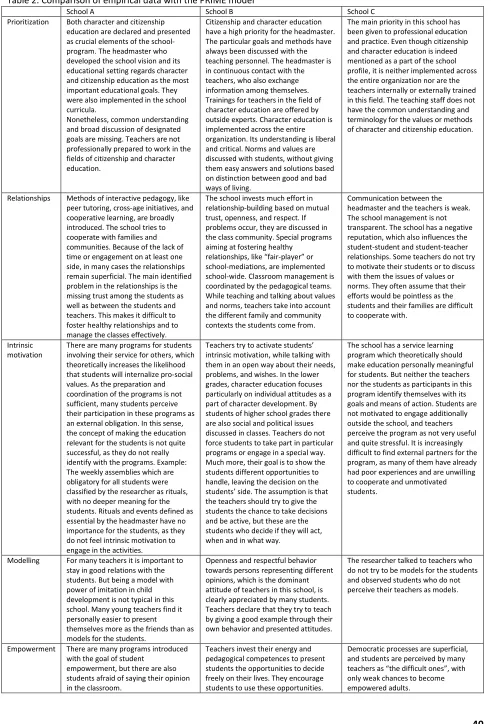
Table 2: Comparison of empirical data with the PRIME modelSchool A School B School C
Prioritization Both character and citizenship education are declared and presented as crucial elements of the school-program. The headmaster who developed the school vision and its educational setting regards character and citizenship education as the most important educational goals. They were also implemented in the school curricula.
Nonetheless, common understanding and broad discussion of designated goals are missing. Teachers are not professionally prepared to work in the fields of citizenship and character education.
Citizenship and character education have a high priority for the headmaster. The particular goals and methods have always been discussed with the teaching personnel. The headmaster is in continuous contact with the teachers, who also exchange information among themselves. Trainings for teachers in the field of character education are offered by outside experts. Character education is implemented across the entire organization. Its understanding is liberal and critical. Norms and values are discussed with students, without giving them easy answers and solutions based on distinction between good and bad ways of living.
The main priority in this school has been given to professional education and practice. Even though citizenship and character education is indeed mentioned as a part of the school profile, it is neither implemented across the entire organization nor are the teachers internally or externally trained in this field. The teaching staff does not have the common understanding and terminology for the values or methods of character and citizenship education.
Relationships Methods of interactive pedagogy, like peer tutoring, cross-age initiatives, and cooperative learning, are broadly introduced. The school tries to cooperate with families and communities. Because of the lack of time or engagement on at least one side, in many cases the relationships remain superficial. The main identified problem in the relationships is the missing trust among the students as well as between the students and teachers. This makes it difficult to foster healthy relationships and to manage the classes effectively.
The school invests much effort in relationship-building based on mutual trust, openness, and respect. If problems occur, they are discussed in the class community. Special programs aiming at fostering healthy
relationships, like “fair-player” or school-mediations, are implemented school-wide. Classroom management is coordinated by the pedagogical teams. While teaching and talking about values and norms, teachers take into account the different family and community contexts the students come from.
Communication between the headmaster and the teachers is weak. The school management is not transparent. The school has a negative reputation, which also influences the student-student and student-teacher relationships. Some teachers do not try to motivate their students or to discuss with them the issues of values or norms. They often assume that their efforts would be pointless as the students and their families are difficult to cooperate with.
Intrinsic motivation
There are many programs for students involving their service for others, which theoretically increases the likelihood that students will internalize pro-social values. As the preparation and coordination of the programs is not sufficient, many students perceive their participation in these programs as an external obligation. In this sense, the concept of making the education relevant for the students is not quite successful, as they do not really identify with the programs. Example: The weekly assemblies which are obligatory for all students were classified by the researcher as rituals, with no deeper meaning for the students. Rituals and events defined as essential by the headmaster have no importance for the students, as they do not feel intrinsic motivation to engage in the activities.
Teachers try to activate students’ intrinsic motivation, while talking with them in an open way about their needs, problems, and wishes. In the lower grades, character education focuses particularly on individual attitudes as a part of character development. By students of higher school grades there are also social and political issues discussed in classes. Teachers do not force students to take part in particular programs or engage in a special way. Much more, their goal is to show the students different opportunities to handle, leaving the decision on the students’ side. The assumption is that the teachers should try to give the students the chance to take decisions and be active, but these are the students who decide if they will act, when and in what way.
The school has a service learning program which theoretically should make education personally meaningful for students. But neither the teachers nor the students as participants in this program identify themselves with its goals and means of action. Students are not motivated to engage additionally outside the school, and teachers perceive the program as not very useful and quite stressful. It is increasingly difficult to find external partners for the program, as many of them have already had poor experiences and are unwilling to cooperate and unmotivated students.
Modelling For many teachers it is important to stay in good relations with the students. But being a model with power of imitation in child development is not typical in this school. Many young teachers find it personally easier to present
themselves more as the friends than as models for the students.
Openness and respectful behavior towards persons representing different opinions, which is the dominant attitude of teachers in this school, is clearly appreciated by many students. Teachers declare that they try to teach by giving a good example through their own behavior and presented attitudes.
The researcher talked to teachers who do not try to be models for the students and observed students who do not perceive their teachers as models.
Empowerment There are many programs introduced with the goal of student
empowerment, but there are also students afraid of saying their opinion in the classroom.
Teachers invest their energy and pedagogical competences to present students the opportunities to decide freely on their lives. They encourage students to use these opportunities.
49
6 DiscussionCase studies from the three high schools in Berlin provided numerous insights about the complexity of citizenship and character education regarding education for living in heterogeneous and democratic societies. Heterogeneity is understood in many different ways by the headmasters, teachers, and students: as diversity of nationalities, cultures, and religions (school C); diversity of personal attitudes and lifestyles (school A); or as a plurality of possibilities to take decisions and act in liberal, democratic societies (school B).
The participating schools claim to utilize instruments of citizenship and character education to deal with the challenges of heterogeneity. Corresponding issues are parts of school programs in all three schools. In school A the school vision and its educational setting base indicate character and citizenship education as the most important educational goals. At the same time, the exchange between teachers and the headmaster on one side and between students and teachers on the other is not deep enough to identify current problems and to have the opportunity to handle them. Citizenship and character education are discussed at a level of abstraction that it makes it difficult for students to identify with. The school community does not reflect deeply on the concrete values to be transmitted in class.
In school B the aims, methods, and processes of citizenship and character education are discussed school-wide on a regular basis. This attitude makes it possible to work constantly on relationships based on mutual trust, openness, and respect. Teachers take into consideration the different family and cultural backgrounds of their students. They do not depreciate them, but try to present and discuss alternative ways of living that are possible to choose from in a democratic society. In this way, teachers try to support the students in the development of their personality, which is typically part of character education. The understanding of character education is however a liberal one, as the psychological characteristics are not treated as facts and the main aim of the teachers is to bring students to critical reflection of the core values of life. Teachers do not try to teach the children a certain set of values. Much more, they present different possibilities. In this sense, citizenship and character education in school B are lived in the classroom. School C does not pay great attention to citizenship and character education in practice. There is no common understanding of the goals of citizenship and character education in this school. Members of the school community seldom feel empowered and motivated to engage and act according to democratic values. Educational processes in the citizenship and character education field are often of a random nature. Reflection, constant work on relationships, modelling, and empowerment are missing. The attempt to shape the character of the students through citizenship education to prepare them for living in a heterogeneous democracy hardly exists at this school. Teachers who tried to act differently from the majority in this school context would find themselves in a challenging situation.
Citizenship and character education at schools in the context of heterogeneity in democratic societies imply multidimensional questions. Individual initiatives are difficult to push through if the headmaster and the majority of teachers do not support them. Discussing the understanding of goals of citizenship and character education, consequent work in constant exchange, interactive pedagogy, family, and community participation, promoting trust, modelling and empowerment: These are crucial elements needed as a set in the context of citizenship and character education. If one of these elements is missing, it influences the educational context in general. That is the reason why the questions of factors influencing citizenship and character education should be analyzed with regard to their interdependence.
The study results described in this paper refer to the analysis of research studies and reviews conducted by Berkowitz and Bier (2004). To analyze the results of our studies in relation to citizenship and character education in the context of preparing for living in heterogeneous democracies, we used the PRIME model with its five components. Our studies contributed to the field of citizenship and character education by analyzing specific factors building up the educational context of three schools in Berlin. The study results showed differences in defining citizenship and character education between the studied schools. They also revealed a gap between the teachers’ perception of character education in different cultural models. Literature on character education describes models from the United States, where character education is strongly normative-oriented. Teachers from the studied schools talk about personality development through character education in the liberal sense of motivating to critical thinking and discussing values.
The study opens new possible directions of research. For instance, the observed forms of bullying and discriminating behavior in the group of teenagers could be further interpreted using Isabell Diehm’s distinction of different forms of direct and indirect discrimination (Diehm, Kuhn, & Machold, 2017) or the concept of intersectionality. In the context of the German system of education we could further analyze the ways of dealing with heterogeneity in schools through the three principles of the Beutelsbacher consensus and the concept of the deliberative education.
50
initiator of a social change) were discussed with thescientific mentors of the researcher as soon as they appeared. The required modifications were implemented up to date.
The PRIME model as the conceptual background was useful to organize the study findings. The participatory action research as the research method made it possible to include some members of school communities into the process of reflection, which may be used for the further development of these communities. For the future it would be desirable to continue these kinds of studies on citizenship and character education in a broader context. Participative research could include more groups being a part or cooperating with the school community, such as parents, social workers, or organizations cooperating with schools. Studies conducted in participation with more partners would make it possible to identify and analyze more factors playing a role in the processes of citizenship and character education in schools.
References
Althof, W., & Berkowitz, M. W. (2006). Moral education and character education: their relationship and roles in citizenship education. Journal of Moral Education. 35 (4), 495-518.
Arthur, J., Davies, I., & Hahn, C. (Ed.). (2008). The SAGE Handbook of Education for Citizenship and Democracy. London: SAGE.
Bacia, E. (2015). Learning democracy in schools: Tools in international school context. Unpublished description of the research project.
Berkowitz, M. W. (2011). Leading schools of character. In A. M. Blankstein & P. D. Houston (Ed.), The soul of educational leadership series. Vol. 9. Leadership for social justice and democracy in our schools (pp. 93-121). Thousand Oaks, CA: Corwin.
Berkowitz, M. W., Althof, W., & Jones, S. (2008). Educating for Civic Character. In J. Arthur, I. Davies, & C. Hahn (Ed.), The Sage Book of Education for Citizenship and Democracy (pp. 399-409). London: Sage.
Berkowitz, M. W., & Bier, M. C. (2005). What works in character education: A research-driven guide for educators. Washington, DC: Character Education Partnership.
Berkowitz, M. W., & Bier, M. C. (2014). Researched-based fundamentals of the effective promotion of character development in schools. In L. Nucci, D. Narvaez, & T. Krettenauer (Ed.), Handbook of Moral and Character Education (pp. 248-260). New York, NY: Routledge.
Bildungsstandards der Kultusministerkonferenz [Standards of education of conference of ministers of education]. (2005). Heusenstamm: Sekretariat der Ständigen Konferenz der Kultusminister der Länder in der Bundesrepublik Deutschland.
Chevalier, J. M., & Buckles, D. J. (2013). Participatory Action Research: Theory and Methods for Engaged Inquiry, Abingdon: Routledge.
Council of Europe (2010). Council of Europe charter on education for democratic citizenship and human rights education. Strasbourg: Council of Europe.
Diehm, I., Kuhn, M, & Machold, C. (Hrsg.) (2017). Differenz – Ungleichheit – Erziehungswissenschaft. Verhältnissbestimmungen im (Inter-)Disziplinären
[Difference – Inequality – Pedagogy. Proportional determinations in the (inter-) disciplinary]. Wiesbaden: VS Verlag für Sozialwissenschaften
Durlak, J. A., Weissberg, R. P., Dymnicki, A. B., Taylor, R. D., & Schellinger, K. B. (2011). The impact of enhancing student’s social and emotional learning: A meta-analysis of school-based universal interventions. Child
Development, 82, 405-432.
Edelstein, W. (2014). Demokratiepädagogik und Schulreform [Citizenship education and school reform]. Schwalbach/Ts.: Wochenschau Verlag.
EPPI (2005). A systematic review of the impact of citizenship education on student learning and achievement. EPPI-Center, University of London (England).
European Parliament (2008). Recommendation of the European Parliament and of the Council of 23 April 2008 on the establishment of the European Qualifications Framework for lifelong learning. 2008/C 111/01, Official Journal of the European Union.
Fauser, P. (2007). Demokratiepädagogik und politische Bildung. Ein Diskussionsbeitrag. [Education for
democracy and civic education. A discussion paper]. In W. Beutel, & P. Fauser (Ed.), Demokratiepädagogik: Lernen für die Zivilgesellschaft [Education for democracy. Learning for civil society] (pp. 16-41). Schwalbach/Ts.: Wochenschau Verlag.
Georgi, V. (2015). Vielfalt lernen und leben. [Learn and live diversity]. In Klasse Vielfalt. Chancen und
Herausforderungen der interkulturellen Öffnung von Schulen [Class diversity. Opportunities and challenges of the intercultural opening of schools] (pp. 7-31).
Gütersloh: Bertelsmann Stiftung.
51
Himmelmann, G. (2004). Demokratie-Lernen: Was? Warum? Wozu? [Learning democracy: What? Why? What for?] Beiträge zur Demokratiepädagogik. Eine Schriftenreihe des BLK-Programms “Demokratie lernen & leben”. Berlin.
Hoskins, B. L., Barber, C., van Nijlen, D., & Villalba, E. (2011). Comparing Civic Competence among European Youth: Composite and Domain-Specific Indicators Using IEA Civic Education Study Data. Comparative Education Review, 55 (1), pp. 82-110. doi: 10.1086/656620 Linckona, T., & Davidson, M. (2005). Smart and Good High Schools: Integrating Excellence and Ethics for Success in School, Work and Beyond. Cortland, N.Y.: Center for the 4th and 5th Rs (Respect & Responsibility), and Washington DC: Character Education Partnership.
Lovat, T., Toomey, R., Dally, K., & Clement, N. (2009).
Project to test and measure the impact of values education on student effects. Newcastle, Australia: University of Newcastle.
Marzano, R.J. (2003a). What works in schools: Translating research into action. Alexandria, VA: Association for Supervision and Curriculum Development.
Marzano, R.J. (2003b). Classroom management that works: Research based strategies for every teacher. Alexandria, VA: Association for Supervision and Curriculum Development.
Marzano, R.J. (2007). The art and science of teaching: A comprehensive framework for effective instruction. Alexandria, VA: Association for Supervision and Curriculum Development.
Mayring, P. (2000). Qualitative Content Analysis. Forum: Qualitative Social Research. Vol. 1, No. 2.
Nucci, L., Narvaez, D., & Krettenauer, T. (Ed.). (2014). Handbook of Moral and Character Education. New York, NY: Routledge.
Statistisches Bundesamt [Federal Office of Statistics]
(2016). Bevölkerung und Erwerbstätigkeit: Bevölkerung mit Migrationshintergrund – Ergebnisse des Mikrozensus 2015 [Population and employment: population with a migration background - results of the microcensus 2015]. Fachserie 1 Reihe 2.2. Wiesbaden: Statistisches
Bundesamt.
Vertovec, S. (2007). Super-diversity and its implications. Ethnic and Racial Studies, 30, 1024-1054.
http://dx.doi.org/10.1080/01419870701599465
Endnotes
1
Examples of open survey questions:
- What are the advantages for you when your class is diverse? In which situations are you looking forward to diversity? Try to give concrete examples. [in German: Welche Vorteile kann es für dich haben, wenn deine Klasse vielfältig ist? In welchen Situationen freust du dich über die Vielfalt? Versuche konkrete Beispiele zu geben].
- And what disadvantages can the diversity in the class have for you? In which situations are you annoyed by the diversity? Answer as concretely as possible. [in German: Und welche Nachteile kann die Vielfalt in der Klasse für dich haben? In welchen Situationen ärgerst du dich über die Vielfalt? Antworte auch möglichst konkret].
- In each class there are sometimes conflicts. Someone makes fun of someone else or makes him angry. Somebody offends another or takes something away from the other. If it happens in your class, for what reasons and in what situations are persons laughed at or offended? Whom does that concern? (You should not give here concrete names, but describe situations in which someone is treated unkindly). [in German: In jeder Klasse kommt es manchmal zu Konflikten. Jemand macht sich über einen anderen lustig oder ärgert ihn. Jemand beleidigt einen anderen oder nimmt einem anderen etwas gewaltsam weg. Wenn es bei euch in der Klasse passiert, aus welchen Gründen und in welchen Situationen werden Personen ausgelacht oder beleidigt? Wen betrifft das? (Hier geht es auf keinen Fall um konkrete Namen, sondern um die Beschreibung der Situationen, in denen jemand unfreundlich behandelt wird)].
2 For more detailed information on data collection, see: E. Bacia “Democratic approaches in education in an international context” (forthcoming).
3 All quotations from interviews were translated by the authors of this paper from the German transcripts.
4