2. Democratizing Innovation: How Consumer
Electronics Is Revolutionizing RocketScience
Abhith Pallegar Independent Researcher
ABSTRACT
The traditional flow of cutting-edge technologies observed over the last 100 years was from government supported defense space to its broader application in the civilian domain. We have seen technology flow into consumer products years after its introduction in defense applications. Most common examples of this movement were the invention and incubation of the Internet and Global Positioning System in prestigious national labs, which later trickled down to benefit millions. But there seems to be a shift in the tide of innovation where consumer market has been influential in developing a range of technologies which have flown the other way around.
This article focuses on the technologies incubated in the consumer space and its push upward to disrupt other areas. We explore how innovations in the consumer electronics industry have made it cost-efficient and more accessible to build, launch rockets and satellites. We illustrate how new technologies can facilitate more significant involvement in the space sector by private companies and educational institutions. We explore how this shift in innovation can influence the Aerospace industry to open up unlimited possibilities for humanity.
KEYWORDS: Electronics,Consumer, Satellite, Rocket, Cost, Innovation.
1. INTRODUCTION
T
he broad narrative previous generations grew up with was that innovationwas due to the result of government largesse and unlimited R&D budgets that flowed to benefit the civilian population. Traditionally, technological innovations have continuously trickled down from defense to the broader consumer space.
The Internet and the GPS are well known and used technologies which filtered down from highly restricted defense applications to the consumer level. Internet was invented to share and coordinate research between governments and universities in the 1960s. Then in the year 2000, GPS technology was opened to the public during the Clinton administration and got rid of selective availability(Laskow, 2014) for peaceful, commercial and scientific purposes. (“Clinton Acts to Make GPS More Accurate,” 2000). Technology invented and incubated by the federal government in the 1960s was finally opened up to the population. The government no longer scrambled the GPS signal and brought pinpoint accuracy in-car navigation to the masses. There are countless examples where technological progress has transpired through pioneering research by government-owned or funded research entities.
in mass market car models. As cost drops and manufacturing technology improves with newer innovations, cars will be made lighter and sturdier. Formula 1, a home for many firsts, have millions poured into their cars each year to make them faster, lighter and safer. Decades later, last generation F1 technology such as suspension, disc brakes, traction control, paddle shift gearbox, sophisticated engines and onboard electronics which was built for the track, has finally entered into commercial mass-market vehicles.
The Taptic engine in the latest iPhones is based on the Haptic technology. This Haptic technology provides tactile feedback for robot-assisted surgery and remote surgery so that the surgeon can get tactile and kinesthetic feedback. Haptic systems are also used to provide sensory feedback for the blind. (Hurst, 2013). As costs dropped and technology matured, we are seeing them more commonly used on consumer devices like mobile phones, gaming controllers, and virtual reality systems.
2. THE SHIFTING TIDE OF INNOVATION - BATTERY TECHNOLOGY
The natural course of evolution for many technologies that flowed down from high technology industries to the consumer space has now reversed. We are seeing an opposite movement in innovation, today, where some of the critical innovations are flowing from the consumer space to the rocket sciences. The world is observing rapid innovation and technological advances influenced by the consumer space. The technologies incubated in these industries are moving to revolutionize other areas. This consumer-driven innovation will change the technology landscape going forward.
The Original Lithium-ion battery technology invented by John Goodenough in the late 1970s has gone through several iterations and evolutions. First with the Lithium Cobalt Oxide battery (Li2CoO2) and later with derivatives of the primary technology with the addition of Manganese, Nickel, and Iron to make them safer and more efficient. (LeVine, 2015). The Japanese consumer electronics companies like Sony benefited immensely from these innovations in the 1980s and 90s, fueling further research to meet the demands of the customers. Consumer electronics industry provided the necessary velocity for the advancements in variations of lithium-based battery chemistry. Battery manufacturers have made marginal improvements over the years in chemistry and manufacturing technology. These improvements were primarily driven by consumer electronics demand and not matured technology from another industry that trickled down to consumers.
3. SPARKING THE ELECTRIC CAR REVOLUTION
sector, since the invention of the automobile. Today, consumer companies like Apple, Google, and Venture capital-backed companies like Tesla are racing to be a part of the electric car revolution not to mention the established players in the market like GM, Ford, Chrysler competing with traditional research labs such as Argonne and Lawrence Livermore national laboratory on innovation.
Tesla used commonly available Lithium Ion batteries available in consumer electronics, today, for its Tesla roadsters, later the premium model S and more recently the mass market model 3. Tesla is making battery technology cheaper and safer while others are improving the energy density to make it competitive with gasoline. Today, the latest in battery technology is the Lithium Nickel Manganese Cobalt Oxide (NMC), modified and improved upon the basic lithium oxide technology. (LeVine, 2015). They are safer and more efficient for storing charge to make electric cars and being embraced by Silicon Valley startups.
4. LOW-COST ELECTRONICS AND CHIPS
The smartphone market virtually nonexistent at the start of the millennium has swollen in the last decade. With 1.5 Billion smartphones sold in 2016, and considering there are around 7.5 billion people in the world, it is an astonishing figure. (“Gartner Says Worldwide Sales of Smartphones,” n.d.). The architecture of chips in these phones are built around SOCs (system-on-chip) licensed by ARM, a British company recently acquired by Softbank. The efficient ARM chips with newer architecture and design have gained ground in smartphone and tablet market. The phenomenal processing power crammed into a small package is coming close to beating sophisticated workhorse laptops made by Intel in performance.
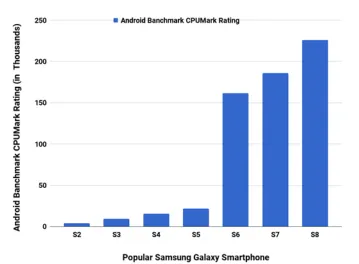
With billions of smartphones sold each year on the planet, the smartphone industry has become a towering force regarding controlling technological choices and R&D budgets alike. The breathtaking pace of consumer growth has made companies to out-innovate each other to get the biggest piece of the growing staple. The market place and consequently innovative technologies are driven by consumers. The users are pushing for greater innovation, and the competition is heating up. The power of consumer demand is rising in the marketplace especially for mobile computing devices. From the figure, in the last seven years, we can see exponential growth in computing power of popular phones.
and large lens. This shift in focus from hardware to the software to build smaller cameras to fit in our phones that are in turn small enough to fit in our pockets is the result of the growing power of consumer electronics market.
Source: Android Devices - CPUMark Rating. (n.d.)
Figure 1: Proxy for processor speed of popular smartphone models
Slapping a chip on everything and branding it an IoT (Internet of Things) device is the hottest trend in the industry, right now. This refers to automating the home and connecting it to the internet. The IoT revolution benefits from economical and ubiquitous processing power available in small form factor. The exponential growth seen in the microprocessor industry with the introduction of ARM chips was largely a product of the enormous demand for cheaper phones and tablets. The core architecture of these chips is such that they are competing against Intel’s offerings and have come out with more groundbreaking innovations than their compatriots who have faltered in the last decade. This sector has witnessed more innovations than the commercial market dominated by established players. The innovation from Intel and other chip makers has lagged, and their relevance in the market has taken a significant hit.
5. REVOLUTIONIZING ROCKET SCIENCE-PRIVATE SPACE PROGRAMS
grade electronic parts in many of their systems as opposed to space grade equipment that NASA and others used historically. These improvements in consumer electronics have significantly reduced the cost of rockets and satellites. (“A sudden light,” 2016). This flow of innovation from consumer space has transformed rocket science more specifically in the building, launching of rockets and sophisticated satellites.
The following figure shows the number of launches of SpaceX in the last eight years. This chart denotes a rapid expansion of private space companies. In addition to this, we also see an increase in the capabilities of private companies; which is made possible by the availability of equipment at a lower price and improved accessibility of sophisticated computers and related systems.
Source : (privco, n.d.)
Figure 2: Number of Launches of SpaceX 6. ASSEMBLING SATELLITES
Satellites in the past were big, expensive, built on custom parts and took years to design and develop. Satellites were massive, weighed hundreds of kilos and needed a big rocket to put them into the orbit. The push today is for building smaller nanosatellites that use cheap and easily available consumer grade electronics commonly found in phones to quickly develop and launch a flock of satellites.
Source : (Kulu, n.d.)
Figure 3: Nanosatellites by announced launch years
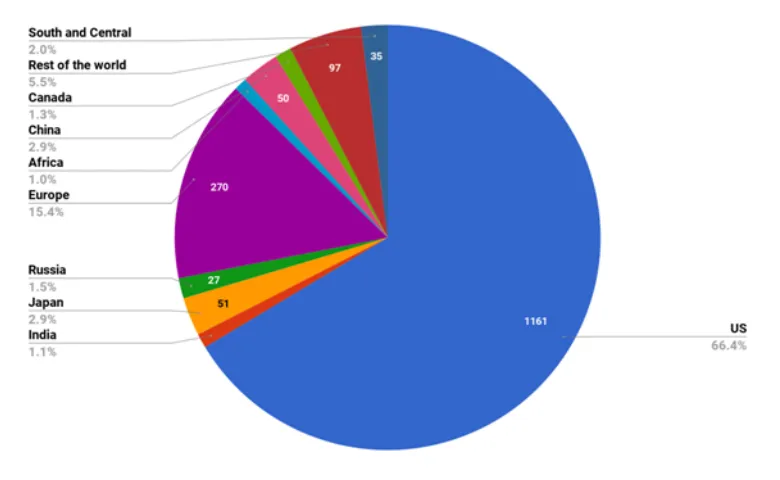
Source : (Kulu, n.d.)
Figures 4: Nanosatellites by Location
same. (Painter, 2016). Since the satellites are economical, going forward, the industry can absorb a higher cost of failure. This also implies industry can take on less risk, than it has taken on, historically. Hundreds of satellites are built on assembly lines like cars and launched in batches. The organizations are now building a constellation of smaller satellites. One such constellation of 88 satellites which belonged to a US-based firm Planet was launched by India’s ISRO ( Indian space research organization) in the year 2016. (Laskar, 2017). AS of 2017, the following figure denotes the status of launched satellites.
Source : (Kulu, n.d.)
Figure 5: Status of launched nanosatellites
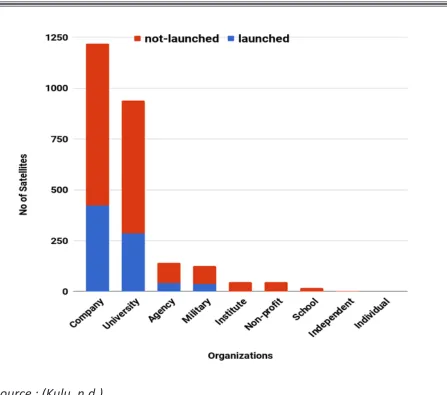
At the dawn of the computer revolution, decades ago, the accessibility to computers was limited to governments and big companies only. But, slowly, as the costs came down computer became accessible to smaller companies and individuals. The space industry is moving along the same technological trajectory with the introduction of cheap and powerful electronics which has widened accessibility. The following graph denotes the remarkable increase in participation by companies and universities.
Source : (Kulu, n.d.)
Figure 6: Nanosatellites by Organization
There are numerous launch vehicles available with diverse capabilities which make space accessible to individuals and companies with limited resources. The consumer electronics have gotten to a point where they can be used to build rockets without specialized parts. In turn, this also means more private companies can take part in the space race.
7. 3D PRINTING
3D printing technology, first developed in the 1980s used to print 3D objects, never received attention from industry but was fondly embraced by the enthusiast crowd. Only recently, it has seen the application in designing and modeling at a commercial level. This technology was perfected by small companies and startups to cater to the enthusiast market and is redefining the conventional innovation path. 3D printers are a perfect example of a democratized technology that was incubated by enthusiasts and has now found use in the most sophisticated industries.
manufacturing capabilities unavailable before to the small and large companies alike. Aerospace industries can benefit from this for making complicated custom parts for aircraft, scale models for wind tunnel testing and various other applications in research and development.
8. CONSUMER DRIVEN INNOVATION
The first wave of democratization was seen with the way people buy with Amazon. This “consumer first” thinking is already embraced by Amazon, where the product purchased is reviewed as well as rated by consumers and not by companies. Therefore, which product gets sold and which does not is determined solely by consumers, themselves. Wikipedia, an online encyclopedia, is created, edited by volunteers and used by many. Even though, just a small percentage of people who view the site contribute, it is still up to date and the most comprehensive encyclopedic database available.
This democratization of power from the sellers and companies to consumers themselves saw an immense shift in the way industries and companies view and interact with customers. Going forward innovation, technology, and R&D budgets will be increasingly influenced by consumer behavior. Innovation is rapidly taking place in the products which people demand. It has come to a point where the consumer is driving innovation and R&D budgets of companies like never before.
9. SOCIAL MEDIA COMPANIES
High valuations by venture capital industry to social media companies are driven by the number of users. Facebook’s valuation of hundreds of billions of dollars and Uber approaching a hundred billion are driven largely by user growth. The consumer-driven marketplace values the number of users on the platform for social media companies. The main metric for calculating the value of social media companies is not profitability but rapid user growth and the level of engagement with a potential for monetization, later on. The following figure denotes the number of user’s popular social media platforms have as of 2017.
10. THE DOWNSIDE
The shift in the world of technology dictated by the needs of the common consumer can have positive and negative effects. More money is spent on developing technology that involves making phone screens 10% better. Consumer-driven innovation landscape skews the effort away from fundamental research. One of the downside to this innovation drive is the lack of effort and funding that goes to foundational basic science research that could be turned into productive technology in the long term. This path of innovation ignores basic science research that has an asymmetric payoff in the future. Capitalistic marketplace underfunds basic science research. Hence, there is a significant need for governments to fund the increasing research gap
11. CONCLUSION - EXPLORING SPACE
REFERENCES
1. A sudden light. (2016, August 10). Retrieved September 04, 2017, from http://www.economist.com/ technology-quarterly/2016-25-08/space-2016
2.Android Devices - CPUMark Rating. (n.d.). Retrieved September 04, 2017, from https://www. androidbenchmark.net/cpumark_chart.html
3. Clinton Acts to Make GPS More Accurate. (2000, May 02). Retrieved September 04, 2017, from http:// www.nytimes.com/2000/05/02/technology/clinton-acts-to-make-GPS-more-accurate.html
4.Grunewald, S. J. (2016, March 22). A New IBISWorld Report Says That 3D Printer Prices Will Continue to Drop in 2016. Retrieved September 04, 2017, from https://3dprint.com/125451/ibisworld-3d-printer-prices/
5. Gartner Says Worldwide Sales of Smartphones Grew 7 Percent in the Fourth Quarter of
2016. (n.d.). Retrieved September 04, 2017, from http://www.gartner.com/newsroom/id/3609817 6.Hurst, N. (2013, February 13). Can You Feel Me Now? The Sensational Rise of Haptic Interfaces. Retrieved September 04, 2017, from https://www.wired.com/2013/02/haptics/
7.Kulu, E. (n.d.). Nanosatellite & CubeSat Database. Retrieved September 04, 2017, from http://www. nanosats.eu/
8.Laskow, S. (2014, November 03). The Plane Crash That Gave Americans GPS. Retrieved September 04, 2017, from https://www.theatlantic.com/technology/archive/2014/11/the-plane-crash-that-gave-americans-gps/382204/
9. LeVine, S. (2015). The powerhouse: inside the invention of a battery to save the world. NY, NY: Viking. 10. Nanosats are go! (2014, June 07). Retrieved September 04, 2017, from https://www.economist. com/news/technology-quarterly/21603240-small-satellites-taking-advantage-smartphones-and-other-consumer-technologies
11. “NASA” - A Member of TheSpaceX Family Group of Companies. (n.d.). Retrieved September 04, 2017, from https://www.privco.com/our-research/about-us/nasa-a-member-of-the-spacex-family-group-of-companies
12.Painter, K. L. (2016, April 27). The Sierra Nevada cuts costs with in-house satellite assembly, testing. Retrieved September 04, 2017, from http://www.denverpost.com/2014/05/30/sierra-nevada-cuts-costs-with-in-house-satellite-assembly-testing/
13. Rezaul H Laskar Hindustan Times, New Delhi. (2017, February 15). US firm main beneficiary of ISRO launch puts 88 satellites into orbit. Retrieved September 04, 2017, from http://www.hindustantimes. com/india-news/us-firm-main-beneficiary-of-isro-launch-puts-88-satellites-into-space/story-gATPr783g5FK0P90wBPd9J.html
14.Top Social Network sites by a number of active users 2017. (n.d.). Retrieved September 04, 2017, from http://www.smartinsights.com/social-media-marketing/social-media-strategy/new-global-social-media-research/attachment/top-social-network-sites-by-number-of-active-users-2017/