Volume 31: October 2016
ISSN 2414-6633
https://doi.org/10.22151/politikon.31
Editorial Board
Editor-in-Chief: Jaroslava Barbieri (Italy, Ukraine)
Luca Arfini (Italy)
Lorand Bodo (Germany)
Andrés Lopez Rivera (Ecuador)
Alice Martini (Italy)
Table of Contents
Editorial Note ... 4
Articles
Parliamentary ombudsman (ouvidoria) and its democratic potential: The Brazilian case /
Thales Torres Quintão ... 5
The impact of societal preferences on national monetary policy outcomes: A revival of
economic pluralism / Christoph Steinert ... 26
Determinants of Re-Autocratization: An Empirical Analysis from 1996 to 2013 /
Kristin Eichhorn ... 53
Editorial Note
Dear Reader,
Our Editorial Board is proud to present Volume 31 of Politikon, the flagship academic journal of the International Association for Political Science Students.
The current issue will certainly prove a fascinating reading for this part of the year.
In this eclectic collection, you will be able to explore the institutional designs of the parliamentary ombudsman in Brazil and the pattern of action that prevails from his/her relationship with the public. You will have the chance to investigate how the size and strength of different economic actors are the central determinants for monetary policy outcomes. Finally, you will have the opportunity to read about re-autocratizations, namely the collapse of electoral democracies in the last decade, with a specific emphasis on effects for economic growth rates and governance performance. We hope you will enjoy the following highly dense 70 pages of valuable academic work from young scholars across the globe.
While this volume has collected papers that use mainly quantitative analysis, we believe that with such a varied yet fascinating range of topics each reader may find something that will catch their interest. Hopefully, you will get inspired and submit your own article to one of our IAPSS academic journals.
We are looking forward to reviewing your work!
Parliamentary ombudsman (
ouvidoria
) and its democratic potential: The
Brazilian case
Thales Torres Quintão
https://doi.org/10.22151/politikon.31.1
Thales Torres Quintão, 29, from Belo Horizonte (Brazil), is currently a PhD Candidate of Political Science at the Federal University of Minas Gerais (UFMG). He graduated with a Bachelor’s in Social Sciences in 2009 (PUC – Minas). He has a specialization degree in Management, 2012 (UFMT). In 2015, he earned a Master’s degree in Political Science at UFMG. His research interests are: civil society, democratic theory, political participation, democratic innovations, and participation and deliberation mechanisms of the legislative branch in Latin America.
Abstract
This research aims to map and analyze the institutional designs of the parliamentary ombudsman in Brazil and the pattern of action that prevails from his/her relationship with the public. A qualitative approach was used for this case study, focusing on document analysis of formal resolutions of state assemblies as well as the information provided on their websites. A case study of the Legislative Assembly of Minas Gerais (ALMG) was also created in order to better understand how the work of the ombudsman is structured and how the interactions of such with other officials may be relevant to his/her performance. The case study determined that the parliamentary ombudsman is constituted as an access mechanism for citizens, amplifying the opportunities for them to present their demands. However, the ombudsman is neither a communication nor a participation channel.
Keywords
Introduction
The Brazilian Constitution of 1988 (also known as the Constitution of the Citizen) recognizes, establishes, and formalizes the political participation of citizens in Brazil. In other words, democracy and participation are perceived as mutually constituent phenomena. Based on institutionalized participation in the state, the public ouvidoria1 (the office of the ombudsman) was formed, as a means
of citizen participation.2 In 1986, Curitiba was the first city to establish a public ouvidoria. However,
the Federal Constitution of 1988, which set out the principles of impartiality and publicity related to government actions, indirectly spread public ouvidorias across the country in different branches and government levels, each with a diverse structural configuration. An assessment made in August 2014 indicated that there were 1,123 public ouvidorias in Brazil (Ouvidoria Geral da União,3 2014). Although
this number is significant, it is important to bear in mind that they may include organizations that, while referred to as ouvidorias, do not fully exercise their intended purposes.
In general, the public ouvidorias analyses prevail in the executive branch, but also have some in the judicial branch. But even so, these studies are quite inexpressive. The studies done on the office of the ombudsman concentrate on the analyses of formal resolutions and normative instruments of the organization without collecting primary data as a methodology, which would enable the identification of political forces and officials involved or even the flow of communication played by this mechanism.
The goal of this research paper is to understand the scope and the purpose of this legislative mechanism for the effectiveness of democratic participation, social inclusion, population control, horizontal accountability, and public justification (Vera and Lavalle, 2012). For said purposes, we utilize the institutional design framework. As a premise, the institutional design can influence the distribution of power of the state legislature’s ouvidorias.
1 Ouvidorias are not exclusive in Brazil. There are ouvidorias in privates companies, whose concern is the quality of the product, the service offered, or customer loyalty (Lyra, 2014).
2 The public ouvidoria does not act in the judiciary field, neither does it possess coercive power nor a high functional status and is not part of the constitutional plan. The ombudsman is appointed to consolidate the external control from a power to another. However, the ouvidoria deals with the internal control of different public organizations (Gomes, 2000). Therefore, using the term ouvidoria in this paper.
1. Public
Ouvidoria
and Institutional Design
The public ouvidoria is an organization that aims to achieve the constitutional principles that control public administration while also guiding the provisions of public services: legality, impersonality, morality, publicity, and efficiency. Beyond that, there are the main attributions of a public ouvidoria, which are change induction, damage repair, and promotion of democracy (Lyra, 2004, p. 144).
This mechanism should allow for the promotion of social and political inclusion,4 along with the
creation of a democracy between citizens and public administration (Antero, 2014; Lyra, 2011). The ouvidoria serves as mediation between Brazil and the people, so as to resolve conflicts in a non-judicial way and guarantee the rights of citizens, acting on recommendations given by the higher power; in the public justification (Vera and Lavalle, 2012); and the exercise of power in transparent ways (accountability as answerability) (Schedler, 1999).
The readings on public ouvidorias indicate that the institutional design can be more “modernizing” (focusing on instrumental rationality) or more “democratic” (focusing on dialogic rationality), both pursuing social justice while also stimulating public participation. The institutional design aims to shape institutional structures and processes to achieve the desired results (Olsen, 1997) through controlling landmarks, formal resolutions, organization charts, and procedures. As the designs are not neutral and reflect the ideas and interests of the officials, their variations and changes will have a direct impact on the end result of the organizations (Goodin, 1996).
Studies show the interrelation between the performance of democratic innovations and the design adopted for the promotion of political participation (Avritzer, 2009; Smith, 2009). Fung (2003, 2006) demonstrates the importance of the design for equality, social inclusion, participation, and deliberation in “mini-publics.” For him, the design offers parameters and limits, defining rules and procedures that directly affect the selection and recruitment of the participants, how public deliberation will be made, where it will happen, the rate of participation, social accountability, etc. The integration of the aforementioned and their respective designs shape what the author calls a “democracy cube,” meaning that those elements are intertwined within each other, influencing the political outcomes of those spheres.
The institutional design is not the only factor influencing political participation. However, it should be recognized as a fundamental vector to assert certain patterns of interference and engagement of citizens as well as the typical obstacles of democracy, which are exemplified by cynicism, apathy, and low political efficiency. These aspects are related to the political design organizations that make up the country and their relationship with the public (Marques, 2010).
Considering the ouvidoria to be a kind of democratic innovation that involves a citizen-state relationship (Isunza and Hevia, 2006), it is still considered to be quite fragile. The hegemonic model of the ouvidoria is created top-down, with the norms established by the same organization of that which will be supervised. The appointment of the ombudsman is of the supervised organization’s own choosing; the selection is done in such a way as to promote efficiency and administrative modernization, all while maintaining citizens’ rights. Those elements reveal the flaws of the ouvidorias’ public autonomy, forming a closer relationship between the government and society, which has a more social and horizontal accountability. For Quintão (2014) three key factors contribute to the optimization of the ouvidoria: public autonomy; cooperation between government bodies in order to foster its recommendations; and performance capacity.
In order to be autonomous and democratic, ouvidorias need to have the following attributes: (1) the ombudsman selection must be made through an independent third party; (2) an advisory council chosen by the people, proposing procedures and supervising the work and actions of said organization; (3) the duration of the term to allow for the possibility of renewing ideas and maintain the status quo;5 (4) financial and administrative autonomy of the ouvidoria; (5) the obligation of a
quick response time from the leader, under legal penalty, setting priority and matter of urgency; (6) the disclosure of their action and their analytical reports in the media, allowing extensive access to the public; (7) confidentially of the person who looked for the ouvidoria, guaranteeing that he/she does not suffer damages or sanctions (Cardoso, 2012; Lyra, 2011; Zaverucha, 2008).
Having an ombudsman is one of the crucial aspects of autonomy, and consequently, for the efficiency of the public ouvidoria as well. Being a single-member position, the ombudsman focuses on the management of this mechanism and its respective attributive functions (Silva, 2012). The role of an ombudsman is essentially political and deals with the power relationship between the leader of the
ouvidoria and the institution over which he/she resides. The idea is that ouvidorias cannot be organized or controlled by the supervising institutions; otherwise, it would jeopardize their public purpose.
For a greater social and public legitimacy, the authors researched suggest the selection of the ombudsman should be through an indirect election by an advisory council outside the political power (Lyra, 2014). After being issued a ballot with three names, it would be sent to public authorities that would then determine the ombudsman.6 However, this model only accepts people with low
representation. Often the least voted in the ballot, drawn up by public authorities, is the chosen one. In other words, the government-owned institution has the final say over the chosen ombudsman.7
Nonetheless, there is still a lack of information on how the ballot process is made. For instance: how is the public deliberation in these forums and meetings conducted; which organizations have voices and participate in this process, why do some participate and others do not; where does the deliberation occur; how many representatives from each organization are there; how is the voting done; what are the possible asymmetries of power in the decision-making process, etc. The aforementioned are unanswered questions about the dynamics of the indirect election of the ombudsman. Moreover, it is crucial to do a more systematic analysis for the ombudsman nomination in order to better understand the distinct political projects (Dagnino, Olvera, Panfichi, 2006) marked by the heterogeneity within society and the government itself, indicating that the relationship between them is not stable but accented by multiplicity of conflicts, political will, and in certain contexts, distinct projects.
2. Methodology
The research strategy of this paper consists of two steps. First, a comparative research was made analyzing the design of all 13 state legislatures as well as the Federal District. We used the documentary research technique, based on a qualitative approach, to examine the data collected on the ouvidorias of the state assemblies. A content analysis was held on formal resolutions (creation decrees, internal regulations, operating manuals, etc.) to measure how this mechanism operates. In addition, a website of the assemblies was made in order to comprehend how the ouvidorias are
6 This format began with the Police Ombudsman in the state of São Paulo in 1995.
included in these institutional organizations, with a look at accessibility and the information made available (Raupp and Pinho, 2013).
Furthermore, the methodology of the Legislative Assembly of Minas Gerais (ALMG) case study was adopted in order to understand the distribution of power and political officials involved directly or indirectly in the performance of the parliamentary ouvidoria. Eight individual in-depth interviews were held with ombudsmen and also with civil servants (four for each group). The selection of civil servants to be interviewed was based on the snowball technique. The case study in ALMG is justified because it was one of the first assemblies to establish an ouvidoria (in 2002), consequently encouraging communication between state legislatures and the people.
According to Gerring (2007), said case study applies to a complete description and understanding of the factors of each situation and context. This paper has the objective of developing studies and further a theoretical development on a topic that, until now, was poorly investigated or relatively new (Babbie, 1986).
3. Parliamentary
Ouvidorias
in Brazil
3.1. Concepts and communication methods
Parliamentary ouvidorias are a direct communication channel established between state legislatures and the people, where the public can contribute to the improvement of services and functions. It allows for the participation of any individual at various time periods as well as offer citizen protection and control of public administration. Furthermore, these mechanisms have a purpose: to indicate paths, alternatives, and suggestions directed to the Board of Directors, providing a mediation space not only for the people but also for the government workers of the state legislatures (Federal Senate, 2013; Queiroz, 2012; Federal Chamber, 2010; Tromska, 2004). Being that the final recipient of the aforementioned purposes is the Board of Directors, this shows that it is a crucial factor for providing more effective ouvidorias.
In general, the ouvidorias can act in three different dimensions: as a house of information, where citizens can acquire data about the legislative administration, with the implementation of the Law on Access to Information (LAI)8 facilitating the process; as a communication platform, which involves
the principle of direct incidence of the flow of interaction between the government and the people;
or as a diffuse control mechanism to develop accountability, either from an internal and horizontal control or from an external and social control. They have the idea to establish a closer and more horizontal relationship between the representatives and the represented, as well as the development of the legislative proposals.
State legislature’s ouvidorias are established by ordinary laws, which differ from state to state. Hence, it is important to analyse the different policies that contribute to their organization. As previously mentioned, 14 assemblies have established an ouvidoria.9 The states with an ouvidoria are: Amazonas,
Bahia, Ceará, Espírito Santo, Minas Gerais, Mato Grosso, Paraíba, Piauí, Rio Grande do Sul, Roraima, Santa Catarina, Sergipe, and Tocantins. The Federal District also has an ouvidoria. Almost half of the states do not have this organization10 (Appendix 1). The first state that formed an
ouvidoria was Espirito Santo in 2001, and the last was Roraima in 200811 (Appendix 2). In just seven
states (Amazonas, Ceará, Espírito Santo, Minas Gerais, Rio Grande do Sul, Santa Catarina, and Tocantins), this organization is recognized in the Internal Regiment (RI) of the assembly, which allows for more legal support, since it decreases political weakness (Appendix 3).
We can only measure the efficiency of a communication channel if the people know it exists. In order to have a mechanism, such as the ombudsman, working and available, it is necessary to disclose its existence through its own institutional media or by making appearances in different communities. The set of existing communication channels in the state legislatures are shown in Chart 1 (absolute numbers).
Out of the 14 ombudsmen analyzed, the communication methods used mostly was the Internet (e-mail and forms) (Appendix 4). The data above shows it is possible to group the ombudsmen based on how well a certain communication method works. If we consider that each positive response to a communication method receives a score equal to one and a state assembly uses all available means of communication, it would achieve a score of seven.
9 Four independent variables were tested on the existence of the ouvidoria in state assemblies: region, state HDI, GDP per capita, and population of the state. We had hypothesized that states with a larger population, HDI, and GDP per capita would have greater financial, human, and technological resources to implement an ombudsman. Data for the last three variables were taken from estimates of the Brazilian Institute of Geography and Statistics (IBGE) for the year 2014. None of the four variables obtained statistical correlation (Pearson test) with the dependent variable (ouvidoria), which showed the difficulty of explaining the reason for implementing an ouvidoria and that it be related to a political order, not socioeconomic factors.
10 In total, Brazil has 26 states, not including the Federal District.
Chart 1 – Communication Methods of Parliamentary Ouvidorias
Source: Author’s elaboration. Estimate made in June 2015.
Only one state (Mato Grosso) provides every means of communication, in other words, it achieved a score of seven, while Rio Grande do Sul reached a score of six (not available in person). Roraima has the minimum score of one, offering only e-mail as a means of communication. Piaui, Santa Catarina, Sergipe, and Tocantins all have a score of two (the most common), having only e-mail and contact forms as a means of communication (Appendix 6).
The diversity of communication methods may mean expanding access for citizens, as well as a quick response time, even with just the single-member official of the ouvidoria, which allows for individual political participation. In states with a lower HDI and GDP, the free communications methods, such as calling the Toll Free Number or having a meeting in person, could be strengthened and prioritized so as to increase representation. Furthermore, the preference for using digital media can, in such cases, mean exclusion and limit the scope of communication and citizen involvement, especially in more remote areas with a lower quality Internet.
Given the importance of the information and communication technologies, especially the Internet, it seemed relevant to see how ouvidorias are presented in the websites of the assemblies and also show its potential for interaction with the people. The purpose of the study of these websites was to examine two variables: placement and provision of information on the ouvidoria.
The first verified variable was where the ombudsman or the link to him/her is on the home page of the website, as an indicator about how much thought went into facilitating the search of the
14
9 9
5
4 4
3
E-mail Form Phone In Person Toll Free Number
ombudsman, in addition to demonstrating how strategic the ouvidoria is for the legislative development.
Out of 14 ouvidorias, only three states (Mato Grosso, Piauí, and Sergipe) have their own access button, placing it on the home page of the state legislature’s website. Two other states (Paraíba and Roraima) provide the link with his/her name at the top of the home page. In nine other states, the link to the ouvidoria is placed as an option on the home page. However, Internet users must use the scroll bar to find the link, which can limit the amount of access per day. It also means Internet users have more screens and clicks to reach the information or the contact forms to register their complaint, making it more difficult to understand the portal and its navigation (Pinho, 2008). The more clicks and screens Internet users have to go through, the more likely they are to give up searching and move on.
It is expected that the websites of the assemblies make a wide range of information available to the public. Some examples include: its features and objectives, a picture of the ouvidor, if there is a mandate assignment as well as his/her term and the possibility of re-election, contact forms, the type of messages to be sent to the ombudsman, legislation and normative acts, and performance rating of the ombudsman. The aforementioned is the minimum amount of information that must be included on the website.
The information is concise and refers to the concept, functions, objectives, and contact information. None of the state assemblies has all the information listed above. Only five assemblies indicate who the ombudsman is (Amazonas, Bahia, Ceará, Minas Gerais, and Paraíba) and only two state assemblies depict the selection process of the ombudsman (Minas Gerais and Paraiba). Only one lists each ombudsman and his/her occupation (Ceará). The disclosure of the ombudsman is considered extremely important because of the single-member position, since only one person is responsible for the duties of said occupation. Lastly, three state assemblies (Piauí, Sergipe, and Tocantins) do not provide any information on the ombudsman and only offer a contact form.
consistent with low visibility of this organization among citizens and can damage the principle of accountability and, the most worrying effect, can verify it is an inert medium.
Among the assemblies that have ouvidorias, there is still little exposure in their institutional websites, materializing what could be classified as “under information: completely insufficient information that discredits the news” (Sartori Apud Pinho and Winkler, 2007, p. 2), i.e., information is not relevant from a political standpoint.
3.2. Designs of the Ouvidorias in State Assemblies
In this section we will see the different structures that contribute to the performance quality of the ouvidoria. We will examine the following factors that contribute to the improvement of democratic potential and autonomy in these ouvidorias: selection process of the ombudsman, period of mandate, possibility of re-election and possibility of public hearings.
The majority of who is selected for the ombudsman position is a state legislator (deputy ombudsman) (Chart 2). The Board of Directors of the assembly chooses the ombudsman, which is a similar process to that of the Chamber of Deputies and the Senate. Out of eight ouvidorias that have this structure, three ouvidorias have determined the length of the term to be two years, two ouvidorias is one year, and the rest did not make said information available. Re-election is possible in four cases; however, in two states re-election is not allowed (Appendix 5).
The length of the term is important so as to provide employment security, preventing the ombudsman from being fired by a higher power. Though the possibility of several re-elections of the ombudsman can be damaging in the future, it can generate a dependency between the organization and the ombudsman.
In two other assemblies, the Board of Directors appoints a government worker as the ombudsman (civil servant ombudsperson) to re-enforce the political role of the Office of the Ombudsman. This system takes place in two states: Mato Grosso and Santa Catarina.
two-year term with the possibility of only one re-election. Yet studies show that the chosen ombudsman is the one less voted on the ballot, has little exposure, and is not involved in politics (Lyra, 2008).
Chart 2 - Profile of the Parliamentary Ombudsman of state assemblies
Source: Author's elaboration. Estimate made in June 2015.
It may seem that the societal ombudsman is the one that provides more autonomy to the ouvidoria, having a greater capacity to develop control over the public and make proposals. However, the deputy ombudsman can be more popular with the other deputies, and could establish a better dialogical relationship with them. This is so because the ombudsman has the same position and social equality as his/her co-workers. We either improve communication internally (deputy ombudsperson) or create a stricter control model (societal ombudsperson).
The crucial role of the ouvidoria is to integrate the relevant aspects of the individual demands as one, that is, understanding the personal complaints as part of a collective structure that needs to be discussed and re-thought (Trombka, 2004). It would be crucial for these organizations to require public hearings, since they are one of the main instruments of participation. Public hearings could be a social interface that enables communication with the people about the structure of the ouvidorias. Eight parliamentary ouvidorias (Amazonas, Bahia, Ceará, Espiríto Santo, Paraíba, Rio Grande do Sul, Roraima, and Tocatins) recognize the right of the ombudsman to request a public hearing (Chart 3).
In conclusion, legislative ouvidorias follow an institutional design that allows it to be: (1) a consultative space for government workers and deputies, so as to publicly ratify the rulers actions previously decided, (2) a mechanism to receive allegations, when the ombudsman role would only be to “pass along” said allegations to other institutions, such as the Public Prosecution’s Office, to investigate the problem.
8
2
1
3
Deputy
Chart 3 – Parliamentary Ouvidorias and the Requirement of Public Hearings
Source: Author’s elaboration. Estimate made in June 2015.
3.3. The Case Study of the Legislative Assembly of Minas Gerais (ALMG)
The ALMG established an ouvidoria in 2002. The president, in agreement with other party leaders, elected a state legislator as the ombudsman. Since its creation, five different ombudsmen have had this position. However, one state legislator assumed the position three different times, in distinct legislatures, which can be a problem as that leaves little room for improvement and new ideas.
In the case study, it is evident that the ouvidoria is a political mechanism and acts in favor of parliamentary decorum. This mechanism is linked to the Ethics Committee of the House and the ombudsman is more of an instrument of control and supervision for the legislators. Therefore, the design attributed to the ouvidoria is to receive complaints and criticism about the misconduct of the officials from any citizen, allowing each one to file a formal complaint against an official. The final decision to continue or not with the complaint depends on the Board of Directors. As a result, the ouvidoria is not a political participation mechanism but rather related to other social communication methods of ALMG with the people.
Confusions between what would be the ouvidoria’s responsibility and that of the internal affairs (individual interviews) can occur when focusing on parliamentary decorum. For example, a civil servant said corregidor numerous times when he/she should have said ouvidor. Comparato (2012) demonstrates that the concept of accountability involves three aspects: supervision, investigation, and punishment. The first aspect is the only one that is of the ouvidoria’s responsibility, which often happens upon demands. The other two is that of the internal affairs’ responsibility.
Through the case study it was possible to identify the variables that directly affect the work of the ouvidoria. First, the nature of the ombudsman can affect his/her performance. Some critiques were made about the political leadership of the deputy ombudsman.
8
4
2
The chosen ombudsman is an unknown member. It is a political decision. Usually the ombudsman is not an active legislator in the political party. The older the member, the more respected he/she is for the position. (Civil Servant 3.)
The position of ombudsman is not attractive for legislators. The president of ALMG appoints a legislator that was recommended to him/her and the legislator accepts the position. From the political standpoint, being the ombudsman is not an important position, from the political standpoint. An ombudsman in the past said, “Ouvidoria was always one of the last positions to be filled.”
No one knew [who the ombudsman was]. It was not a known position. It had no visibility. Not even the deputies knew who the ombudsman was. I went to a public hearing in Uberlândia. The deputy asked me, “Is there an ombudsman at this hearing?” And I answered, “I am the ombudsman.” (Deputy ombudsman 2.)
The second variable is the Board of Directors of the assembly, who has the power to decide future actions. The Board has the power to archive or implement inquires made by the ombudsman. Finally, there is a crucial component that limits its autonomy: the corporatism. As the ouvidoria takes action based on suggestions and proposals, it interrelates with other political officials.
I had no autonomy. When it was related to a government complaint, the Board of Directors of the assembly said, “This is not going forward.” If the governor is badly criticized, the Board will have it removed. There was a conspiracy. There was some control over personal issues, i.e. harassment. There is more control over these issues than that of government work. Corporatism is involved when dealing with these matters. (Deputy Ombudsman 3.)
4. Conclusions
If we consider the parliamentary ombudsman as a means of communication, as it is written in formal decrees, it is expected to reinforce the bond between the government and the people, develop a democratic stance in the legislative branch, and stimulate political and social inclusion. Those who associate with an ouvidoria want to be connected with the organization, regardless if it is a complaint or a suggestion.
From a performance and evolution standpoint, the ombudsman can be understood in three distinct ways: (1) access: receiving demands, complaints, and criticism; (2) communication method: mutuality, disclosure of actions, bilateral relations, and closer relationships with the people; (3) citizen participation instrument: incorporation of citizens in a system of important matters and human rights.
Nowadays, this instrument is inserted predominantly in the first step because the ouvidoria is a social interface expanding the platforms that people have to express their demands and complaints, but it’s unilateral and in favor of the government. The media does little to advertise the ouvidoria to the public. One example is the difficulty to obtain certain information about the designs and the work of the ouvidoria. It was not possible for us to get this data, even after sending several e-mails, making numerous phone calls, and requesting data on the Law on Access to Information (LAI). For the ouvidorias to have true transparency, the data must be made available to the public. There is little to no exposure about the ouvidoria in the media.
Also, the people who seek the ombudsman are not included in the aftermath of their complaint/suggestion. They are not a part of the deliberation process of these public policies, which could stimulate new considerations on the public sphere and expand the political field, having greater involvement of “ordinary citizens” and discursive accountability (Dryzek, 2000).
Conclusively, it was evident that the role of the ouvidoria of the state legislature is not institutionalized and still unfamiliar, especially if we compare them to the ouvidorias in the executive branch, which increased the amount of public services. However, in order for the ouvidorias of the state legislatures to undertake the concept of citizen participation, structural changes must be made so they can be autonomous and democratic in the future. This organization can be classified as a “sleeper institution” (Pereira, 2013), initially ineffective, but later strengthened, becoming more effective when combining political will and commitment, pressure from society, institutional design, etc.
References
ANTERO, Samuel A (2014). Evaluating the Participatory Potential of the Brazilian Active Model in the Federal Executive Branch: an implementation perspective. Research Proposal. PHD in Government: University of Canberra.
AVRITZER, Leonardo (2009). Participatory Institutions in Democratic Brazil. Johns Hopkins. University Press, 205 p.
BABBIE, Earl (1986). The practice of social research. 4º Ed: Belmont, Wadsworth
BORGES, Doriam (ed.) (2012). Sumário Executivo: Pesquisa Diagnóstico das Ouvidorias do Poder Executivo Federal. Brasília, 33 p.
CARDOSO, Antônio. S. R. (2010). Ouvidoria Pública como Instrumento de Mudança. Textos para Discussão. IPEA, nº 1480, Brasília.
CARDOSO, Antônio S. R. Ouvidoria Pública e Democracia (2012). In: CARDOSO, Antônio. S. R; LYRA. Rubens. P (orgs.). Modalidades de Ouvidoria Pública no Brasil: terceira coletânea. João Pessoa: Editora Universitária da UFPB, p.83-102.
CARDOSO, Antônio. S. R; NETO, Fernando C. L.; ALCANTARA, Elton. L. da C (2013|). Ouvidoria Pública e Governança Democrática. Boletim de Análise Político-Institucional, nº 03. IPEA, p. 51-60.
COMPARATO, Bruno. K. (2012). As ouvidorias públicas como instrumento de democracia participativa: o exemplo das ouvidorias da polícia. In: 8º Encontro Associação Brasileira de Ciência Política (ABCP), Gramado.
DAGNINO, Evelina; OLVERA, Alberto J.; PANFICHI, Aldo (2006). Para uma outra leitura da disputa pela construção democrática na América Latina. In: DAGNINO, Evelina; OLVERA, Alberto J.; PAMFICHI, Aldo (orgs.). A disputa pela construção democrática na América Latina. São Paulo. Editora: Paz e Terra, p. 13-92.
DRYZEK, John. S (2000). Deliberative Democracy and Beyond: liberals, critics, contestations. New York: Oxford University Press.
FEDERAL CHAMBER (2009). 1º Encontro Nacional de Ouvidorias Parlamentares. Seminário da Ouvidoria Parlamentar da Câmara dos Deputados: Centro de Documentação e Informação. Edições Câmara. Brasília, 150 p.
FEDERAL CHAMBER (2010). Ouvidoria da Câmara dos Deputados – Ouvidoria Parlamentar: O que é? Para que serve? Biblioteca Digital da Câmara dos Deputados: Edições Câmara. Brasília, 46 p.
FEDERAL SENATE (2013). Ouvidoria do Senado Federal – Sugira, Critique, Elogie: Saiba Como. Brasília, 16 p.
FUNG, Archon (2003). Recipes for Public Spheres: Eight Institutional Design Choices and Their Consequences. The Journal of Political Philosophy: volume 11, Number 3, p. 338-367.
http://dx.doi.org/10.1111/1467-9760.00181
FUNG, Archon (2006). Varieties of Participation in Complex Governance. Public Administration Review. Special Issue, December, p. 66-75. http://dx.doi.org/10.1111/j.1540-6210.2006.00667.x
FUNG, Archon (2015). Putting the Public Black into Governance: The Challenges of Citizen Participation and Its Future. Public Administration Review 25, February, p. 1-10.
GERRING, John. (2007). The Case Study: What it is and what it does. In: The Oxford Handbook of comparative politics. Oxford University Press; p.90-122.
GOMES, Manoel E. A. C. e (2000). O regime jurídico das Ouvidorias públicas brasileiras: causalidade de sentido e adequação estruturo - funcional. Tese (Doutorado em Direito), Universidade Federal de Santa Catarina, Florianópolis, 400 p.
IZUNZA, Ernesto V.; HEVIA, Felipe de la J. (2006). Relaciones Sociedad Civil – Estado en México: un ensayo de interpretación. Xalapa: Ciesas – Cuadernos para la democratización, n. º 4.
LYRA, Rubens P. (2008). Ouvidor: o defensor dos direitos humanos na administração pública brasileira. In: LYRA, Rubens. P. (org.). Participação, democracia e segurança pública a experiência brasileira. João Pessoa: Editora UFPB, p. 65-96.
LYRA, Rubens P. (2011). A ouvidoria pública brasileira e a questão da autonomia. Revista Prim@ Facie, v. 15, p. 9-23.
LYRA, Rubens P. (ed.) (2014). A Ouvidoria Pública no Brasil: modelos em disputa. João Pessoa. Editora Universitária da UFPB, 350 p.
MIGUEL, Luiz F (2013). Democracia e Representação: territórios em disputa. São Paulo, Editora Unesp.
PEREIRA, Anthony (2013). Police Ombudsman. Presentation for the International Seminars in Political Science. Federal University of Minas Gerais (UFMG).
PINHO, José A. G. de (2008). Investigando portais de governo eletrônico dos estados do Brasil: muita tecnologia, pouca democracia. Revista de Administração Pública. Rio de Janeiro, vol. 42, nº 03, p. 471-493.
PINHO, José A. G. de; WINKLER, Ingrid (2007). Dabliu, Dabliu, Dabliu: Sociedade da Informação. Que informação? Anais do XXXI Encontro da ANPAD. Rio de Janeiro.
PIRES, Roberto; VAZ, Alexander (2012). Participação Social como Método de Governo? Um mapeamento das “Interfaces Socioestatais” nos Programas Federais. Texto para Discussão, nº 1707, IPEA.
QUINTÃO, Thales. T (2014). Ouvidoria Pública e Instituições Participativas: um desenho para ampliar o “Cânone Democrático”. In: CUNHA, Eleonora. S M.; THEODORO, Hildelano. D (orgs.). Desenho Institucional, Democracia e Participação: conexões teóricas e possibilidades analíticas. Belo Horizonte. Editora D’Plácido, p. 313-329.
RAUPP, Fabiano M.; PINHO, José A. G. de (2013). Accountability em câmaras municipais: uma investigação em portais eletrônicos. Revista Administração. São Paulo, vol. 48, nº04, p. 770-782.
http://dx.doi.org/10.5700/rausp1120
SCHEDLER, Andreas (1999). Conceptualizing Accountability. In: SCHEDLER, Andreas; DIAMOND, Larry; PLATTNER; Marc (Org.). The Self-Restraining State: power and accountability in new democracies. Boulder: Lynne Rienner, p. 13-28.
SMITH, Graham (2009). Democratic Innovations: designing institutions for citizens. Cambridge University Press, 220 p. http://dx.doi.org/10.1017/cbo9780511609848
TROMBKA, Ilana (2004). Ouvidoria Parlamentar: uma proposta para o Senado Federal. Revista de Informação Legislativa. Senado Federal. Brasília, v. 42, nº 166, abr./ jun. p. 151-162.
VERA, Ernesto I.; LAVALLE, Adrian G (2012). Arquitetura da participação e controles democráticos no Brasil e no México. Novos Estudos, n. 92, p.105-121.
http://dx.doi.org/10.1590/S0101-33002012000100007
ZAVERUCHA, Jorge (2008). O papel da ouvidoria de polícia. Revista Sociologias, Porto Alegre, ano 10, nº 20, jun/dez; p. 224-235. http://dx.doi.org/10.1590/s1517-45222008000200010
Appendices
Appendix 1 – Relation of the Parliamentary Ouvidorias
Number Ouvidorias States Assemblies Ouvidoria
1 Amazonas Ouvidoria-Internal Affairs
2 Bahia Ouvidoria
3 Ceará Ouvidoria
4 Espírito Santo Ouvidoria
5 Minas Gerais Ouvidoria
6 Mato Grosso Ouvidoria
7 Paraíba Ouvidoria
8 Piauí Ouvidoria
9 Rio Grande do Sul Ouvidoria
10 Roraima Ouvidoria
11 Santa Catarina Ouvidoria
12 Sergipe Ouvidoria
13 Tocantins Ouvidoria
14 Distrito Federal (Federal District) Ouvidoria
15 Pernambuco Institutional email
16 Rondônia Institutional email
17 Acre System Contact Us
18 Amapá System Contact Us
19 Goiás System Contact Us
20 Maranhão System Contact Us
21 Pará System Contact Us
22 Rio Grande do Norte System Contact Us
23 Alagoas System Contact Us
24 Paraná System talk to the Legislative
25 Mato Grosso do Sul System talk to the Assembly
26 São Paulo Contact Center
Chamber of Deputies Ouvidoria
Federal Senate Ouvidoria
Appendix 2 – Parliamentary Ouvidorias and Year of Creation
Number Ouvidorias States Assemblies Year of Creation
1 Amazonas No information
2 Bahia 2007
3 Ceará 2007
4 Espírito Santo 2001
5 Minas Gerais 2002
6 Mato Grosso 2002 - Law in the approval stage
7 Paraíba 2002
8 Piauí No information
9 Rio Grande do Sul 2001
10 Roraima 2008
11 Santa Catarina 2003 - Law in the approval stage
12 Sergipe No information
13 Tocantins No information
14 Distrito Federal (Federal District) 2002 * Unregulated
Chamber of Deputies 2001
Federal Senate 2011
Appendix 3 – Parliamentary Ouvidorias and Internal Regiment
Number Ouvidorias States Assemblies In the Internal Regiment
1 Amazonas Yes
2 Bahia No
3 Ceará Yes
4 Espírito Santo Yes
5 Minas Gerais Yes
6 Mato Grosso No
7 Paraíba No
8 Piauí No
9 Rio Grande do Sul Yes
10 Roraima No
11 Santa Catarina Yes
12 Sergipe No
13 Tocantins Yes
14 Distrito Federal (Federal District) No
Chamber of Deputies Yes
Appendix 4 – Parliamentary Ouvidorias and Ways of Contact
Number Ouvidorias States Assemblies Contact Toll Free Number
1 Amazonas E-mail (form Internet)/Phone/Letter Yes
2 Bahia E-mail/Phone/Letter No
3 Ceará E-mail (form Internet)/Phone/Fax No
4 Espírito Santo E-mail/Phone/In person No
5 Minas Gerais E-mail (form Internet)/Phone Yes
6 Mato Grosso E-mail (form Internet)/Phone/In person/Fax/Letter Yes
7 Paraíba E-mail/Phone/In person No
8 Piauí E-mail (form Internet) No
9 Rio Grande do Sul E-mail (Internet)/Phone/Fax/Letter Yes
10 Roraima E-mail No
11 Santa Catarina E-mail (Internet) No
12 Sergipe E-mail (Internet) No
13 Tocantins E-mail (Internet) No
14 Distrito Federal (Federal District) E-mail/Phone/In person/Fax Yes
Chamber of Deputies E-mail/Phone/Fax/Letter Yes
Federal Senate E-mail/Phone/Letter Yes
Appendix 5 – Profile of the Parliamentary Ombudsman
Number Ouvidorias States Assemblies Profile of the Ombudsman
1 Amazonas Deputy ombudsman
2 Bahia Deputy ombudsman
3 Ceará Deputy ombudsman
4 Espírito Santo Deputy ombudsman
5 Minas Gerais Deputy ombudsman
6 Mato Grosso Civil servant ombudsman
7 Paraíba Societal ombudsman
8 Piauí No information
9 Rio Grande do Sul Deputy ombudsman
10 Roraima Deputy ombudsman
11 Santa Catarina Civil servant ombudsman
12 Sergipe No information
13 Tocantins No information
14 Distrito Federal (Federal District) Deputy ombudsman
Chamber of Deputies Deputy ombudsman
Appendix 6 - States by Media Communication
States
Scale Media Communication
1 2 3 4 5 6 7
Roraima Catarina/Sergipe/Tocantins Piauí/Santa Bahia/Espírito Santo/Paraíba Amazonas/Ceará/Minas Gerais District Federal Grande Rio do Sul
The impact of societal preferences on national monetary policy
outcomes: A revival of economic pluralism
Christoph Steinert
https://doi.org/10.22151/politikon.31.2
Christoph Steinert, 24, from Ravensburg has graduated in Political Science and Public Law at the University of Mannheim. He is going to start his Master in International Relations at the University of Oxford in October 2016. His main areas of interest are the fields of conflict research and international political economy. He has professional experience in the State Parliament of Baden-Württemberg, the Human Rights Centre of the University of Potsdam and in the German Institute of Global Area Studies in Hamburg. Furthermore, he was working for three years at the chair of International Relations in a project on pro-government militias. During his undergraduate studies he has published two papers in peer-reviewed academic journals.
Abstract
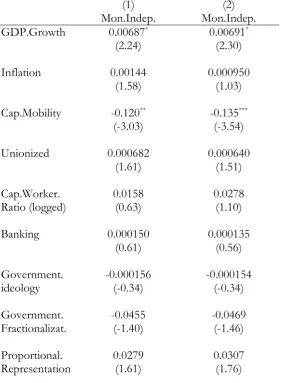
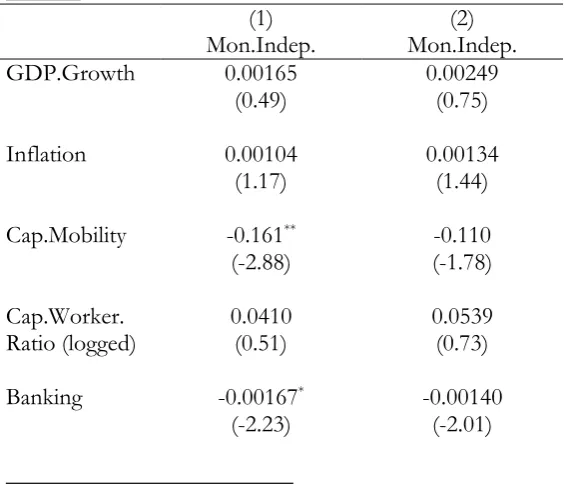
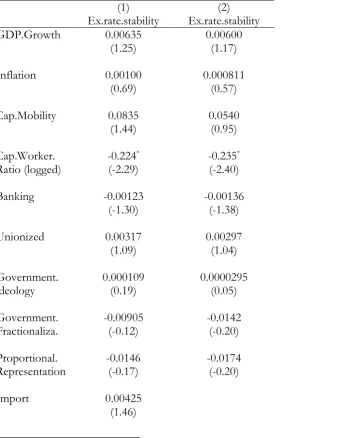
This study investigates how societal preferences impact policy choices in the trade-off between exchange rate stability and monetary policy autonomy. Building on the theoretical approach of economic pluralism, it is argued that the size and strength of different economic actors are the central determinants for monetary policy outcomes. Times-series cross-sectional regression analysis and a fixed effect model are used to analyse the predictors for domestic monetary policy outcomes in a timespan from 1960 up to 2010 (N=467). The results suggest that the size of the export sector, the banking sector and the share of workers to gross capital formation are the central determinants for monetary policy outcomes. Being in line with economic pluralism, the finding stands in contrast to the previous assumption that the partisan character of governments plays the decisive role. This implies a dominance of lobby groups over government discretion in monetary policy choices.
Keywords
Introduction
The question of who holds the reins in a country and determines the direction of public policy has always fascinated academic scholars and political theorists (e.g. already Aristotle 4th-centruy BC; Machiavelli 1532). In democracies, the basic principle of rule of the people entails that the will of the population has to be translated in some way into policy outcomes. However, it is debatable how these translation processes occur and which channels between the people and the state are the main platforms of policy-creation.
Some scholars have argued that governments have a significant degree of discretion in policy-creation and that their ideological orientation is the central determinant for policy outcomes (e.g. Bearce 2003; Bjørnskov 2008; Potrafke 2009). They assume that governments are mainly motivated by policy-seeking goals and always try to implement their favored policies. Other scholars doubt the discretionary power of politicians and emphasize the crucial impact of powerful interest groups (e.g. Berger 1983; Lijphart 1975; Pizzorno 1981). In this vein, Becker has once compared the role of politicians with managers of firms. He argued that politicians are hired to further the collective interests of pressure groups, who could fire or repudiate them with the next elections in case they deviate from their interests (Becker 1983, 396). According to this logic, politicians are reduced to mere puppets which have to serve the interests of powerful groups in the society.
The question who determines the direction of a country is in particular relevant with regard to highly controversial topics where conflicting interests are competing with each other. One of those topics is the trade-off between monetary policy autonomy and exchange rate stability which each state faces in an environment of international capital mobility (Mundell 1964). While it is beneficial for some groups in society to pursue an autonomous monetary policy, others held a distinct preference for stable exchange rates. This paper aims to shed light on the translation of societal preferences into policy outcomes with focus on exactly this dilemma of monetary policy. Consequently, this analysis aims to answer the following research question:
“How do societal preferences shape policy outcomes in the trade-off between monetary policy autonomy and exchange-rate stability?”
between monetary policy autonomy and exchange-rate stability. Based on a principal-agent model he suggests that leftist parties are the agents of all societal groups which prefer monetary policy autonomy and that rightist parties are the agents of all societal groups with a preference for exchange-rate stability. Thus, he concludes that the partisan character of a government determines the monetary policy of a country whereas he regards the size and strength of different societal groups as irrelevant. He underpins this assumption with empirical evidence of twenty-two OECD countries in the period between 1975 and 1992 and he supplies his findings with further evidence from a historical case study about lobbying for monetary policy in the US. His quantitative evidence illustrates that the ideology of government parties is indeed the central determinant for a country’s monetary policy and that the strength of different societal groups emphasized by the economic pluralism is of minor importance. However, his analysis is based on several theoretical and methodological flaws which will be elucidated in the following. In particular, a re-analysis of his study with a newer dataset and a more sophisticated measure of the central explanatory variable will demonstrate that the power and willingness of government parties to shape the monetary policy of a country is actually smaller than previously thought.
This paper will proceed in the following way. First, the Mundell-Fleming model - which represents the foundation of this study - will be introduced. Secondly, I will demonstrate with several theories about preference formation why different actors in the society have different priorities regarding monetary policies. In a next step, the two central theories for the translation of societal preferences into policy outcomes will be contrasted with each other. Hereby, I will critically discuss Bearce’s party-as-agent model and its implications. Afterwards, I will explain in the methods section the databases and the statistical model used for this re-analysis. Hereby, I will supply a times-series cross-sectional OLS regression analysis with a fixed effects model which accounts for several problems of pooled data. Finally, I will summarize the findings and explain why economic pluralism is still the dominant theory for the translation of societal preferences into monetary policy outcomes.
1.)
The implications of the Mundell-Fleming trilemma for monetary policy
(Aizenman 2011) which posits that economies cannot simultaneously maintain free capital movement, a fixed exchange rate, and an independent monetary policy.
Marcus Fleming argued in his seminal study on international macroeconomics that the stimulus to employment, income, and output resulting from a given increase in public expenditure will be larger with a floating exchange rate than with a fixed one (Fleming 1962, 372). Underpinning this assumption, Robert Mundell demonstrated that under a floating exchange rate monetary expansion puts downward pressure on the interest rate and induces capital outflow, further depreciating the exchange rate and creating an export surplus, which in turn increases, via the multiplier effect, income and employment (Mundell 1963). Hence, Mundell showed that monetary policy becomes a powerful tool of stabilization policy under flexible exchange rates when the condition of capital mobility is given (Mundell 1963). The same impact cannot be achieved under a fixed exchange rate since the maintenance of the exchange rate thwarts the effect triggered by a depreciation of the currency. The contemporary international economy is characterized by a great mobility of capital across national borders (Frieden 1991), i.e. the condition of capital mobility is fulfilled for almost all developed economies. Thus, the choice of any exchange-rate system in each country is based on the trade-off between domestic economic independence on the one hand and exchange-rate stability on the other (Oatley 2012, 205).
The question arises which of those two conflicting monetary policy goals is more desirable for states. It can be assumed that in democratic states the choice for one of those monetary policy goals is determined by societal preferences since the people should be the sovereign of the country. Therefore, I will discuss in the next section how societal preferences towards the trade-off between monetary policy autonomy and exchange rate stability emerge and which opposing interests are competing.
2.)
Societal preferences for monetary policy outcomes
The idea of production factors is based on the influential Heckscher-Ohlin model. This model assumes that all factors of production within countries are mobile across sectors, that there are constant returns to scale in production and that markets are perfectly competitive (Mansfield and Mutz 2009, 427). Based on those assumptions, the Heckscher-Ohlin model distinguishes in its basic form between two main production factors, namely capital and labor. While the model was originally developed to explain trade policy preferences (Oatley 2012, 70f.), diverging preferences of capital and labor can be also identified with regards to other national economic policies. In this vein, it has been argued that the production factor labor is more tied to the local economy than capital and that it therefore prefers domestic monetary autonomy (Kapstein 1996). This can be explained by the fact that domestic actors can benefit from currency depreciations processes induced by monetary policies. And because of its prevailing domestic economic activity, the production factor labor is less affected by varying exchange rates. In the contrary, the production factor capital has a highly mobile nature. Therefore, it relies more on stable exchange rates and less on an autonomous monetary policy by national states which shapes its preference the other way around. Taken together, the framework of production factors predicts that capital has a preference for exchange rate stability whereas labor holds a preference for domestic monetary policy autonomy.
with varying exchange rates and therefore have no fundamental interest in stable currencies. This applies also to producers of non-tradable services who do not operate in an international context.
In summary, it can be stated that all internationally oriented actors prefer currency stability, while domestically oriented actors accept the costs of greater currency instability and prefer monetary autonomy (Frieden 1991, 446). Considering the predictions made by the production factor and the economic sector model, several different groups with preferences for either monetary autonomy or for exchange rate stability can be identified. Namely, the production factor labor, the import-competing sector, and the non-tradable services sector have a preference for monetary autonomy, whereas the production factor capital, the export-competing sector, the banking sector, and international investors prefer exchange rate stability.
3.)
Translation of societal preferences into monetary policy outcomes
After the identification of different preferences for either monetary autonomy or exchange rate stability, it is necessary to scrutinize in a second step how those preferences are translated into monetary policy outcomes. There are two main theoretical frameworks for those translation processes which will be introduced and contrasted below.
3.1) Economic pluralism
The theory of economic pluralism argues that policy outcomes are a function of the political competition between different societal actors which is determined by their relative power and their propensity for collective action (Garrett and Lange 1995, 628). Rooted in a liberal theory of international politics (Moravcsik 1997), pluralism assumes that the dominant groups in a society will finally implement their favored policies. Therefore, Dahl has connected the emergence of pluralism to a particular kind of regime termed ‘polyarchy’ (Dahl 1978, 191). While hegemonic regimes thwart the development of pluralism, polyarchies are more open to organised opposition and thereby induce the formation of a pluralistic order.12 In such political systems, political institutions regard interest
representation in the population (Pizzorno 1981, 259). Following the logic of pluralism, government institutions just provide the arena for group competition and do not exert a significant impact on policy decisions themselves (Ikenberry, Lake, and Mastanduno 1988, 7). Therefore, politicians have not an autonomous role of policy shaping but instead they follow the will of the powerful actors in a country which emerge as dominant pressure groups (Becker 1983, 396).
Applied to the trade-off between monetary policy autonomy and exchange rate stability, the pluralist theory suggests that a state will either strive for monetary policy autonomy in case that groups with such a preference predominate in a society or pursue exchange rate stability in case that groups with the opposite preference are superior. Thus, the distribution of the size and strength of different societal groups will shape monetary policy outcomes. Connecting this rationale to the preference patterns discussed above, it can be assumed that the respective size of those economic actors shapes the monetary policy choice. More specifically, according to the pluralist logic it is expected that the size of the export-competing sector, the import-competing sector, the banking sector as well as the size of unionized workforce influence the choice between monetary autonomy and exchange rate stability. Based on this assumption, I will examine the following hypotheses to test the theory of economic pluralism:
H1: Countries with higher percentages of exports to total GDP have higher degrees of exchange rate stability.
H2: Countries with higher percentages of imports to total GDP have a higher degree of monetary autonomy.
H3: Countries with a higher percentage of unionized workforce to total salary earners have a higher degree of monetary autonomy.
H4: Countries with a larger banking sector have a higher degree of exchange rate stability.
3.2) The ‘party-as-agent model’ from David Bearce
David Bearce provides in his paper an alternative theory for the translation of societal preferences into monetary policy outcomes. Building on a principal-agent approach, he emphasizes the crucial role of the partisan character of governments for the choice of monetary policies.
His point of departure is the fact that leftist parties are traditionally the protectors of labor interests and that rightist parties often form close alliances with capital owners. By focusing on the US context, Bearce argues that less-skilled manual workers in the import-competing manufacturing sector and white-collar workers in the service sector are a solid leftist constituency. In contrast, skilled-manual workers which often work in export-oriented industries, capital-intensive industries and investment banks are closely aligned with the political right. Considering the different preference patterns elucidated above, Bearce infers that leftist political parties advocate the interests of societal groups with preferences for monetary autonomy and that rightist political parties represent the interests of societal actors with preferences for exchange rate stability. He assumes that a delegation process from actors with particular monetary policy preferences to political parties takes place, whereby he regards the societal groups as principals and political parties as agents. In the desire to fulfil the policy preferences of their respective principals, leftist governments pursue an autonomous monetary policy and rightist governments implement stable exchange rates. Thus, the central indicator of a country's monetary policy is the partisan character of its respective government.
for an impact of government ideologies on monetary policy outcomes. Thus, I examine the party-as-agent model in its pure form by testing the following hypotheses:
H6: Countries with more leftist governments have higher degrees of monetary autonomy.
H7: Countries with more rightist governments have higher degrees of exchange rate stability.
3.3) Critical discussion of David Bearce’s ‘party-as-agent model’
Several points of criticism should be considered with regard to the party-as-agent model. First, the party-as-agent model makes very optimistic assumptions about the ability and willingness of government parties to pursue the favored policies of their voters. It assumes that a government is determined to implement the preferred policies of its voters irrespective of opposition from various powerful actors in the society. Previous research has demonstrated that governments are not immune against pressures from interest groups and especially not against pressure from powerful business entrepreneurs (Golden 1998; Klüver 2009; Yackee and Yackee 2006). A remarkable example for the significant influence of interest groups on policy outcomes is the lobbying of the National Rifle Association in the US against gun control which is successful against the majority’s preference for a more restricted gun control (Dearden 2015). Ignoring such impacts, the party-as-agent model treats government parties as pure policy-seeking actors which try to implement the policies they promised to their voters. In contrast to this assumption, a multitude of studies showed that governments are also motivated by vote-seeking goals and that they often act strategically to reassure their re-election (Crisp et al. 2004; Crisp, Jensen, and Shomer 2007).
Thirdly, Bearce employs a one-dimensional left-right heuristic of party ideologies which is a strong simplification of reality. This might work for the American context with only two parties to be classified but the party structure in other OECD countries is often far more complex. Taking into account this polymorphic character of ideology, it has become a standard to differentiate between the economic and sociopolitical dimension when classifying party ideologies (Bräuninger and Debus 2011). Bearce fails to acknowledge those different dimensions and treats party ideologies as one-dimensional categorizing them on a scale ranging from 1 up to 5. This problem will be encountered with a more fine-grained measure of party ideology which will be elaborated in the methodological section below.
4.)
Methods
The methodological section is divided into three parts. First, I will critically evaluate the measures used by Bearce. Afterwards, I describe my own variables and their operationalizations and subsequently I introduce my statistical model.
4.1) Critique of David Bearce’s methods
France is as influential as the monetary policy of raising economic players such as China, India or Brazil. The recent inclusion of the Chinese Yuan to the SDR basket of reserve-currencies by the IMF (Mathew 2015) illustrates the growing importance of other currencies and shows that they also significantly impact the prevailing world interest rate. Acknowledging the difficulties of capturing such latent concepts as monetary policy autonomy and government ideology, this analysis aims to improve their measurement by using more sophisticated and fine-grained measures that have been developed by other scholars.
4.2) Variables and Data Sources
For the purpose of my re-analysis, I use the same variables as Bearce, but the variables originate from other sources with different operationalizations.13
The main dependent variable ‘monetary autonomy’ will be operationalized with the so-called monetary independence index taken from Aizenman’s open economy trilemma dataset (Aizenman, Chinn, and Ito 2008). Aizenman has developed a remarkable dataset which quantifies the degree of achievement along the three dimensions of monetary independence, exchange-rate stability and financial openness. He standardizes the extent of realization of the three conflicting monetary policy goals with three indices ranging from 0 to 1 whereby higher values indicate higher achievement of the respective policy goals.14 By comparing a country’s monetary policy to a respective base country,
he is able to detect autonomous policy choices along these three dimensions. The choice of the respective base country builds on a study by Shambaugh who classifies countries’ currencies as pegged or nonpegged and identifies to which country the monetary policy is most closely linked to (Shambaugh 2004). The application of Aizenman’s monetary independence index has two significant advantages. First, it does not rely on an arbitrary choice of the prevailing world interest rate but compares closely connected currencies. Secondly, the standardization between 0 and 1 facilitates the interpretation of the achievement along the three dimensions of the impossible trilemma.
The proxy variable for the party-as-agent model tries to overcome the weaknesses of Bearce’s simplistic measure of government ideology discussed above. In contrast to Bearce, I use a very sophisticated and fine-grained indicator developed by the Comparative Manifesto Project (CMP) to
13 In distinction from Bearce, I do not control for central bank independence, the size of the non-tradable service sector and outward foreign direct investments since the amount of missing cases for those variables decrease the number of observations used for the analysis in an inadequate way.