The Relationship between the Big Five personality
Factor and self-efficiency in managers of Bank
Maryam Rajabzadeh
1, Mohammad Moshkani
21-Management Department, Management & Accounting College, Islamic Azad University, Aliabad Katool, Aliabad, Iran
2- PHD Student in psychologh, Counseling and Psychological Services Of Center Baran, Gorgan ,Iran
Abstract: The present research aimed at investigating the relationship between Big Five personality Factorand self-efficiency in managers of Bank Saderat,Golestan province, Iran. For this purpose, the hypotheses proposed were tested using data collected from NEO Five-Factor Personality Inventory and scale of self-efficiency. Research sample included 81 managers of Bank Saderat branches in Golestan province who were selected through convenience sampling. Research method was based on correlation analysis and stepwise regression test. Results indicated that there was a statistically positive significant relationship between extraversion, agreeableness, openness to experience, and conscientiousness to self-efficiency. However, there was a statistically negative (reverse) significant correlation between neuroticism and self-efficiency in managers. Moreover, results of stepwise regression indicated that two of NEO five personality factors, i.e. conscientiousness (directly) and neuroticism (reversely) had significant relationships with self-efficiency.
Keywords:Big Five-Factor personality, personality traits, self-efficiency, bank managers.
1. Introduction
60
Encountering unfavorable and stress situations, those with high self-efficiency could control their thoughts, exhibit more sustainability, and do not accept negative thoughts of themselves and disabilities (Masoudnia, 1986). Those with low efficiency view tasks and works difficult and it increases their stress ;strong efficiency beliefs bring about comfort and approach to difficult tasks. On the other hand, basis for strong self-efficiency could increase individual performance and self-self-efficiency determines how to confront barriers and unfavorable experiences and how much effort and insistence to be made to remove barriers (Friedel, Cortina ,Turner & Midgley, 2007).Research indicates that there is a relationship between personality traits and self-efficiency. There is a negative relationship between neuroticism and self-efficiency (Judge, Erez Bono &Thoresen, 2002)while there is a positive relationship between openness to experience and self-efficiency(Nauta, 2004; Rottinghaus, Lindly, Green &Borgen, 2002). Therefore, neuroticism is a strong predictor for lack of self-efficiency while extraversion and conscientiousness are positive predictors for self-efficiency. Furthermore, openness to experience has a positive relationship with self-efficiency whereas "agreeableness" has no relationship to it (Hartman, Betz, 2007). Research indicates that form among the five personality factors, three important factors (extraversion, openness to experience, and conscientiousness during job interviews) for managers have a significant role in social equations, i.e. communications with others. Also, among these three, conscientiousness is the most important one. That is why they play more important role in non-social processes (Van Dam 2003; Kaldol& Burger, 1998). A research conducted by Moss et al. (2007) on styles of leadership and management and its relationship with openness to experience and organizational commitment indicated that whenever level of openness to experience in NEO questionnaire decreases as one of personality traits, level of fidelity and commitment to the organization decreases in turn. In another study conducted by Aronson et al. (2006) on the effect of manager's personality on working teams and performance, results indicated that the personality variable and openness to experience had a strong relationship with team work and performance. Other personality variables such as extraversion and conscientiousness had indirect relationship on performance by working team. Results of a research by Silverthorne (2001) on the relationship between personality factors of NEO questionnaire and prediction of leadership ability in managers of three countries, China, Thailand, and USA ,suggested that compared to managers who do not view themselves much capable, capable managers from all three cultures described themselves as extravagant, agreeable, and highly conscientious, although, they scored low on neuroticism. Thus, given theaim of the research and importance of organizational and psychological elements in increasing productivity and improving quality of services and human communications with clients and employees, the present study was conducted with the aim of investigating the relationship between personality traits and self-efficiency in managers of Bank Saderat Branches of Golestan Province.2. Methodology
Considering the purpose of the study, research method was a correlational one. Since in the present research, we studied the relationship between the independent variable, i.e. personality traits as the criterion variables and dependent variable, i.e. self-efficiency as a predicting variable among managers of Bank Saderat branches in Golestan province, we used the correlation method.
2-1. Statistical population, sample and sampling method
Statistical population for this research consistedof all managers and deputies working in branches of Bank Saderatin Golestan Province in 2014. From Supervision Branch, it was revealed that 91 managers and deputies are working at branches of the province. Thus, statistical population for the research consisted of 91 managers and deputies of Bank Saderat branches in Golestan Province, 81 of whom were selected as sample. Sampling method was based on convenient sampling asall of managers and deputies of branches in Golestan Province were studies. List of all of managers and deputies was first prepared. Because there are not more than one or two branches in cities of Golestan province except Gorgan and some of the branches do not have deputies and only have managers, then all of them were studies. Questionnaires were sent for all of them (91 participants) and they were asked to answer questions carefully. Thus, in addition to data collection, some questionnaires which were not completely answered or those which were accidentally answered by interpretation were ignored and finally 81 questionnaires were analyzed. Thus, statistical sample for the present research included the total number of 81 managers and deputies working at Bank Saderat branches in Golestan Province in 2014. (It is worth mentioning that given Krejcie and Morgan tables, 73 people were determined as research sample.)
2-2. Revised NEO Personality Questionnaire
61
2-3. General Self-Efficiency Questionnaire
This scale was developed by Sherer & Maddux in 1982. It includes 23 questions; 12 questions measure general health, and the other 6 are related to self-efficiency experiences for social situations (AsgharNejad, KhodaPanahi, and Heidari, 2004). The participants specified their success rates by marking one of the choices. Questions are formulated to assess expectations for general self-efficiency such as social skills and professional competencies. 5 answers have been suggested for any self-efficiency question. That is why 5 points are given to any question. Points for questions No. 1, 3, 8, 9, 13, and 15 are increased from right to leftand it is reverse for the other questions (from left to right). In 1995, Barti (cited in Vaghri, 1997) applied split-half method to study reliability of self-efficiency scale. Reliability coefficient was found to be 0.76 for equal length and 0.76 for unequal length by Spirman-Brown and it was determined 0.75 by Gutman. Cronbach's alpha or overall homology for the questions was obtained 0.79 which were accepted as satisfactory for the given research.
3. Results and Data Analysis
Table (1) Colmograph-Smirnov for determination of data distribution
Self-efficiency conscientiousness Agreeableness Openness Extraversion Neuroticism Variables 876 . 636 . 993 . 852 . 802 . 861 . Kolmogorov– Smirnov 219 . 814 . 270 . 453 . 540 . 448 . Sig.
Given significance level obtained for every variable, as the obtained statistics for every variable is not significant at the 0.05 error level, then H0, which assumes normal distribution, andH1,which assumes both abnormal distribution and difference, are both rejected. Thus, all variables have normal distribution and parametric statistics could be used.
Table (2) Matrix of correlation between independent and dependent variables Self-efficiency conscie ntiousn ess Agreea bleness Opennes s Extrave rsion Neuroti cism Correlation Sig. level Neuroticism df 630 -. 000 . 78 572 -. 000 . 78 480 -. 000 . 78 251 -. 025 . 78 427 -. 000 . 78 1 . 0 353 . 001 . 78 489 . 000 . 78 352 . 001 . 78 377 . 001 . 78 1 . 0 427 -. 000 . 78 Correlation Sig. level Extraversion df 316 . 004 . 78 215 . 056 . 78 104 . 358 . 78 1 . 0 377 . 001 . 78 251 -. 025 . 78 Correlation Sig. level Openness df 267 . 017 . 78 396 . 000 . 78 1 . 0 104 . 358 . 78 352 . 001 . 78 480 -. 000 . 78 Correlation Sig. level Agreeableness df 692 . 000 . 78 1 . 0 396 . 000 . 78 215 . 056 . 78 489 . 000 . 78 572 -. 000 . 78 Correlation conscientiousness Sig. level df 1 . 0 692 . 000 . 78 267 . 017 . 78 316 . 004 . 78 353 . 001 . 78 630 -. 000 . 78 Correlation Sig. level Self-efficiency Sig. level
micro-62
scales, NEO personality questionnaire indicates that correlation coefficient (p<0.01, n=8, r=0.353) is positive and significant between extraversion and self-efficiency. Also, correlation coefficient for openness to experience is (r=0.316); for agreeableness, it is (r=0.267); and for conscientiousness it is (r=0.692). results show that there is a positive and significant relationship between extraversion, openness to experience, agreeableness, and conscientiousness and self-efficiency.Table (3) summary of specifications of multi-variable regression models
Model Correlation coefficient Determination coefficient Modified determination coefficient
1 0.699 0.488 0.482
2 0.755 0.571 0.560
As it can be seen from table (3), two models are obtained by regression analysis ,while the second model has the largest determination coefficient (0.571) and correlation coefficient (0.755). ℜ2 indicates that 0.57% of changes in self-efficiency could be explained by introducing dependent variables in the analysis and the rest of changes are related to the other factors that are unknown here.
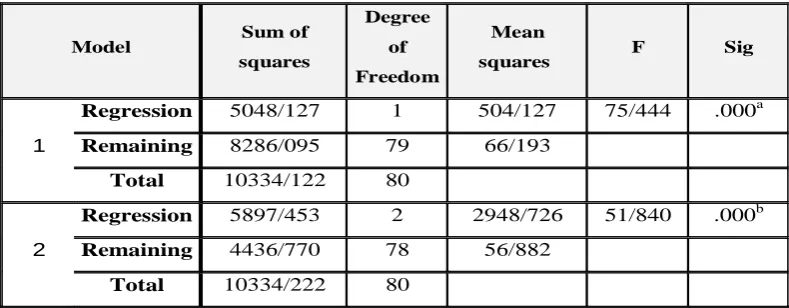
Table (4) regression line and the rest (fitting of regression line)
Model Sum of
squares
Degree
of
Freedom
Mean
squares F Sig
1
Regression 5048/127 1 504/127 75/444 .000a
Remaining 8286/095 79 66/193
Total 10334/122 80
2
Regression 5897/453 2 2948/726 51/840 .000b
Remaining 4436/770 78 56/882
Total 10334/222 80
Given table (4) and level of significance 0.000, H1 for accuracy of regression model is approved. Table (5) multiple regression for identification of factors affect self-efficiency
Model
NonStandardized
Regression coefficient
Standardize
d
Regression
coefficient
T
Sig
B SD Beta
Intercept (
1
) 22/595 4/498 5/023 .000
Consciousness 0/736 .0/58 0/699 8/868 .000
Intercept (
2
) 54/355 9/207 5/904 .000
Consciousness 0/520 0/96 0/494 5/415 .000
Neuroticism -0/434 0/112 -0/352 -3/864 .000
63
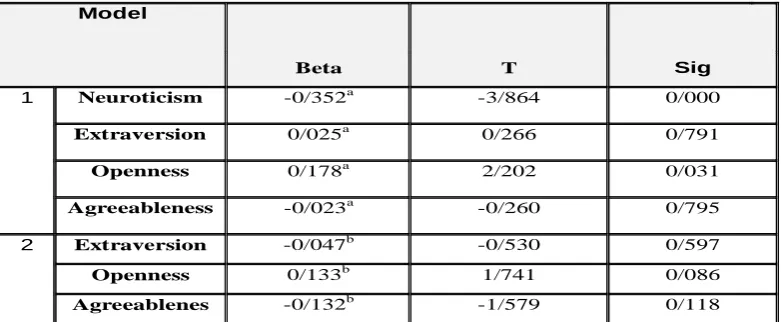
values suggests that relative contribution of conscientiousness to self-efficiency is 0.494, which is more than that of neuroticism.Table (6) variables removed from themodel
Model
Beta T Sig
1 Neuroticism -0/352a -3/864 0/000
Extraversion 0/025a 0/266 0/791
Openness 0/178a 2/202 0/031
Agreeableness -0/023a -0/260 0/795
2 Extraversion -0/047b -0/530 0/597
Openness 0/133b 1/741 0/086
Agreeablenes -0/132b -1/579 0/118
According to table (6), at second stage, level of significance for variables extraversion, openness to experience, and agreeableness was more than 0.5 and they were removed from the model.
4. Conclusion and Discussions
64
References
Alipour, A. Principles of health psychology. Tehran: Payame Noor University Publication. 2011.
Arney, R.D., Bouchard,D.J.,Segal,N.L., Abraham,L.M.1989 .Job satisfaction:environmental and genetic components. Journal of applied psychology,74,184-192.
Aronson, Z. H., Reilly, R. R. ,& Lynn, G. T.2006 .The Impact of Leader Personality on New Product Development Teamwork and Performance: The Moderating Role of Uncertainty. Journal of Engineering and Technology Management, 23(3), 221-247. Bandura, A. Self-efficacy mechanism in human agency.American Psychologist, 37, 122-147.1982.
Bandura, A.2000. Exercise of human agency through collective efficacy. Current Directions of Psychological Science, 9, 75-78.
Barrick, M., &Mount,M.K..1991 The big five personality dimensions and job performance : A meta analysis. Journal of personality psychology.4(4),1-26.
Caldwell, D. F., & Burger, J.1998. M.Personality Characteristics of Job Applicants and Successful in Screening Interviews. Journal of Personality Psychology, 51(1), 119-135.
Costa, P. T., & McCrae, R. R1992..Four ways five factors are basic. Personality Individual Difference, 13, 653-665. FathiAshtiani, H. Psychological tests. Tehran: Besat Publishing. 2009.
Feist, J., & Feist, G. J. Theories of personality. New York. McGraw-hill Press.Seventh edition.2009.
Friedel, J. M., Cortina, K. S., Turner, J. C., &Midgley, C.2007.Achievement goals, efficacy beliefs and coping strategies in mathematics: The roles of perceived parent and teacher goal emphases. Contemporary Educational Psychology, 32, 434-458.
Goldberg, L. R .1992.The development of markers for the Big Five factor structure.Psychological Assessment, 4, 26-42.
Haghshenas, H. 2006.Five factor personality traits model: A guide for interpreting and norms of NEO FFIand NEO PI-R. Shiraz: University of Medical Sciences.
Hartman,R.O& Betz ,N.E .2007.The five factor model and career self-efficacy general and domain- specific relationship. Journal of career assessment.15(2),45-61.
Judge, T. A., Erez, A., Bono, J. E., &Thoresen, C. J. 2000.Are measures of esteem, neuroticism, locus of control, and generalized self-efficacy indicators of a common core construct? Journal of Personality and Social Psychology, 83, 693-710.
Kateb, G, R., & Amin, F. 2008.Designing an empowerment plan for mangers based on their managerial roles. The Humanities Journal of Semnan University, 4, 27: 110-125.
Khakpour, A., Yamini, M., &Pardakhtchi, M.H.2008.Study of relationship between five factor model personality and guidance school principal’s job performance contextual performance – task performance. Journal of Applied Psychology, 2,2-3: 564-597.
Masoudnia, E. Relationship between control source and coping strategies in Yazd University students.Psychological Studies, 3, 4: 124-142. 2006.
McCrae, Robert R.; Costa, Paul T.1985. Updating Norman's "adequacy taxonomy": Intelligence and personality dimensions in natural language and in questionnaires. Journal of Personality and Social Psychology, 49(3), 710-721.
Mitchell, T. R .1986.An Evaluation of The Validity of Correlation Research Conducted in Organizations. Academy of Management Review, 10, 192-202.
Moss, A. S. ,Mcfarland, J. , Ngu. S. ,&Kijowska, A. 2007. Maintaining and Open Mind to Closed Individuals, The Effects of Resource Availability and Leadership Style on the Association between Openness to Experience and Organizational Commitment. Journal of Research in Personality, 14(2), 259-275.
Nauta, M. M. 2004.Self-efficacy as a mediator of the relationships between personality factors and career interests.Journal of Career Assessment, 12, 381-394.
Rottinghaus, P. J., Lindley, L. D., Green, M. A., &Borgen, F. H.2002. Educational aspirations: The contribution of personality, self-efficacy, and interests. Journal of Vocational Behavior, 61, 1-19.
Salimi, H., Karaminia, R., Amiri, M., Mirzamani, S.M.2006. Relationship between personality traits to job success in high-ranking mangers of a governmental organization.Journal of Research in Behavioural Sciences, 1,4: 5-12.
Sherer, M .Maddux , L.1982 .Self-efficacy scale: Construction and validation. Psychological Reports , 51 ,663 – 671 .
Silverthorne, C. 2001. Leadership Effectiveness and Personality: A Cross Cultural Evaluation . Journal of Personality and Individual Differences, 30(2), 303-309.
Super, D. E. 1998. Vocational Adjustment. Journal of Career Development Quarterly , 36, 351-358.
Vaghri, E.2000. Investigating the relationship between self-efficiency and crisis coping strategies and newly married couples in Tehran University in 1999-2000 academic year. Unpublished MA thesis. Tehran: TarbiateMoalem University.