Evaluating the effectiveness of computer
software on architectural design
Vahid Alaeddin
1, Azadeh Esmaeili Sales
1, Ali asghar Sepehrifar
2, Faezeh Biklari
2,
Golnesa Honarvar
11. Mirdamad Higher Education Institute, Gorgan, Iran
2. Department of Architecture, Gonbad Kavous branch, Islamic Azad University, Gonbad Kavous, Iran
ABSTRACT: This paper examines the impact of architecture software of trend designing the architectural engineering; despite software, can we help to designing and engineering of architecture? Answering this question, five of software and several papers related to the virtual world have been studied; the various researchers say that each software have its own application. Drawing and designing software of the architecture called sketch up, Architect, 3D max, Revit and Catia software are that have been compared in this article. For each of these applications after reasonable inquiry and investigation, we have reached the conclusion that in terms of quality and modeling, software of 3D max, Catia are the best and of drawing precision, software of Revit and Architect and of speed, software of sketch up; of course any software has capabilities of its own, and each used for a special project.
Key words: software, Computer, Architectural Design, 3D max, sketch up.
INTRODUCTION
76
lead to the development of successful experiences that can be applied to solve similar problems (Sommerville, 2006).
1-1 Theoretical evaluation of software architecture concepts
77
come to the conclusion that high speed Revit has led designer does several designs at the same time, instead of designing one plan (libarsima, 2009).
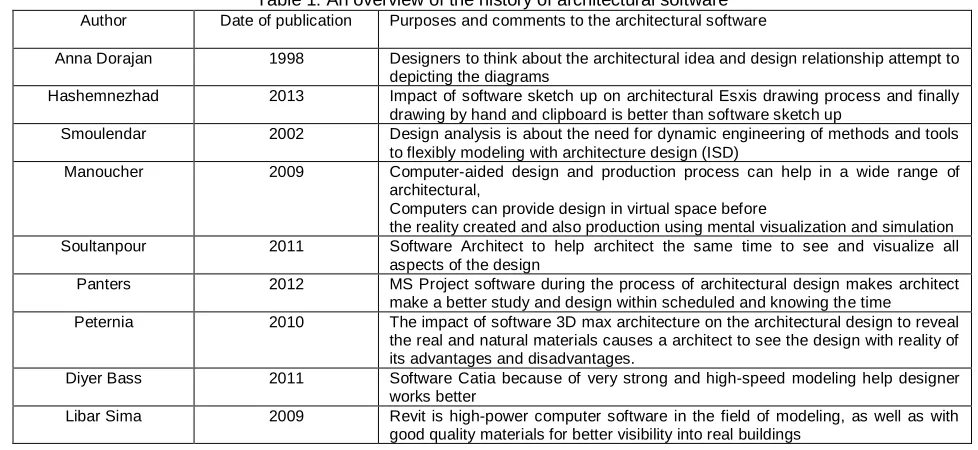
Table 1: An overview of the history of architectural software
Author Date of publication Purposes and comments to the architectural software
Anna Dorajan 1998 Designers to think about the architectural idea and design relationship attempt to depicting the diagrams
Hashemnezhad 2013 Impact of software sketch up on architectural Esxis drawing process and finally drawing by hand and clipboard is better than software sketch up
Smoulendar 2002 Design analysis is about the need for dynamic engineering of methods and tools to flexibly modeling with architecture design (ISD)
Manoucher 2009 Computer-aided design and production process can help in a wide range of architectural,
Computers can provide design in virtual space before
the reality created and also production using mental visualization and simulation Soultanpour 2011 Software Architect to help architect the same time to see and visualize all
aspects of the design
Panters 2012 MS Project software during the process of architectural design makes architect make a better study and design within scheduled and knowing the time Peternia 2010 The impact of software 3D max architecture on the architectural design to reveal
the real and natural materials causes a architect to see the design with reality of its advantages and disadvantages.
Diyer Bass 2011 Software Catia because of very strong and high-speed modeling help designer works better
Libar Sima 2009 Revit is high-power computer software in the field of modeling, as well as with good quality materials for better visibility into real buildings
2-1- An applied review of architecture software
78
and design; unlike others this is not able todesigning and materializing. Its ability is linked to the project management and duration of implementation of the project.
3-1- Reviewing the strengths and weaknesses of each of the architectural applications
The strengths of drawing the table of the process of architectural design makes designer to divide the design and use the factors will affect. The table makes a designer at a glance see several issues or several pages of a table and this action causes the planner to think and analyze further. The weakness of the table for the designer is that some important cases cannot be found in the table and they have an impact on the design process. Another application called sketch up in architecture has led the designer can see oneself as an Esxisy and hands-free, and this makes designers access to some of the movements when designing. It can be said that the application sketch because of speediness and simplicity it has, a designer can see the project in a short time. It has a weakness in the field of materials’ quality, which is possible the designer when viewing the plan cannot see some things while they should exist in real and it leads the plans to be change. The quality of design is very important. Another application called Architect has benefits in terms of objects that are the applied and ready objects available within the application. It can be said that this has other features when designing two-dimensional plan, three-two-dimensional inevitably is drawn to us, and it is of very high speed one in mapping. And the designer can easily in a short time change several the interior decoration projects, another benefit of this application is that it gives index, horizontal cutting, vertical cutting, perspective of view of bird observers to us at the same time and also the designer draws a wall at the same time the wall material of the wall is clear and obvious. But the weakness is that the quality of the object is low. Another application called 3D max has many functions to the architecture that is one of the best known over the world. This is an advantage to having excellent qualities and that makes the designer see the actual plan. But the weakness is that this application has a low speed and designer cannot do in the shortest time the original plan with lower quality. Another application called Catia is the same as 3D max that, in the modeling, is stronger than 3D max. The application Catia has poorer materials compared with 3D max, however, better quality than other software. Another application called Revit, works like the two previous applications, has the benefits of being higher speed in the interior design than others; another is that it makes the plan meter for us and delivers it packaged. The weakness is that it is a lot of time of rendering, the application Revit works like AutoCAD software, but is more advanced in the three-dimensional drawing.
4-1- Methodology, population, sample size, data collection method
The purpose of this paper is to evaluate the effectiveness of computer software developed in the architectural design. Similarly, in order to operationalize this in the article, the combined approach is used to scrutiny. This combined is defined generally both quantitatively and qualitatively. The combined approach in this study is based on survey and documentary methods. The documentary method is used to collect information in the field and assess functionality, the strengths and weaknesses of each of architectural software. To improve the quality and accuracy of the study as a survey and via a questionnaire of 38 specialists who deal with this software, information was collected. Each of these experts has different and sometimes the same perspective to the software.
5-1 The results of the questionnaire
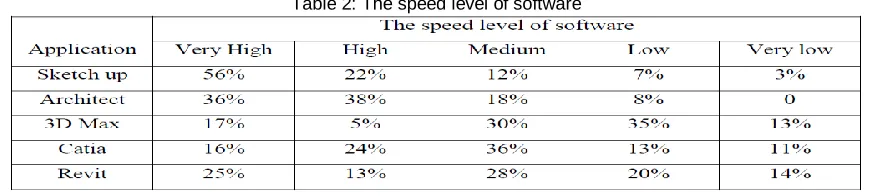
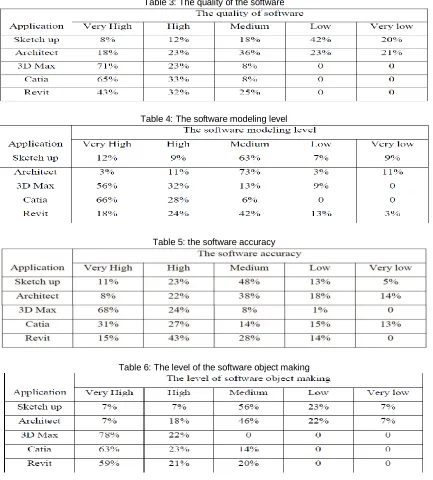
According to the inquiry conducted in this study, it is achieved the following information.
79 Table 3: The quality of the software
Table 4: The software modeling level
Table 5: the software accuracy
Table 6: The level of the software object making
6-1- Conclusion
80
RESOURCES
H.Hashemnezhad (2013), “The effect of software Sketch Up on the process of architectural Esxis drawing” Publication: Research center for architecture and urbanism. Page 29-38.
F. Sultan Pour, (2011), “Effects of Software Architect in architectural design. Publication: Research center for archit ecture and urbanism. Page 65-74.
R.Manocher (2009), “Cyberspace and its impact on the architecture” Publications: Special Architectural Engineering. Page 72-53. K. Smolander, Software Architecture Design in Information Systems Development: A Method Engineering View, 2002, pp. 220-226. I. Sommerville, Software Engineering: Architectural design, th,Ed, 2006,pp. 241-245.1.
M.Anandarajan, B. Arinze, Information & Management: Matching client/server processing architectures with information processi ng requirements, ELSEVIER, 1998, pp. 266-268.
H. panterz, Impact on the architecture of software MS Project, 2012, pp. 216-221.