WWJMRD 2018; 4(2): 237-243 www.wwjmrd.com
International Journal Peer Reviewed Journal Refereed Journal Indexed Journal UGC Approved Journal Impact Factor MJIF: 4.25 e-ISSN: 2454-6615
Eltohamy K. M. Water Relations and Field Irrigation Department, National Research Centre, Cairo. Egypt
Sabreen Kh. Pibars Water Relations and Field Irrigation Department, National Research Centre, Cairo, Egypt
El-Bagoury K. F. Agricultural Engineering Department, Faculty of Agriculture, Ain Shams University Cairo, Egypt
Mona A. M. Soliman Water Relations and Field Irrigation Department, National Research Centre, Cairo, Egypt
Abdel-Aziz A. A. Agricultural Engineering Department, Faculty of Agriculture, Ain Shams University Cairo, Egypt
Correspondence: Eltohamy K. M. National Research Centre (NRC), Agricultural Division, Water Relations and Field Irrigation Dept.
33 El-Buhouth St., Dokki, Giza, Cairo, Egypt
Model for Irrigation Management by Implementing
the Two Crop Coefficient Approaches. 1.
Computational Strategy and Verification
Eltohamy K. M., Sabreen Kh. Pibars, El-Bagoury K. F., Mona A. M.
Soliman, Abdel-Aziz A. A.
Abstract
Accurately estimation of crop evapotranspiration (ETc), as a vital parameter of irrigation management, is very critical for maximizing the use of limited irrigation water resources. Due to the complexity of estimating the daily ETc precisely, models are quick, accurate and easy to use. Therefore, an interactive Irrigation Management model for growing Crops (IMC-Model) was developed with the purpose of computing daily ETc to provide appropriate information of irrigation water management. This paper is the first part of a two-part series, where the second one describes the Model validating on some oil crops under surface and sub-surface drip irrigation. The IMC-Model was structured using Visual Basic 2013 language. This model followed the ETo-Kc method for computing the daily ETc. The ETo was computed by Penman-Monteith equation. Additionally, the model followed the two Kc approaches (single-Kc and dual-Kc) in order to be appropriate for all users and agricultural conditions. The model was also verified by two ready-to-use programs (CropWat-8 and ETo Calculator-3.2) for estimating the ETo, in addition, a spreadsheet named (FAO56Ax8.xls) introduced in FAO-56 for computing the daily ETc. The obtained results showed that the ETo calculated using the IMC-Model gave a high agreement among the values obtained from CropWat-8.0 and ETo Calculator-3.2 programs. In addition, the estimation of daily ETc using the model gave a high correlation (R2 ≈ 0.99) with those obtained from the FAO-56 spreadsheet. Conclusion: It can concluded that the IMC-Model is a proper solution for precisely computing ETc and the other irrigation management parameters.
Keywords:Interactive model, crop evapotranspiration, dual crop coefficient, single crop coefficient, irrigation management
1. Introduction
estimate the soil evaporation coefficient (Ke) and the basal crop coefficient (Kcb) separately5. As the fact that the ETo represents closely all climate effects but the Kc varies mostly with specific crop characteristics and have relatively lower effects of climate6. Computing ETc using the single-Kc approach has provided satisfying results for various time step calculations, including daily estimation of ETc, with proper accuracy for many programs. However, the single-Kc has difficulty in estimating impacts of irrigation and/or rainfall frequency or the type of irrigation system on water consumption. These impacts typically become more vital because of water shortage. The dual-Kc is more precise and more appropriate for operational programs where daily estimates of ETc are critical needed by compared with single-Kc7-9. However, Odhiambo and Irmak10mentioned that the dual-Kc approach is uncommon because it requires a daily water balance of the evaporation from the soil layer as well as soil water balance at the root zone. Thus, it requires knowledge about the soil evaporable characteristics, a few parameters describing the ground cover, and the energy availability for soil water evaporation addition to knowledge of irrigation events8. Many studies report the program of the dual-Kc approach to several crops, including for cereals, e.g. Liu and Luo11 for the wheat-maize crop; Tolk and Howell12 for sorghum, Zhao and Nan13for maize, and López -Urrea et al.14for wheat. The use of the dual-Kc approach become more demanding than single-Kc approach, which justifies all needs for implementing a proper model program, however, few model programs are available8,15. Therefore, an interactive model named (IMC-Model) was developed to provide an accurate information about irrigation management parameters. The IMC-Model is an easy-to-use model which will be proper for both experienced users and novice as farmers and support them with decision-making related to irrigation management easily.
2. Methodology
2.1. The computational formulas
A detailed description of procedures for calculating ETo and ETc according to dual-Kc and single-Kc approaches are introduced in FAO-564.
2.1.1. Reference evapotranspiration
The reference evapotranspiration (ETo) was calculated using the FAO-56 Penman-Monteith equation and the equations of the aerodynamic and canopy resistance as following4:
Where ETo = reference evapotranspiration (mm d-1), ∆ = slop of saturation vapor pressure versus air temperature curve (kPa ℃-1), Rn = net radiation (MJ m-2d-1), G = soil heat flux (MJ m-2
d-1), = psychometric constant (kPa ℃-1), T = mean daily air
temperature(℃), u2= mean daily wind speed at 2-m height (m s
-1), (es-ea) = vapor pressure deficit (kPa).
2.1.2. Crop coefficient
The crop coefficient (Kc) is defined by Allenet al.4as the ratio of the ETc to the reference ETo and can be calculated according to the two following approaches (single-Kc and dual-Kc):
Single crop coefficient
In the single-Kc approach, which combines effects of both soil evaporation and crop transpiration, the crop evapotranspiration is estimated by Allenet al.4as surface is dry, Ke is small and even zero when no water remains close to the soil surface for evaporation. The Ke was adjusted as4:
ETc = Kc ETo
(2)
Where Kc = single-Kc under standard climatic conditions (where mean RHmin = 45 %, and u2 at 2-m = 2 m s-1). According to the recommendation of Allenet al.4, the Kc should be adjusted for the local climatic conditions (where RHmin ≠ average 45 % or u2at 2-m ≠ 2 m s-1). The Kcmid and Kcend(if Kcend> 0.45) values are adjusted as16:
2
min
0.30.04 2 0.004 45 (3) 3
adj table h
Kc Kc u RH
Where Kctable= the value of Kcmidor Kcend(if > 0.45), Kcadj = the value of Kcmid or Kcendadjusted according the local climatic conditions, u2 = the mean wind speed at 2-m height during the mid- or late season growing stage
(%%) for 1 m s-1 ≤ u2 ≤ 6 m s-1, RHmin = the mean minimum relative humidity during mid- or late season growing stage (m s-1) for 20% ≤ RHmin≤ 80%, andh= mean crop height during the mid- or late season growing stage (m) for 0.1 m
≤h≤ 10 m.
Dual crop coefficient
The dual-Kc approach separately estimates the effects of crop transpiration and the soil evaporation. So, the ETc is estimated according to Allenet al.4as:
ETc=Kcb Ke ETo
(4)
Where Kcb = the basal crop coefficient under the standard climatic conditions (mean RHmin= 45 %, and u2at 2-m = 2 m s-1). The Kcb is defined as the ratio of the ETc to the ETo when the soil surface is dry, and transpiration is non-limited by water. Hence, Kcb-ETo represents mainly the transpiration component of ETc. The value of Kcb, according to Allenet al.4 and Allen and Pereira16, should be adjusted for the local climatic conditions (where mean RHmin≠ 45 % or u2at 2-m height ≠ 2 m s-1). The values of Kcbmidand Kcbend(if Kcbend> 0.45) are adjusted as4:
(5) 3 )] 45 ( 04 . 0 ) 2 ( 04 . 0 [ 3 . 0 min 2
Kcb u RH h
Kcbadj table
Where Kcbtable= the value of Kcbmidor Kcbend(if Kcbend> 0.45), Kcbadj = the value of Kcbmid or Kcbend adjusted according to the local climatic conditions, u2 = the mean daily wind speed at 2-m height during the mid- or late season grows stage (%) for 1 m s-1≤ u2≤ 6 m s-1, RHmin= the mean daily minimum relative humidity during the mid-or late season grows stage (m s-1) for 20% ≤ RHmin≤ 80%, andh = mean crop height during the mid- or late season grows stage (m) for 0.1 m ≤ h ≤ 10 m.
The Ke describes the evaporation component of ETc. The Ke is maximal where the topsoil is wet and where the soil surface is dry, Ke is small and even zero when no water remains close to the soil surface for evaporation. The Ke was adjusted as4:
Ke = Kr
(
Kc
maxKcb
)
f
ewKc
max(6)
Where Kr = the evaporation reduction coefficient
2
2 900
0.408 ( ) ( )
273 (1)
(1 0.34)
Rn G u es ea
dependent on the cumulative depth of water evaporated from the topsoil (-), Kcmax = the maximum value of Kc following rain or irrigation (-), and few= the fraction of the soil that is both exposed and wetted (-).
2.1.3. Actual crop evapotranspiration:
The actual ETc under soil water stress can be calculated following FAO-56 methodology, according to Allenet al.4, when single-Kc and dual-Kc approaches were employed:
ETa = Ks Kc ETo
(7)
ETa =
(
Ks Kcb Ke
)
ETo
(8)
Where Ks = the transpiration reduction factor dependent on available soil water (0 - 1.0). The Ks was introduced to account for increased evaporation occurring when the soil surface is wetted by irrigation or rainfall. The Ks is given by4:Ks=
(
TAW Dr
) for
Dr RAW
,
Ks
1 when
Dr RAW
(9)
TAW RAW
Where TAW = the total available soil water in the root zone (mm), Dr = root zone depletion (mm), RAW = readily available soil water in the root zone (mm).
2.1.4. Irrigation requirements:
The irrigation requirements (IR) was estimated according to Keller and Bliesner18as:
IR
=
I
×
(1 +
LR
)
×
4.2
(10)
Ea
Where IR = Irrigation requirements (m3fed-1), = irrigation depth that infiltrates the soil (mm), LR = leaching requirements (-), and Ea = water application efficiency (-).
2.2. Modeling approach:
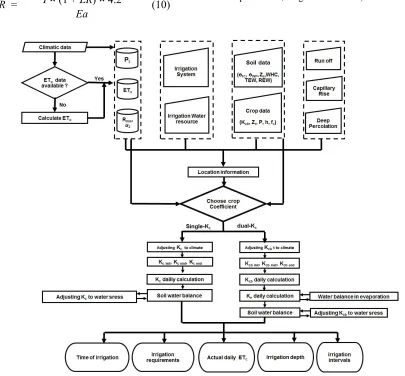
An interactive model named IMC-Model was coded and compiled using Microsoft visual basic 2013 language. The schematic overview showing the key input and output processes and main computational steps needed for the model are shown in Fig 1. The following sections outline how the IMC-Model was built.
2.2.1. Model description:
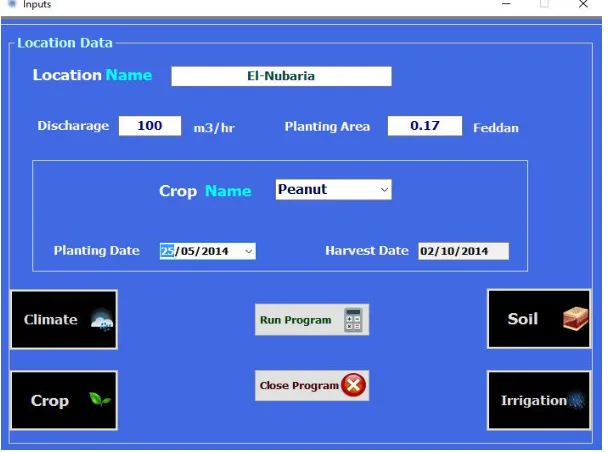
Graphic user interfaces (GUI) were designed to advance an easy use for both experienced users and novice as farmers and supporting them with decision-making related to irrigation management easily. In addition, a Microsoft Access 2007 database is created to be connected with the model. This database provides the model with the climatic data of the growing site and can restore any data entered by users for using it again. It can be updated directly from the model. As shown in Fig 2, the main menu of the IMC-Model is the central interface of the model from which the user can access the different interfaces where required data on soil, crop, climate, and irrigation options are loaded. The output interfaces display the calculation results using single-Kc and dual-Kc approaches. The calculation results are daily values of adjusted crop coefficient, actual crop evapotranspiration, depth of irrigation, irrigation requirements, irrigation intervals, and time of irrigation.
Fig. 2:The main interface of the IMC-Model.
2.2.2. Computational structure
As introduced in FAO-56, the methodology for computing ETc by IMC-Model followed the ETo-Kc method. The ETo was calculated according to Penman-Monteith equation for daily calculation time steps4. Additionally, the methodology followed the two Kc approaches (single-Kc and dual-Kc) in order to be appropriate for both all users and agricultural conditions.
2.3. Model Verification
The IMC-Model was verified by comparing with some
ready-to-use software programs such as CropWat-8 Windows version 8.0, introduced by Smith et al.19, and ETo-Calculator Windows version 3.2, introduced by FAO20, for the estimation of daily ETo. The average daily weather data, which used for estimating ETo at El-Nubaria site during the verification months, were obtained from Central Laboratory for Agricultural Climate (CLAC) as shown in Table 1. The model was also verified using a spreadsheet introduced in FAO-56 by Allen et al.4 which was reproduced for applying the dual-Kc approach. Peanut (Arachis hypogaea L.) had been selected for the verification purpose of the model. The input data of peanut which used for estimating dual-Kc and then ETc according to Allenet al.4are tabulated in Table 2.
Table 1:Average values of daily weather data at El-Nubaria site during the verification months (CLAC, 2015)
Month T(maxC) (TCmin) RH(%)mean (m su2-1) (MJ mRa-2d-1) (mm)P
May 32.5 26.2 59.6 2.2 40.7 0.0
June 35.0 28.7 63.9 2.0 41.2 0.0
July 36.6 31.9 65.3 1.9 40.6 0.2
August 35.1 30.7 65.1 1.6 37.6 0.2
September 32.6 27.8 68.8 1.4 33.0 0.0
Tmaxand Tmin: maximum and minimum values of air temperature; RHmean: mean value of relative humidity; u2: wind speed; Ra: extraterrestrial radiation; and P: precipitation.
Table 2:Input data of peanut for estimating dual-Kc and ETc as a verification step4:
Crop Data Value Unit
Length of initial stage (Linit) 25 day
Length of development stage (Ldev) 35 day
Length of mid-season stage (Lmid) 45 day
Length of mid-season stage (Llate) 25 day
Minimum rooting depth (Zrmin) 0.2 day
Maximum rooting depth (Zrmax) 0.8 m
Maximum crop height (hmax) 0.4 m
Depletion from root zone (
) 0.5-Basal crop coefficient at initial stage (Kcbinit) 0.15 -Basal crop coefficient at mid-season stage (Kcbmid) 1.10
-3. Results and discussion
The application of the IMC-Model is presented in the companion paper, which describes the validation of the model on some oil crops under the surface and sub-surface drip irrigation for estimating daily actual ETc and the other irrigation management parameters. The IMC-Model follows the two crop coefficient (single-Kc and dual-Kc) approaches for computing the actual ETc in order to be appreciate for all users and agriculture conditions. Although most of the available models followed only one approach for estimating the ETc such as SIMDualKc model, introduced by Rosa et al.21 and HYDRUS software, introduced by Šimůneket al.22, which followed the dual-Kc approach, unlike, the CropWat-8.0 software, introduced by Smithet al.19, which followed the single-Kc approach.
3.1. Model Verification for computing ETo:
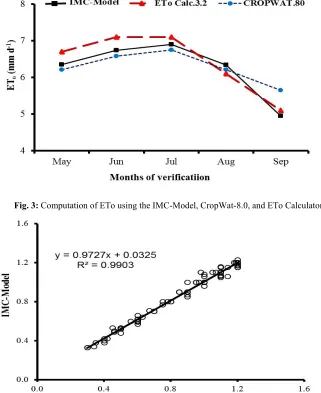
A comparison was made between the ETo calculated using IMC-Model program against both CropWat-8.0, introduced by Smith et al.19, and ETo Calculator-3.2, introduced by FAO20, in the summer months
(
May to September,2014)
according to the weather data collected from the
CLAC at El-Nubaria site as shown in Fig 3.
The results indicated a high agreement among the
values of the three software programs. It is also clear
that the average value of ETo among the verifying
months computed by IMC-Model (6.26 mm d
-1) was
in closer agreement with the CropWat-8.0 (6.28 mm
d
-1) compared with the Calculator-3.2 program (6.42
mm d
-1).
3.2. Model Verification for estimating Kc:
The daily values of dual-Kc computed by the IMC-Model were compared with those estimated by the FAO-56 spreadsheet named (FAO56Ax8.xls), introduced by Allen et al.4, as shown in Fig 4. It can be noticed a high correlation (R2 ≈ 0.99) between the IMC-Model and the FAO56Ax8.xls spreadsheet.
3.3. Model Verification for estimating ETc:
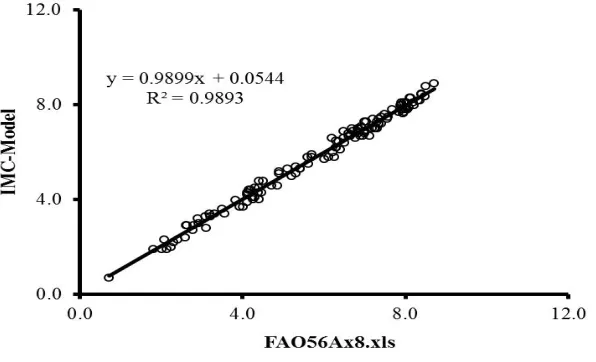
Fig 5 illustrate the regression plots of the ETc estimated by dual-Kc approaches using the IMC-Model program and the FAO56Ax8.xls spreadsheet during the growing season period for peanut. It can be noticed that the correlation (R2 ≈ 0.99) between two programs is higher
Fig. 3:Computation of ETo using the IMC-Model, CropWat-8.0, and ETo Calculator-3.2.
Fig 5:Computation of ETc using the IMC-Model and FAO-56 spreadsheet for peanut according to dual-Kc approach
4. Conclusion
It could be concluded from the results that, the IMC-Model is a proper solution for precise computing ETc and then the other irrigation management parameters (Irrigation requirements, irrigation intervals, and the irrigation time). The model followed the two Kc approaches (single-Kc and dual-Kc) besides the Penman-Monteith equation for daily calculation time steps for computing the daily actual ETc in order to be appropriate for both all users and agricultural conditions. The IMC-Model gave also a high agreement with both CropWat-8.0, ETo-Calculator-3.2, and the FAO-56 spreadsheet programs among the verifying months.
5. Acknowledgment
This study was supported by the National Research Centre (NRC) and Agricultural Engineering Department, Faculty of Agriculture, Ain Shams University, Cairo, Egypt.
6. References
1. United Nations Educational (UNESCO), 2006. Water a Shared Responsibility. The United Nations World Water Development Report 2, 7, Scientific and Cultural Organization, place de Fontenoy, 75007 Paris, France.
2. Dai, Z.Y. and Y.P. Li, 2013. Multistage irrigation water allocation model for agricultural land-use planning under uncertainty. Agricultural Water Management, 129: 69-79.
3. Gao, Y., L. Yang, X. Shen, X. Li, J. Sun, A. Duan and L. Wu, 2014. Winter wheat with subsurface drip irrigation (SDI): Crop coefficients, water-use estimates, and effects of SDI on grain yield and water productivity. Agricultural Water Management, 146: 1-10.
4. Allen, R.G., L.S. Pereira, D. Rase and M. Smith, 1998. Crop evapotranspiration: Guidelines for computing crop requirements, United Nations, FAO, Irrigation and Drainage, Paper No. 56, Rome.
5. Allen, R.G., J.L. Wright, W.O. Pruitt, L.S. Pereira and M.E. Jensen, 2007. Water requirements. in Design and Operation of Farm St. Joseph, MI.
6. Allen, R.G., L.S. Pereira, M. Smith, D. Rase and J.L. Wright, 2005. FAO-56 dual crop coefficient method for estimating evaporation from soil and program extensions. J. Irrig. Drain. Eng., 131: 2-13.
7. Abyaneh, H.Z., M.B. Varkeshi, A. Ghasemi, S.
Marofi and R.A. Chayjan, 2011. Determination of water requirement, single and dual crop coefficient of garlic (Alliumsativum) in the cold semi-arid climate. Aust. J. Crop Sci., 5: 1050-1051.
8. Rosa, R.D., P. Paredes, G.C. Rodrigues, R.M. Fernando, I. Alves, L.S. Pereira and R.G. Allen, 2012. Implementing the dual crop coefficient approach in interactive software: 2. Model testing. Agricultural Water Management, 103: 62-77.
9. Cancela, J.J., M. Fandino, B.J. Rey and E.M. Martinez, 2015. Automatic irrigation system based on dual crop coefficient, soil and plant water status for Vitis vinifera (cv Godello and cv Mencía). Agricultural Water Management, 151: 52-63.
10. Odhiambo, L.O. and S. Irmak, 2012. Evaluation of the impact of surface residue cover on single and dual crop coefficient for estimating soybean actual evapotranspiration. Agricultural Water Management, 104: 221-234.
11. Liu, Y.J. and Y. Luo, 2010. A consolidated evaluation of the FAO-56 dual crop coefficient approach using the lysimeter data in the North China Plain. Agricultural Water Management, 97: 31-40.
12. Tolk, J.A. and T.A. Howell, 2001. Measured and simulated evapotranspiration of grain sorghum with full and limited irrigation in three High Plains soils. Trans. ASAE, 44: 1553-1558.
13. Zhao, C. and Z. Nan, 2007. Estimating water needs of maize (Zea mays L.) using the dual crop coefficient method in the arid region of northwestern China. African Journal of Agricultural Research, 2: 325-333. 14. López-Urrea, R., A. Montoro, J. González-Piqueras, P.
López-Fuster and E. Fereres, 2009. Water use of spring wheat to raise water productivity. Agricultural Water Management, 96: 1305-1310.
15. Jiang, J., Y. Zhang, M. Wegehenkel, Q. Yu and J. Xia, 2008. Estimation of soil water content and evapotranspiration from irrigated cropland on the North China Plain. Journal of Soil Science and Plant Nutrition, 171: 751-761.
16. Allen, R.G. and L.S. Pereira, 2009. Estimating crop coefficients from fraction of groundcover and height. Irrig. Sci., 28: 17-34.
extensions. J. Irrig. Drain. Eng., 131: 2-13.
18. Keller, J. and R.D. Bliesner, 1990. Trickle irrigation planning factor. Part III, In Sprinkler and trickle irrigation, Van Nostrand Reinhold, New York, 453-477.
19. Smith, M., G. V. Halsema, F. Maraux, G. Izzi, R. Wahaj and G. Munoz, 2007. CropWat 8, Windows Version 8.0. Water resources development and management service, FAO, Rome, Italy.
20. FAO, 2009. ETo Calculator. Windows Version 3.1, Land and Water Digital Media Series, N° 36, Rome, Italy.
21. Rosa, R.D., P. Paredes, G.C. Rodrigues, I. Alves, R.M. Fernando, L.S. Pereira and R. G. Allen, 2012a. Implementing the dual crop coefficient approach in interactive software. 1. Background and computational strategy. Agric. Water Manage, 103:8-24.
22. Šimůnek, J., M. Šejna, H. Saito, M. Sakai and M.T. van Genuchten, 2009. The HYDRUS-1D Software Package for Simulating the Movement of Water, Heat, and Multiple Solutes in Variably-Saturated Media. Version 4.08. HYDRUS Software Series 3. Department of Environmental Sciences, University of California Riverside, Riverside, CA, USA, 315 p.