(UDC: 620.179.2:678.71]:519.673)
Finite element based small punch testing method for stiffness measurement
of polymers
X. Chen, C.P. Tsui, C.Y. Tang*
Department of Industrial and Systems Engineering, The Hong Kong Polytechnic University, Hung Hom, Hong Kong, P.R. China
*Corresponding author email: [email protected]
Abstract
Mechanical evaluation of a small size specimen is of great necessity. The small punch testing method, as one of the most commonly adopted techniques, was successfully used in determination of elastic modulus for small polymeric specimens. However, the ring support design in this method resulted in an inappropriate specimen-support contact, such as the large contact area and probably the partially non-contact condition, thus lowering the accuracy and sensitivity. In the present study, a finite element based small punch testing method has been developed to determine the elastic moduli of small polymer specimens. In order to measure the initial stiffness, a three-point support based small punch testing device rather than the conventional ring support type was designed and produced for conducting an indentation process. A finite element model for the indentation process was built for determining the elastic moduli of the polymer specimens from the measured initial stiffness through the computed correlation between the elastic modulus and initial stiffness. The differences between the elastic moduli of the PE, PP and PMMA specimens with certain Poisson’s ratios determined by the developed method and those from the standard tensile tests were found to be not statistically significant. With a reduction in the contact area and an elimination of the potential non-contact condition for the specimen-support contact, the developed finite element based method has been shown to be more accurate and sensitive in terms of the determined elastic modulus as compared with the ring-support based small punch testing method. This method may be served as a promising tool for determining the elastic modulus of small polymeric specimens with high sensitivity and accuracy.
Key words: Small punch test, finite element analysis, elastic modulus, PE, PP, PMMA
1. Introduction
size specimen testing techniques are also of great necessity (Kurtz et al. 1997; Tang et al. 2003). Among all small size specimen techniques, one of the most commonly adopted is the small punch testing technique.
The small punch testing technique was firstly used for mechanical characterization of metals (Mao et al. 1991; Foulds et al. 1995). More recently, application of this technique has been extended to the mechanical property evaluation of polymeric materials. It has been adopted to evaluate the elastic modulus (Kurtz et al. 1997), and qualitatively evaluate some other mechanical properties, such as wear properties and toughness (Kurtz et al. 1999; Tang et al.2003; Akagi et al. 2006). This technique has found to be reproducible and effective for the elastic behavior characterization of PMMA (Giddings et al. 2002), and could be readily adopted to evaluate the through-thickness mechanical properties of the PE components for total joint arthroplasty (Kurtz et al. 1999).
The elastic modulus prediction by this small punch testing technique could be achieved by three steps (Kurtz et al. 1997). Firstly, initial stiffness of a material was measured from a load-displacement curve from an indentation process. Secondly, an inverse finite element (FE) model for the indentation process was constructed to obtain a correlation of initial stiffness and elastic modulus for the material. Finally, the elastic modulus of the material could be determined from the measured initial stiffness by using the predicted correlation.
While success has been achieved to some extent, some problems exist in this small punch testing technique due to the limitation of the device design. A typical design consists of a testing guide and die, a hemispherical head punch, and a disc-shaped specimen which is supported by a ring support and indented by the hemispherical punch. In this ring support based design, it is entirely possible that not all parts of the ring support fully contact with the specimen during the indentation process, either due to the operation variation or the specimen dimensional error, which may further influence the accuracy of the experimental results. Another potential disadvantage may arise from the large contact surface area between the specimen and the ring support. It may result in a relatively large slope for the linear curve of initial stiffness versus elastic modulus within the elastic range, i.e., low sensitivity for elastic modulus prediction for a certain initial stiffness, which is not preferred for the measurement.
Finite element approach has been widely to analyze mechanical response of various materials (Tang et al. 2007; Mijuca 2008), and useful for determination of material properties which may be difficult to be obtained by purely experimental method (Balac et al. 2006). In this study, a finite element based small punch testing method was developed to determine the elastic modulus of small polymer specimens. A finite element model for the indentation process was used to predict the correlation between the initial stiffness and elastic modulus. For determining the elastic modulus of the specimen through the predicted correlation, the initial stiffness was determined by using a novel three-point support based small punch testing device with reduction in the specimen-support contact area. Comparison between the developed method and the ring support based testing method in terms of accuracy and sensitivity was also conducted.
2. Development of the Finite Element Based Small Punch Testing Method
2.1 Finite element models of the indentation process
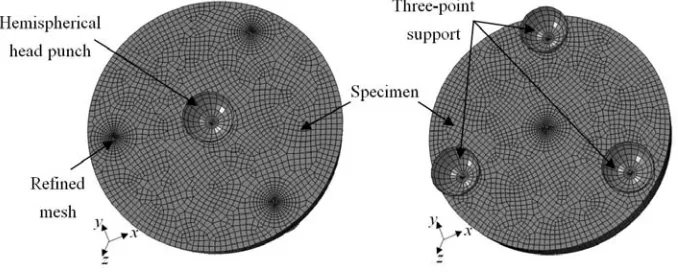
considered as a deformable part constructed from 32726 hex-dominated elements. The diameter of the circle passing through the three spherical centers of the three-point support is 7.9 mm. The diameters of hemispherical heads of both support and punch are 3.9 mm. The deformable specimen that may contact with the rigid surfaces was meshed with refinement as shown in Fig.1. The contact pairs of punch-specimen and support-specimen were simulated using the penalty stiffness method so as to allow some relative motion between the surfaces. During simulation, a small punch displacement of 0.01 mm was introduced before the punching process to build a firm contact between the specimen and these hemispherical heads. The circular plane of the specimen was positioned in parallel to x-y plane, while the thickness direction of the specimen was along with z axis. The support was constrained along all x, y and z directions, while the punch was fixed along x and y directions. The circumference of the specimen was constrained in all directions including both translation and rotation before the firm contact was built, after which all the constraints were removed. A friction coefficient of 0.05 between the contact surfaces was adopted with reference to similar work (Kurtz et al. 2002).Poisson’s ratios (υ) of 0.46~0.47 for PE obtained from material datasheet from GoodfellowTM and the reference (van Krevelen & Te Nijenhuis 2009) were adopted, while those of PP (0.42~0.45) were acquired from the material datasheet from INEOS Olefins & Polymers USATM and the reference (Lo et al. 2005). The values of υ for PMMA were set to 0.35~0.40 with reference to the material datasheet from GoodfellowTM.
Fig. 1. Finite element mesh of the three-point support based small punch testing device and specimen, (a) upper view and (b) lower view.
From the simulation, a load-displacement curve was constructed by using the prescribed punch displacement (Dp) of 0.05 mm, and the corresponding computed indentation force (Fs).
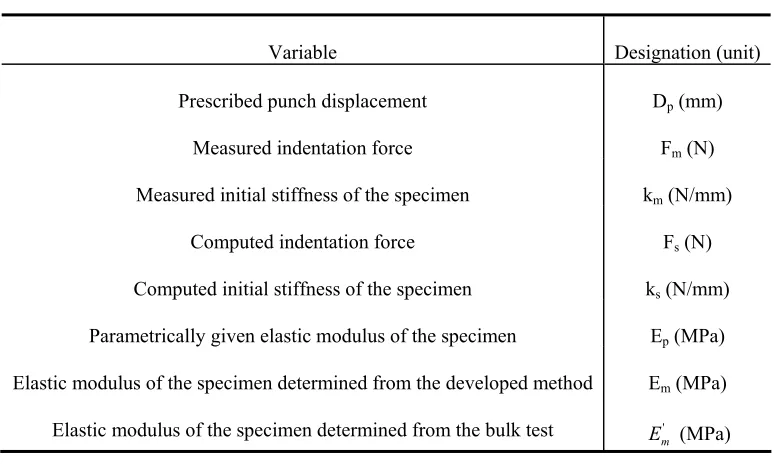
The parametrically given elastic modulus of the specimen (Ep) was varied within a range from
600 to 3000 MPa at a step of 200 MPa for each simulation, from which a corresponding computed initial stiffness of the specimen (ks) was obtained by linearly fitting the curve of Fs
versus Dp within a certain range of Dp. After a number of these simulations with varying Ep, the
correlation of ks versus Ep was found. By substituting ks with km from the experimental curve,
the corresponding elastic modulus (Em) could be determined. The variables used in the present
Variable Designation (unit)
Prescribed punch displacement Dp (mm)
Measured indentation force Fm (N)
Measured initial stiffness of the specimen km (N/mm)
Computed indentation force Fs (N)
Computed initial stiffness of the specimen ks (N/mm) Parametrically given elastic modulus of the specimen Ep (MPa)
Elastic modulus of the specimen determined from the developed method Elastic modulus of the specimen determined from the bulk test
Em (MPa)
' m
E (MPa) Table 1. Definition of the variables used in the present work.
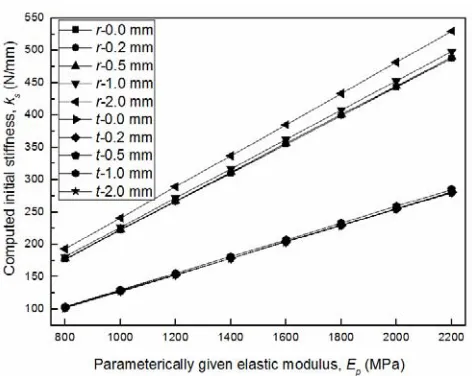
In order to compare the developed finite element based method and the ring support type small punch testing method in terms of accuracy and sensitivity, two separate FE models were constructed. The boundary conditions of the model described above were adopted here for these two series of simulations. During a real indentation process, it is generally impossible to ensure that the punch is located at the center of the specimen, which may lead to certain errors. In each series of simulations, the punch head eccentricities of 0.0, 0.2, 0.5, 1.0 and 2.0 mm were considered and simulated as potential errors. In the two series of simulations, the specimen dimensions, the inner diameters of both supports and the diameters of both punches were the same. The diameter of the circle that passing through the three peak of the three-point support was 7.5 mm, and the diameter of the each head of the support was 3.0 mm, i.e., the inner diameter of the three-point support was also 6.0 mm, the same as that for the ring support. The head diameters of the two punches were both 3.0 mm. The Poisson’s ratios, υ, for both series of simulations were chosen as 0.46.
2.2 Experimental details
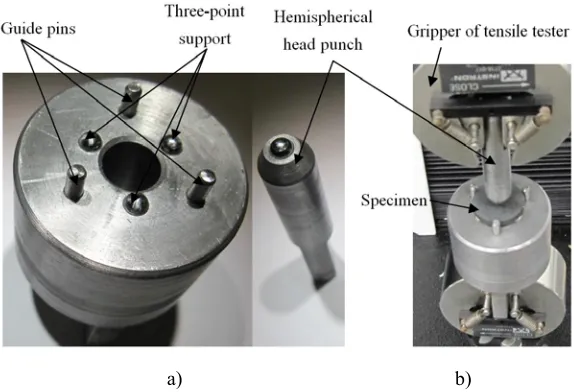
In order to measure the initial stiffness of the specimens, km as mentioned in the section 2.1, a
a) b)
Fig. 2. Three-point support based small punch testing device: (a) punch and support (b) with connection to the tensile tester.
For the developed device, the coordinates of the spherical centers of the hemispherical heads of the three-point support and the punch, and the positions of the guide pins were determined with the aid of a high performance video measurement system (SmartScope Flash 300). The dimensions of the support, punch and specimens were the same as those used in the finite element study. The circle tangent to the inner surface of the three guide pins is 20.1 mm in diameter, which indicates the suitability of the pins for fixing a specimen of 20 mm in diameter. These dimensions, together with a chamfer as shown in Fig. 2, were designed to ensure that the upper and lower surfaces of the specimen could not contact with any part of the device other than the support and the punch head during indentation.
In this study, five disc-shaped specimens for each of PE, PP and PMMA polymers were tested by using the developed testing device. The specimen was supported by the support, and then indented with the hemispherical head punch at a constant displacement rate of 0.5 mm/min, which was based on another similar work (Kurtz et al. 1997). During indentation, a curve of measured indentation force (Fm) versus punch displacement (Dp) was digitally
recorded. Initial tests showed that the linear (elastic) portion of the load-displacement curve occurred at a displacement less than 0.05 mm. The measured initial stiffness of the specimen (km) was calculated by analyzing the curve up to the displacement of 0.05 mm. Each set of
specimens was tested at every 60º around the specimen central point for six times. The curve for each test was analyzed by linear fitting. Relative experimental uncertainty was calculated with reference to some similar work, i.e., dividing the standard deviation by average value for each of the three material groups (Kurtz et al. 2002).
As controlled experiments, tensile tests, designated as a “bulk test” below were conducted for measurements of elastic moduli ( '
m
E ) of the PE, PP and PMMA specimens by following the requirements of ASTM D 638-08 standard using tensile bars of type IV dimension. Results obtained from the finite element based method and the bulk tests were analyzed by t-tests, and a
3. Results and Discussion
3.1 Determination for elastic moduli of PE, PP and PMMA
With the finite element based method, the indentation process using the three-point support based small punch testing device was simulated for determining the correlation between elastic modulus, Ep and initial stiffness, ks. of three small PE, PP and PMMA specimens. Contours of
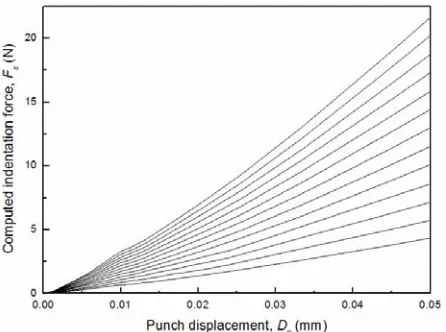
the von Mises stress at a punch displacement of 0.05 mm for the specimen with a Poisson’s ratio (υ=0.35) and elastic modulus (E=3000 MPa) are shown in Fig. 3. In Fig. 4, the curves (r20.99) of F
s versus Dp for specimens with a fixed Poisson’s ratio (υ=0.35) and varying Ep
increased from 600 to 3000 MPa at a step of 200 MPa are presented. Fig. 3 and Fig. 4 indicate that the specimens exhibit elastic response for the punch displacement within 0.05 mm.
a) b)
Fig. 3. Contours of von Mises stress at a punch displacement (Dp) of 0.05 mm for the specimen
with a Poisson’s ratio (υ=0.35) and elastic modulus (E=3000 MPa): (a) upper view and (b) lower view.
Fig. 4. Computed indentation force (Fs) versus punch displacement (Dp) for specimens with
Since a punch displacement of 0.01 mm was introduced to enable a firm contact during the FE analysis, a small curvature at around 0.01 mm can be observed in each curve in Fig. 4. Therefore, a punch displacement range from 0.02 to 0.05 mm was used to determine the computed initial stiffness of the specimen, ks. For each studied polymer, ks could be linearly
correlated with Ep for each Poisson’s ratio, υ. The linear correlations between ks and Ep of PE (υ
= 0.46-0.47), PP (υ = 0.42-0.45) and PMMA (υ = 0.35-0.4) (r20.99) are expressed by the following equations (1)~(3) for, respectively.
0.1812 ~ 0.1845
s p
k E
(1)
0.1757 ~ 0.1805
s p
k E (2)
0.1629 ~ 0.1709
s p
k E (3)
After substituting ks with km, and Epwith Em in equations (1)~(3), the correlation between
Em and km, for PE, PP and PMMA can be expressed in the following equations (4)~(6),
respectively.
5.42 ~ 5.52
m m
E k (4)
5.54 ~ 5.69
m m
E k (5)
5.85 ~ 6.14
m m
E k (6)
Fig. 5. Measured indentation force (Fm) versus punch displacement (Dp) curves from the
three-point support based small punch testing technique for each typical specimen of PE, PP and PMMA.
In order to determine the elastic modulus of the PE, PP and PMMA specimens, initial stiffness, km was measured by using the the curves of Fm versus Dp (shown in Fig. 5) obtained
234.4±4.6 N/mm, and 434.6±1.8 N/mm, respectively. The experimental uncertainties of km for
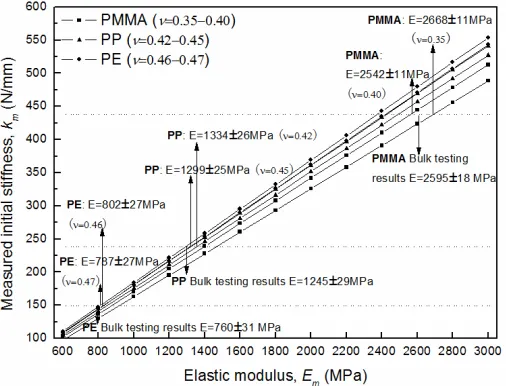
all the tests were 2.9 % for PE, 1.8 % for PP and 0.4 % for PMMA. The repeatability of this technique is acceptably good. By using Eq.(4)~(6), the elastic moduli, Em for PE, PP and
PMMA were found to be 787±27~802±27 MPa, 1299±25~1334±25 MPa, and 2542±16~2668±16 MPa, respectively. The elastic moduli obtained from the bulk tests, '
m
E , are 760±31 MPa for PE, 1245±29 MPa for PP and 2595±18 MPa for PMMA.
Figure 6 shows the curves of km versus Em for PE, PP and PMMA specimens with
corresponding υ range obtained by using the developed finite element based method and the bulk tests. PMMA is within the range of the elastic values predicted for υ=0.35~0.40. No statistical significance (p0.05) for the difference in the elastic moduli, Em, of PE, PP and
PMMA was observed for υ=0.46~0.47, υ=0.45 and υ=0.40, respectively as compared with the bulk testing results, '
m
E . Thus, the developed finite element based method was validated as an effective tool for determining the elastic moduli of polymers.
Fig. 6. Measured initial stiffness (km) versus elastic modulus (Em) for PE, PP and PMMA specimens with corresponding Poisson’s ratio (υ) range, determined by the developed method
and bulk test.
3.2 Accuracy and sensitivity of the finite element based method as compared with ring support based small punch testing method
In this subsection, the results of the comparison in terms of accuracy and sensitivity between the finite element based method and the ring support based small punch testing method are presented and discussed. The contours of von Mises stress at the Dp value of 0.05 mm when the
punch is 2.0 mm eccentrically away from the center for three-point support based and ring support based small punch testing techniques are shown in Fig. 7. Fig. 7 indicates that the material exhibits elastic response at the punch displacement of 0.05 mm. The maximum von Mises stress in Fig. 7 (a)&(b) for the three-point support based small punch testing technique is lower than that in Fig. 7 (c)&(d) for the ring support based one, suggesting the ks value obtained
a) b)
c) d)
Fig. 7. Contours of von Mises stress at a punch displacement (Dp) of 0.05 mm when the punch is 2.0 mm horizontally away from the specimen center. The finite element based method: (a) upper view and (b) lower view; ring support based small punch testing method: (c) upper view
and (d) lower view.
Fig. 8. Computed initial stiffness (ks) versus parametrically given elastic modulus (Ep) for both
developed method (designated as “t-“) and ring support type (designated as “r-“) with punch eccentricities of 0.0, 0.2, 0.5, 1.0 and 2.0 mm from the center.
4. Conclusions
The present work was to develop a finite element based small punch testing method for determining the elastic modulus of a small polymer specimen. The developed method has been successfully implemented for determining the elastic moduli of small PE, PP and PMMA specimens with or without the information of Poisson’s ratio. The elastic modulus of the specimen with known Poisson’s ratio could be determined from the measured initial stiffness by using the predicted correlation between the elastic modulus and measured initial stiffness through the inverse finite element method. The elastic moduli determined from the developed method were comparable to those from the bulk tests. The differences between the determined elastic moduli of the specimens with certain Poisson’s ratios and those from the standard tensile tests were found to be not statistically significant. Even without the information of the Poisson’s ratio, the elastic moduli of the PE, PP and PMMA specimens could also be determined by the developed method but with uncertainty of 1.8~4.8%. Moreover, the sensitivity and accuracy as compared with the conventional ring-support based small punch testing method were proved to be higher. The method may be a promising tool for determining the elastic modulus for small polymer specimen with high sensitivity and accuracy.
Извод
Мерење
крутости
полимера
помоћу
методе
тестирања
малим
клином
на
бази
методе
коначних
елемената
X. Chen, C.P. Tsui, C.Y. Tang*
Department of Industrial and Systems Engineering, The Hong Kong Polytechnic University, Hung Hom, Hong Kong, P.R. China
*Corresponding author email: [email protected]
Резиме
Механичкоиспитивањеузоракамалевеличинејевеомаважно. Методатестирањамалим клином, као једна од техника која је најчешће у употреби, успешно се користи у одређивањумодулаеластичностималихполимерскихузорака.
Међутим, прстенасти дизајнослонца уовој методирезултирало јенеодговарајућим контактом узорак-ослонац, као што је велика контактна површина и вероватно делимичнобезконтактностање, чимесесмањујепрцизностиосетљивост.
Уовомрадунатемељимаметодеконачнихелеменатаразвијенајеметодатестирања малог клина за одређивање модула еластичности малих полимерских узорака. У циљу мерења иницијалне крутости, конструисан је и изведен уређај са малим клином са ослонцем на три тачке уместо конвенцијалног прстенастог да се уради процес утискивања. Развијен је модел коначних елемената за процес утискивања у циљу испитивања модула еластичности полимерских узорака на основу иницијалне мерене крутостипутемизрачунатекорелацијеизмеђуеластичногмодулаииницијалнекрутости.
Разлике између модула еластичности PE, PP и PMMA узорака са одређеним Поасоновим односимакоје су добијених употребом ове методе и оних са стандардних тестова затезања нису статистички велике. Са редукцијом контактне површине и елиминацијом евентуалног неконтактног стања узорак-ослонац, развијени метод се показао тачнијим и осетљивијим за одређивање еластичних модула у поређењу са конвенционалним методом тестирања који користи мали утискивач који се заснива на прстенастимослонцем. Овајметодможепослужитикаообећавајућиалат заодређивање еластичнихмодуламалихполимерскихузоракасависокомосетљивошћуитачношћу.
Кључне речи: Тестирање помоћу малог клина, анализа методом коначних елемената,
модулеластичности, PE, PP, PMMA
References
Balac I, Tang C Y, Tsui C P, Chen D Z, Uskokovic P S, Ignjatovic N, Uskokovic D P (2006). Nanoindentation of in situ polymers in hydroxyapatite/poly-l-lactide biocomposites, Materials Science Forum, 518, 501-506.
Foulds J, Woytowitz P, Parnell T, Jewett, C. (1995). Fracture toughness by small punch testing, Journal of Testing and Evaluation, 23, 3-10.
Giddings V L, Kurtz S M, Jewett C W, Foulds J R, Edidin A A (2001). A small punch test technique for characterizing the elastic modulus and fracture behavior of PMMA bone cement used in total joint replacement, Biomaterials, 22, 1875-1881.
Hyde T H, Sun W, Williams J A (2007). Requirements for and use of miniature test specimens to provide mechanical and creep properties of materials: a review, International Materials Reviews, 52, 213-255.
Kurtz S M, Jewett C, Foulds J, Edidin A (1999). A miniature specimen mechanical testing technique scaled to articulating surface of polyethylene components for total joint arthroplasty, Journal of Biomedical Materials Research Part B: Applied Biomaterials, 48, 75-81.
Kurtz S M, Foulds J R, Jewett C W, Srivastav S, Edidin A A (1997). Validation of a small punch testing technique to characterize the mechanical behaviour of ultra-high-molecular-weight polyethylene, Biomaterials, 18, 1659-1663.
Kurtz S M, Jewett C W, Bergström J S, Foulds J R, Edidin A A (2002). Miniature specimen shear punch test for UHMWPE used in total joint replacements, Biomaterials, 23, 1907-1919.
Lo J C W, Lu Y C, Shinozaki D M (2005). Kink band formation during micro-indentation of oriented polypropylene, Materials Science and Engineering: A, 409, 76-86.
Lucas G E, Odette G R, Sokolov M, Spätig P, Yamamoto T, Jung P (2002). Recent progress in small specimen test technology, Journal of Nuclear Materials, 307-311, 1600-1608.
Mao X, Saito M, Takahashi H (1991). Small punch test to predict ductile fracture toughness JIC and brittle fracture toughness KIC, Scripta Metallurgica et Materialia, 25, 2481-2485. Mijuca D (2008). On a reliable finite element approach in multiscale multimaterial solid
thermo-mechanics, Journal of Serbian Society for Computational Mechanics, 2, 44-62. Pompe W, Worch H, Epple M, Friess W, Gelinsky M, Greil P, Hempel U, Scharnweber D,
Schulte K (2003). Functionally graded materials for biomedical applications, Materials Science and Engineering A, 362, 40-60.
Tang W, Santare M H, Advani S G (2003). Melt processing and mechanical property characterization of multi-walled carbon nanotube/high density polyethylene (MWNT/HDPE) composite films, Carbon, 41, 2779-2785.
Tang C Y, Guo Y Q, Tsui C P, Gao B (2007). Multi-scale Finite Element Analysis on Biomechanical Response of Functionally Graded Dental Implant / Mandible System, Journal of Serbian Society for Computational Mechanics, 1, 164-173.