Reducing Energy Consumption of
Wireless Sensor Networks through
Processor Optimizations
Gürhan Küçük and Can Başaran Department of Computer Engineering, Yeditepe University, 34755 Istanbul, Turkey {gkucuk, cbasaran}@cse.yeditepe.edu.tr
Abstract- When the environmental conditions are stable, a typical Wireless Sensor Network (WSN) application may sense and process very similar or constant data values for long durations. This is a common behavior of WSN nodes that can be exploited for reducing their power consumption. This study combines two orthogonal techniques to reduce the energy dissipation of the processor component of the sensor nodes. First, we briefly discuss silent-store filtering MoteCache. Second, we utilize Content-Aware Data MAnagement (CADMA) on top of
Mote-Cache architecture to achieve further energy savings
and possible performance improvements. The plexity increase introduced by CADMA is also com-pensated by further complexity reduction in Mote-Cache architecture. Our optimal configuration reduc-es the total node energy, and hence increasreduc-es the node lifetime, by 19.4% on the average across a wide varie-ty of simulated sensor benchmarks. Our complexivarie-ty- complexity-aware configuration with a minimum MoteCache size with only four entries not only achieves energy sav-ings up to 16.2% but also performance improvements up to 14%, on the average.
Index Terms- Computer Architecture, Sensor Networks
I. INTRODUCTION
Recent advances in process technologies and the shrinking sizes of radio communication devices and sen-sors allowed researchers to combine three operations (i.e. sensing, communication and computation) into tiny de-vices called wireless sensor nodes. Once these dede-vices are scattered through the environment, they can easily construct data-oriented networks known as wireless sen-sor networks (WSNs). Today, there are a vast number of application scenarios involving WSNs in business, mili-tary, medical and science domains.
The lifetime, scalability, response time and effective sampling frequency are among the most critical parame-ters of WSNs, and they are closely related to one crucial resource constraint that is very hard to satisfy: the power
consumption. The WSN nodes are designed to be battery-operated, since they may be utilized in any kind of envi-ronment including thick forestry, volcanic mountains and oceanbeds. Consequently, everything must be designed to be power-aware in these networks.
Small-scale operating systems, such as TinyOS [1], ambientRT [2], and computation-/communication-intensive applications significantly increase the energy consumption of the processor component of WSN nodes. Today, new sensor platforms with 16- [3] and 32-bit [4] processor architectures target more and more power-hungry applications. In [5], the researchers show that the processor itself dissipates 35% of the total energy budget of the MICA2 platform while running Surge, a TinyOS monitoring application. In [6], the authors claim similar energy values when running a TinyDB query reporting light and accelerometer readings once every minute. In [7], the researchers find that the energy consumption of the processor/memory component for raw data compres-sion is higher than the energy consumption of raw data transmission. Similarly, today most of the WSN applica-tions avoid extensive computaapplica-tions and choose to transfer raw data to server machines to increase the lifetime of the sensor nodes. On the contrary, our proposed design en-courages the WSN application developers to design less centralized applications by distributing the computation work and reducing the network traffic among the nodes.
After observations of the results from our departmen-tal testbed and various simulations, we found two impor-tant characteristics of WSN data:
1. Temporal and value locality: Sensor network
be-ing written), and propose to filter them by extendbe-ing the MoteCache architecture.
2. Common data values: Further, we find that there
are some common data values flowing through the data-path. In the second part of this study, we propose a tech-nique called Content-Aware Data MAnagement (CADMA) that exploits this behavior and boosts our energy savings by reducing the read/write energy not only in SRAM but also in register file and the Mote-Cache. When combined with the silent-store filtering MoteCache technique, we show that we can even in-crease the performance of the processor as much as 14%. We begin by presenting a brief summary related work and current state of the art of processors used in wireless sensor networks in Section II and III. Following that, in Section IV, we present the design of MoteCache. Next, CADMA design is presented in Section V. The simula-tion methodology is given in Secsimula-tion VI, and our results are presented in Section VII. Finally, we conclude our study in Section VIII.
II. RELATED WORK
In the literature, there are various studies that target energy-efficient microprocessors for wireless sensor nodes [9, 10, 11]. However, to our best knowledge, this is a unique study that proposes architecture-independent extensions to the existing commercially available, gener-al-purpose microprocessors that are used by sensor nodes.
In [9], the authors present SNAP/LE, an event-driven microprocessor for sensor networks. They avoid the TinyOS overhead by their asynchronous, event-driven approach. In [10], the authors seek to fully leverage the event-driven nature of applications. They study the appli-cation domain of sensor networks and they seek to re-place the basic functionality of a general-purpose micro-controller with a modularized, event-driven system.
In [12], the authors reveal that significant benefits can be gained by detecting and removing silent store instruc-tions. They propose free silent store squashing and suc-cessfully increase the processor performance by 11%, on the average. In this study, on the other hand, we choose to move to a completely different direction, and utilize a similar mechanism to reduce the energy consumption of the microcontrollers that are used in wireless sensor de-vices.
In [13], the authors study partial value locality, which is defined as occurrence of multiple live value instances identical in a subset of their bits. This study targets integ-er registinteg-er files in a 8-way supinteg-erscalar processor.
III. CURRENT STATE OF THE ART
In this paper, we study the MICA2 platform manufac-tured by Crossbow Inc. [14]. The platform includes an
AVR-RISC processor, ATmega128L. The AVR architec-ture implements the Harvard architecarchitec-ture with two main memory spaces, 4Kx8 bytes of SRAM data memory and 64Kx16 bytes of flash program memory space. Addition-ally, the Atmega128 features an EEPROM memory for data storage. All three memory spaces are linear and regular [15]. In this study, we mainly focus on the energy reduction of SRAM storage component.
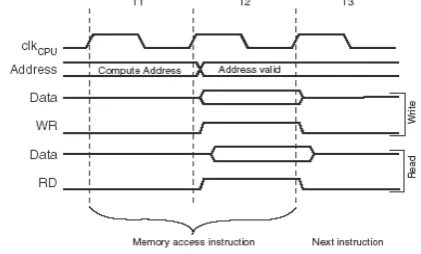
Figure 1 shows the timing diagram of memory read/write operations for the SRAM structure of the AVR. Each memory read/write operation takes two cycles to complete. In the first clock cycle, T1, the mem-ory address is computed, and in the second clock cycle, T2, the actual memory access takes place.
Fig. 1. On-chip Data SRAM access cycles for ATmega128L.
The AVR architecture does not contain a cache struc-ture. The reason behind this cacheless architecture be-comes very clear, when we examine the timing diagram in Figure 1, in detail. The main idea to include a cache structure in any design is to increase the processor per-formance, and it is clear that no cache structure may improve the performance of a 1-cycle-access SRAM. On the other hand, a cache structure may be beneficial from the energy/power point of view. A tiny cache structure may reduce the memory access energy by filtering most of the accesses to the main memory. In the first part of this study, we propose such cache structure, called Mo-teCache, for the same purpose. Moreover, we show that with a very small, additional complexity we can also use this cache structure to filter silent-store instructions [12].
It is also important to emphasize that our techniques are platform-independent and can be easily applied to other sensor platforms such as moteiv [3], EYES [16] and imote2 [4] sensor nodes. Moreover, these platforms util-ize 16- and 32-bit microprocessors (compared to 8-bit microprocessor of the MICA2 platform). Thus, our tech-niques will achieve much better energy savings in these new platforms.
IV. MOTECACHE
corres-ponding to the contents of these buffers. The idea is to cache data values of the N most recently accessed ad-dresses in an N-byte MC [17, 18].
A. The MoteCache Configurations
In this paper, we study three types of MoteCache con-figuration:
1) Direct-Mapped MoteCache (DMMC): This
con-figuration mimics the behavior of an ordinary direct-mapped cache. Since the SRAM of the MICA2 platform contains a single byte at each line, the direct-mapped cache is organized to contain a single byte at each of its sets. The DMMC configuration has the smallest latency among all, since we can read data in parallel with the tag comparison as soon as the address is available.
2) Set-Associative MoteCache (SAMC): In order to
reduce the possible conflict misses of the DMMC confi-guration; we also decided to try the set-associative cache configuration. This configuration is similar to a standard set-associative cache configuration, and requires the activation of more comparators in a single access.
3) Fully-Associative MoteCache (FAMC): This
con-figuration activates all the tag/address comparators for each memory access. Therefore, it dissipates more power compared to other configurations, and its latency is not better than the DMMC configuration since it has addi-tional multiplexer delay.
B. Access to MoteCache
A read access in the MC structure proceeds as follows:
Cycle 1. MoteCache Tag Comparison: As soon as
the address is computed, its tag part is compared associa-tively with the tag numbers associated with the contents of the MC. If there is a match (MC-hit), the scheduled readout of the memory is cancelled, potentially saving energy wasted in reading out the row from the memory. Again, the tag comparison and data retrieval from the MC may be overlapped to decrease the access latency in the DMMC configuration.
Cycle 2. Data Steering: In case of a MC-hit, data is
read from the corresponding MC entry1. When the asso-ciative match, using the CAM, fails (MC-miss), the memory access continues in this cycle and the data is read out into a MC entry selected as a victim, based on the least recently used (LRU) replacement policy.
Writing to a MC entry has analogous steps, followed by a step that installs the update into the tag and data part of the corresponding MC entry. We study the writeback policy, since it is more suitable for our power-aware design.
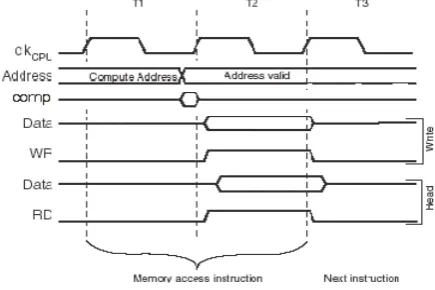
Figure 2 shows the modified timing diagram for the proposed architecture. Notice that, at the end of the first clock cycle, T1, there is a comparison latency that com-pares the tag (or tags, depending on the MC
1 To increase processor performance, data can be read from the MC at the end of the first cycle.
tion) of the MC set with the computed address2. Accord-ing to the outcome of the tag comparison process, either MC or SRAM is accessed.
Fig. 2. Modified On-chip Data SRAM and MC access cycles
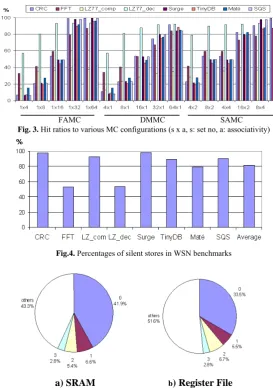
As locality of reference guarantees that there is a good chance of producing a hit. Figure 3 shows that MC-hit rate is more than 89%, on the average, for the SAMC configuration with maximum size (8x8). The lowest hit rate is observed in the smallest DMMC configuration (4x1) as 18.4%. Please refer to Table 1 in Section VI for the details of the simulated WSN benchmarks.
C. Silent-Store Filtering MoteCache
When a store instruction writes a value that actually matches the value already stored at the memory address being written, that store instruction is called a silent store [12]. These instructions have no effect on machine state, and we show that detection and removal of these instruc-tions may considerably improve the lifetime of WSNs. Figure 4 shows the percentages of silent store instruc-tions. Across all WSN benchmarks, the average percen-tage of silent stores is 81.6%.
We increase the functionality of the dirty-bit in our writeback MC for detecting and removing silent store instructions. Therefore, the dirty-bit is renamed to dir-ty&noisy-bit (DN). A data value is written back to SRAM only when it is dirty (i.e. it is modified) and also noisy (i.e. not silent: if the new data value is different than the one stored before.) A write access in the silent-store fil-tering MC structure proceeds as follows:
1. MC-hit and Silent Store Detection: After a
MC-hit, the data value to be written is compared with the data value of the corresponding MC line. If there is no match, the DN-bit of that MC line is set to indicate that the store instruction is noisy
2. MC-miss and Writeback: After a MC-miss, we
select a victim line. If the DN-bit of the victim line is set, the standard MC write-back procedure is fol-lowed. Otherwise, we just replace the MC line and cancel the rest of the writeback process, since the MC and SRAM data are already in sync.
V. CONTENT-AWARE DATA MANAGEMENT (CADMA)
In this section, we describe the details of our second technique in this study: Content-Aware Data MAnage-ment (CADMA.)
During our simulations, we observed that there are some common data values (specifically, 0, 1, 2 and 3) flowing in the datapath. Figure 5 shows that, across all simulated benchmarks, 48.4% of the SRAM data and
56.7% of the register file data are composed of these common data values.
The idea behind CADMA is to exploit this phenome-non to reduce energy dissipation of the SRAM, the Mo teCache and the register file. For this purpose, we intro-duce an additional bit, common data (CD), to each line of these structures. The CD bit is very similar to zero-byte indicator in [19]. Figure 6 depicts the circuitry needed to derive the CD bit for a byte. The CD operations are as follows:
1. Data Write + CD Reset: The CD bit is reset to
ze-ro when there is a register/memory write operation trying to store a common data value. In that case, CADMA only writes 3 bits (one CD bit + the two least significant bits of the common data value) for that byte. Note that, for all of the common data values (0, 1, 2 and 3), there is no need for any encoding/decoding process, since they al-ready fit into the least significant 2 bits.
FAMC DMMC SAMC Fig. 3. Hit ratios to various MC configurations (s x a, s: set no, a: associativity)
Fig.4. Percentages of silent stores in WSN benchmarks
a) SRAM b) Register File
Fig. 6. Encoding logic for the Common Data (CD) bit
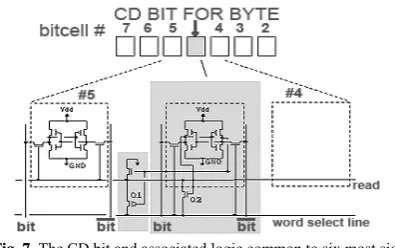
Fig. 7. The CD bit and associated logic common to six most signifi-cant bitcells within byte
When the data value is not one of the four common data values, on the other hand, CADMA writes 9 bits (one CD bit + the eight bits of data value) dissipating slightly more power compared to the baseline case.
2. Data Read + CD Probe: A read operation with
CADMA starts by probing the CD bit. When it is reset, CADMA only activates the read operation for the two least significant bitlines. By canceling the read from the other six bitlines, CADMA achieves significant power savings in all three structures. In this case, the rest of the byte is constructed by setting the six most significant bits to logic-0. The logic used to disable the readout of six most significant bits of a byte is shown in Figure 7. P-transistor Q1 and n-P-transistor Q2 are used to connect the read line of the corresponding six most significant bits of a byte to the word select line if the value stored in the CD is one. Otherwise, the local read line is grounded and the six most significant bits of the byte is not read out.
If CD bit is set, slightly more power is dissipated (reading 9 bits: one CD bit + the eight bits of data value) compared to the baseline case.
In this study, we integrated CADMA within MC, SRAM, and register file structures. In our experiments, across all simulated benchmarks, we observed that CADMA boosts our processor energy savings as much as 10% and sensor node’s total energy savings by 5% com-pared to the bare MC.
VI. SIMULATION METHODOLOGY
The most important requirement of this study was us-ing a simulator that accurately models ATmega128L processor of MICA2 platform in a cycle-accurate man-ner, and simulates sensor networks in various topologies. We found Avrora, the AVR Simulation and Analysis Framework [20], quite suitable to our needs. For all
si-mulated benchmarks, a three-node network topology is used.
A. Wireless Sensor Networks Benchmarks
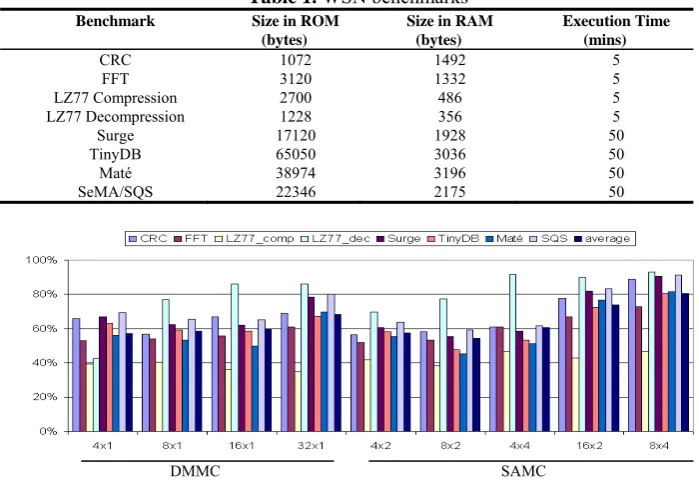
Table 1 gives the details of the benchmarks used in this study. The detailed descriptions of the studied benchmarks are given below:
• CRC implements a CRC32 algorithm continuous-ly running on 448 bytes of data. CRC can be uti-lized in sensor networks for error detection and is heavy on CPU. We have added packet transfers in between calculations as to simulate a sensor net-work operation.
• FFT benchmark is a discrete Fast Fourier Trans-form on 256 bytes of data. This transTrans-formation is executed within an infinite loop [21]. Fast Fourier Transform has many uses in sensor networks, mainly for event detection. This is also a CPU in-tensive benchmark. We have inserted radio trans-mission every 2 seconds, so it acts like an event is detected and propagated through the network.
• LZ77 compression is again enclosed in an infinite loop and works on 448 bytes of data taken from the header file of an excel file.
• LZ77 decompression is the decompression of the compressed data obtained from the LZ77 com-pression. This data is 330 bytes long3. Decom-pression, along with the compression has also a significant use in sensor networks. This is because the data-send operation requires significantly more energy than compressing or decompressing that data.
• Surge is a TinyOS core application to demonstrate multi-hop routing. This is a radio intensive benchmark and represents a regular sensor net-work application.
• TinyDB application is used to execute the query “select light from sensors each second”. This benchmark is again a radio intensive one. Most applications in sensor networks require a database framework. TinyDB is an important selection in that sense. However, there are many algorithms that reduce the need for radio transmission such as predicting next reading or pruning the data to be propagated. So, TinyDB does not represent an op-timal WSN application and is highly communica-tion-intensive.
• Maté (BombillaMica) is used with a script that reads light sensor readings in every 10ms and sends them through RF interface after 10 readings [22]. Maté implements a scripting language with data querying capabilities.
• SeMA/SQS is a data querying framework devel-oped in Yeditepe University. SQS creates a topol-ogy tree, which is used both for error handling and optimal radio usage purposes. SeMA/SQS is used to execute the query “select temperature from sensors each second” [23]. The query results are sent to the base station after each reading. B. Calculation of Energy Dissipation
We modified Avrora to record transitions at the level of bits for the processor/memory components. We com-bined the simulator results with energy per transition measurements obtained from the SPICE simulations of the actual component layouts for 0.35μ CMOS technolo-gy. We modified the energy model of Avrora to accurate-ly model very fine-grain, instruction-level energy dissipa-tions of the processor. For accurate energy savings esti-mations, we also considered detailed energy dissipations of the additional CADMA logic.
VII. RESULTS AND DISCUSSIONS
Figure 8 shows our energy savings for selected silent-store filtering MC configurations. Notice that, even the smallest MC configuration (4x1) saves more than 57% of the memory access energy, on the average. The optimum configuration is found to be the 8x4 configuration, since it gives similar savings compared to the MC configura-tions twice of its size (80.6% of 8x4 vs. 81.4% of 8x8 – not shown in the Figure.)
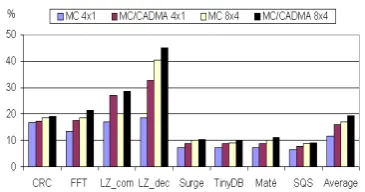
When we apply CADMA on top of these MC results, the energy savings gap between the minimum (DMMC 4x1) and the maximum (SAMC 8x4) configurations almost disappears (70% of 4x1 vs. 84% of 8x4). In Fig-ure 9, we also show the percentage of improvement in the energy savings compared to the bare MC case (the rightmost bar.) Again, notice that the integration of CADMA architecture with the previously proposed MC makes the minimum MC configuration quite feasible.
Table 1. WSN benchmarks
Benchmark Size in ROM (bytes)
Size in RAM (bytes)
Execution Time (mins)
CRC 1072 1492 5
FFT 3120 1332 5
LZ77 Compression 2700 486 5
LZ77 Decompression 1228 356 5
Surge 17120 1928 50
TinyDB 65050 3036 50
Maté 38974 3196 50
SeMA/SQS 22346 2175 50
DMMC SAMC
Fig. 8. Average savings on memory access energy dissipation for various MC configurations with the silent-store filter (s x a, s: set no, a: associativity)
DMMC SAMC
We then compute the effect of CADMA on total pro-cessor energy savings. The rightmost bar in Figure 10 shows that 41% of total instructions are memory read/write instructions, on the average. When we apply these figures to our optimal configuration (SAMC 8x4), we find that the total processor energy savings are 51.3% (Figure 10). Note that CADMA extracts additional ener-gy savings from register file (with bare MC, total proces-sor energy savings stay at 46.5%, on the average).
Fig. 10. Processor energy savings and percentages of memory access
When we focus on the minimum MC configuration, energy savings due to CADMA become much clearer. Total processor savings of MC/CADMA combination are 44%, on the average. Notice that, these savings are very close to the savings of bare optimum MC configuration. The energy savings of bare minimum MC configuration are as low as 34%, on the average. These results show that CADMA is a very effective technique that boosts savings of low complexity MC configurations.
Next, we identify the percentage of CPU energy dissi-pation over total energy dissidissi-pation of a sensor node to compute the possible lifetime increase with MC/CADMA architecture. Figure 11 shows that, CPU energy consti-tutes 49.6% of the total energy dissipation across the simulated benchmarks, on the average. Using the percen-tages given in this graph, we computed the percenpercen-tages of total energy savings of individual WSN nodes. Figure 12 shows that the total energy savings are 19.3% for opti-mum MC/CADMA and 17% for bare optiopti-mum MC con-figuration. Notice that, the gap between the bare mini-mum MC and minimini-mum MC/CADMA configurations in Figure 10 is still preserved in Figure 12. Again, the ener-gy savings with minimum MC/CADMA configuration are 16.2% (very close to 17% of the bare optimum MC configuration.) The energy savings for the bare minimum MC configuration are 11.7%, on the average. These energy savings are directly related to lifetime improve-ment of the nodes.
Fig. 11. Energy dissipation of components in MICA2 platform
Fig. 12. Node-level energy savings and lifetime improvements
Fig. 13. Possible performance improvements in DMMC configura-tions
Finally, we also studied the possible performance im-provements when we assume that we can access to a MC structure in the first cycle of a memory operation. In Figure 13, we give these results for three DMMC confi-gurations: 4x1, 8x1 and 16x1. The minimum configura-tion improves the performance by 4.3%, on the average, whereas 8x1 and 16x1 improve it by 8% and 14%, re-spectively. These figures also indicate that when the latency of our MC/CADMA architecture and address computation cannot be squeezed into a single cycle pe-riod, we can still increase the cycle time and tolerate slight performance penalties.
VIII. CONCLUDING REMARKS
In this study, we proposed a platform-independent MC/CADMA architecture for reducing the energy dissi-pation of the processor component of wireless sensor nodes. We studied various MC configurations and found that 32-byte, 4-way, set-associative, silent-store-filtering configuration shows the best energy/lifetime characteris-tics. Combined with CADMA, this optimal configuration reduces the node energy by 19.4%, on the average, across a variety of simulated sensor benchmarks. We also found that CADMA integration noticeably improves the results of the minimum MC configuration (4-byte, direct-mapped with silent-store filter.) We showed that this configuration achieves not only energy savings up to 16.2%, but also performance improvements up to 4.3%, on the average. We strongly believe that better results can be observed once these platform-independent techniques are implemented in newer platforms.
CPU load and radio load. However, energy consumption of radio is always the leading factor in the context of real life WSN applications. So we believe that results we gathered strongly applicable to any WSN application.
IX. ACKNOWLEDGMENTS
This work is supported by The Scientific and Technical Research Council of Turkey (TUBITAK) under the grant EEEAG/105E0158.
REFERENCES
[1] Hill J., Szewczyk, R., Woo, A., Hollar, S., Culler, D., and Pister, K., “System Architecture Directions for Networked Sensors“, in Proc. of ASPLOS IX, 2000
[2] AmbientRT: Real-Time Operating System for embedded devices, http://www.ambient-systems.net
[3] Tmote Sky wireless sensor device,http://www.moteiv.com [4] imote2 sensor, http://www.intel.com/research/sensornets/ [5] Conner, W.S., Chhabra, J., Yarvis, M., Krishnamurthy, L.,
“Experimental Evaluation of Synchronization and Topol-ogy Control for In-Building Sensor Network Applica-tions”, in Proc. of WSNA’03, Sep. 2003
[6] Madden, S., Franklin, M.J., Hellerstein, J.M., and Hong, W., “TinyDB: An Acquisitional Query Processing System for Sensor Networks”, in ACM TODS, 2005
[7] Polastre, J.R., “Design and Implementation of Wireless Sensor Networks for Habitat Monitoring”, Research Project, University of California, Berkeley, 2003
[8] Kucuk, G., Basaran, C., “Reducing Energy Dissipation of Wireless Sensor Processors Using Silent-Store Filtering MoteCache”, in Proc. of PATMOS’06, France, 2006 [9] Ekanayake, V. et al., “An Ultra Low-Power Processor for
Sensor Networks”, in Proc. ASPLOS, Oct. 2004
[10] Hempstead, M. et al., “An Ultra Low Power System Ar-chitecture for Sensor Network Applications”, in the Proc. of 32nd ISCA’05, Wisconsin, USA, 2005
[11] Warneke, B.A. and Pister, K.S., “An Ultra-Low Energy Microcontroller for Smart Dust Wireless Sensor Net-works”, in Proc. ISSCC, Jan. 2005
[12] Lepak, K.M., Bell, G.B., and Lipasti, M.H., “Silent Stores and Store Value Locality”, in IEEE Transactions on Computers, (50)11, Nov. 2001
[13] Gonzalez, R., Cristal, A., Veidenbaum, A., and Valero, M., “A Content Aware Register File Organization”, in Proc. 31st International Symposium on Computer Archi-tecture (ISCA04), Munich, Germany, June 2004.
[14] Crossbow Technology, Inc., http://www.xbow.com [15] Atmel 8-bit AVR Microcontroller with 128K Bytes
In-System Programmable Flash, http://www.atmel.com/dyn/ resources/prod_documents/doc2467.pdf
[16] Dulman, S. and Havinga, P., “Operating System Funda-mentals for the EYES Distributed Sensor Network”, in Progress 2002, Utrecht, the Netherlands, October 2002 [17] Ghose, K. et al., “Reducing Power in Superscalar
Proces-sor Caches Using Subbanking, Multiple Line Buffers and Bit-Line Segmentation”, in ISLPED'99, 1999
[18] Kucuk, G. et al., “Energy-Efficient Register Renaming”, in Proc. of PATMOS'03, Torino, Italy, September 2003. Published as LNCS 2799, pp.219-228
[19] Ponomarev, D., Kucuk, G., Ergin, O., Ghose, K., and Kogge, P. M., “Energy-Efficient Issue Queue Design”, in IEEE Transactions on Very Large Scale Integration (VLSI) Systems, Vol. 11, No.5, October 2003, pp.789-800 [20] Titzer, B. et al., “Avrora: Scalable Sensor Network
Simu-lation with Precise Timing”, In 4th Int’l. Conference on In-formation Processing in Sensor Networks, 2005
[21] Numerical recipes in C,
http://www.library.cornell.edu/nr/cbookcpdf.html
[22] Levis, P., Culler, D. “Maté: A Tiny Virtual Machine for Sensor Networks”, in Proc. of the ASPLOS X, 2002 [23] Baydere, S., Ergin, M.A., “An Architectural Approach to
Service Access in Wireless Ad Hoc Networks”, in Proc. of Wireless and Optical Communications Conf., 2002
Gurhan Kucuk Received his BS degree in Computer
Engineering from Marmara University, Istanbul, Turkey, in 1995, the MS degree in Computer Engineering from Yeditepe University, Istanbul, Turkey, in 1999, and the Ph.D. degree in Computer Science from the State Univer-sity of New York at Binghamton in 2004. Since 2004, he has been on the faculty of the Computer Engineering department at the Yeditepe University, where he is an Assistant Professor. His current research interests include wireless sensor networks, energy-efficient/high-performance processor design.
Can Basaran Received his BS degree in Computer