e-ISSN: 2250-3021, p-ISSN: 2278-8719 Vol. 3, Issue 6 (June. 2013), ||V3|| PP 31-36
Design And Strength Analysis Of Composite Bamboo Column
Elements
Diwakar Bhagat
1, Mukul Gupta
2, Dr. Suresh Bhalla
3 1(Research Scholar, IIT Delhi, Civil Engineering Department, India)
2
(B-Tech, Civil Engineering Department, IIT Delhi, India)
3
(Associate Professor, Civil Engineering Department, IIT Delhi, India
Abstract: This paper presents the development of bamboo composites (high capacity sections of bamboo for column) for modern bamboo structures. Bamboo being a natural outcrop from mother earth is a grass which grows very tall and has excellent structural properties. It is in use since time immemorial in building small houses and structures in a non engineered manner. In this paper, the development of bamboo composite column of high capacity with test results has been put forth. Compressive tests on composite column segment of bamboo of 150x 150x 405 mm were conducted on compression testing machine (CTM) and a maximum failure load of 670kN has been observed, Load vs. Displacement curve, Stress vs. Strain curve and Peak loads has been recorded. The results of the test confirms that the capacity of these bamboo composites to be comparable on strength with similar reinforced concrete (RC) and steel sections. With these encouraging test results, modern engineered bamboo structures can be a real possibility, wherein replacing RC and steel structures/sections wherever required and thought of in an acceptable manner. The possible replacement of RC and steel by increased usage of bamboo as building material can be possibly bring in a reduction in release of green house gases in atmosphere and would bring about curbing environmental pollution.
Keywords: Bamboo Composite, , C.T.M., Modern Engineered Bamboo.
I. INTRODUCTION
There is a phenomenal rise in the construction activities in the field of civil engineering during the recent years, depicting increased requirement of housing and other infrastructure facilities like schools, colleges, airports, hospitals resulting from enhanced requirements of society to build more and more, consistent with increasing population of the world, especially in India. All these activities demand building more and more structures, which will have an adverse impact globally, as carbon-dioxide is one of the undesirable effluent of steel and cement industry. Cement, the main constituent of concrete, requires heating limestone and other ingredients to over 1,400oC by burning fossil fuels. Producing one ton of carbon dioxide (CO2) is released for energy [1]. Roughly 5 to 10 percent of global CO2 emissions are related to the manufacture and transportation of cement [2]. Similarly, production of every ton of steel is accompanied with the release of over two tons of CO2 in the atmosphere [3]. On the other hand, usage of bamboo will help in reduction of emission of carbon dioxide and also other pollutants related to steel and cement plant industry.
When we start using bamboo for housing, its value will increase several times compared to the present situation. When the demand becomes massive, millions of small farmers can safely go in for bamboo plantations in a big way and shall be financially benefitted.
From structural engineering point of view, bamboo has competitive strength characteristics. Typically, species like dendrocalamus giganteus (DG) have tensile strength of about 120 MPa, compressive strength of 55 MPa and Young’s modulus of 140 GPa. These figures do not compare badly with mild steel which has an ultimate strength of 410 MPa, yield strength of 250 MPa and Young’s modulus of 200 GPa. Concrete has much lower strength (compression/tension) than those of bamboo reported here. In addition, the low density of bamboo, which is typically 700 kg/m3, results in much higher strength to weight ratio as compared to steel (density = 7800 kg/m3) and concrete (density = 2400 kg/m3). The only shortcoming with raw bamboo is susceptibility to termite attack, which can be set aside by suitable chemical treatment. [4]
Despite the use of bamboo in various construction activities, rarely has there been any serious effort to do any engineering analysis/design or calculation before commencing upon any fabrication/erection, based on the theory of Structural Engineering. The problem lies on non availability of any reliable data on mechanical properties of bamboo to be reliably used for designing structural sections using bamboo.
bamboo are difficult to construct with and being a natural vegetative matter, it is prone to deterioration due to insects and moisture related damage.
Thirdly, a single bamboo shoot can grow into a really tall slender member along with leaves. It is exposed to really large stresses under high speed winds and storms. As the section modulus (z) and inertia (I) of a single bamboo culm is low, since the section successfully resists the forces caused by winds, it indicates high
fibre strength. Although it is proven that bamboo fibres are really strong and have high yield (ultimate stress) value, comparing of single bamboo section to the requirement of gross sectional capacities (moment, shear, axial) of a real life structural element, it turns out to be miniscule.
Hence, if bamboo is to find its place as a reliable construction material alongside the main stream of construction materials like steel, Reinforced concrete(R.C) and wood, then structural forms created using bamboo must be reliable in strength and comparable to RC and steel\wood in sectional/structural capacities to resist moment, shear and axial force.
To proceed onto column design and capacity, following strength tests of a bamboo were attempted,
1. бc. (Allowable compressive stress for design) with an objective to achieve modulus of elasticity in compression, Ec (bamboo)
The compressive test is a vital test providing indications of several structural strength parameters. High compressive strength indicates denseness and compactness (lesser voids) to take up a high stresses under loads, which further indicates the material to be less porous, less permeable and to have lesser creep and be more durable. Also sustained load carrying capacity of a section without splitting apart is a parameter indicating energy absorption ability of a section in the non linear range (a highly valuable property) for earthquake resisting structures.
II. UNAXIAL COMPRESSION TEST
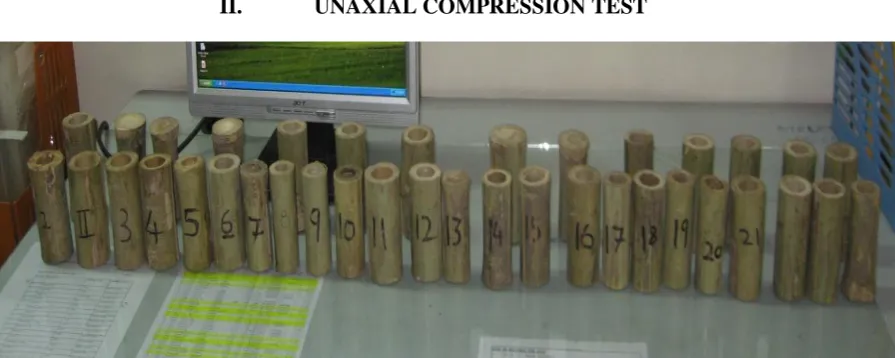
Fig. 1 Specimen no. 1 to 50 for uniaxial compressive test
Selection of bamboo species for testing and fabricating purpose denrocalamus strictus (Bengal bamboo) was chosen, from a consistent source. To achieve uniformity in quality of bamboo for test usage and exact dimensional measurement of bamboo samples for tests were taken. The age of bamboo to be tested and acceptable time frame of age of bamboo 2 to 3 yrs with usage of sections after minimum two weeks from the felling.
The averages of all tests for approximately 50 test specimens are as follows:
Bamboo stubs of approximately 105 mm in length, representing cylindrical shell and having an average sectional area of 1064 mm2 (ref fig 1) were loaded onto Heicos CTM and load applied at 0.1 KN/sec each end surface of these stubs polished out to be parallel and loaded axially. Peak compressive of 30.08 N/ mm2 with maximum average load of 32 KN was recorded
Sample type : Cylindrical Shell Length : 105 mm
2.1 Uniaxial compressive test showing Stress v/s Strain
Fig.2 Stress vs. Strain graph sample no 4 under uniaxial compression(Dry test)
Fig. 3 Stress vs. Strain graph sample no.6 under uniaxial compression (Dry test)
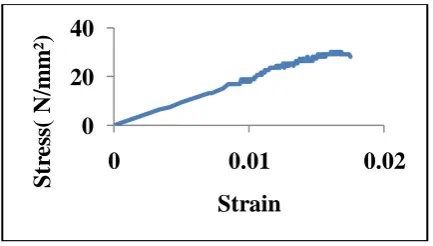
The bamboo stubs more than 50 in numbers were tested with dry condition and wet condition (saturated). with peak average failure stress being approximately 30N/ mm2 . A distinct failure pattern for the dry type and the wet type was also observed. Failure of dry bamboo stubs was distinct with substantial drop in load carrying capacity of the section (kinks) as the loading & test proceeded, whereas the wet section showed minor and numerous drops (kinks) in load carrying capacity of the wet section as the section was continuously loaded .Also locked in water inside the boundaries of shell of the bamboo element showed a distinct increase in ultimate strength of the section when saturated, which could be an issue of study and further investigation in itself.
Fig. 4 Stress vs. Strain graph under uniaxial compression (wet test sample no 16)
0 5 10 15 20 25 30
0 0.5 1 1.5 2
S
tr
es
s (
N
/m
m
²)
Strain %
0 5 10 15 20 25 30 35
0 0.5 1 1.5 2 2.5
St
re
ss
(N
/m
m
²)
Strain %
0
20
40
0
0.01
0.02
S
tr
es
s(
N/
m
m
²)
Fig. 5 Stress vs. Strain graph under uniaxial compression (wet test sample no 21)
III. SETUP & TEST PROCEDURE FOR BAMBOO COMPOSITE COLUMNS
To integrate all the bamboo into an aggregated prismatic shape, a single composite unit is formed so as to achieve a regular unified rectangular/circular (prismatic) member which remains as a single unit under all conditions of load, moment and shear induced stresses. The aim was to achieve a desired cross-section, which may be visualized as numbers of holes punched through at regular intervals out of aggregated structurally sized section.
After creating the bamboo column, the most difficult part was to have the two planar surfaces at the ends of the prismatic section to be parallel, and to be orthogonally placed to the vertical load axis of the prismatic section. Also tremendous amount of effort in terms of grinding at each prismatic sections end were undertaken, so as all faces of the sixteen bamboos at each end were perfectly leveled to each other and also perfectly parallel.
The adopted machine for testing bamboo column was cyclic compressive testing machine of 4000kN capacity with dynamic and static load testing facility. Five test samples of bamboo columns each having approximate dimension of 160x160x405 mm were chosen, each member having 16 bamboos were numbered from 1 to 16 and each bamboo was measured for inside and outside diameter with the help of vernier callipers at each end thrice. The average values of inside and outside diameter were adopted to achieve the gross cross sectional area of each bamboo and thereafter net effective area of each bamboo column was calculated. After placement on parallel loading plates of CTM, the composite columns were put on a static incremental load of 2 kN/sec.
Fig.6 Bamboo column under CTM
Initially, upon increment of load onto the bamboo column test sample, a uniform smooth transition curve of load vs. displacement was observed with minor teething in curve seen as the test progressed, which meant minor rupture in the internal bonds and the bamboo fibres.
When the bamboo column was no longer taking up load at the failure stage, the member bulged out at the centre slightly indicated that the bonding of the bamboo had started yielding. The figure 7 shows a composite column section C2A after test and after uniaxial load of 670 KN applied and failure shown by the CTM. Noticeably the whole prismatic section is seen to be a single unit without any major splitting and without fragmentation. Also seen in figure 8 is local crumpling effect at the ends of each individual bamboo caused at ultimate failure load for C1B.
0
20
40
0
0.02
0.04
S
tr
es
s
(N/m
m
²)
Fig.7 High capacity Composite C2B column
Fig.8 Failure of column (local crumpling and crushing at ends under axial compression)
It has been seen clearly and is evident that the integrity of the prismatic section has been retained even after application of failure load. It is concluded that these composite bamboo column sections are capable of taking up large uniaxial loads with large strains without fragmenting and splitting apart, hence it can be an ideal structural member with earthquake resisting ability within linear and non linear range of deformation and perceptible good ability to absorb energy under earthquake damage as would be expected under hysteresis in a cyclic loading.
IV. GRAPHS FOR STRESS V/S STRAIN FOR COMPOSITE BAMBOO
COLUMN LOADED UNDER HEICO ( C.T.M)
SAMPLES: Bamboo column Sample ( C1B)
Area = 15972 mm² (Effective cross sectional Area)
Fig.9 Composite column C2B. (stress vs. strain graph uner CTM test)
0
20
40
0
0.005
0.01
0.015
S
re
ss
N/m
m
²)
strain
V. RESULTS
There has been various bonding materials put to use for integrating bamboo to form a unit and with tests performed and ultimate strength values depicted the series C2 of tests and its bonding material to be better, giving better peak stress values
Type I
Table 1 Results
S.No Young's Modulus N/mm² Yield Stress N/mm² Peak Stress N/mm²
C1A 2850 28.5 30.34
C1B 2923 25.67 28.16
C1C 3146 25 28.46
Type II
Table 2 Results
S.No Young's Modulus N/mm² Yield Stress N/mm² Peak Stress N/mm²
C2A 3616 35.12 36.37
C2B 4200 31.5 32.49
Type I (C1A, C1B, C1C)
Average Young’s Modulus = 2923 N/mm² Average Peak Stress = 28.98 N/mm²
Type II (C2A,C2B)
Average Young’s Modulus = 3908 N/mm² Average Peak Stress = 34.43 N/mm2
VI. CONCLUSIONS
The paper suggests that high capacity sections in Bamboo Compositescan be a reality as the test results on column shows column yields E=3.6GPa, whereas single stub of bamboo tested individually yielded a modulus of elasticity (E) of 3000N/mm2.This indicates presence of bonding agent as reinforcement and filler to have increased the modulus of elasticity (E) of bamboo column. The axial compressive tests performed on bamboo columns 160x160x405mm in size revealed very high capacity in resisting axial loads as columns. A total of five samples were tested. Results has been encouraging with best results being ultimate capacity of column at failure being 670 kN axial load, amounting to (670000N/18000mm2) = 37.24 N/mm2 of peak average compressive stress (of effective gross section).
It was also noticed that four out of five samples finally failed at a strain of 1.2%. The paper concludes that the test on composite bamboo column showed large deformations against sustained compressive load, and indicated a continuous, smooth curve of stress versus strain with teething in the graph (load drop) indicating minor rupture internally. The gross composite bamboo section never split apart in fragments as an RC member would fracture and rupture under sustained increasing load. This phenomenon of sustained load carrying capacity without splitting till failure indicates high energy absorption and ductile behavior of the section in the non linear range. This would turn out to be a highly valued property of any structural member for earthquake resistance.
REFERENCES
[1] The Christian Science Monitor (2008), ‘Industry scrambles to find a greener concrete’ in The CS Monitor. Available at http://www.csmonitor.com/2008/0312/p14s01-stgn.html . (Accessed: 26 May, 2013).
[2] Scientific American, http://www.sciam.com/article.cfm?id=cement-from-carbondioxide, 2008. (Accessed on 28th May, 2013).
[3] GHAVAMI, K., Bamboo: Low cost energy saving construction materials, Proc. International conference on Modern Bamboo Structures, 28-30 October, Changsha, China, 5-21, (2007).