T cell depleted haploidentical
transplantation: positive
selection
Franco Aversa
Pediatric Oncology/Hematology, BMT Unit, Section of Hematology, Department of Internal and Experimental Medicine, University of Perugia, Perugia, Italy
Abstract
Interest in mismatched transplantation arises from the fact that a suitable one-haplo-type mismatched donor is immediately avail-able for virtually all patients, particularly for those who urgently need an allogenic trans-plant. Work on one haplotype-mismatched transplants has been proceeding for over 20 years all over the world and novel transplant techniques have been developed. Some centres have focused on the conditioning regimens and post transplant immune suppression; others have concentrated on manipulating the graft which may be a megadose of extensively T cell-depleted or unmanipulated progenitor cells. Ex-cellent engraftment rates are associated with a very low incidence of acute and chronic GVHD and regimen-related mortality even in patients who are over 50 years old. Overall, event-free survival and transplant-related mortality com-pare favourably with reports on transplants from sources of stem cells other than the matched sibling.
Introduction
A matched sibling or a well-matched unre-lated donor are the best options for patients with acute leukemia at high risk of relapse but unfortunately most patients do not have a suit-able matched donor while in first hematolog-ical complete remission (CR).1-3The only way to narrow the gap is to use a family donor with whom the patient shares one HLA haplotype for HLA-A, B, C and DR but not the other. This donor is immediately availability for all trans-plant candidates and unlike transtrans-plants from other alternative stem cell sources, the hap-loidentical transplant offers the advantage of another family member who is immediately available as an alternative donor or even a second graft from the original donor for nearly all patients who reject the graft. Furthermore any engrafted patients may potentially benefit from future attempts to modulate the cellular environment by delayed infusions of donor cell populations.
As the haplo transplant has spread to cen-tres worldwide and several hundred patients have been treated, we have enough data to in-clude the haploidentical option in an inten-tion-to-treat flow-chart at least for high-risk acute leukemia patients who are the major group requiring transplantation.
One-haplotype mismatched HSCT
In this setting, our efforts have long concen-trated on managing T cell alloreactivity in order to ensure engraftment without causing GvHD and, at the same time, minimise the major problems which are closely correlated with extensive T cell depletion, i.e. leukemia relapse and post transplant immune defi-ciency.4In 1993, we applied the stem cell megadose in clinical practice for the first time.5 T-cell-de-pleted bone marrow cells were supplemented with T-cell-depleted G-CSF-mobilized periph-eral blood progenitor cells (PBPCs). After the immuno-myeloablative conditioning regimen that included single fraction total body irradia-tion (TBI), thiotepa, cyclophosphamide (CY) and rabbit antithymocyte globulin (rATG), 36 patients received a median of 10.7x10⁶CD34+ cells/kg and 2x10⁵CD3+cells/kg. T-cell deple-tion with soybean agglutinadeple-tion and E-roset-ting was the only prophylaxis for GvHD. A pri-mary full-donor engraftment was achieved in 80% of patients and the incidence of acute grade II-IV GvHD was 17%, in the absence of any postgrafting immunosuppression.
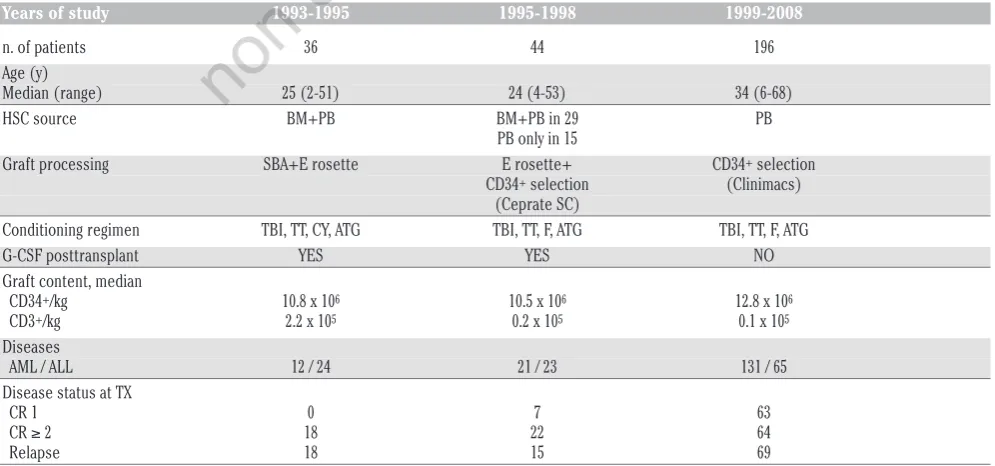
After this successful pilot study attention fo-cussed on optimising graft processing and con-ditioning regimen. In October 1995, in an at-tempt to enhance immunosuppression without increasing the extra-hematologic toxicity of the conditioning, we substituted fludarabine for CY in the pretransplant chemotherapy.6,7 Our adult patients receive 8 Gy TBI in a single fraction at high dose rate with lung shielding. To prevent growth inhibition TBI is fraction-ated in children. The total dose is 12 Gy over 3 days. Since we introduced these two modifica-tions – fludarabine and 4 Gy TBI to the lung – we have had no cases of idiopathic interstitial pneumonitis. As far as regards ATG, we ad-justed our doses according to the source (6-10 mg/kg thymoglubulin, 20-25 mg/kg Fresenius, all over 5 days) (Figure 1). Furthermore, with the aim of eliminating GvHD we tried to re-duce the number of T lymphocytes in the in-oculum to a mean of 2x10⁴/kg, i.e. one log less than in the previous series of patients. The technical inconveniences of the our original graft processing procedure were overcome when, in January 1999, we started positively selecting the CD34+cells using the Clinimacs device which in a one-step, fully automated procedure selects a highly purified CD34+cell population. Our final inocula now contains a median of 12x106 CD34+ cells/kg and 1x10⁴
CD3+cells/kg recipient body weight. Finally, given its immunosuppressive properties, we also suspended post-transplant G-CSF admin-istration to the recipients (Table 1).8,9
Results
The extra-hematological toxicity of this in-novative conditioning regimen was minimal even in patients who were at risk because 25% were in the upper age group for transplanta-tion, between 45 and 68 years, and about 50% were in advanced stage disease.
Under protocols that include fludarabine we have achieved a 95% primary engraftment rate. Acute and chronic GvHD were almost completely prevented with ex vivopositive se-lection of the grafts and in vivoT cell depletion exerted by ATG.
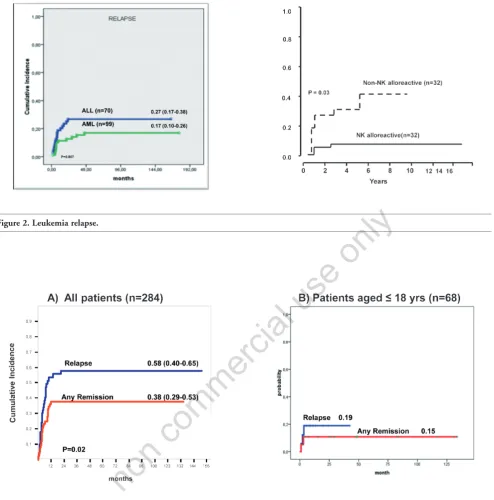
With minimal GvHD one might expect a high relapse rate in patients who were at high risk of relapse at transplant and did not benefit from the GvHD-related GvL effect. However, the relapse rate was 17% in AML and 27% in ALL patients who were transplanted in any CR (Figure 2a). Our intensely myeloablative con-ditioning regimen might have compensated for the lack of T-cell mediated GvL effect. Fur-thermore, unlike matched transplants, hap-loidentical transplants can benefit from a NK-cell mediated GVL effect.10-13Indeed, patients transplanted in remission had a 3% and 47% probability of relapse respectively whether the donor was NK alloreactive or not (Figure 2b). Therefore, given this evidence, donor-vs-recip-ient NK alloreactivity, as predicted by the HLA disparity, should be exploited when selecting the optimal donor from among the mismatched family members. Cytomegalovirus (CMV) was the main cause of infection-related deaths in
Pediatric Reports 2011; volume 3:(s2)14
Correspondence: Franco Aversa, Pediatric Oncology/ Hematology, BMT Unit, Section of Hematology, Department of Internal and Experimental Medicine, University of Perugia, Perugia, Italy. E-mail: [email protected]
Key words: T cell depleted haploidentical trans-plantation.
Received for publication: 4 May 2011. Accepted for publication: 4 June 2011.
This work is licensed under a Creative Commons Attribution NonCommercial 3.0 License (CC BY-NC 3.0).
©Copyright F. Aversa, 2011
Licensee PAGEPress, Italy Pediatric Reports 2011; 3(s2):e14 doi:10.4081/pr.2011.s2.e14
non
commercial
Figure 1. Conditioning regimen.
Table 1. Modifications in the Perugia Haplotransplant Programme.
Years of study 1993-1995 1995-1998 1999-2008
n. of patients 36 44 196
Age (y)
Median (range) 25 (2-51) 24 (4-53) 34 (6-68)
HSC source BM+PB BM+PB in 29 PB
PB only in 15
Graft processing SBA+E rosette E rosette+ CD34+selection
CD34+selection (Clinimacs)
(Ceprate SC)
Conditioning regimen TBI, TT, CY, ATG TBI, TT, F, ATG TBI, TT, F, ATG
G-CSF posttransplant YES YES NO
Graft content, median
CD34+/kg 10.8 x 10⁶ 10.5 x 10⁶ 12.8 x 10⁶
CD3+/kg 2.2 x 10⁵ 0.2 x 10⁵ 0.1 x 10⁵
Diseases
AML / ALL 12 / 24 21 / 23 131 / 65
Disease status at TX
CR 1 0 7 63
CR ≥ 2 18 22 64
Relapse 18 15 69
HSC: Hematopoietic Stem Cells; BM: Bone Marrow; PB: Peripheral Blood; SBA: Soybean Agglutinin; TBI: Total Body Irradiation; TT: Thiotepa; CY: Cyclophosphamide; ATG: Anti Thymocyte Globulin; G-CSF: Granulocyte Colony Stimulating Factor; AML: Acute Myeloid Leukemia; ALL: Acute Lymphoid Leukemia; CR: Complete Remission.
our patients. Other infections which con-tribute to our 40% incidence of non relapse mortality include fungi and bacteria (Figure 3a). Our anti-infective approach is mainly based upon ganciclovir over the conditioning followed by foscarnet for the first three weeks after transplanation. Liposomal amphotericine B is the standard anti-Aspergillus propylaxis until the neutrophil count normalises. Overall, disease status at transplant is a significant
factor for TRM and the risk of life threatening infections plateaus out after about one year when the immunity tends to normalize. On the other hand we have less mortality in children and adolescents, particularly when they are transplanted in remission (Figure 3b).
Our overall population of 284 patients has a maximum follow-up now of 17 years. DFS ranged from 30% in ALL to 43% in AML in pa-tients who were transplanted in any CR and it
is worth nothing that, with no chronic GvHD, all these long term survivors have an excellent quality of life. We have 60% survival in patients aged 18 or under. As might be expected, out-comes are extremely poor in patients who are transplanted in chemoresistant relapse. How-ever our 18% DFS for advanced AML patients is really quite good, considering that they had no other option beyond the haplo-transplant (Figure 4). Having a NK alloreactive donor
im-Article
non
commercial
pacts strongly on outcomes in patients with AML in remission.13
Another positive factor which emerged from Martin Stern’s analysis was that a maternal donor is associated with best survival. In a ret-rospective analysis of 118 patients, having a mother who can exert donor vs recipient NK cell alloreactivity offers an excellent proba-bility of survival.14
In conclusion, the ideal haplotransplant should be structured as follows: patients should be in CR, the donor should be selected
according to CMV serology and should perfer-ably be a mother and /or someone who can exert donor vs recipient NK cell alloreactiviy. TBI can be given as a single or fractionated schedule. Lung shielding is important. Flu-darabine is better than CY and the recom-mended ATG doses are 25 mg/kg for Fresenius and 6 mg/kg for thymoglobulin. Extensive T and B cell depletion is crucial for success and of course a megadose of CD34+cells must be reached. Post-transplant the only recommen-dation is for anti-infective prophylaxis.
The present challenge is to reduce post-transplant infectious mortality in adults and researchers are focussing on strategies to en-sure faster and better immunological reconsti-tution separating GvHD from favourable donor immune responses.
In extensively T cell depleted transplants such as we use in Perugia, strategies are based on post-transplant addbacks of donor T cells.
To prevent GvHD, these addbacks are purged of alloreactivity using a photodynamic method.15
Article
Figure 3. Non-relapse mortality. Figure 2. Leukemia relapse.
non
commercial
We are also attempting to down modulate al-loreactivity by infusion of naturaly occurring donor T regulatory cells.16
In conclusion, today we are in a position to offer a transplant to all patients with high-risk leukaemia. HLA typing must be done at diag-nosis. If a sibling donor is not available atten-tion should focus on alternative sources of stem cells limiting the registry search for a well-matched unrelated donor to 2 or 3 months. If unsuccessful, consider a cord blood unit or a haplo donor. Both are immediately available but an haploidentical NK alloreactive donor of-fers a better outcome and survival.
References
1. Gupta V. Alternative donor transplants for high-risk acute myeloid leukemia. Curr Opin Hematol 2008;15:115-20.
2. Bachanova V, Weisdorf D. Unrelated donor allogeneic transplantation for adult acute lymphoblastic leukemia: a review. Bone Marrow Transplant 2008;41:455-64. 3. Rocha V, Gluckman E. Eurocord-Netcord
registry and European Blood and Marrow Transplant group. Improving outcomes of cord blood transplantation: HLA matching, cell dose and other graft- and transplanta-tion-related factors. Br J Haematol 2009; 147:262-74.
4. Reisner Y, Martelli MF. Stem cell escala-tion enables HLA-disparate haematopoi-etic transplants in leukaemia patients. Im-munol Today 1999;20:343-7.
5. Aversa F, Tabilio A, Terenzi A, et al. Suc-cessful engraftment of T-cell-depleted hap-loidentical “three-loci” incompatible transplants in leukemia patients by addi-tion of recombinant human granulocyte colony-stimulating factor-mobilized pe-ripheral blood progenitor cells to bone
marrow inoculum. Blood 1994;84:3948-55. 6. Terenzi A, Aristei C, Aversa F, et al. Efficacy of fludarabine as an immunosuppressor for bone marrow transplantation condi-tioning: Preliminary results. Transplant Proc 1996;28:3101.
7. Aversa F, Tabilio A, Velardi A, et al. Treat-ment of high risk acute leukemia with T-cell-depleted stem cells from related donors with one fully mismatched HLA haplotype. N Engl J Med 1998;339:1186-93. 8. Aversa F, Terenzi A, Tabilio A, et al. Full-haplotype mismatched hematopoietic stem cell transplantation: A phase II study in pa-tients with acute leukemia at high risk or relapse. J Clin Oncol 2005;23:3447-54. 9. Volpi I, Perruccio K, Tosti A, et al.
Post-grafting granulocyte colony-stimulating factor administration impairs functional immune recovery in recipients of HLA hap-lotype-mismatched hematopoietic trans-plants. Blood 2001;97:2514-21.
Article
Figure 4. Disease-free survival.
non
commercial
10. Ruggeri L, Capanni M, Casucci M, et al. Role of natural killer cell alloreactivity in HLA-mismatched hematopoietic stem cell transplantation. Blood 1999;94:333-9. 11. Velardi A, Ruggeri L, Moretta A, Moretta L.
NK cells: a lesson from mismatched hematopoietic transplantation. Trends Im-munol 2002;23:438-44.
12. Ruggeri L, Capanni M, Urbani E, et al. Ef-fectiveness of donor natural killer cell al-loreactivity in mismatched hematopoietic
transplants. Science 2002;295:2097-2100. 13. Ruggeri L, Mancusi A, Capanni M, et al. Donor natural killer cell allorecognition of missing self in haploidentical hematopoi-etic transplantation for acute myeloid leukemia: challenging its predictive value. Blood 2007;110:433-40.
14. Stern M, Ruggeri L, Mancusi A, et al. Sur-vival after T cell-depleted haploidentical stem cell transplantation is improved using the mother as donor. Blood 2008;112:2990-5.
15. Perruccio K, Topini F, Tosti A, et al. Photo-dynamic purging of alloreactive T cells for adoptive immunotherapy after haploiden-tical stem cell transplantation. Blood Cells Mol Dis 2008;40:76-83.
16. Di Ianni M, Falzetti F, Carotti A, et al. Adoptive Immunotherapy with Tregs Prevents GvHD and Favours Immune Reconstitution After HLA Haploidentical Transplants for Hemato-logical Malignancies. Blood (ASH Annual Meeting Abstracts) 2009;114:Abstract 4.