25
Volume 13, 2009
EDUCATIONAL POSSIBILITIES IN THE
DEVELOPMENT OF THE AMBIENT
INTELLIGENCE CONCEPT
Vladimír Bureš, Pavel Čech, Karel Mls
University of Hradec Králové, Czech Republic E-mail: [email protected]; [email protected]; [email protected]
Abstract
In 2001, IST Advisory Group, as an advisory body of the European Commission in the field of information and communication technology, introduced four scenarios of the future development in information society forming an Ambient Intelligence (Ami) environment. This vision is a relatively new concept that is being developed at both theoretical and practical level. The problem is that although the concept of AmI has a strong technological orientation, there are also social, psychological, ethical or legislative dimensions that have to be taken in to consideration. Successful application of AmI requires entwining technological, managerial and other aspects to a complex soft system. In order to design and create appropriate architecture of this intelligent environment, which will match given requirements, it is necessary to acquire qualitative description of future stakeholders’ needs. One needs appropriate tools or techniques to be able to comprehend such complexity and people in general usually do not possess needed skills or tools. Therefore, the role of education is of a crucial importance here. The paper describes the AmI concept and outlines its relation with educational issues. Experience obtained while implementing of so-called learner-directed educational approach together with achieved findings and lessons learned are introduced.
Keywords: ambient intelligence, decision-support systems, learner-directed learning, object modelling, systems thinking.
Introduction
practical applications of pervasive/ubiquitous computing efforts led to idea of ambient intelligence (ami) concept that promotes pervasive, distributed technology, not intrusive, but always present (remagnino, 2005). this vision of the future digital environment is full of intelligent devices surrounding us while travelling, working or doing leisure time activities. four major aspects of ami are of crucial importance - user friendliness, effectiveness, distributed support and interactivity. ami is primarily based on integration of information and communication technologies (ict) to the environment so that from the point of view of the user it is absolutely non-essential with what technologies he/she is interacting; with how many applications he/she is in contact; how the applications are related and how the applications cooperate. in fact the user might not be even aware that he/she is interacting with technology or applications at all (mikulecký, 2007). that is why ami supports the shift of computing from desktop computers to various intelligent devices integrated in everyday life of users.
according to van houten (2006), the ami vision can be applied to very diverse application
environments, varying from homes, offices, or cars to homes for the elderly and hospitals. It
26 they are included in the istaG report (ducatel, 2001) that introduced four scenarios of the future development in information society.
The everyday workplace of managers is one of significant application areas of AmI.
faculty of informatics and management at the university of hradec Kralove (fim uhK) in the czech republic is educating on the interdisciplinary basis both future managers with strong technological background and it specialists who are aware of managerial issues related to ict. in this way, students represent prospective managers or employees providing essential technological support to an organizational management. therefore, they should be able to impose requirements
for the structure and behaviour of AmI from the point of view of final users. Moreover, they
should also be able to participate on the development of solutions that form ami. to be able to achieve these goals, students have to acquire and practice several tools, methods or skills. these are experimentally applied in relevant subjects and represent the main focus of this paper.
The research framework
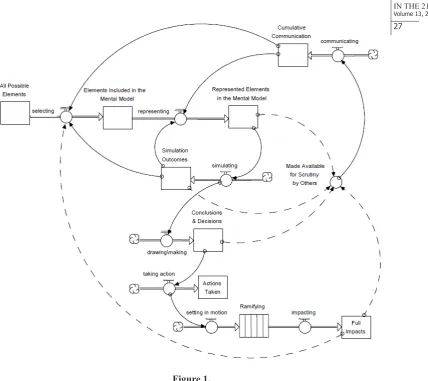
there are several perspectives in ami. besides a technological perspective, social perspective, or ethical perspective, we can also identify an educational perspective. it deals with problems and challenges related to proper education in relevant ami areas. since fim uhK is the educational institution, it focuses its attention on the educational perspective primarily. the research and education in the ami area are based on the framework introduced by barry richmond (2004). in his work, he described the dynamics of learning, communication and thinking processes. this
dynamics is depicted in figure 1 in the form of a stocks-and-flows diagram. The figure shows that
the Thinking process consists of two activities: constructing mental models, and then simulating them in order to draw conclusions and make decisions. the Communication process is based on outcomes of the thinking process, i.e. inputs to this process are mental models represented in any
form, outcomes from simulations with mental models, final conclusions and decisions, and impacts
of these decisions. in the communication process the mental models, simulations, decisions, or
relevant impacts are discussed and in this manner the thinking process is influenced again. The figure also outlines that the Learning process types are two-fold. The first type of learning is
called self-reflective learning. it is realized when simulation outcomes are used to drive a process in which a mental model’s content, and/or representation of content, is changed. the second type of learning is driven by the communicating process. it is called other-inspired learning and the material for this type of learning is: the mental model itself, the simulation outcomes associated with that model, and/or the conclusions drawn from simulating. as richmond (2004) stated, how much learning occurs, depends upon both the quality of the feedback provided - where “quality” includes content and “packaging” - as well as the willingness and ability to “hear” the feedback. the fourth source of raw material for learning: the impacts of one’s actions can be used
in both self-reflective learning and other-inspired learning. Its assignment to the specific type
of learning depends on if somebody is learning from his/her own actions or actions of others.
One way or another this learning can be identified as the third type of learning, which is usually
27
in the 21st century Volume 13, 2009
Figure 1.
Learning, communication and thinking processes (adopted from [Richmond, 2004]).
The educational Method
The educational method is based on Richmond’s earlier work (1993), in which he identified
several types of thinking that should be applied for successful realization of the systems thinking. since previous research proved that systems thinking is the appropriate tool for ami development
(Bureš, 2006; Bureš, 2007), these types of thinking were identified as a convenient instruments
28 Theory of systems
the whole subject is split in two subjects titled theory of systems 1 (tesy1) and theory of systems 2 (tesy2). While tesy1 is focused on basic principles of systems thinking and its application in practice, tesy2 deals with particular systems sciences and systems disciplines. there are several educational goals of this subject. however, one is of crucial importance for students’ ability to comprehend ami concept. this goal is to improve students’ capability to analyze (both formally and informally) complex phenomenon.
this objective should be ensured by the development and consequent application of so called 10.000 meter thinking, “system as cause” thinking, and dynamic thinking. as stated by richmond (2004), the 10,000 Meter Thinking was inspired by the view one gets on a clear sunny day when looking down from the seat of an airplane. he/she see horizontal expanse, but little vertical detail. it is possible to gain a “big picture,” but relinquish the opportunity to make
fine discriminations. The “System as Cause” Thinking also works to counter the vertical bias toward including too much detail in the representations contained in mental models. “system as cause” thinking should ensure the occam’s razor principle (i.e., the simplest explanation for a phenomenon is the best explanation). it holds that mental models should contain only those elements whose interaction is capable of self-generating the phenomenon of interest. it should not contain any so-called “external forces.” Dynamic thinking is the ability to see and deduce behaviour patterns rather than focusing on, and seeking to predict, events. it is thinking about phenomena as resulting from ongoing circular processes unfolding through time rather than as belonging to a set of factors. having students think about everyday events or newspaper stories in terms of general concepts, endogenous or exogenous variables, or graphs over time would be good exercises for developing these thinking skills. also very helpful is the use of simple models in real-time exercises in which students are asked to hypothesize what behaviour pattern will result when a particular system is disturbed in a particular way. students can also work with a series of generic structures that progress from simple exponential growth and decay, through s-shaped growth, to overshoot/collapse and oscillation. they also can do exercises with the classic policy insensitivity structures, e.g., shifting the burden to the intervener, floating Goal, first response in the Wrong direction, and promotion chain (richmond, 2004).
Introduction to Object Modelling
the above mentioned thinking skills, developed in tesy, are to be practiced in iomo in order to master other skill called Operational Thinking.
thinking operationally means thinking in terms of how things really work - not how they ought to theoretically work. operational thinking grounds students in reality. it is easy to create exercises that develop operational thinking by looking around at real-world processes (like learning, becoming friends, pollution, drug or alcohol addiction) and ask how do these processes really work (richmond, 2004). however, orientation of fim uhK is the reason why business processes are modelled during iomo lessons. consequently, students can take a look at representation of their mental models in form of particular diagrams and ask themselves questions if this is how it really works.
29
in the 21st century Volume 13, 2009
Management support systems
the general management support systems subject is split to two related and consecutive subjects – to management support systems 1 (mss1) and management support systems 2 (mss2). in general, the last two ways of thinking are exercised here. these are continuum and
scientific thinking. As stated by Richmond (1993), Continuum Thinking is nourished primarily by working with simulation models that have been built using a continuous modelling approach, as opposed to a discrete one. continuous models are the opposite to the discrete models that can be characterized as containing many “if, then, else” type of equations. although, from a mechanical standpoint, the differences between the continuous and discrete formulations may seem unimportant, the associated implications for thinking are quite profound. an “if, then, else” view of the world tends to lead to “us versus them” and “is versus is not” distinctions. such distinctions, in turn, tend to result in polarized thinking. issues are seen as black or white; gray is not an option. for instance, in terms of ami the continuum thinking should avoid the separation of users and networks operators, which could cause problems in practical realisation of this concept. continuum thinking is based on the ability to see connections and interdependencies rather than sharp boundaries and disconnections. this ability is exercised in mss1, whose main goal is to familiarize students with theoretical and practical aspects of the decision-making process in complex, or semi-structured situations. individual and group decision-making processes are studied with the help of analysing data and modelling. fuzzy (continuum) approach to problem solving is considered when expressing individual preferences as well. moreover, new and prospective approaches and technologies for intelligent and autonomous decision making systems that may be included into ami environment are discussed.
Scientific Thinking is first of all about quantification in sense of being rigorous about testing
hypotheses. this process begins by ensuring that students in fact have a hypothesis to test. if an a priori hypothesis absences, the experimentation process can easily degenerate into a useless game (richmond, 1993). the hypothesis-testing process itself (not in the statistical point of
view, but in the pragmatic perspective) also needs to be informed by scientific thinking. People thinking scientifically modify only one thing at a time and hold all other factors constant (ceteris
paribus principle). they also test their models from steady state, using idealized inputs to call forth “natural frequency responses”. this ability is exercised in the subject mss2. in the frame of the mss2 further development of a standard decisional support is also researched. Game theory, decision making under risk and uncertainty and an approach to data warehousing and data mining technologies represent main ideas that not only extend students’ perspective, but enable their better orientation in complex real situations.
Learner-directed Learning approach
30 has to be considered as an active process. being quiet and listening often can be antithetical to construction activities.
implementation of the learner-directed approach is based on teamwork at particular subjects. students obtain creative assignments, in which they have to come with their own solutions. the point is that assignments do not have the only one and correct solution. therefore, students have to not only come with meaningful solution, but they also have to defend it in consequent presentation. during these presentations different viewpoints as well as mental models “collide”. that is why students can not simply accept others’ (i.e. teachers’ and students’) knowledge passively. they have to construct their own knowledge during ongoing comparison and confrontation process.
Results
There are two main findings or lessons learned that were acquired from the described
research and education processes. firstly, appropriate tools for work with mental models can improve the ability to comprehend the ami concept. While systems thinking is a convenient tool
for mental models creation and modification, object modelling offer appropriate tools for their
representation, and management support systems can provide an environment, in which individual and group decision-making processes can be simulated and impacts of related decisions can be modelled. in this way the whole system of learning, communication and thinking processes can be supported and the educational perspective of ami realized.
secondly, in order for the learner-directed approach to work, it is essential that both teachers and students rethink their roles and respective contributions to the learning process (richmond, 1993). While teachers play roles of project managers, i.e. set objectives and coordinate students’ activities, students must be willing to take personal responsibility for their learning and achieved results. students must also learn to cooperate with each other as learning partners, not
competitors. However, there is an overall belief that the described transition is first of all the
matter of teachers and educational institutions in general. nevertheless, the experience shows clearly that students’ approaches to their learning act as the biggest barrier. Whereas teachers can change the organisation of their subjects relatively quickly, students’ habits and attitudes gained during their studies at primary and high schools have strong roots in their behaviours and value hierarchy. consequently, these make successful implementation of learner-directed approach at
the university level of education difficult. Although learner-directed learning approach improves
students’ ability to comprehend complex systems and their self-reliance, it is also accompanied by the higher percentage of failures and incompletion of subjects. unfortunately, overcoming of this
problem is a question of changes in the whole society and its educational system specifically. As
educational institutions or teachers come with their own approaches, these regrettably represent only partial solutions and do not have a potential to become an overall systemic solution.
Conclusions
ami is a complex system which can be developed only with the help of appropriate tools, techniques or methods. research and education at fim uhK show that different types of thinking can be used for this purpose. in general, these thinking types can be either exercised in a specialised
curriculum, or tied to particular subjects, whose content is focused primarily on a specific area. The
latter approach was chosen at fim uhK, where skills teaching and exercising was split in several subjects with contents relevant to ami. the sequence of their introduction to students was set as follows: 10.000 meter thinking, “system as cause” thinking, and dynamic thinking, operational
Thinking, Closed-Loop Thinking, Continuum Thinking, and Scientific Thinking. Selected subjects
31
in the 21st century Volume 13, 2009 approach is related to the shift in educational processes. experience shows that the biggest barrier
is not represented by teachers, who are able to change their approach quite quickly. surprisingly, students’ habits and attitudes to their education constitute an obstacle that needs a relatively long time to be overcome.
Acknowledgement
This paper is partially supported by project GAČR 402/09/0662 Decision making processes
in autonomous systems.
References
bureš, V. (2006). systems thinking as a basis for ambient intelligence. ACM SIGCSE Bulletin, 38(3), pp.318.
Bureš, V. & Čech, P. (2007). Complexity of Ambient Intelligence in Managerial Work. ACM SIGCSE
Bulletin, 39(3), pp.325.
ducatel, K. et al. (2001). Scenarios for Ambient Intelligence in 2010: Final report. seville, spain: information society technologies advisory Group. retrieved february 2, 2009, from ftp://ftp.cordis.lu/pub/ist/docs/ istagscenarios2010.pdf.
Mikulecký, P., Olševičová, K., & Ponce, D. (2007). Ambient Intelligence - Monitoring and Supervision of new type. in p. Kleve, r. V. de mulder, & c. van noortwijk (eds), First international seminar of the Legal Framework for the Information Society (LEFIS) on Monitoring, Supervision and IT (pp. 115-134). Zaragoza, spain, Zaragoza university press.
remagnino, p., foresti, G.l., & ellis, t. (eds.). (2005). Ambient Intelligence: a Novel Paradigm. new york, springer.
richmond, b., peterson, s., & Vescuso, p. (1987). An Academic User’s Guide to STELLA. lebanon, nh, high performance systems.
richmond, b. (1993). systems thinking: critical thinking skills for the 1990s and beyond. System Dynamics
Review 9(2), 113-133.
richmond, b. (2004). An Introduction to Systems Thinking. lebanon, nh, isee systems.
roberts, n. et al. (1983). Introduction to Computer Simulation: A System Dynamics Modeling Approach. reading, mass., addison-Wesley.
van houten, h. (2006). the physical basis of ambient intelligence. in s. mukhejree et al. (eds.). AmIware: Hardware Technology Drivers of Ambient Intelligence. dordrecht, springer.
Adviced by Daniela Ponce, University of Hradec Králové, Czech Republic
Vladimír Bureš
Assistant professor, University of Hradec Králové, Rokitanskeho 62, 500 03 Hradec Králové, Czech Republic.
Phone: +420 493 332 259 E-mail: [email protected] Website: http://www.uhk.cz/eng/
Pavel Čech
Assistant professor, University of Hradec Králové, Rokitanskeho 62, 500 03 Hradec Králové, Czech Republic.
Phone: +420 493 332 262 E-mail: [email protected] Website: http://www.uhk.cz/eng/
Karel Mls
Assistant professor, University of Hradec Králové, Rokitanskeho 62, 500 03 Hradec Králové, Czech Republic.