Original Research Article
Association between physical activity and obesity in adolescent
population in urban areas of Maharashtra
Sanjeev Chincholikar
1, Amit Sohani
2*
INTRODUCTION
Obesity is an escalating problem worldwide as a major risk factor in many serious chronic diseases including cardiovascular disease, dyslipidemia, hypertension, type 2 diabetes, some forms of cancer, and osteoarthritis.1,2 The lack of physical activity is one of the main risk factors that lead to overweight and obesity.3,4 The level of physical activity may impact the amount of weight gain occurring over time. Body Mass Index (BMI), as the individual's body weight in kilograms divided by the square of the height in meters (kg/m2), has been widely
used to define obesity across populations. It is well documented that physical activity begins to decline in adolescence with concomitant increase in weight.5,6 Whether these trends continue in the transitional period from adolescence to adulthood, a time critical for the development of obesity is not clear.7 The relationship between physical inactivity in adolescence and obesity in adulthood has been weak or non-existent in the few published longitudinal studies.8 Available studies from Chennai and Delhi have shown prevalence of childhood obesity 6.2% and 7.4% respectively.9 50-80% of obese children will continue as obese adults and falls into risk ABSTRACT
Background: Obesity is a major risk factor in many serious chronic diseases including cardiovascular disease, dyslipidemia, hypertension, type 2 diabetes, some forms of cancer, and osteoarthritis. The lack of physical activity is one of the main risk factor that leads to overweight and obesity. Objective of the study was to determine the association of obesity with physical activity.
Methods: The study was carried out in 4 institutions (3 schools and 1 college) of semi-urban area of Maharashtra from Jan 2013 to Jan 2014. 585 students were selected by systematic sample i.e. every 3rd student was included in the study sample. A pretested standardized questionnaire was used. Body mass index was calculated by dividing the weight in kilogram by square of height in meter.
Results: The subjects were asked regarding use of gym facility for exercise, it was found 26.21% subjects, who did
not have exercise, had either overweight or obesity. It was also observed that 26.15% study subjects who daily walk less than a kilometer had either overweight or obesity. There was statistically significant difference between physical inactivity and prevalence of overweight as well as obesity.
Conclusions: The subjects were asked regarding use of gym facility for exercise, it was found 26.21% subjects, who
did not have exercise, had either overweight or obesity. It was also observed that 26.15% study subjects who daily walk less than a kilometre had either overweight or obesity. There was statistically significant difference between physical inactivity and prevalence of overweight as well as obesity.
Keywords: Physical activity, Obesity, Mode of travel, Exercise
Department of Community Medicine, 1MIMER Medical College, Talegaon Dabhade, Pune, 2PHC, Mudshingi, Tal-Karveer, Maharashtra, India
Received: 13 May 2019
Revised: 02 July 2019
Accepted: 03 July 2019
*Correspondence: Dr. Amit Sohani,
E-mail: [email protected]
Copyright: © the author(s), publisher and licensee Medip Academy. This is an open-access article distributed under
the terms of the Creative Commons Attribution Non-Commercial License, which permits unrestricted non-commercial use, distribution, and reproduction in any medium, provided the original work is properly cited.
group of diabetes, hypertension, coronary heart diseases and many more obesity related diseases.8 Complications of adult obesity are made worse if the obesity begins in childhood. 10 According to NHFS 3, in India 12.1% male and 16% female were either overweight or obese. Many studies have shown that the prevalence of overweight among adolescent varies between 10 to 30 %.11,12
Once obesity is established, energy balances changes. Data on 319 adults from the UK indicate that total energy expenditure (TEE, assessed by the doubly-labelled water method), basal metabolic rate (BMR), and AEE (activity-induced energy expenditure) are increased in obesity due to the larger body size.13 According to these results, physical activity is not changed in obesity. Other studies suggest the contrary: obese subjects are less active and expend less energy in physical activity than do lighter subjects.14,15 With this background in mind, present study was carried out in semi-urban area of Maharashtra to identify potential involvement of physical activity in development of obesity.
Objective
To determine the association of obesity with physical activity.
METHODS
The study was carried out in 4 institutions (3 schools and 1 college) of semi-urban area of Maharashtra, Talegaon Dab hade, from Jan 2013 to Jan 2014. Ethical committee of parent institute approved the study. It was also approved by the concerned committee of the Maharashtra University of Health Sciences Nashik. Permission for the study was obtained from respective in-charges of schools and colleges.
It was a cross sectional observational study. A pilot study of 100 adolescents was carried out for determining sample size and validating the questionnaire. It was found that the prevalence of obesity was 15%. Prevalence of obesity is between 10 to 30% in India as reported by various studies.16 Finding of pilot study confirm the prevalence as 15% in the reference population also. Therefore, considering prevalence of obesity in adolescent as 15%, with 95% confidence interval (α =0.05) power of test=80% (β=0.2), estimated sample size for adolescent population including 5% non-responsive error was 575. Actual study was carried out on 585 students. Out of all the schools and colleges which provided education up to 10th standard or above 10th standard were considered as reference population. As there were no government schools or colleges providing teaching up to 10th standard or above, thus only private schools and colleges were represented in data. Thus, reference population consisted of 17 schools and 3 colleges, all private. 3 schools and 1 college were selected by simple random sampling. Thus the study population consisted of 585 students.
All adolescent school going boys and girls in the age group between 10 to 19 years were included as per definition of adolescent. 585 students were selected by systematic sample i.e. every 3rd student was included in the study sample. A pretested standardized questionnaire was used. Height and weight of each individual was measured with the help of fibre plastic measuring tape up to the nearest millimetres and weighing scale up to the 0.5 kg respectively. Height was measured by asking the subject to stand erect without footwear on flat surface with heels together and upper limbs hanging closely to the sides of the body with the investigator standing on the left side of the subject. By placing hard cardboard on the head of the subject marking was made on the wall and later with the help of measuring tape height was calculated to the nearest millimetres. Before making the markings the head of the subject was positioned in such a way that the imaginary line drawn from tragus of the ear to the infra-orbital margin was parallel to the ground. For the weight measurement standardized calibrated spring balance was used and subject was made to stand on platform of the balance without footwear. The weight was recorded nearest to 0.5 kg.
Body mass index was calculated by dividing the weight in kilogram by square of height in meter. The prevalence of overweight and obesity in adolescents is defined according to the WHO growth reference for school-aged children and adolescents (overweight=one standard deviation body mass index for age and sex, and obese= two standard deviations body mass index for age and sex). Chi square test was used for statistical analysis.
RESULTS
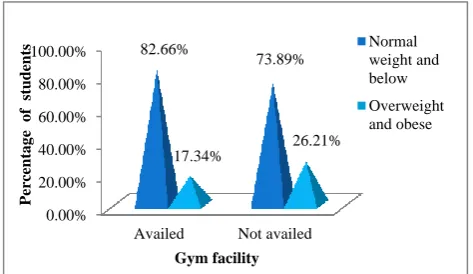
The subjects were asked regarding use of gym facility for exercise, it was found from Figure 1 that there was statistically significant difference between exercise with prevalence of overweight and obesity. 26.21% subjects, who did not have exercise, had either overweight or obesity. The results are as follows.
Figure 1:Prevalence of overweight and obesity in study subjects as per exercise.
χ2= 4.065899, df=1, p<0.05.
0.00% 20.00% 40.00% 60.00% 80.00% 100.00%
Availed Not availed 82.66%
73.89%
17.34%
26.21%
Perc
entag
e
of
student
s
Gym facility
As revealed from Table 1, there was statistically significant difference between daily walk with prevalence of overweight and obesity. It can be observed that 26.15% study subjects who daily walk less than a kilometer had either overweight or obesity. In concurrence with regular walking use of motor vehicle for reaching school or college was also observed.
Table 1:Association of daily walk with prevalence of overweight and obesity.
Distance in kilometre
Number of students
Students with normal weight and below
Students with overweight and obesity
N (%) N (%) N (%)
<2 413 (100) 305 (73.85) 108 (26.15)
≥2 172 (100) 142 (82.56) 30 (17.44)
Total 585 (100) 447 (76.41) 138 (23.58)
χ2=3.90353, df= 1, p<0.05.
As mentioned in material and methods, viewing television for more than 2 hours was considered as one of the criteria for physical inactivity. As revealed in Figure 3, there was statistically significant difference between physical inactivity and prevalence of overweight as well as obesity. It can be seen that there were 26.85% students with overweight and obesity, who had physical activity less than 2 hours a day.
It can be observed from Table 2 that 27.19% Students with overweight and obesity had outdoor activity less than 2 hours a day. Significant association was found between prevalence of overweight and obesity with outdoor activity less than 2 hours a day.
Figure 2:Association of mode of travel with overweight and obesity in study subjects. χ2 = 4.386506, df =1, p<0.05.
Figure 2 reveals that there was a strong association between mode of travel and prevalence of overweight as well as obesity. It can be seen that overweight and obesity was relatively less in those who prefer walk and
bicycle as their mode of travel. It was observed that 31.39 % subjects with vehicle as a mode of travel had overweight or obesity while only 19.72% subjects with either walk and bicycle as mode of travel had overweight or obesity.
Table 2:Relation of outdoor activity and obesity in study subjects.
Outdoor activity per day (in hours)
Number of students
Students with normal weight and below
Students with overweight and obesity
N (%) N (%) N (%)
<2 331 (100) 241 (72.81) 90 (27.19)
≥2 254 (100) 206 (81.10) 48 (18.90)
Total 585 (100) 447 (76.41) 138 (23.59)
χ2=4.189568, df=1, p<0.05.
Figure 3: Physical inactivity and obesity in study subjects.
χ2
=5.211201, df=1, p<0.05.
DISCUSSION
Physical activity, prevalence of overweight and obesity
As revealed from the Table 1 and Figure 1 that, there was statistically significant difference between daily walk, with overweight and obesity. Similarly, significantly high (26.21%) prevalence of overweight and obesity was found among those who did not avail gym facility. It was observed from Figure 2 that 31.39% subjects with vehicle as a mode of travel had overweight or obesity while only 19.72% subjects with either walk and bicycle as mode of travel had overweight or obesity. As seen from Table 2, when outdoor activity was correlated with overweight and obesity in study subjects it was found that there was statistically significant difference between prevalence of overweight and obesity and outdoor activity. This indicates, outdoor activity influences body weight. As mentioned in material and methods, viewing television for more than 2 hours was considered as one of the criteria for physical inactivity. Figure 3 reveals, significant statistical difference between physical inactivity and prevalence of overweight as well as obesity.
0.00% 10.00% 20.00% 30.00% 40.00% 50.00% 60.00% 70.00% 80.00% 90.00%
Walk and bicycle Vehicle 80.28%
68.61%
19.72%
31.39%
Perc
entag
e
of
students
Mode of traval
Normal weight and below Overweight and obese
0.00% 20.00% 40.00% 60.00% 80.00% 100.00%
< 2 Hours ≥ 2 Hours 73.15%
84.51%
26.85%
15.49%
Perc
entag
e
of
students
physical inactivity
Kotian et al found that prevalence of overweight was higher among adolescents in those adolescent populations who had physical activity of less than 1 hour per day, watched television for 4 hours/day, and ate chocolates daily.17 Increase in trend of physical inactivity among children and adolescents due to sedentary activities such as watching television and playing computer games have been noted by Hanley et al.18
Studies on obesity treatment have shown that decreases in sedentary behaviour are linked with decreases in weight problems and body fat.19,20 Poirier and Despres in their study concluded that longer periods of moderate intensity exercises like brisk walking burn more fat as calories and are excellent for reducing body fat.21 Irving et al in USA further observed that high-intensity exercise training significantly reduced total abdominal fat, abdominal subcutaneous fat. However, there were no significant changes observed in any of these parameters within the control or the low-intensity exercise training conditions.22
Al Ghamdi found a higher BMI in adolescent population who, watched television for more than three hours and ate more than three snacks per day.23 Goyal et al reported that overweight and obese children were having less participation in sports and outdoor activities. In addition they also observed that overweight and obesity was less that prefers cycling or walking even for short distances. He also concluded that watching TV or playing computer games for more than 2 h/day increased the risk of being overweight or obese.16 The association between TV viewing and overweight could be due to snacking and physical inactivity during viewing time.
A major limitation of the study is its cross-sectional design, which could not ascertain a causal relationship between physical activity and obesity. Obesity was defined by BMI, which is more valid and predictive of future cardio metabolic diseases, especially in Asian populations. To investigate and compare causal associations between physical activity and different obesity measures in various populations, intervention studies are clearly warranted.
CONCLUSION
A statistically significant observation was found between exercise with overweight and obesity. When body mass index was correlated with various socioeconomic variables related to physical activity, it was found that prevalence of obesity was more in subjects with outdoor activity less than 2 hours (27.19%) as compared to outdoor activity more than 2 hours (18.90%). It was also observed that subjects with less utilization of gym facility had relatively more obesity (26.11%) as compared to subjects with more utilisation of gym (17.34%). Prevalence of overweight and obesity was also found more in subjects with viewing television for more than 2 hours (26.85%) than subjects with viewing television for less than 2 hours (15.49%). Obesity was little less in
subjects with bicycle (19.72%) as a mode of travel as compared to vehicle walk (31.39%).
Psychological counselling session on physical exercise, outdoor activity should be regularly arranged in schools and colleges. This being institutionalized study, community based studies on a larger representative sample of adolescent children will be needed for confirming and quantifying the epidemiological determinants of obesity.
ACKNOWLEDGEMENTS
We sincerely thank all the study participants for their kind help.
Funding: No funding sources Conflict of interest: None declared
Ethical approval: The study was approved by the Institutional Ethics Committee
REFERENCES
1. Yusuf S, Hawken S, Ounpuu S, Bautista L, Franzosi MG, Commerford P, et al. Obesity and the risk of myocardial infarction in 27,000 participants from 52 countries: a case-control study. Lancet. 2005;366(9497):1640-49.
2. Pischon T, Boeing H, Hoffmann K, Bergmann M, Schulze MB, Overvad K, et al. General and abdominal adiposity and risk of death in Europe. N Engl J Med. 2008; 359(20):2105-20.
3. Hamilton MT, Hamilton DG, Zderic TW. Role of low energy expenditure and sitting in obesity, metabolic syndrome, type 2 diabetes, and cardiovascular disease. Diabetes. 2007;56(11):2655-67.
4. Hill JO, Wyatt HR. Role of physical activity in preventing and treating obesity. J Appl Physiol. 2005;99(2):765-70.
5. Kimm SY, Glynn NW, Kriska AM, Barton BA, Kronsberg SS, Daniels SR. Decline in physical activity in black girls and white girls during adolescence. N Engl J Med. 2002;347(10):709-15. 6. Kimm SY, Glynn NW, Obarzanek E, Kriska AM,
Daniels SR, Barton BA, et al. Relation between the changes in physical activity and body mass index during adolescence: a multicentre longitudinal study. Lancet. 2005;366(9482):301-7.
7. Gordon-Larsen P, Adair LS, Nelson MC, Popkin BM. Five-year obesity incidence in the transition period between adolescence and adulthood: the National Longitudinal Study of Adolescent Health. Am J Clin Nutr. 2004;80(3):569-75.
8. Parsons TJ, Manor O, Power C. Physical activity and change in body mass index from adolescence to mid-adulthood in the 1958 British cohort. Int J Epidemiol. 2006;35(1):197–204.
national prevalence of overweight and obesity in children and adults during 1980–2013: a systematic analysis for the Global Burden of Disease Study 2013. Lancet. 2014;384(9945):766-81.
10. Kapil U, Singh P, Pathak P, Dwivedi SN, Bhasin S. Prevalence of obesity among affluent adolescent school children in Delhi. Indian Pediatr. 2002;39(5):449-52.
11. Sidhu S, Kaur N, Kaur R. Overweight and obesity in affluent school children. Ann Hum Biol. 2006;33(2):255-9.
12. Chhatwal J, Verma M, Rair SK. Obesity among preadolescent and adolescents of a developing country (India). Asia Pac Clin Nutr. 2004;13(3):231-5.
13. Prentice AM, Black AE, Coward WA, Cole TJ. Energy expenditure in overweight and obese adults in affluent societies: an analysis of 319 doubly-labelled water measurements. Eur J Clin Nutr. 1996;50(2):93-7.
14. Ferraro R, Boyce VL, Swinburn B, De Gregorio M, Ravussin E. Energy cost of physical activity on a metabolic ward in relationship to obesity. Am J Clin Nutr. 1991;53(6):1368-71.
15. Rising R, Harper IT, Fontvielle AM, Ferraro RT, Spraul M, Ravussin E. Determinants of total daily energy expenditure: variability in physical activity. Am J Clin Nutr. 1994;59(4):800–4.
16. Aggarwal T, Bhatia RC, Singh D, Sobati P. Prevalence of obesity and overweight in affluent adolescent from Ludhiana Punjab. Indian Pediatr. 2008;45:500-1.
17. Kotian MS, Kumar GS, Kotian SS. Prevalence and Determinants of Overweight and Obesity among
Adolescent School Children of South Karnataka, India. Indian J Community Med. 2010;35(1):176-8. 18. Hanley JG, Harris SB, Gittlesohn J, Wolever MS,
Saksvig B. Overweight among children and adolescents in a Native Canadian Community: Prevalence and associated factors. Am J Clin Nut. 2000;71(3):693-700.
19. Elgara FJ, Robertsb C, Moorec L, Tudor-Smith C. Sedentary behaviour, physical activity and weight problems in adolescents in Wales. Public Health. 2005;119(6):518–24.
20. Robinson TN. Reducing children’s television viewing to prevent obesity: a randomized controlled trial. JAMA. 1999;282(16):1561-7.
21. Poirier P, Després JP. Exercise in weight management of obesity. Cardiol Clin. 2001;19(3):459-70.
22. Irving BA, Davis CK, Brock DW, Weltman JY, Swift D, Barrett EJ et al. Effect of exercise training intensity on abdominal visceral fat and body composition. Med Sci Sports Exerc. 2008;40(11):1863-72.
23. Al-Ghamdi SH. The association between watching television and obesity in children of school age in Saudi Arabia. J Family Community Med. 2013; 20(2):83-9.
Cite this article as: Chincholikar S, Sohani A.