Original Research Article
Health care needs assessment of elderly with functional disability in
Palam village of Delhi
Devendra Kumar*, S. K. Rasania, Ranjan Das
INTRODUCTION
According to population census 2011, there are nearly 104 million elderly persons (aged 60 years or above) in India; 53 million females and 51 million males.1
Disability has been defined as restriction or lack of ability to perform an activity in the manner or within the range considered normal for a human being and functional disability defined as having disability in activities of daily living (ADL) or blindness or bilateral hearing impairment or a combination of these.2-4 Functional ability falls within general context of disability.
Exploring the health care needs of the aged is important in any society. Not much of research into these matters has been done in developing worlds. Certain assessments of the elderly are comprehensive in that they are able to measure the met and unmet physical, mental and social needs in this population group and thus lead to overall improvement in their care as well as assistance for their health care providers.
There has been a lack of adequate measure for defining needs in older people with functional disability. So planning and delivery of health care services in this area would require information on the magnitude of the problem in the community, hence this study was carried out to assess the health care needs in relation to
ABSTRACT
Background: Exploring the health care needs of the aged is important in any society. Certain assessments of the elderly are comprehensive in that they are able to measure the met and unmet physical, mental and social needs in this population group and thus lead to overall improvement in their care as well as assistance for their health care providers. The objective of the present study was to assess the health care needs in elderly having functional disability in Palam village of Delhi.
Methods: Health care needs assessment was done using CANE questionnaire in 81 elderly who were found to be functionally disabled out of the total 350 study subjects. It comprised of 24 items and two items related to caregivers need. Kappa test was applied to check for the inter rater agreement between the study subject and their caregivers.
Results: Varied range of agreement was observed on most of the items, highest agreement noted for accommodation (98.7%) and lowest for intimate relationships (50.6%).
Conclusions: Appropriate social and economic policies need to be made to mitigate the ill effects of ageing which should also address their health care needs.
Keywords: Elderly, Health care needs, Functional disability
Department of Community Medicine, Lady Hardinge Medical College, New Delhi, India
Received: 13 May 2019
Revised: 14 August 2019
Accepted: 17 August 2019
*Correspondence:
Dr. Devendra Kumar,
E-mail: [email protected]
Copyright: © the author(s), publisher and licensee Medip Academy. This is an open-access article distributed under the terms of the Creative Commons Attribution Non-Commercial License, which permits unrestricted non-commercial use, distribution, and reproduction in any medium, provided the original work is properly cited.
functional disabilities among the elderly persons in Palam village of Delhi.
METHODS
The community based cross-sectional study was carried out in Palam village of West Delhi from January to December 2016 which is one of the field practice area of Community Medicine Department, Lady Hardinge Medical College, New Delhi.
A semi-structured interview schedule was administered to all the study subjects for obtaining socio-demographic details. Sample size was calculated using the prevalence of 19% (at least one ADL restriction), absolute error of 5%, (confidence interval=95%, power=80%).5 Taking design effect of 1.25 and response rate of 90%, the effective total sample size was 350. In Palam village, elderly population is around 960 of the total population which is around 10700, (2015). First house was selected randomly and subsequent houses were selected by systematic random sampling (every 2nd house was taken to choose the study subjects). People aged more than 60 years of both sexes in the study area and willing to participate were included in the study.While people more than 60 years of age who are known case of psychiatric disorder and those who refuse to give informed consent were excluded from the study. To get the total sample size of 350 elderly, we had to screen 418 households.
Health care needs assessment was done in 81 elderly who were found to be functionally disabled. Barthel ADL index was used for assessment of activities of daily living disability in the study population (ADL disability). 6,7 Visual acuity was assessed by using Snellen’s distance vision chart and all the participants were examined with whisper test, Rinne’s test and Weber’s test for hearing assessment.8 The participants were categorized as functionally disabled if either ADL disability is present or better eye presenting vision is <6/60 or bilateral hearing impairment is present or a combination of either these.3
For assessment of the health care needs of the elderly, CANE questionnaire (Camberwell Assessment of Need for the Elderly) was used which is specifically designed to measure the numerous needs of elderly, for which prior permission was taken from the concerned authors.9,10 It comprises of 24 items and two items related to caregivers
need. These items include those related to
accommodation, looking after the home, food, self-care,
caring for someone else, daytime activities, memory, eyesight or hearing or communication, mobility or falls, continence, physical health, drugs, psychotic symptoms, psychological distress, information (on condition and treatment), deliberate self-harm, accidental self-harm, abuse or neglect, behaviour, alcohol, company, intimate relationships, money or budgeting, benefits. The two items related to caregivers are caregiver’s need for information (about subject’s condition) and caregiver’s psychological distress.
The CANE defines a “NEED” as “a situation in which there is a significant problem, for which there is an appropriate intervention that could potentially help or alleviate the problem”. The CANE assessment has defined the needs of elderly persons in three categories as “no need”, “met need” and “unmet need”. No need as defined by the CANE for the purpose of assessment is for the user who is coping well independently. A met need is defined as a problem that is receiving intervention and an unmet need is a significant problem that is considered to require an intervention. As part of the CANE assessment, the carer is also assessed
Data entered in proforma subsequent to interview was checked for correctness manually before entering them into a spreadsheet database created using Statistical Package for Social Sciences software version 19. Kappa test was applied to check for the inter rater agreement between the study subject and their caregivers.
RESULTS
Among the elderly with functional disabilities, 28.4% had unmet needs related to benefits, 16% related to company, 19.8% related to psychological distress and 18.5% had unmet needs related to money/budgeting. It also shows that of the 81 elderly with functional disabilities, 77.8% were receiving help with eyesight/hearing, 60.5% with physical health and 74.1% were receiving help related to drugs. It was observed that about 22.2% did not knew whether their caregivers had any need concerning psychological distress and 17.3% did not know whether there were any needs related to behaviour. The table also shows that of the 81 elderly with functional disabilities, 93.8% did not perceive any need related to accommodation, food (74.1%), memory (87.6%), continence (93.8%), information (83.9%), abuse/neglect (92.5%) and alcohol intake (87.6%).
Table 1: Needs assessment as rated by the subject.
Items No need Met need Unmet need Not known
Accommodation 76 2 3 0
Looking after the home 60 17 3 1
Food 48 31 2 0
Self-care 52 27 2 0
Caring for someone else 64 12 3 2
Daytime activities 54 21 6 0
Items No need Met need Unmet need Not known
Memory 71 8 1 1
Eyesight/hearing/communication 11 63 7 0
Mobility/falls 59 18 4 0
Continence 76 5 0 0
Physical health 28 49 3 1
Drugs 19 60 2 0
Psychotic symptoms 81 0 0 0
Psychological distress 52 11 16 2
Information (on condition and treatment) 68 5 0 8
Deliberate self-harm 81 0 0 0
Accidental self-harm 70 3 2 6
Abuse/neglect 75 2 4 0
Behaviour 64 1 2 14
Alcohol 71 8 2 0
Company 48 18 13 2
Intimate relationships 65 7 9 0
Money/budgeting 56 10 15 0
Benefits 46 9 23 12
Carers need for information 64 0 10 7
Carers psychological distress 61 2 0 18
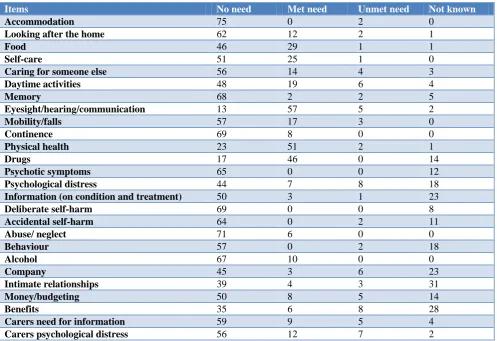
Table 2: Needs assessment as rated by the caregiver.
Items No need Met need Unmet need Not known
Accommodation 75 0 2 0
Looking after the home 62 12 2 1
Food 46 29 1 1
Self-care 51 25 1 0
Caring for someone else 56 14 4 3
Daytime activities 48 19 6 4
Memory 68 2 2 5
Eyesight/hearing/communication 13 57 5 2
Mobility/falls 57 17 3 0
Continence 69 8 0 0
Physical health 23 51 2 1
Drugs 17 46 0 14
Psychotic symptoms 65 0 0 12
Psychological distress 44 7 8 18
Information (on condition and treatment) 50 3 1 23
Deliberate self-harm 69 0 0 8
Accidental self-harm 64 0 2 11
Abuse/ neglect 71 6 0 0
Behaviour 57 0 2 18
Alcohol 67 10 0 0
Company 45 3 6 23
Intimate relationships 39 4 3 31
Money/budgeting 50 8 5 14
Benefits 35 6 8 28
Carers need for information 59 9 5 4
Carers psychological distress 56 12 7 2
Of the 81 elderly with functional disability, 4 (4.9%) of them had no caregivers. Among them, 3 (3.7%) were living alone and 1 (1.2%) did not elicit any caregiver for them. It was observed that 74% of the caregivers felt that
no need of the subjects related to accommodation, abuse/ neglect (92.2%), continence (89.6%), memory (88.3%),
alcohol (87%) and 64.9% of the caregivers perceived that the subjects had no need related to money/budgeting.
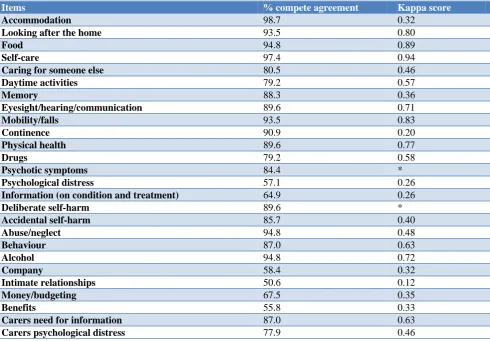
Table 3: Inter rater agreement between study subjects and their caregivers.
Items % compete agreement Kappa score
Accommodation 98.7 0.32
Looking after the home 93.5 0.80
Food 94.8 0.89
Self-care 97.4 0.94
Caring for someone else 80.5 0.46
Daytime activities 79.2 0.57
Memory 88.3 0.36
Eyesight/hearing/communication 89.6 0.71
Mobility/falls 93.5 0.83
Continence 90.9 0.20
Physical health 89.6 0.77
Drugs 79.2 0.58
Psychotic symptoms 84.4 *
Psychological distress 57.1 0.26
Information (on condition and treatment) 64.9 0.26
Deliberate self-harm 89.6 *
Accidental self-harm 85.7 0.40
Abuse/neglect 94.8 0.48
Behaviour 87.0 0.63
Alcohol 94.8 0.72
Company 58.4 0.32
Intimate relationships 50.6 0.12
Money/budgeting 67.5 0.35
Benefits 55.8 0.33
Carers need for information 87.0 0.63
Carers psychological distress 77.9 0.46
*: Kappa score could not be calculated as one or both the variables were constant.
It was observed that there was varied range of agreement on most of the items, highest agreement noted for accommodation (98.7%) and lowest for intimate relationships (50.6%). For none of the items agreement was 100% (complete agreement) while items like psychological distress, information (on condition and
treatment), company, intimate relationships,
money/budgeting, benefits had low agreement.
DISCUSSION
Reynolds et al developed the Camberwell Assessment of Need for the Elderly (CANE) based on the structural model of the Camberwell Assessment of Need (CAN). 9
The CANE questionnaire used in primary health care has shown to be a useful screening tool in terms of detecting health care needs.
It was observed in our study that among the elderly with functional disabilities, maximum unmet needs were related to benefits and majority of them were receiving help with eyesight/hearing (Table 1). Of the total 512 needs identified, 389 (75.9%) were met needs and 123
(24.1%) were unmet needs. A cross sectional study done by Zisis in Johannesburg using the CANE assessment found that of the total 264 needs, 253 (95.83%) were met needs and 11 (4.17%) were unmet needs.11
Prabhaker et al found that living with children and spouse or living with a partner was advantageous for older adults in receiving care for their ADL limitations and during hospitalization.12 Beach et al in their study done in United States found that of the care recipients, 44.3% reported at least one unmet need for care in the past month (38.2% ADL related).13
study done for the health care needs assessment in elderly with psychiatric disorders.14
CONCLUSION
To face the challenges of ageing population, the country needs to be well prepared. Appropriate social and economic policies need to be made to mitigate its ill effects which should also address their health care needs.
Recommendations
Comprehensive geriatric care should be incorporated into all levels of health care and particularly in primary health care. Elderly living without families or under difficult conditions should be identified in the community and proper care should be provided to them with the help of health workers. Elderly needing supportive items like walking sticks or calipers, walker (ordinary), spectacles, hearing aids etc., should be identified and should be provided with them starting from the sub centre level only.Although many non-government organizations like Help Age India, Agewell Foundation etc., are working but more NGO’s should be encouraged to serve in the field of elderly care.
Funding: No funding sources Conflict of interest: None declared
Ethical approval: The study was approved by the Institutional Ethics Committee
REFERENCES
1. Elderly in India-profiles and programmes, 2018. Available at http://mospi.nic.in/sites/default/files/ publication_reports/ElderlyinIndia_2016.pdf. Accessed on 18 August 2018.
2. International Classification of Impairments,
Disabilities and Handicaps-manual of classifications relating to the consequences of disease: WHO, Geneva; 1980.
3. Gupta P, Mani K, Rai SK, Nongkynrih B, Gupta SK. Functional disability among elderly persons in a rural area of Haryana. Indian J Public Health. 2014;58(1):11-6.
4. The disabled elderly and their use of long-term care, 2018. Available at: http://www.aspe.hhs.gov/daltcp/ reports/diseldes.htm#chap1. Accessed on 20 August 2018.
5. Venkatarao T, Ezhil R, Jabbar S, Ramkrishnam R. Prevalence of disability and handicaps in geriatric population in rural south India. Indian J Public Health. 2005;49(1):11-7.
6. Collin C, Wade DT, Davies S, Horne V. The
Barthel ADL Index: a reliability study. Int Disabil Stud. 1988;10(2):61-3.
7. Wade DT, Collin C. The Barthel ADL Index: a standard measure of physical disability? Int Disabil Stud. 1988;10(2):64-7.
8. Definition of visual impairment, 2018. Available at: http://www.bpaindia.org/VIB%20Chapter-I.pdf. Accessed on 20 August 2018.
9. Reynolds T, Thornicroft G, Abas M, Woods B, Hoe
J, Leese M, Orrell M. Camberwell Assessment of Need for the Elderly (CANE). Br J Psychiatr. 2000;176(5):444-52.
10. Walters K, Iliffe S, Tai SS, Orrell M. Assessing needs from patient, carer and professional perspectives: the Camberwell Assessment of Need for Elderly people in primary care. Age Ageing. 2000;29(6):505-10.
11. Zisis D. An assessment of the health care needs of people aged 65 years and older in homes for the aged in Johannesburg (Doctoral dissertation). Johannesburg; 2013.
12. Ugargol AP, Hutter I, James KS, Bailey A. Care Needs and Caregivers: Associations and Effects of Living Arrangements on Caregiving to Older Adults in India. Aging Int. 2016;41(2):193-213.
13. Beach SR, Schulz R. Family caregiver factors associated with unmet needs for care of older adults. J Am Geriatr Soc. 2017;65(3):560-6.
14. Mandal A. A clinicosocial study of psychiatric disorders and related health care needs of the elderly in Delhi [MD thesis]. New Delhi, India: University of Delhi; 2002.
15. Woo J, Ho SC, Yuen YK, Yu LM, Lau J. An estimation of the functional disability burden in elderly Chinese age 70 years and over. Disabil Rehabil. 1996;18(12):609-12.
16. National programme for health care of the elderly, 2009. Available at: http://www.mohfw.nic.in/show file.php?lid=1403. Accessed on 10 April 2017.
17. Singh N, Kumar S, Muzammil K, Raghav SK,
Singh JV. Assessment of functional status in the elderly persons in the rural area of Punjab. Indian J Community Health. 2014;26(1):25-9.
18. Goel PK, Garg SK, Singh JV, Bhatnagar M, Chopra
H, Bajpai SK. Unmet needs of the elderly in a rural population of Meerut. Indian J Community Med. 2003;28(4):165-6.
19. Gebreyohannis B, Kharel K. Needs assessment on assisted living facilities among elderly population. Kokkola: Centria University of Applied Sciences; 2012.
20. Beach SR, Schulz R. Family caregiver factors associated with unmet needs for care of older adults. J Am Geriatr Soc. 2017;65(3):560-6.
21. Park K. Park’s Textbook of Preventive and Social Medicine. 23rd edition. Jabalpur, India: M/s Banarasidas Bhanot Publishers; 2015.