Current Trends of High capacity Optical
Interconnection Data Link in High
Performance Optical Communication
Systems
Dr. Ahmed Nabih Zaki RashedElectronics and Electrical Communications Engineering Department Faculty of Electronic Engineering, Menouf 32951, Menoufia University, EGYPT
E-mail: [email protected]
---ABSTRACT---
Optical technologies are ubiquitous in telecommunications networks and systems, providing multiple wavelength channels of transport at 2.5 Gbit/sec to 40 Gbit/sec data rates over single fiber optic cables. Market pressures continue to drive the number of wavelength channels per fiber and the data rate per channel. This trend will continue for many years to come as electronic commerce grows and enterprises demand higher and reliable bandwidth over long distances. Electronic commerce, in turn, is driving the growth curves for single processor and multiprocessor performance in data base transaction and Web based servers. Ironically, the insatiable taste for enterprise network bandwidth, which has driven up the volume and pushed down the price of optical components for telecommunications is simultaneously stressing computer system bandwidth increasing the need for new interconnection schemes and providing for the first time commercial opportunities for optical components in computer systems. The evolution of integrated circuit technology is causing system designs to move towards communication based architectures. We have presented the current tends of high performance system capacity of optical interconnection data transmission link in high performance optical communication and computing systems over wide range of the affecting parameters.
Keywords: Optical fiber link, High speed optical interconnection, Integrated optics, Optical source, Optical detector. ---
Date of Submission : May 12, 2012 Date of Acceptance: September 10, 2012
---
I. Introduction
O
ptical interconnections on silicon have been extensively investigated in recent years as interconnections become the bottleneck for the next-generation computing systems [1]. The goal of these investigations is to provide a compact, low power consumption, high bandwidth and low-latency optical interconnection system with full CMOS compatibility. Silicon based optical components such as low-loss silicon-on-insulator (SOI) optical waveguides [2], high speed silicon modulators, and Germanium on SOI detectors enabling large-scale optical integration on a silicon chip. While most attention is focused on single channel systems at this stage, wavelength division multiplexing (WDM) technology is necessary to fully utilize the ultra wide bandwidth of the optical interconnection medium, given that the transmission bandwidths of both silicon waveguides and optical fibers are on the order of 10 to 100 THz. As the key components of such a system, we show high speed and multi-channel modulation using cascaded silicon micro ring modulators [3].Optical transparency is widely recognized to play a central role in next-generation optical networks and to offer significant networking advancements in terms of performance and cost [4]. The scalability of optical
technology and the elimination of expensive optical-electrical-optical (OEO) equipment is expected to significantly reduce the capital costs, whereas operational cost savings are expected to result from reduced power requirements and the flexibility of transparent service provisioning. The first steps toward this goal were point-to-point links routed via optical add–drop multiplexers (OADMs) at intermediate nodes, and increasingly the trend is toward so-called islands of transparency, with the eventual aim of fully meshed transparent optical networks with reconfigurable optical cross connects (OXCs) [5]. For the wavelength division multiplexing interconnection systems, in addition to the low power consumption and small size, ring modulators have another advantage: they modulate only light at particular wavelengths (the resonant wavelengths of the ring resonators) and allow light at all other wavelengths to pass through the modulators without been affected. Therefore, one can cascade several ring modulators with different resonant wavelengths on a single waveguide, and modulate different wavelengths of light independently [6].
II. Simplified Architecture for WDM Optical
Interconnection System
Fig. 1. WDM Optical interconnection system. As shown in Fig. 1 presents a simple architecture for
a WDM interconnection system. A similar structure has been proposed for polymer modulators [7]. Light from a WDM source or a broadband source is sent into a silicon waveguide coupled to multiple ring modulators with different resonant wavelengths. If the input is a wavelength division multiplexing source, the resonant wavelength of each modulator needs to match the wavelength of each channel of the wavelength division multiplexing source. At the receiver side, these channels can be demultiplexed using similar ring resonators with drop ports, and detected separately. If the input is a broadband source, it only requires that the resonant wavelengths of the ring modulators match one-to-one with those of the ring demultiplexers [8, 9].
III. Theoretical Model Analysis
In order to quantify the requirements for drive current for satisfactory laser modulation performance, the optical pulse data stream is fed into a thermal noise dominated simple photodiode receiver (50 Ω load) through 6 dB of optical loss (a typical number in short transmission distance optical interconnect). The received photocurrent after equalization at the receiver has the simple form [10].
( )
,2
cos2
= I Bt
t
h ηlink m π (1)
Where Im is the drive current to the laser, B is the transmission bit rate, the link efficiency (ηlink) includes the laser differential quantum efficiency (0.3 Watt/A), the link loss (6 dB), and the detector responsivity (0.5 A/Watt). The required drive current to maintain a BER of 10-9 as a function of the laser threshold current. The bit error rate at the receiver can be:
( )
( )
( )
− += ∫0
0 2
2 25
.
0 t on on
on dt
D t h erfc t p D erfc BER σ
σ (2)
Where D is the decision level, σ is the variance of the thermal noise, and erfc(x) is the complementary error function. For each data point the decision level (D) is numerically chosen to minimize the corresponding BER. Where the distribution function of turn on time of the laser (ton) can be expressed as:
( )
1 ,0 η η − − = t t t t p on on
on (3)
This required drive current is used to calculate the average electrical power consumption for the laser given by:
(
)
, 5.
0 I V0 I Z0
PE= m + m
(4) The initial carrier number in the laser n depends on the number of “0” bits which precede the “1” bit. At the end of a bit, the carrier number decays exponentially with time constant τ such that:
, exp − = τ T N n
ni th (5)
Where N is the number of “0” bits preceding the considered transmission bit, nth is the threshold carrier number, τ is the carrier life time and T = 1/B. The threshold current and turn on time of the laser can be expressed by [11]:
,
τ
e n
Ith= th (6)
, exp
1
0 − −
=t τNT
ton (7)
Where e is the electronic charge,t0=τIth/Im, and the
coupling efficiency from optical source to the optical link is:
( )
2 ,ln τ
ηlink = B (8)
III. 1. Materials based connector
A connector is used to join a fiber cable to a transmitter or receiver, or is used to join together strands of fiber link. A connector for fiber is similar in concept to a traditional electrical connector, but the fiber connector is actually more delicate, as it must precisely align the internal fibers to insure a proper flow of data through the cables. For single mode fibers (SMF), the Fresnel reflection loss caused by the differences between the refractive indeces of the silica doped and plastic fibers and the material separation are given as the following [13]:
(
4)
,log 20 2 + = clad clad C n n n n
L dB/cm (9)
as a function of both silica-doped and plastic core refractive indices and relative refractive-index difference as the following:
(
n)
nnclad = 1−∆ (10)
Then by substituting from Eq. (10) into Eqs. (9), we can obtain:
(
)
(
)
, 2 1 4 log 20 2 2 ⋅ ∆ − ∆ − = n n n n nLC dB/cm (11)
The relative refractive-index difference ∆n for both silica-doped and plastic materials are given by:
,
n n n n= − clad
∆ (12)
The refractive-index of silica-doped material waveguide based on Sellemier equation is given by [14]:
2 6 2 2 5 2 4 2 2 3 2 2 2 2 1 2 1 A A A A A A n − + − + − + = λ λ λ λ λ
λ (13)
The Sellmeier coefficients of the refractive index of this waveguide is cast as [14]:
A1= 0.691663+0.1107001* x, A2= (0.0684043+0.000568306 * x)2 * (T/T
0)2, A3= 0.4079426+0.31021588 * x,
A4= (0.1162414+0.03772465 * x)2 * (T/T0)2, A5= 0.8974749-0.043311091 * x, and A6= (9.896161+1.94577 * x)2.
Where T is the ambient temperature in ºC, T0 is considered to be as 25 ºC (room temperature), and x is the ratio of germania dopant added to silica material to improve its optical performance characteristics within the range of 0.0 ≤ x ≤ 0.3 [14]. Also the plastic cable core material which the investigation of the spectral variations of the waveguide refractive-index (n) require Sellemeier equation under the form [15]:
2 6 2 2 5 2 4 2 2 3 2 2 2 2 1 2 1 B B B B B B n − + − + − + = λ λ λ λ λ
λ (14)
For the plastic material, the coefficients of the Sellmeier equation and refractive-index variation with ambient temperature are as: B1= 0.4963, B2= 0.6965 (T/T0), B3= 0.3223, B4= 0.718 (T/T0), B5= 0.1174, and B6= 9.237 (T/T0).
III. 2. Materials based optical waveguide
Special emphasis is given to the transmission characteristics of silica-doped and plastic fibers as promise links in long and short distance optical communications. Silica-doped and plastic waveguide characteristics (spectral loss and chromatic dispersion) are thermal dependent, thus, these two variables must be taken into account when studying the transmission bit rate capacity of the waveguides over wide range of the operating parameters.
III. 2. 1. Silica-doped material based waveguide
Based on the models of [14], the spectral losses of silica-doped waveguides are cast as:
,
IR UV S
I α α α
α
α= + + + dB/cm (15)
Where αI ≡theintrinsicloss≅3x10⁻⁸, dB/cm, and (16)
, 10 66 75 . 0 0 5 4 + ∆ = ≡ − T T x n scattering Rayleigh S λ
α dB/cm (17)
Where the scattering loss is linearity is related to the ambient temperature Τ, T0 is a reference temperature or room temperature and is taken as value of 25 °C, ∆n and λ are the relative refractive index difference and operating optical signal wavelength respectively. The absorption losses αUV and αIR are given as [14]:
, 10
1 .
1 9ω 00 4.9λ
αUV = × − ge e dB/cm (18)
, 10 7 2 24 10 × = − − λ
αIR e dB/cm (19)
Where ωge % is the weight percentage of germania, GeO2 added to optical silica fibers to improve its optical transmission characteristics. The percentage of germania ωge % and the mole fraction x are cast under the form:
4 3
2 0
0 213.27x 594x 2400x 4695x
ge = − + −
ω (20)
The first and second differentiation of Eq. (13) with respect to operating signal wavelength λ which yields:
(
) (
) (
)
, . 2 2 6 2 2 6 5 2 2 4 2 2 4 3 2 2 2 2 2 2 1 − + − + − − = A A A A A A A A A n d dn λ λ λ λλ (21)
(
)
( )
3( )
(
3)
( )
(
3)
,. 1 2 3 2 6 2 2 6 2 2 6 5 3 2 4 2 2 4 2 2 4 3 3 2 2 2 2 2 2 2 2 1 2 2 − − + + − + + − + − = λ λ λ λ λ λ λ λ d dn A A A A A A A A A A A A n d n d (22)
III. 2. 2. Plastic material based waveguide
Plastics, as all any organic materials, absorb light in the ultraviolet spectrum region. The mechanism for the absorption depends on the electronic transitions between energy levels in molecular bonds of the material. Generally the electronic transition absorption peaks appear at wavelengths in the ultraviolet region, and their absorption tails have an influence on the plastic optical fiber (POF) transmission loss [15]. According to urbach’s rule, the attenuation coefficient αe due to electronic transitions in POF is given by the following expression [15]:
(
)
1.10 1010exp 8 , × = − λ
αe plastic dB/cm (23)
(
)
1310 0.633 , 4 5 = − λαR plastic x dB/cm (24)
Then the total losses of plastic optical fibers is given by: α
(
plastic)
=αe(
plastic)
+αR(
plastic)
dB/cm (25) The first and second differentiation of Eq. (14) with respect to operating wavelength λ which yields:(
) (
) (
)
, . 2 2 6 2 2 6 5 2 2 4 2 2 4 3 2 2 2 2 2 2 1 − + − + − − = B B B B B B B B B n d dn λ λ λ λλ (26)
(
)
(
3)
(
(
3)
)
(
(
3)
)
,. 1 2 3 2 6 2 2 6 2 2 6 5 3 2 4 2 2 4 2 2 4 3 3 2 2 2 2 2 2 2 2 1 2 2 − − + + − + + − + − = λ λ λ λ λ λ λ λ d dn B B B B B B B B B B B B n d n d (27)
III. 3. Classical transmission bit rate
The total pulse broadening due to material and waveguide dispersion in single mode fibers is given by:
w
t L
D. . .
105 λ
τ= ∆
∆ − nsec/nm.cm (28)
Therefore, the total chromatic dispersion in standard single mode fiber that limits the transmission bit rates in system based optical communication can be calculated as follows [16]:
(
md wd)
,t M M
D =− + (29)
Where Mmd is the material dispersion coefficient in nsec/nm.cm, Mwd is the waveguide dispersion coefficient in nsec/nm.cm, ∆λ is the spectral line width of the used optical source in nm, and Lw is the waveguide length in cm. The material dispersion coefficient is given as the following equation: , 2 2 2 2 2 ∆ − − = λ λ λ λ d n d c d n d c
Mmd (30)
The waveguide dispersion coefficient is given by the following expression:
( )
V ,F c n n M s clad wd ∆ − = λ (31) Where nclad is the refractive-index of the cladding material, ∆n is the relative refractive-index difference, λ
is the operating optical signal wavelength in µm, and F (V) is a function of V number or normalized frequency. Based on the work [16], they designed the function F (V) is a function of V as the following expression:
( )
V 1.38V 6.98V2 13.45V3 4.84V4 1.48V5,F = − + − − (32)
When they are employing V-number in the range of (0 ≤
V ≤ 1.15) yields the above expression. We are taking into account V-number as unity to emphasis single mode operation. Then the classical transmission bit rate as a function of waveguide length, total losses (α), and total pulse broadening (∆τ) due to total chromatic dispersion is given by [16]:
(
)
, . 5 000 5 w w L L e rate bit on Transmissi B τ α ∆ += − Gbit/sec
(33)
Then the transmission bit rate length product can be expressed as the following expression:
, . w
W BL
P = Gbit.cm/sec (34)
III. 4. Shannon transmission capacity
The signal to noise ratio (SNR) is a measure of signal quality at the receiver side, it is given by [16]:
(
)
(
)
,. 2 .
4 . 0 . 0
0 2 0 P I G W B Z e W B T k Z P G SNR D n sig sig ρ ρ + +
= (35)
, log 10 )
(SNRdB= SNR (36)
Where P0 is the received or output optical power, ρ is the detector’s unamplified responsivity, G is the detector gain if an avalanche photodiode (APD) is used, n accounts for the excess noise of the avalanche photodiode (usually between the value of 2 and 3), B.Wsig. is the signal bandwidth at the receiver, k is Boltzmann’s constant (k = 1.38 x 10⁻²³ J/K), e is the magnitude of the charge on an electron (1.6 x 10⁻¹⁹ coulomb), T is the ambient temperature in ºC, ID is the detector’s dark current, and Z0 is the resistance of the load resistor that follows the photodetector. The signal bandwidth and maximum transmission bit rate or capacity according to modified Shannon technique is given by [17]:
, . 44 . 0 . . w sig L W B τ ∆
= GHz (37)
BR( )SH =B.Wsig.log2
(
1+SNR)
,Gbit/sec (38)Where B.Wsig. is the actual bandwidth of the optical signal and SNR is the signal to noise ratio in absolute value (i. e., not in dB). Where the Shannon bandwidth-length product within waveguide can be given by [18, 19]:
( )SH . w ,
R
SH B L
P = Gbit.cm/sec (39)
Where Lw is the waveguide length, and BR(SH) is the Shannon transmission bit rate.
IV. Simulation Results and Discussions
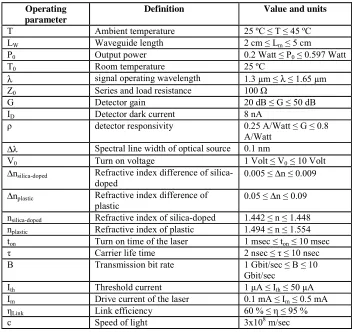
Table 1: Proposed operating parameters for optical interconnection model.
Operating parameter
Definition Value and units
T Ambient temperature 25 ºC≤ T ≤ 45 ºC LW Waveguide length 2 cm ≤ Lm≤ 5 cm
P0 Output power 0.2 Watt ≤ P0≤ 0.597 Watt
T0 Room temperature 25 ºC
λ signal operating wavelength 1.3 µm ≤λ≤ 1.65 µm Z0 Series and load resistance 100 Ω
G Detector gain 20 dB ≤ G ≤ 50 dB
ID Detector dark current 8 nA
ρ detector responsivity 0.25 A/Watt ≤ G ≤ 0.8 A/Watt
∆λ Spectral line width of optical source 0.1 nm
V0 Turn on voltage 1 Volt ≤ V0≤ 10 Volt ∆nsilica-doped Refractive index difference of
silica-doped 0.005 ≤∆n ≤ 0.009
∆nplastic Refractive index difference of
plastic 0.05 ≤∆n ≤ 0.09 nsilica-doped Refractive index of silica-doped 1.442≤ n ≤ 1.448 nplastic Refractive index of plastic 1.494 ≤ n ≤ 1.554 ton Turn on time of the laser 1 msec ≤ ton≤ 10 msec
τ Carrier life time 2 nsec ≤τ≤ 10 nsec
B Transmission bit rate 1 Gbit/sec ≤ B ≤ 10 Gbit/sec
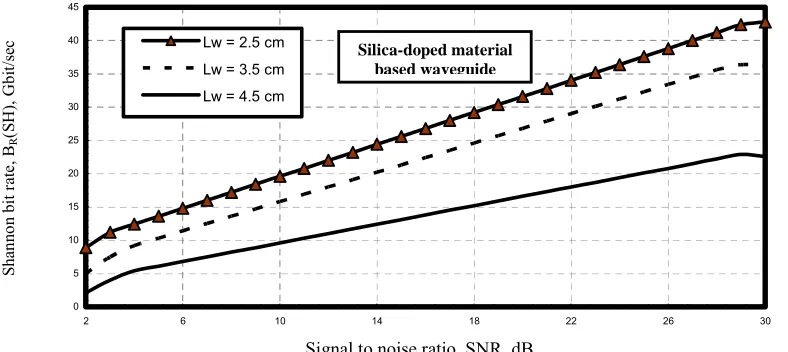
Ith Threshold current 1 µA ≤ Ith≤ 50 µA Im Drive current of the laser 0.1 mA ≤ Im≤ 0.5 mA ηLink Link efficiency 60 % ≤η≤ 95 %
c Speed of light 3x10⁸m/sec
The following facts are assured as shown in the series of Figs. (2-27):
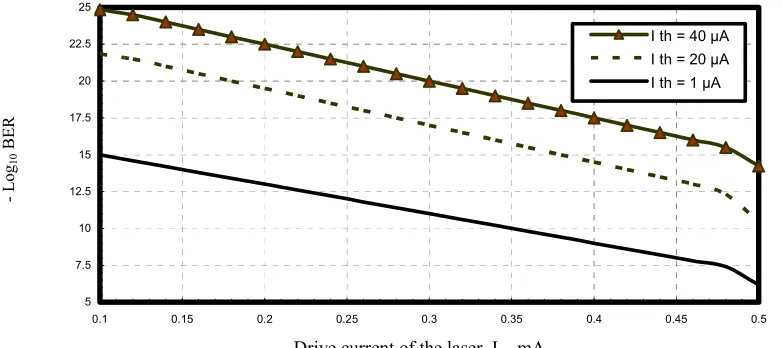
i) Fig. 2. has assured that as that as drive current of the laser increases, the bit error rate decreases at constant threshold current. Moreover as threshold current increases, the bit error rate also increases at constant drive current of the laser.
ii) As shown in Figs. (3, 4) have demonstrated that as both drive current and turn on voltage of the laser increases, the electrical power also increases. As well as transmission bit rate increases, the electrical power also increases. iii) Figs. (5, 6) have proved that carrier life time in the laser diode increases, both turn on time of the laser and
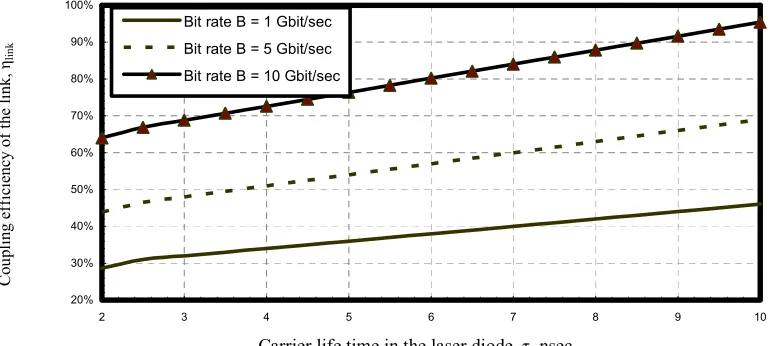
coupling efficiency also increases at constant transmission bit rate. With increasing transmission bit rates, the turn on time of the laser and coupling efficiency to the waveguide must be increased.
iv) Fig. 7 has indicated that as carrier life time in the laser diode increases, the threshold current decreases at constant drive current to the laser. But as drive current to the laser increases, the threshold current must be increased.
v) Fig. 8 has demonstrated that as both coupling efficiency of the laser to the optical link, and turn on time of the laser increases, the transmission bit rates also increase.
5 7.5 10 12.5 15 17.5 20 22.5 25
0.1 0.15 0.2 0.25 0.3 0.35 0.4 0.45 0.5
I th = 40 µА
I th = 20 µА
I th = 1 µА
Drive current of the laser, Im, mA
Fig. 2. Variations of bit error rate (BER) against drive current of the laser at the assumed set of parameters.
0 0.5 1 1.5 2 2.5
0.1 0.15 0.2 0.25 0.3 0.35 0.4 0.45 0.5
Bit rate B = 1 Gbit/sec Bit rate B = 5 Gbit/sec Bit rate B = 10 Gbit/sec
Drive current to the laser, Im, mA
Fig. 3. Variations of electrical power against drive current of the laser at the assumed set of parameters.
0 0.5 1 1.5 2 2.5
1 2 3 4 5 6 7 8 9 10
I m = 0.1 mA I m = 0.3 mA I m = 0.5 mA
Turn on voltage of the laser, V0, Volt
Fig. 4. Variations of electrical power against turn on voltage of the laser at the assumed set of parameters.
- L
og10
BER
E
lect
ri
cal
pow
er
, PE
, mWa
tt
El
ect
ri
cal
pow
er
, P
E
, m
W
0 0.5 1 1.5 2 2.5 3
2 3 4 5 6 7 8 9 10
Bit rate B = 1 Gbit/sec Bit rate B = 5 Gbit/sec Bit rate B = 10 Gbit/sec
Carrier life time in the laser diode, τ, nsec
Fig. 5. Variations of turn on time of the laser against carrier life time in the laser at the assumed set of parameters.
20% 30% 40% 50% 60% 70% 80% 90% 100%
2 3 4 5 6 7 8 9 10
Bit rate B = 1 Gbit/sec Bit rate B = 5 Gbit/sec Bit rate B = 10 Gbit/sec
Carrier life time in the laser diode, τ, nsec
Fig. 6. Variations of turn on time of the laser against carrier life time in the laser at the assumed set of parameters.
5 10 15 20 25 30 35 40
2 3 4 5 6 7 8 9 10
I m = 0.1 mА
I m = 0.3 mА
I m = 0.5 mА
Carrier life time in the laser diode, τ, nsec
Fig. 7. Variations of threshold current to the laser against carrier life time in the laser at the assumed set of parameters.
T
ur
n
on
ti
m
e o
f
th
e la
se
r,
ton
, m
se
c
Cou
pl
in
g ef
fi
ci
ency
of
th
e li
nk,
ηlin
k
T
hr
es
ho
ld
cu
rr
en
t to
th
e l
ase
r,
Ith
,
µ
0 1.5 3 4.5 6 7.5 9 10.5 12 13.5 15
1 2 3 4 5 6 7 8 9 10
ηlink = 60 %
ηlink = 75 %
ηlink = 90 %
Turn on time of the laser, ton, msec
Fig. 8. Variations of transmission bit rate against turn on time of the laser at the assumed set of parameters.
0 2.5 5 7.5 10 12.5 15 17.5 20
1.442 1.443 1.444 1.445 1.446 1.447 1.448
∆n = 0.005
∆n = 0.007
∆n = 0.009
Refractive index of silica-doped material, n
Fig. 9. Variations of coupling loss against refractive index of silica-doped material at the assumed set of parameters.
0 10 20 30 40 50 60 70 80 90
1.494 1.504 1.514 1.524 1.534 1.544 1.554
∆n = 0.05
∆n = 0.07
∆n = 0.09
Refractive index of plastic material, n
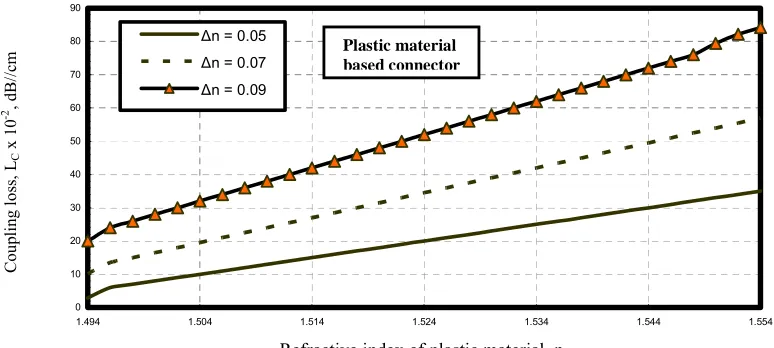
Fig. 10. Variations of coupling loss against refractive index of plastic material at the assumed set of parameters.
T
ra
ns
m
is
si
on
b
it
r
at
e, B
, Gb
it/s
ec
C
oup
li
ng
lo
ss
, L
C
x 1
0
-4 , d
B
//
cm
C
oup
lin
g los
s,
LC
x 10
-2 , d
B
//c
m
Silica-doped material based connector
0 1 2 3 4 5 6 7
25 27 29 31 33 35 37 39 41 43 45
∆n = 0.005
∆n = 0.007
∆n = 0.009
Ambient temperature, T, ºC
Fig. 11. Variations of total losses against ambient temperature of silica-doped material at the assumed set of parameters.
0 5 10 15 20 25 30 35 40
1.3 1.35 1.4 1.45 1.5 1.55 1.6 1.65
x = 0.1 x = 0.2 x = 0.3
Operating signal wavelength, λ, µm
Fig. 12. Variations of total losses against operating wavelength of silica-doped material at the assumed set of parameters.
30 31.5 33 34.5 36 37.5 39 40.5 42 43.5 45
1.3 1.35 1.4 1.45 1.5 1.55 1.6 1.65
Plastic material based waveguide
Operating signal wavelength, λ, µm
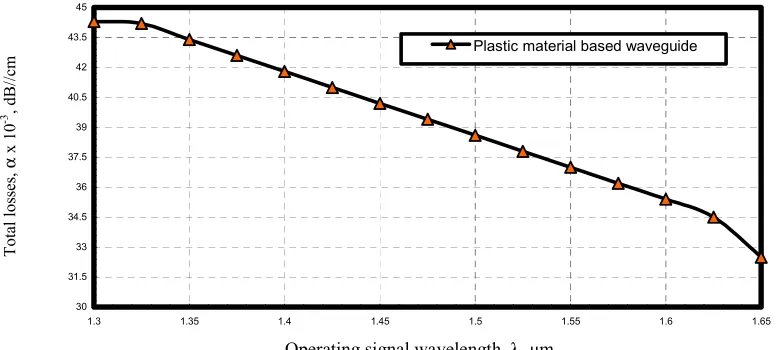
Fig. 13. Variations of total losses against operating wavelength of plastic material at the assumed set of parameters.
T
ota
l lo
ss
es,
α
x 10
-5, d
B
//c
m
T
otal
lo
sses,
α
x 10
-5, d
B
//c
m
Silica-doped material based waveguide
Silica-doped material based waveguide
T
otal
lo
sses,
α
x 10
-3, d
B
//c
4 5 6 7 8 9 10 11 12 13
2 2.5 3 3.5 4 4.5 5
∆n = 0.005
∆n = 0.007
∆n = 0.009
Waveguide length, Lw, cm
Fig. 14. Variations of classical transmission bit rate versus waveguide length at the assumed set of parameters.
0.2 0.3 0.4 0.5 0.6 0.7 0.8 0.9
2 2.5 3 3.5 4 4.5 5
∆n = 0.05
∆n = 0.07
∆n = 0.09
Waveguide length, Lw, cm
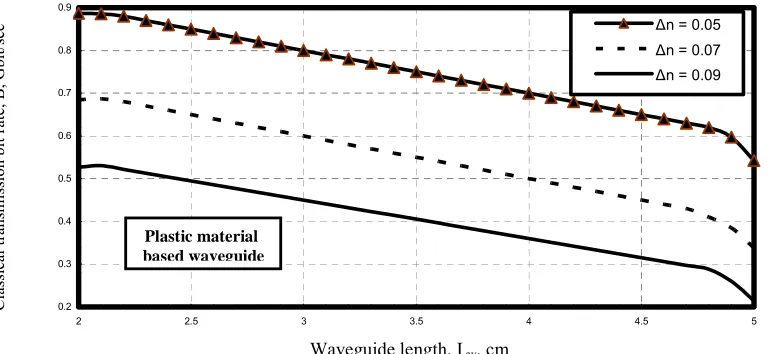
Fig. 15. Variations of classical transmission bit rate versus waveguide length at the assumed set of parameters.
0 2 4 6 8 10 12 14 16 18
2 2.5 3 3.5 4 4.5 5
T = 25 ºC T = 35 ºC T = 45 ºC
Waveguide length, Lw, cm
Fig. 16. Variations of bit rate length product versus waveguide length at the assumed set of parameters.
Cl
ass
ical
tr
ansm
issi
on
bi
t r
at
e, B,
G
bit
/s
ec
Cl
ass
ical
tr
ansm
issi
on
bi
t r
at
e, B,
G
bit
/s
ec
Bi
t r
at
e-lengt
h pr
oduct,
PW
, G
bit.
cm
/s
ec
Silica-doped material based waveguide
Silica-doped material based waveguide Plastic material
0 2 4 6 8 10 12 14 16 18 20
2 2.5 3 3.5 4 4.5 5
x = 0.1 x = 0.2 x = 0.3
Waveguide length, Lw, cm
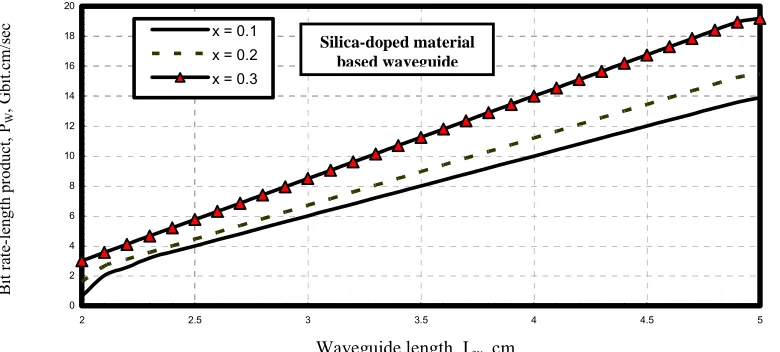
Fig. 17. Variations of bit rate length product versus waveguide length at the assumed set of parameters.
0 0.2 0.4 0.6 0.8 1 1.2
2 2.5 3 3.5 4 4.5 5
T = 25 ºC T = 35 ºC T = 45 ºC
Waveguide length, Lw, cm
Fig. 18. Variations of bit rate length product versus waveguide length at the assumed set of parameters.
0 4 8 12 16 20
0.005 0.0055 0.006 0.0065 0.007 0.0075 0.008 0.0085 0.009
λ = 1.35 µm
λ = 1.45 µm
λ = 1.55 µm
Relative refractive index difference, ∆n
Fig. 19. Variations of classical transmission versus relative refractive index difference at the assumed set of parameters.
Bi
t r
at
e-lengt
h pr
oduct,
PW
, G
bit.
cm
/s
ec
Bi
t r
at
e-lengt
h pr
oduct,
PW
, G
bit.
cm
/s
ec
C
la
ss
ic
al
tr
an
sm
is
si
on
b
it ra
te
, B
, G
bit/
se
c
Silica-doped material based waveguide
Silica-doped material based waveguide Plastic material
0 0.1 0.2 0.3 0.4 0.5 0.6 0.7 0.8
0.05 0.055 0.06 0.065 0.07 0.075 0.08 0.085 0.09
λ = 1.35 µm
λ = 1.45 µm
λ = 1.55 µm
Relative refractive index difference, ∆n
Fig. 20. Variations of classical transmission versus relative refractive index difference at the assumed set of parameters.
2 3 4 5 6 7 8 9 10 11 12
0.005 0.0055 0.006 0.0065 0.007 0.0075 0.008 0.0085 0.009
T = 25 ºC T = 35 ºC T = 45 ºC
Relative refractive index difference, ∆n
Fig. 21. Variations of signal bandwidth versus relative refractive index difference at the assumed set of parameters.
0.2 0.3 0.4 0.5 0.6 0.7 0.8 0.9 1
0.05 0.055 0.06 0.065 0.07 0.075 0.08 0.085 0.09
T = 25 ºC T = 35 ºC T = 45 ºC
Relative refractive index difference, ∆n
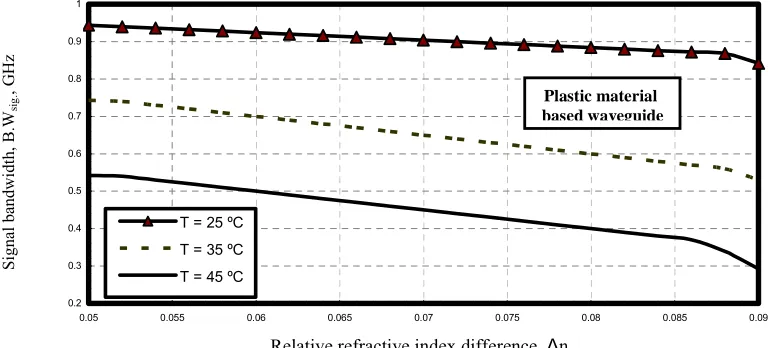
Fig. 22. Variations of signal bandwidth versus relative refractive index difference at the assumed set of parameters.
Cl
ass
ical
tr
ansm
issi
on
bi
t r
at
e, B,
G
bit
/s
ec
Plastic material based waveguide
Si
gn
al ba
ndw
id
th
, B.
Wsi
g.
, GHz
Si
gnal
bandwi
dt
h,
B.
Wsig
.
, G
H
z
Silica-doped material based waveguide
0 5 10 15 20 25 30
0.2 0.23 0.26 0.29 0.32 0.35 0.38 0.41 0.44 0.47 0.5 0.53 0.56 0.59
T = 25 ºC T = 35 ºC T = 45 ºC
Output power, P0, mWatt
Fig. 23. Variations of signal bandwidth versus relative refractive index difference at the assumed set of parameters.
0 5 10 15 20 25 30 35 40 45
2 6 10 14 18 22 26 30
Lw = 2.5 cm Lw = 3.5 cm Lw = 4.5 cm
Signal to noise ratio, SNR, dB
Fig. 24. Variations of Shannon transmission bit rate versus signal to noise ratio at the assumed set of parameters.
0 0.25 0.5 0.75 1 1.25 1.5 1.75 2 2.25 2.5
2 6 10 14 18 22 26 30
Lw = 2.5 cm Lw = 3.5 cm Lw = 4.5 cm
Signal to noise ratio, SNR, dB
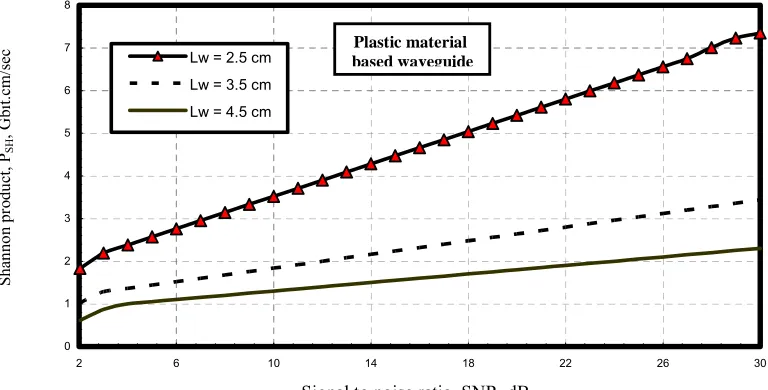
Fig. 25. Variations of Shannon transmission bit rate versus signal to noise ratio at the assumed set of parameters.
Si
gn
al
to
no
is
e
ra
ti
o,
S
N
R
, d
B
Silica-doped and plastic materials based waveguide
Shan
no
n bi
t r
ate
, B
R
(S
H)
, Gbi
t/s
ec
Sh
an
no
n b
it ra
te
, B
R
(S
H), G
bit/
se
c
Silica-doped material based waveguide
0 10 20 30 40 50 60 70
2 6 10 14 18 22 26 30
Lw = 2.5 cm Lw = 3.5 cm Lw = 4.5 cm
Signal to noise ratio, SNR, dB
Fig. 26. Variations of Shannon transmission bit rate versus signal to noise ratio at the assumed set of parameters.
0 1 2 3 4 5 6 7 8
2 6 10 14 18 22 26 30
Lw = 2.5 cm Lw = 3.5 cm Lw = 4.5 cm
Signal to noise ratio, SNR, dB
Fig. 27. Variations of Shannon transmission bit rate versus signal to noise ratio at the assumed set of parameters.
vii) As shown in Figs. (11, 12) have proved that as ambient temperature percentage amount of germanium and relative refractive index difference increase, the total losses of silica-doped material based waveguide also increase. But as operating signal wavelength increase, the total loss of silica-doped material based waveguide decreases. viii) Fig. (13) has assured that as operating signal
wavelength increase, the total loss of plastic material based waveguide decreases.
ix) Figs. (14, 15) have assured that as both waveguide length and relative refractive index difference decrease, the classical transmission bit rate increases for both silica-doped and plastic materials based waveguide. We observed the increased classical transmission bit rate for silica-doped waveguide than plastic waveguide.
x) Figs. (16-18) have demonstrated that as waveguide length increases and ambient temperature decrease, the transmission bit rate-length product increases for both silica-doped and plastic materials based waveguide. We observed the increased classical bit rate-length product for silica-doped waveguide than plastic waveguide. Moreover as percentage amount of germanium increases, this leads to the increased bit rate length product within silica-doped material based waveguide.
xi) As shown in Figs. (19, 20) have indicated that as relative refractive index difference decreases, and operating signal wavelength increases, the classical transmission bit rate increases for both silica-doped and plastic materials based waveguide. As well as we have observed the
Sh
an
no
n pr
oduct
, PSH
, G
bi
t.c
m
/s
ec
Shan
no
n pr
od
uc
t, P
SH
, Gb
it.c
m
/s
ec
Silica-doped material based waveguide
increased classical transmission bit rate for silica-doped material based waveguide than plastic material based waveguide.
xii) Figs. (21, 22) have assured that as both ambient temperature and relative refractive index difference decrease, the signal bandwidth increases for both silica-doped and plastic materials based waveguide. We observed the increased signal bandwidth for silica-doped material waveguide than plastic material based waveguide.
xiii)As shown in Fig. (23) has indicated that as ambient temperature decreases and output power at the receiver point increase, the signal to noise ratio also increases for both silica-doped and plastic materials based waveguide.
xiv)Figs. (24-27) have assured that as signal to noise ratio increases and waveguide length decreases, the Shannon transmission bit rate increases for both silica-doped and plastic materials based waveguide. Moreover as both signal to noise ratio and waveguide length increase, this leads to increase of Shannon product for both silica-doped and plastic materials based waveguide.
V. Conclusions
In a summary, we can conclude that the increased drive current to the laser, and turn on voltage of the laser, this leads increase of electrical power that limits the bit error rate. Also the increased carrier life time this leads to increase of transmission bit rate and coupling efficiency to the optical link. The decreased of both relative refractive index difference, and refractive index of silica-doped and plastic materials based connector, this leads to decrease coupling losses. The decreased of both ambient temperature, and percentage amount of germanium added to silica, and the increased operating signal wavelength, this leads to decrease of waveguide loss of silica-doped waveguide. As well as increase operating signal wavelength, this leads to decrease of optical loss of plastic material based waveguide. With decreasing of both ambient temperature, and relative refractive index difference and increasing of both signal to noise ratio, and waveguide length of both silica-doped and plastic materials based waveguide this leads to increasing of both classical bit rate-length and Shannon product for both materials based waveguide. It is evident that silica-doped material based both connector and waveguide present lower optical losses, and higher of both classical transmission bit rate, and product and Shannon transmission bit rate and product than plastic material based of both connector and waveguide.
REFERENCES
[1] S. Sygletos, I. Tomkos, and J. Leuthold, “Technological Challenges on the Road Toward Transparent Networking,” J. Opt. Network, Vol. 7, No. 2, pp. 321–350, 2008.
[2] D. Fishman, D. L. Correa, E. H. Goode, T. L. Downs, A. Y. Ho, A. Hale, P. Hofmann, B. Basch, and S.
Gringeri, “The Rollout of Optical Networking: Lambda Xtreme National Network Deployment,” Bell Technology Journal, Vol. 11, No. 3, pp. 55–63, 2006.
[3] S. J. B. Yoo, “Optical Packet and Burst Switching Technologies for the Future Photonic Internet,” J. Lightwave Technol. Vol. 24, No. 1, pp. 4468–4492, 2006.
[4] C. W. Chow, G. Talli, A. D. Ellis, and P. D. Townsend, “Rayleigh Noise Mitigation in DWDM LR-PONs Using Carrier Suppressed Subcarrier Amplitude Modulated Phase Shift Keying,” Opt. Express Vol. 16, No. 4, pp. 1860–1866, 2008.
[5] Y. Ishii, S. Koike, Y. Arai, and Y. Ando, “SMT Compatible Large Tolerance Opto Bump Interface for Inter Chip Optical Interconnections,” IEEE Trans. Adv. Packag., Vol. 26, No. 2, pp. 122–127, May 2003.
[6] Y. Ishii, N. Tanaka, T. Sakamoto, and H. Takahara, “Fully SMT Compatible Optical I/O Package With Microlens Array Interface,” J. Lightw. Technol., Vol. 21, No. 1, pp. 275–280, Jan. 2003.
[7] J. A. Kash, “Internal Optical Interconnects in Next Generation High Performance Servers,” IEEE Fiber Optics Photon., Vol. 3, No. 1, pp. 29–30, Sep. 2005. [8] S. H. Hwang, M. H. Cho, K. Kang, H.-H. Park,
S.-H. Kim, K.-U. Shin, and S.-W. Ha, “Passively Assembled Optical Interconnection System Based on an Optical Printed Circuit Board,” IEEE Photon. Technol. Lett., Vol. 18, No. 3, pp. 652–654, Mar. 2006.
[9] S. H. Hwang, M. H. Cho, S.-K. Kang, T.-W. Lee, and H.-H. Park, “Two Dimensional Optical Interconnection Based on 2-Layered Optical Printed Circuit Board,” IEEE Photon. Technol. Lett., Vol. 19, No. 5, pp. 411–413, Mar. 2007.
[I0] T. R. Chen, L. E. Eng, B. Zhao, Y. H. Zhuang, and A. Yariv, “Strained Single Quantum Well InGaAs Lasers With A threshold Current of 0.25 mA,” Appl. Physics Letters., Vol. 63, No. 19, pp. 2621-2623, 1993.
[11] T. Odagawa, K. Nakajima, K. Tanaka, H. Nobuhara, T. Inoue, N. Okazaki, and K. Wakao, “High Speed Operation of Strained InGaAs/InGaAsP MQW Lasers Under Zero Bias Condition,” IEEE J. Quantum Electronics, Vol. 29, No. 6, pp. 1282-1286, 1993.
[12] David K. Cheng, Field and Wave Electromagnetics (2nd edition), Prentice Hall, 1989.
[13] B. Saleh and M. C. Teich, Fundamental of photonics, Wiley-Interscience, 1991.
[14] W. Fleming, “Dispersion in GeO2-SiO2 Glasses,” Applied Optics, Vol. 23, No. 24, pp. 4486-4493, 1984.
[15] T. Ishigure, E. Nihei, and Y. Koike, “Optimum Refractive Index Profile of the Graded-Index Polymer Optical Fiber, Toward Gigabit Data Links,” Appl. Opt., Vol. 35, No.12, pp. 2048-2053, 1996. [16] Abd Naser A. Mohammed, Gaber E. S. M.
Zaki Rashed, “High Transmission Bit Rate of A thermal Arrayed Waveguide Grating (AWG) Module in Passive Optical Networks,” IJCSIS International Journal of Computer Science and Information Security, Vol. 1, No. 1, pp. 13-22, May 2009.
[17] I. P. Kaminow and T. L. Koch, Optical Fiber Telecommunications, III, New York: Academic Press, 1997.
[18] A. Pilipetskii, “High Transmission Capacity Undersea Long Haul Communication Systems,” J. Lightwave Technol., Vol. 12, No. 4, pp. 484-496, 2006.
[19] Abd El-Naser A. Mohammed, Abd El-Fattah A. Saad, and Ahmed Nabih Zaki Rashed and Mahomud M. Eid, “Characteristics of Multi-Pumped Raman Amplifiers in Dense Wavelength Division Multiplexing (DWDM) Optical Access Networks,” IJCSNS International Journal of Computer Science and Network Security, Vol. 9, No. 2, pp. 277-284, Feb. 2009.
[20] Abd El-Naser A. Mohammed, and Ahmed Nabih Zaki Rashed, “Comparison Performance Evolution of Different Transmission Techniques With Bi-directional Distributed Raman Gain Amplification Technique in High Capacity Optical Networks,” International Journal of Physical Sciences, Vol. 5, No. 5, pp. 484-495, May 2010.