Analysis of Adaptive Group Key Management
Protocol Using Network Simulator 2
Mr. Rahul B. Mapari
Department of CSE, MIT, Aurangabad (MS),
Email: [email protected]
Mr.Prashant M. Adhao
Department of IT, SGGS Institute of Engineering and Technology, Nanded (MS), India. Email: [email protected]
---ABSTRACT---IP Multicast is increasingly used as an efficient communication mechanism for group oriented applications. This success urged the development of security mechanisms for that communication model. In dynamic multicast groups, new members may join or current members may leave the group dynamically. Due to dynamic nature of these multicast groups, the group key is needed to be changed dynamically to maintain group key confidentiality. Existing group key management protocols do not take into consideration the dynamicity of group members. In this paper we first classify proposed protocols for secure multicast and discuss their non suitability for dynamic group. This leads to inefficient solutions for real multicast session. We then propose an efficient protocol, called AKMP, which maintain good performance by adapting the key management process with the membership frequency during the multicast session. A simulation result shows that AKMP is more efficient than existing protocols.
Keywords – backward secrecy, dynamic group, forward secrecy, secure multicast, traffic encryption key.
Date of Submission: April 24, 2013 Date of Acceptance: May 21, 2013
---
I. INTRODUCTION
I
P multicast is an efficient communication mechanism for group-oriented applications such as video conferencing, interactive group games and video on demand. IP multicast saves bandwidth by sending the source traffic on a multicast tree that spans all the members of the group. Security concerns for IP multicast are very complex because of the important number of communicating participants. This raises the problem of group communication confidentiality and thus group key management. Group communication confidentiality requires that only valid users could decrypt the multicast data even if the data is broadcast to the entire network. We assume in what follows that data is encrypted to ensure confidentiality using asymmetric cryptosystem. In this case, a symmetric key is used to encrypt data by the source and to decrypt it by receivers. It is generally called Traffic Encryption Key (TEK). The confidentiality requirements can be translated mainly into two key distribution rules [18]:1) Forward confidentiality: Users that left the group should not have access to any future key. This ensures that a member cannot decrypt data after it leaves the group.
2) Backward confidentiality: A new user joining the group should not have access to any old key. This ensures that a member cannot decrypt data sent before it joins the group.
1. Rekeying Process
In order to meet the above requirements, a re-key process should be triggered after each join/leave. It consists in generating a new TEK and distributing it to the members including the new one in case of a join or to the residual members in case of a leave. This process ensures that a new member cannot decrypt old multicast data and prevents a leaving member from eavesdropping future multicast data. Unfortunately, no security mechanisms were foreseen in the initial multicast architectural design [6]. A lot of work has been done these last years to cope with this limitation. We propose to classify current group key management proposals into two approaches:
2. Approach A
distribution and suffers from a single point of failure. Some distributed solutions are proposed to share re-keying process among different entities and thereby to cope with scalability, bottlenecks and fault tolerance issues, but they remain suffering from the «1 affects n» phenomenon [14] [4]. Approach B
In order to cope with the approach A drawbacks («1 affects n», scalability, bottlenecks), in this approach the multicast group is divided into multiple subgroups. Each subgroup shares a local TEK managed by a special entity: the subgroup controller. The set of protocols proposed within this approach (called also: hierarchical key management protocols) are more scalable than centralized protocols. They also attenuate the «1 affects n» problem. In fact, if a member joins or leaves the group, only the concerned subgroup updates its local TEK. However, this improvement is not for free: as subgroups have different TEKs, multicast packets should be decrypted and re-encrypted by subgroup controllers whenever they pass from a subgroup to another. A common drawback of both approaches A and B is that they are not flexible regarding the dynamicity of the group: for multicast applications with few membership changes, protocols using approach A would fit better than others since re-keying would not be frequent and decryption / re-encryption overhead changes, protocols supporting approach B would fit better because of the attenuation of the «1 affects n» phenomenon and a better scalability. Moreover, the frequency of membership changes is generally unpredictable for a large range of multicast applications. Hence, none of both approaches A and B can be the best during all the secure session lifetime.
In this paper we propose to take advantage of both approaches A and B by dynamically adapting the key management process with respect to the frequency of membership changes. To do so we present a new protocol called the Adaptive Key Management Protocol. Within the same secure multicast session, AKMP begins with using a single TEK (approach A behaviour) and dynamically constructs subgroups with different local TEKs (approach B behaviour) whenever the join/leave frequency exceeds a certain threshold.
II. ADAPTIVE GROUP KEY MANAGEMENT PROTOCOL
The main idea of AKMP is to meet approach A as long as no frequent membership change is depicted by group members and to switch to approach B whenever members show certain dynamicity. What distinguishes AKMP from other hierarchical solutions [17] [19] [7] is restricting decryption / re-encryption process to the sub-networks that are subject to high dynamicity. In AKMP environment, we have several AKMP enabled routers. The protocol begins with a single group that shares a unique TEK. This group is initially managed by one AKMP router. During the multicast secure session, if an AKMP router detects a local dynamicity, it initiates a subgroup with an independent local key. To do so, this AKMP router generates and distributes the local key to the members in the constructed subgroup. This key is called a Downstream Key (DK). Then, the router decrypts received packets using its parent AKMP-router key (this key is called the Upstream Key
(UK) and re-encrypts the packets downstream using DK. We say that this AKMP-router has switched from an inactive state to an active state (or switched to a decryption / re-encryption process).This way, AKMP reduces decryption / re-encryption overhead to the minimum while attenuating the «1 affects n» problem. Each AKMP-router Ri holds:
• A dynamicity-evaluation function I.: this measures the level of dynamicity of the group. This function could be based on a probabilistic model of the group dynamicity. In this paper we will use the following dynamicity-evaluation function:
if mcf > d then { switch to decryption/re-encryption proc}
fi=true; else fi=false; end
mcf : membership frequency change d= threshold
• An upstream key UKi and a downstream key DKi:
the UKi is used to decrypt upstream packets in
order to re-encrypt them downstream using DKi.
Note that if UKi=DKi then Ri is not involved in
decryption / re-encryption process.
• A pair of private/public keys (Ki-1/Ki) for secure
exchanges between AKMP-routers.
AKMP does not require that all routers should be AKMP enabled. All AKMP-routers are grouped in a virtual AKMP tree (Fig.1). Only the AKMP-enabled routers are involved in security mechanisms described below.
Fig.1. AKMP-tree concept
1. Initialization
Group controller (GC) is responsible for announcing the secure session. It also authenticates the AKMP routers and the members before their registration.
2. Notation
[a b: m] - “a” send message “m” to “b” [{m}k] - “m” encrypted with “k”
[<m>k-1] - “m” signed using the private key k-1 3. AKMP dynamic aspect
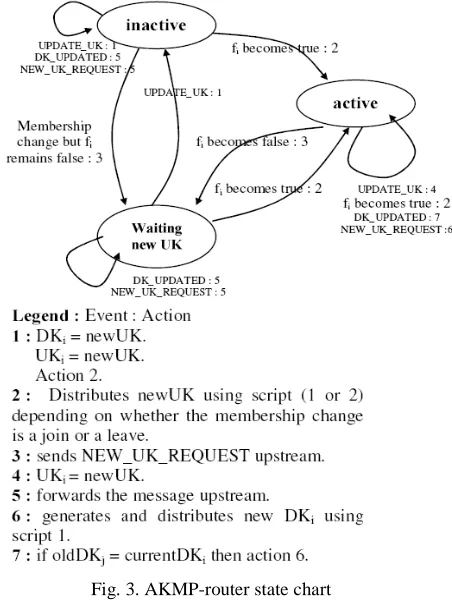
As AKMP is an adaptive solution, the state of AKMP routers is dynamic. Each AKMP-router could be in one of the three states (active, inactive, or waiting new UK):
• Inactive: an AKMP-router is “inactive” if it does not assure decryption / re-encryption process.
• Waiting new UK: an AKMP-router is in this state if it waits for a new UK from an upward AKMP-router which is already involved in decryption / re-encryption process.
When an AKMP-router detects a membership change that yields fi true, it becomes “active” (if it is not already
“active”) and thus generates a new DKi and switches to
decryption / re-encryption process as shown in Figure 3.3. The new DKi will be considered as the traffic encryption
key for the members attached to Ri and as an upstream key
UK for the child routers of Ri. Thus DKi is distributed by
Ri to the attached members (resp. the residual attached
members) and the child routers using script 1 (resp. script 2) as shown in Figure 2. A “DK_UPDATED, oldDKi”
message is sent to the parent AKMP-router (as shown in Figure 2) in order to update and distribute its DKj in the
case of oldDKi=DKj. Note that this latter update is
necessary to ensure backward and forward confidentiality and that it is not a concern since it happens only for the first time that the child AKMP router switches to decryption / re-encryption process.
If fi remains false after a membership change, Ri
forwards this membership change upstream asking a new UK (it sends “NEW_UK_REQUEST” message to its upstream AKMP-router) and changes its state into “WAITING_NEW_UK” (as shown in Figure 3). This request is forwarded upstream until it reaches the first active AKMP-router Rj, it is then discarded by the latter
which generates a new DKj. Rj distributes then the new
DKj (inside a special message “UPDATE_UK”) using
script 1 (as shown in Figure 2) and each child AKMP-router Rp reacts to the message according to the state chart
of Figure 3depending on its state. When Ri receives DKj it
resumes its “inactive” state (as shown in Figure 3) and, initializes UKi and DKi to DKj and distributes it using
script 1 or 2 depending on whether the membership change is a join or a leave.
Fig.2. Distributing New Dk
If an active AKMP-router detects that there is no longer dynamicity among its attached members, it stops decryption / re-encryption process and rejoins “inactive”
state. A new DK(s) is (are) generated and distributed according to the above process. This manner of dealing with membership changes adapts easily to partial dynamicity and fits better to applications with unpredictable membership behavior.
Fig. 3. AKMP-router state chart
III.RESULTS AND DISCUSSIONS
In this section, we provide an overview of our simulation model and some of the results we obtained by comparing AKMP with centralized solution.
1. Simulation Model
All schemes discussed in this paper have been tested using Network Simulator NS version 2.34. NS give the facility of defining our own protocols. For defining our own protocol, classes and their functionalities are to be defined using C++. Parallel classes are then need to be defined using OTcl (Object-oriented Tool Command Language) and linking can be done between the OTcl classes and C++ classes.
2. Results
Different test scripts have been written for different sizes of groups as 9, 27, 81, 243, 729 and 1001 members. Trees with 9, 27, 81, 243, 729 members are complete trees whereas those with 1001 members are incomplete trees. These scripts have been written for all CtrMcast and CtrMcastAKMP protocols.
end of execution of the script. For getting time, the date command with +%r option is used.
Scripts are used for testing time required for join as well as leave operation for all the group sizes. In all these scripts, node labelled ‘0’ is treated as a Group Controller. The internal nodes in the tree are logical; but while simulating the topologies they have been assumed as real nodes.
After simulation the overall runtime for join operation is summarized in table 1 and is briefed in figure 4.
TABLE4.1
OVERALLRUNTIMEOFJOINOPERATION(INSECONDS)
Fig.4. Chart showing performance analysis of Join operation
Using above simulation, overall runtime for leave operation is summarized in table 2 and is briefed in figure 5.
TABLE4.2
OVERALLRUNTIMEOFLEAVEOPERATION(INSECONDS)
No. of Members
CtrMcast (Time in sec)
AKMP (time in Sec)
9 1 0
27 1 0
81 3 1
243 10 7
729 122 72
1001 164 129
Fig. 5. Chart showing performance analysis of Leave operation
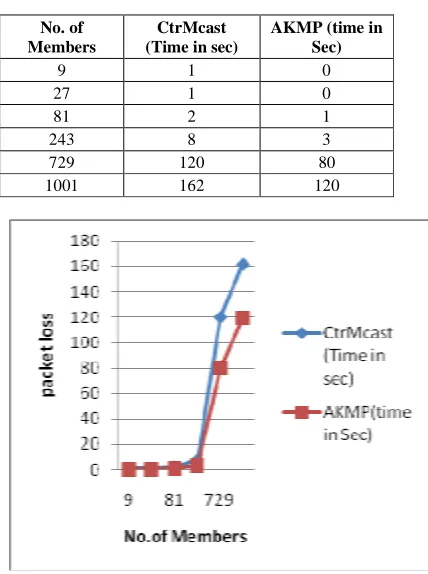
Using above simulation, Overall packet loss for join leave operation is summarized in table 3 and is briefed in figure 6.
TABLE 4.3
OVERALL PACKET LOSS OF JOIN LEAVE OPERATION (IN SECONDS)
Fig.6. Chart showing Comparison of performance analysis of Join Leave operation with Packet Loss Parameter No. of
Members
CtrMcast (Time in sec)
AKMP (time in Sec)
9 1 0 27 1 0 81 2 1 243 8 3 729 120 80 1001 162 120
No. of Members
Packet Loss CtrMcast
Packet Loss AKMP
Packet Loss Proposed
IV.CONCLUSION
In this paper, Approach A and Approach B group key management protocols are analysed. A proposed scheme is based on combination of Approach A and Approach B protocols. All schemes are simulated using ns2 simulation tool. When dynamicity in the multicast group is increased, greater overall computational and communication cost (run-time) is required for join/leave operation because of problems such as “1 affects n”, decryption and re-encryption overhead.
From performance analysis of all the above schemes for computation and communication cost (i.e. overall run-time) of join / leave operation in dynamic multicast group, it has been observed that overall run-time is minimum for the AKMP.
In comparison with the approach A, approach B and adaptive group key management protocol, performance analysis shows that proposed scheme reduces overall packet loss during the message transfer.
As a result, we can conclude that Adaptive Key Management Protocol takes advantage of both approaches A and B by dynamically adapting the key management process with respect to the frequency of membership changes. Which reduced overall run time cost and packet loss.
As a future scope, the work can be done to reduce the value of parameters like bandwidth, end to end delay, and jitter.
ACKNOWLEDGMENT
The authors wish to thank the anonymous reviewers and the editor for their constructive comments. The authors would also like to thanks to management of MIT, Aurangabad for continuous guidance and support.
REFERENCES
[1] K. Almeroth and M. Ammar. “Collecting and modeling the join/leave behavior of multicast group members in the Mbone” , In the proceedings of the Symposium on High Performance Distributed Computing, Syracuse NY, 1996.
[2] K. Almeroth and M.Ammar. “Multicast group behavior in the internet’s multicast
backbone (Mbone)” , IEEE communications Magazine, 1997.
[3] A. Ballardie, “Scalable Multicast Key Distribution”, RFC 1949 May 1996.
[4] Ghassen Chaddoud, Isabelle Chrisment, André Shaff , “Dynamic Group Communication Security”, 6th IEEE Symposium on computers and communication, 2001.
[5] Chung Kei Wong, Mohamed Gouda, Simon S. Lam, “Secure Group Communications Using Key Graphs”, ACM SIGCOMM’ 98, Columbia, 1998.
[6] S. Deering,“Host Extensions for IP Multicasting”, RFC 1112. Stanford University, August 1989.
[7] Lakshminath R. Dondeti, Sarit Mukherjee, Ashok Samal, “ Scalable secure one- to-many group communication using dual encryption”, Computer Communications, ELSEVIER Science 2000.
[8] Lakshminath R. Dondeti, Sarit Mukherjee, Ashok Samal, “Comparison of Hierarchical Key Distribution Schemes” , In Proceedings of IEEE Globcom Global Internet Symposium, 1999.
[9] Lakshminath R. Dondeti, Sarit Mukherjee, Ashok Samal,“Survey and Comparison of Secure Group Communication Protocols” , Tech Rep,
University of Nabraska-Lincoln. 1999.
[10] Thomas Hardjono, Gene Tsudik, “IP Multicast Security: Issues and Directions”, Annales de telecom 2000.
[11] Peter S. Kruus,“A survey of multicast security issues and architectures”, 21st NISSC Proceedings, Virginia (USA). 1998.
[12] H. Harney, C. Muckenhirn, “Group Key Management Protocol Architecture”, RFC 2094 July 1997. [13] H. Harney, C. Muckenhirn,“Group Key Management
Protocol (GKMP) specification”, RFC 2094 July 1997.
[14] Rolf Oppliger, Andres Albanese, “Distributed registration and key distribution”, Proceedings of the 12th International Conference on Information Security IFIP SEC’96, Greece, 1996.
[15] H. F. Salama, “Multicast Routing for real-Time Communication on High-Speed Networks”, PhD thesis, North Carolina State University,1996.
[16] Sandro Rafaeli, “A Decentralized Architecture for Group Key Management”, Computer Department Lancaster University, September 2000.
[17] Clay Shiels, J. J. Garcia-Luna-Aceves,“KHIP—A scalable protocol for secure multicast routing”, Proceedings of ACM SIGCOMM’ 99. 1999.
[18] Jack Snoeyink, Subhash Suri, George Vorghese,“A Lower Bound for Multicast Key Distribution”, IEEE INFOCOM 2001.
[19] Suvo Mittra, “Iolus: A Framework for Scalable Secure Multicasting”, In Proceedings of ACM SIGCOMM’97, Cannes, France, 1997.
[20] D. Wallner, E. Harder, R.Agee, “Key Management for Multicast: Issues and Architecture”, RFC 2627, National Security Agency Jun 1999.
[21] R. Waxman, “Routing of multipoint connections”, IEEE Journal on Selected Areas in Communications, December 1988.
[22] Hatem Bettahar, A. Bouabdallah, Yacine Challal, “AKMP: An Adaptive Key Management Protocol for secure multicast”, Computer Communications and Networks, 2002. Proceedings, Eleventh International Conference on 14-16 Oct. 2002 .
[24] B. Schneier, “Applied Cryptography”, Second Edition, John Wiley & Sons Inc., 1996.
[25] Kevin Fall, Kannan Vardhan, “The ns Manual (formerly ns Notes and Documentation”, The VINT Project, October 19, 2008.
[26] D.R. Stinson and T. van Trung, “Some New Results on Key Distribution Patterns and Broadcast Encryption”, Designs, Codes and Cryptography, vol. 14, pp. 261-279, 1998.
[27] D.R. Stinson,“On Some Methods for Unconditionally Secure Key Distribution and Broadcast Encryption”, Designs, Codes and Cryptography, vol. 12, pp. 215-243, 1997.
[28] C. Blundo, L.A. Frota Mattos, and D.R. Stinson, “Trade-Offs between Communication and Storage in Unconditionally Secure Schemes for Broadcast Encryption and Interactive Key Distribution”, Advances in Cryptology—Proc. 16th Ann. Int’l Cryptology Conf. (CRYPTO ’96), pp. 387-400, 1996. [29] C. Blundo, A. De Santis, A. Herzberg, S. Kutten, U. Vaccaro, and M. Yung, “Perfectly Secure Key Distribution in Dynamic Conferences”, Advances in Cryptology—Proc. Workshop Theory and Application of Cryptographic Techniques (EUROCRYPT ’93), pp. 471-486, 1993.
[30] B .A. Forouzan, “Cryptography and Network Security”, Second Edition, Mcgraw Hill Publication, pp.001 - 025