Design of Dependable and Trustworthiness Of
Data Communication In WSN
R.Satheeskumar
Head of the Department Computer Science
and Engineering,
Bharath Niketan Engineering College,
Email:[email protected]B.Anbuselvan
Assistant Professor Computer Science
and Engineering,
Bharath Niketan Engineering College,
Email:[email protected]M.Kasipandi
Department of Computer Science,Bharath Niketan Engineering College Email:[email protected]
---ABSTRACT--- This work discusses a novel of the most challenging issues so far is the extension of network lifetime with regards to small battery capacity and self-sustained operation. Endeavors to save energy have been made on various frontiers, ranging from hardware improvements over medium access and routing protocols to network clustering and role changing strategies. In addition some authors studied failures in communication regarded as error detection First, a lightweight trust decision-making scheme is proposed based on the nodes’ identities (roles) in the clustered WSNs, which is suitable for such WSNs because it facilitates energy-saving. Due to canceling feedback between cluster members (CMs) or between cluster heads (CHs), this approach can significantly improve system ef iciency while reducing the effect of malicious nodes. More importantly, considering that CHs take on large amount of data forwarding and communication tasks, a dependability-enhancedtrust evaluating approach is defined for cooperations between CHs. This approach can effectively reduce networking consumption while malicious, selfish, and faulty CHs. Moreover, a self-adaptive weighted method is defined for trust aggregationat CH level. This approach surpasses the limitations of traditional weighting methods for trust factors, in which weights are assignesubjectively. Theory as well as simulation results shows that LDTS demands less memory and communication overhead compared with the current typical trust systems for WSNs.
Keywords: Reputation, self-adaptivity, trust management, trust model, wireless sensor network.
--- Date of Submission: December 03, 2013 Date of Acceptance: December 30, 2013 ---
1. Introduction
To the best of our knowledge, we are the first to conduct a systematic study of a trust management system for clustered WSNs from the perspective of both dependability and resource efficiency. The key features of LDTS go beyond existing approaches in terms of the following aspects:
1) A lightweight trust evaluating scheme for cooperations
between CMs or between CHs. Within the cluster, the
indirect trust of a CM is evaluated by its CH. Thus each CM does not need to maintain the feedback from other CMs, which will reduce the communication overhead and eliminate the possibility of a bad-mouthing attack by compromised CMs. The feedback of a CH is applied a similar manner to obtain the same benefits.
2) A dependability-enhanced trust evaluating approach for
cooperations between CHs. Considering that CHs take on
large amounts of data forwarding and communication tasks, a dependability-enhanced trust evaluating approach is defined for cooperations between CHs. This approach can effectively reduce networking consumption while preventing malicious, selfish, and faulty CHs.
3) A self-adaptive weighting method for CH’s trust
aggregation.
Roles and identities of nodes in a clustered WSN model
2.Lightweight Scheme for Trust Decision-Making Our proposed LDTS facilitates trust decision-making based on a lightweight scheme. By closely considering the identities of nodes in clustered WSNs, this scheme reduces risk and
improves system efficiency while solving the trust evaluation problem when direct evidence is insufficient (See Section IV-B).
This scheme is described as follows: 2.1 Trust Decision-Making at CM Level:
A CM calculates the trust value of its neighbors based on two information sources direct observations (or direct trust degree, DTD) and indirect feedback (or indirect trust degree, ITD). DTD is evaluated by the number of successful and unsuccessful interactions. In this work, interaction refers to the cooperation of two CMs. All CMs communicate via a shared bidirectional wireless channel and operate in the promiscuous mode, that is, if node sends a message to CH via node , then node can hear wether node forwarded such message to CH , the destination. If does not overhear the retransmission of the packet within a threshold time from its neighboring node or if the overheard packet is found to be illegally fabricated (by comparing the payload that Trust decision-making at CH level. is attached to the packet), then will consider the interaction unsuccessful. Unlike most existing reputation or trust models, which rely on broadcast-based strategy to collect feedback from the whole cluster, consequently increasing the system communication overhead significantly, our LDTS does not utilize a broadcast- based strategy and instead sets the value of ITD is based on the feedback reported by the CH about a specific node. Thus, each CM does not need to share trust information with its neighbors. This indirect feedback mechanism has numerous advantages such as the effective mitigation of the effect of malicious feedback, thereby reducing the networking risk in an open or hostile WSN environment.
Given that the feedback between CMs need not be considered, this mechanism can significantly reduce network communication overhead, thus improving system resource efficiency. As an example of trust decision-making at the CM level, if a node wants to communicate with node, first checks whether it has any past interaction records with during a specific time interval. If a past interaction record exists, then makes a decision directly; otherwise, will send a feedback request to its CH.
2.2 Trust Decision-Making at CH Level: In cluster WSNs,
CHs form a virtual backbone for intercluster routing where CHs can forward the aggregated data to the central BS through other CHs. Thus, the selection of CHs is a very important step for dependable communication. In our LDTS, the GTD of a CH is evaluated by two information sources CH-to-CH direct trust and BS-to-CH feedback trust. During CH-to-CH communication, the CH maintains the records of past interactions of another CH in the same manner as CMs keeps interaction records of their neighbors. Thus, the direct trust value can be computed according to the number of successful and unsuccessful interactions. The BS periodically asks all CHs for their trust ratings on their neighbors. After obtaining the ratings from CHs, the BS will aggregate them to form an effective value of ITD.
Similar to the trust decision-making process at the CM level, in our LDTS, the ITD of a CH only depends on the feedback reported by the BS. Thus, in the CH-to-CH communication case, when a CH wants to interact with another CH , it will send a feedback request to the BS, at the maximum. Therefore, including the response message form the BS, the total communication overhead is two packets. Thus, this mechanism can also greatly reduce network communication overhead and consequently improve the system’s resource efficiency. Compared with trust making at the CM level, trust decision-making at the CH level has to calculate for direct trust and feedback trust simultaneously. As an example of trust decision- making at the CH level, if a CH wants to communicate with another CH, first calculates CH-to-CH direct trust for based on the past interaction records with during a specific time interval. Meanwhile, sends a feedback request to the BS. After receiving the request, the BS will send a response message to , in which ’s feedback trust value (BS-to-CH feedback trust) is embedded. Then, will aggregate these trust sources into a GTD, after which will make a final decision based on’s GTD.
3. LIGHTWEIGHT AND
DEPENDABILITY-ENHANCED TRUST CALCULATION
The domain of trust values has the Following benefits:
1) Less memory overhead. An unsigned integer between 0
saving save 50%memory space compared with trust values represented as an integer between 0 and 100 (1 bytes) and 87.5% compared with trust values represented as a real number (4 bytes).
2) Less transmission overhead. Given that a smaller
number of bits require transmission during the exchange of trust values between nodes, we gain the benefit of less overhead of transmission and reception power.
3.1Dependability-Enhanced Intercluster Trust Evaluation
In accordance with the characteristics of clustered WSNs, both CMs and CHs are resource-constrained nodes, and BSs have more computing and storage capacity and no resource constraint problem. Thus, energy conservation remains a basic requirement for trust calculation at CHs. In LDTS, we propose a dependable and energy-saving scheme, which is suitable for large-scale and clustered WSNs.
4. THEORETICAL ANALYSIS AND
EVALUATION
i) Dependability Analysis against Malicious Attacks In this section, we analyze the dependability of the LDTS protocol against attacks on a trust management system. In clustered WSNs, the main attacks from a malicious node primarily include two kinds of patterns:
1) Garnished attack. In such an attack, malicious nodes
behave well and badly alternatively with the aim of remaining undetected while causing damage. For instance, garnished malicious nodes may suddenly conduct attacks as they accumulate higher trustworthiness.
2) Bad mouthing attack. As long as feedback is considered,
malicious nodes can provide dishonest feedback to frame good parties and/or boost trust values of malicious nodes. This attack, referred to as the bad mouthing attack [6], is the most straightforward attack. After providing evidence of the malicious nodes’ objectives, we can prove that our trust management system at both the CM and CH levels is dependable against attacks from malicious nodes because this system can detect the malicious behavior and can prevent such nodes from fulfilling their objectives. We broadly categorize two types of nodes (CMs or CHs): Good ones and malicious ones. Our assumption is that good nodes interact successfully most of the time and submit true feedback. Conversely, malicious nodes try to launch garnished attacks or bad mouthing attacks. In Section VI, we define this concept more rigorously, capture the behavior of malicious nodes, and model how such nodes might try to gain an unfair advantage in our trust scheme. Then, we prove our trust system’s dependability against such malicious attacks.
ii). Communication Overhead Analysis and Comparison To evaluate the communication overhead under full-load conditions, we assume a worst-case scenario which is similar to [8], in which every CM wants to communicate with every other CM in the cluster, and every CH wants to communicate with the rest of the CHs in the network. At the same time, each CH needs to collect feedback reports from its CMs, and the BS has to collect feedback reports from its CHs. Let us assume that the network consists of clusters and that the average size of clusters is (including the CH of the cluster). In intracluster trust evaluation, when node wants to interact with node, node will send a maximum of one CH feedback request, for which node will receive one response. If node wants to interact with all the nodes in the cluster, the maximum communication overhead will be . If all nodes want to communicate with one another, the maximum communication overhead is .When a CH wants to collect feedback from its members, it will send requests and receive responses, thus resulting in a total communication overhead of
Thus, the maximum intra cluster communication overhead is Cinter=2(m-1)(m-1)+2m=2(m1)2+2m.
5. STORAGE OVERHEAD ANALYSIS AND
COMPARISON
the total storage overhead at the CH level is bytes. Evidently, the value
of primarily depends on the number of nodes at each cluster. As the number of nodes at each cluster increases, the storage consumption requirement also increases at the CH. As the number of nodes at each cluster decreases, the storage consumption requirement also decreases linearly at CH
6. SIMULATION-BASED ANALYSIS AND
EVA L U AT I O N
By extending the Netlogo-basedtrust simulation engine [23],[28], we implemented a simulator to test the feasibility of the proposed LDTS. For the purpose of comparison, we also added GTMS [8] into the simulator, because both LDTS and GTMS are independent of any specific routing scheme and platform. We did not implement the ATRM system [20] because it requires a specific agent-based platform.
A. LDTS Simulator and Environment
In the simulator, three kinds of nodes exist based on their identities (Table III), i.e., as a CM, as a CH, and as a BS. A CM or a CH can be a collaborator or a rater toward other nodes. The behavior of a CM as a collaborator can be one of two types: good CM (GCM) and bad CM (BCM). GCMs will provide successful interaction for the requested messages, whereas BCMs will provide an unsuccessful interaction. The behavior of a CM as a rater can be one of two types: honest CM (HCM) and malicious CM (MCM). An HCM always gives the appropriate rating for any CM, whereas an MCM always gives a random rating between 0 and 10 for other CMs. Similar to a CM, a GCH always provide successful interaction, whereas a BCH provide an unsuccessful interaction. An HCH always gives an appropriate rating, whereas an MCH always gives random rating between 0 and 10. Based on discussions in Section III and IV, we can see that LDTS works with two topologies: the intercluster (CH-to-CH) topology, where distributed trust management is used, and intracluster (CM-to-CM) topology, where the centralized trust management approach is employed. We alsofind that different calculation mechanisms are employed for intracluster and intercluster trust evaluations. According to these characteristics of LDTS, in this simulator, we separately evaluate the performance of LDTS based on intracluster and intercluster cases. This approach will not affect the results of performance evaluation and will greatly reduce the complexity of the simulator. Instead of using the physical running time, we use the notion of time-step,which is introduced in Netlogo, to calculate the simulation time.The simulation parameters and default values used in the experiments are listed in Table IV. B. Overhead Evaluation and Comparison
We aim to study the effect of the trust management system in a WSN community, which closely resembles a real
network environment. We suppose that most CMs and CHs are good, where only 20% CMs and CHs are malicious. The comparison results are shown in With the increasing the number of CMs in a cluster, the CM-to-CM communication overhead of GTMS rapidly increased according to a exponential curve. However, the CM-to-CM communication overhead of LDTS slowly increased with the increasing number of CMs. This finding further confirms our conclusions from the theoretical analysis in Section VI, that is, given that feedback between CMs need not be considered, this trust calculation mechanism in LDTS can greatly reduce communication overhead. show the comparison results of the CH-to-CH communication overhead between LDTS and GTMS. LDTS and GTMS have a relatively close network overhead as the network size increases, which indicates that both LDTS and GTMS are suitable for large-scale clustered WSNs. However, by comprehensively analyzing the results in LDTS is more suitable for large-scale clustered WSNs with a large size of clusters, thus outperforming GTMS. The comparison results of average storage overhead at each CM in a cluster. With the increasing number of CMs in a cluster, the average storage overhead of GTMS gradually increased according to a linear curve. However, the average storage overhead of LDTS was less than a third of that of GTMS and slowly increased with the increasing number of CMs. This finding confirms our conclusions from the theoretical analysis in Section VI. The average storage overhead of the two trust systems at each CH in a WSN network having an equal size f clusters (10 nodes). We find that as the number of clusters increases in the network the GTMS introduces slightly less storage overhead compared with LDTS. The results in can be easily explained by (2). Each CH has to maintain an additional table, which is used to store the feedback matrix (see (2)). The total storage overhead is . Although the introduction of matrix increases the storage overhead of a CH node, this matrix can significantly enhance the dependability of CH-to-CM trust evaluation.
C. Dependability Evaluation and Comparison
percentage of MCHs is only 5%. We can see that both LDTS and GTMS have a high PSDR, which reflects that these two models have a high dependability under an honest WSN environment. In and the simulation results when MCHs is 10% and 20% have larger differences compared with . With the increase in the percentage of malicious CHs, the performance of both LDTS and GTMS show a marked decline. Relatively, LDTS has a robust performance under a dishonest WSN environment. These results are consistent with a real situation, i.e., in a dishonest WSN community, malicious CHs may conduct a bad-mouthing attack, which can greatly affect the performance of the WSN system. To reduce the risk of trust evaluation, we adopt the idea that the GTD of a CH is adaptively merged by two parts (which is not aggregated by GTMS):CH-to-CH direct trust and BS-to-CH feedback trust. This can significantly improve the dependability of LDTS. Shows the PSDR comparison results under different percentages of MCMs. We find that LDTS also has a more robust dependability than the GTMS scheme. Shows the experimental results under an honest environment. In the simulation, the total percentage of MCMs is 10%, and the total percentage of MCHs is likewise 10%, which indicate that the community is a relatively honest community (i.e., with fewer MCHs and MCMs). Both LDTS and GTMS have relatively stable performance within 1,000 time-steps, even if their PSDRs change from 0.92 to 0.96. Shows the experimental results under a relatively honest environment, where 20% of CMs are dishonest. The results show that LDTS has a higher PSDR than GTMS. The experimental results under a highly dishonest environment, where 30% of CMs are dishonest. Under this case, LDTS still shows better dependability than GTMS.
7. SIMULATION AND RESULTS
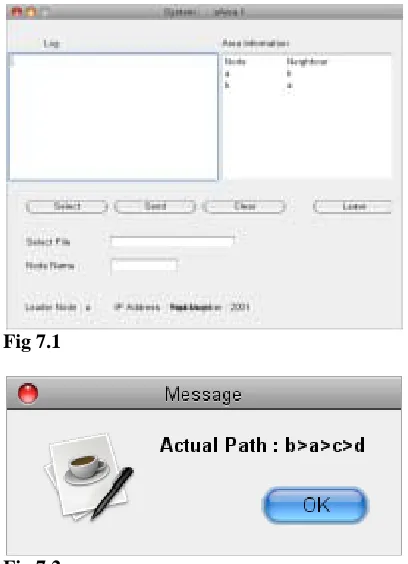
In this (Fig7.1, Fig7.2) result, to propose LDTS for clustered WSNs. Given the cancellation of feedback between nodes, LDTS can greatly improve system efficiency while reducing the effect of malicious nodes. By adopting a dependability-enhanced trust evaluating approach for cooperation’s between CHs, LDTS can effectively detect and prevent malicious, selfish, and faulty CHs. Theory as well as simulation results show that LDTS demands less memory and communication overhead as compared with other typical trust systems and is more suitable for clustered WSNs.
Fig 7.1
Fig 7.2
8. CONCLUSION
In this work, we proposed LDTS for clustered WSNs. Given the cancellation of feedback between nodes, LDTS can greatly improve system efficiency while reducing the effect of malicious nodes. By adopting a dependability-enhanced trust evaluating approach for cooperation’s between CHs, LDTS can effectively detect and prevent malicious, selfish, and faulty CHs. Theory as well as simulation results show that LDTS demands less memory and communication overhead as compared with other typical trust systems and is more suitable for clustered WSNs.
REFERENCES
[1] W. B. Heinzelman, A. P. Chandrakasan, andH. Balakrishnan, “An application-specific protocol architecture for wireless microsensor networks,”IEEE
Trans. Wireless Commun., vol. 1, no. 4, pp. 660–
670,Oct. 2002.
[2] D. Kumar, T. C. Aseri, and R. B. Patel, “EEHC: Energy efficient heterogeneous clustered scheme for wireless sensor networks,” Comput. Commun., vol. 32, no. 4, pp. 662–667, Apr. 2009.
[3] Y. Jin, S. Vural, K. Moessner, and R. Tafazolli, “An energy-efficient clustering solution for wireless sensor networks,” IEEE Trans.WirelessCommun., vol. 10, no. 11, pp. 3973–3983, Nov. 2011.
sensor networks,” IEEETrans. Mobile C
no. 4, pp. 366–379, Oct. 2004.
[5] S. Ganeriwal, L. K. Balzano, and M. “Reputation-based framework for high i networks,” ACM Trans. SensorNetw., v 1–37, May 2008.
[6] Y. Sun, Z. Han, and K. J. R. Liu, “D management vulnerabilities in distribu
IEEE Commun.Mag., vol. 46, no.2, pp.
2009.
[7] H. Yu, Z. Shen, C. Miao, C. Leung, and survey of trust and reputation managem wireless communications,” Proc. IEEE, pp. 1752–1754, Oct. 2010.
[8] R. A. Shaikh, H. Jameel, B. J. d’Auriol, Lee, “Group-based trust managemen clustered wireless sensor networks,”
Parallel Distrib. Syst., vol. 20, no. 11, Nov. 2009.
[9] F. Bao, I. Chen,M.Chang, and J. Cho trust management for wireless sensor n applications to trustbased routing detection,” IEEE Trans. Netw. Service M
no. 2, pp. 169–183, Jun. 2012.
[10]G. Zhan, W. Shi, and J. Deng, implementation of TARF: A trust-framework for WSNs,” IEEE Trans. D Comput., vol. 9, no. 2, pp. 184–197, Apr [11]E. Aivaloglou and S. Gritzalis, “Hy reputation management for sensor netw
Netw., vol. 16, no. 5, pp. 1493–1510, Jul [12]A.Rezgui andM. Eltoweissy, “ :Arel
servicedriven efficient routing protocol s actuator networks,” IEEE Trans. Paralle
vol. 20, no. 5, pp. 607–622, May 2009. [13]G. V. Crosby, N. Pissinou, and J. Gadze,
for trust-based cluster head election in networks,” in Proc. Second IEEE Dependability and Security in Sensor Systems, 2006, pp. 10–22.
[14]R. Ferdous, V. Muthukkumarasam Sithirasenan, “Trust-based cluster h algorithm for mobile ad hoc networks, Int. Joint Conf. IEEE TrustCom-1111 11/FCST-11, pp. 589–596.
[15]Z. Liang and W. Shi, “TRECON: economic framework for efficient int
IEEE Trans. Syst., Man, Cybern. A, Sys
40, no. 1, pp. 52–67, Jan. 2010.
[16]R. Zhou and K. Hwang, “Power-trust: scalable reputation system for truste computing,” IEEE Trans. Parallel Dis
18, no. 5, pp. 460–473, May 2007. [17]Y. Sun, W. Yu, Z. Han, and K. J. R. Liu
theoretic frameworkof trust modeling
Comput., vol. 3, B. Srivastava, integrity sensor vol. 4, no. 3, pp. Defense of trust uted networks,”
112–119, Feb. d D. Niyato, “A ment systems in vol. 98, no. 10, , H. Lee, and S. nt scheme for
IEEE Trans.
pp.1698–1712, o, “Hierarchical
etworks and its and intrusion
Manag., vol. 9, “Design and -aware routing
Depend. Secure
r. 2012.
ybrid trust and works,” Wireless
l. 2010.
liable adaptive suite for
sensor-el Distrib. Syst., , “A framework wireless sensor EWorkshop on
Networks and my, and E. head selection
” in Proc.2011 1/IEEE
ICESS-A trust-based ternet routing,”
t .Humans, vol.
: A robust and ed peer-to-peer
trib. Syst., vol. u, “Information and evaluation
for ad hoc networks,” IEEE J.S
24, no. 2, pp. 305–317, Feb. 200 [18]G. Theodorakopoulos and J. S.
and trust evaluation metrics for
J. Sel. Areas Commun.,vol. 24, 2006.
[19]S. Ganeriwal and M. B. Srivas framework for high integrity se
ACM Workshop Security of
Networks (SASN’04), Oct. 2004
[20]A. Boukerche, X. Li, and K. E security for wireless ad hoc
Computer Commun., vol. 30
2007.
Authors Biography
R.Satheeskumar M.Tech. degree in Pursuing his Phd He is currently w Department of C Engineering
at
College , Madura interest are Data Mining, Soft Computer Networks and Wirel Currently he has published many International journals. He is the lif and IEEEB.Anbuselvan rec Computer Science Pursuing his Phd He is currently Professor Depar Science and En Engineering college , Madurai, Ind are Software Testing ,Software En Networks and DataStructures and A has published many papers in na journals. He is the lifetime member M.kasipandi rec from university university and Engineering fr Chennai, India. data mining, Sof Wireless sensor Networks. He has in national conference in various paper, he is working on deve protocols for wireless networks wireless sensor network. He is also systems support for mobile hosts .H
Sel. Areas Commun., vol. 06.
Baras, “On trust models ad hoc networks,” IEEE
no. 2, pp. 318–328, Feb. stava, “Reputation-based ensor networks,” in Proc.
f ad hoc and Sensor
4, pp. 66–67.
EL-Khatib, “Trust-based and sensor networks,” , pp. 2413–2427, Sep.
received his B.E. and n Computer Science and
from Anna University . working as Head of the
Computer Science and Bharath Engineering ai, India. His areas of tware Engineering and less Sensor Networks. y papers in national and
fetime member of ISTE
ceived his M.E. degree in e and Engineering and d from Anna University.
working as Assistant rtment of Computer ngineering
at
Bharathdia. His areas of interest ngineering and Computer Algorithms. Currently he ational and International
r of ISTE and IEEE. ceived his M.C.A degree y department of Anna