http://www.ijcmph.com pISSN 2394-6032 | eISSN 2394-6040
Original Research Article
Investigation of fever in the eastern borders of
Kollam district, Kerala, India
Soumya Gopakumar
1*, Sonia Scaria
2, Achu Thomas
2, Zinia T. Nujum
3, Devi Mohan
4INTRODUCTION
Kerala is endemic for dengue.1 The capital city of Thiruvananthapuram district has reported the highest number of dengue cases in Kerala in 2017 followed by Kozhikode and Palakkad districts in the state.2 There has been dengue related deaths in the neighbouring state also with deaths in children in 2012, the year which reported
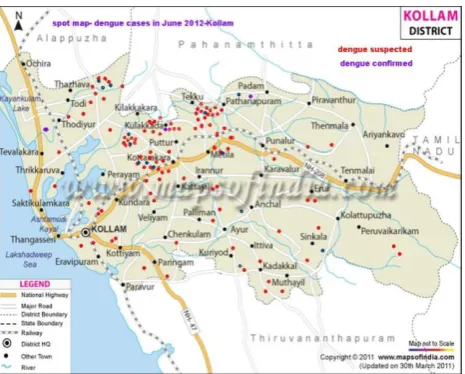
12,826 cases with 66 deaths.3 There were also reports of atypical dengue cases admitted in tertiary care centres. In Kollam district, Kerala also, there has been an increase in number of fever cases as reported from Official disease notification system integrated disease surveillance project (IDSP) and several newspapers and media. The data from the district shows that dengue cases were increasing since 2009. A spot map prepared by IDSP Kollam also shows clustering of suspected dengue cases in Pathanapuram,
ABSTRACT
Background: The state of Kerala is endemic for dengue. The district Kollam in Kerala reported increasing fever trend as per the state surveillance report. So an investigation was planned to estimate the burden of fever in the locality of reported dengue cases, to calculate vector indices around areas of confirmed cases and to study the clinical profile and risk factors of dengue fever.
Methods: A cross sectional survey with entomological survey was conducted in houses around the confirmed dengue cases. A case control analysis was done with dengue positive as cases and negative test results among the fever cases as controls. Odds ratio was calculated for strength of association and statistical test of significance using Chi Square test.
Results: Total number of households visited was 80; numbers of hospitalized patients were 26. Total fever cases studied were 46 of which 30.4% and 8.7% were positive for IgM and IgG dengue respectively. PCR was positive in 28.3%. Chills [OR–3.55 (1.05-12.1)], p<0.03, was found to be significantly associated with dengue positivity. Dengue positivity was higher among housewives, but not found to be statistically significant. 51.2% of the households had water storage containers at home. Breteau index in one of the areas surveyed was 60 and 52.
Conclusions: More awareness needs to be generated among the public of the importance of identifying and destroying the vector breeding sites around households as very often breeding sites are found right inside houses.
Keywords: Dengue fever, Breteau index, Arthralgia, Myalgia
1
Department of Community Medicine, Dr. Somervell Memorial CSI Medical College, Karakonam, Thiruvanantha-puram, Kerala, India
2
Department of Health Service, Government of Kerala, India
3
Government Medical College, Kollam, Kerala, India
4
Global Public Health, School of Medicine, Monash University, Malaysia
Received: 05 April 2018
Revised: 23 April 2018
Accepted: 24 April 2018
*Correspondence:
Dr. Soumya Gopakumar,
E-mail: [email protected]
Copyright: © the author(s), publisher and licensee Medip Academy. This is an open-access article distributed under the terms of the Creative Commons Attribution Non-Commercial License, which permits unrestricted non-commercial use, distribution, and reproduction in any medium, provided the original work is properly cited.
Kottarakkara and Kulakkada as shown in Figure 1. The line listing of cases admitted in Govt Medical College, Thiruvananthapuram, obtained from Regional PIED (prevention of infectious and epidemic disease) cell shows a clustering of cases in areas around the eastern border of the district. The intermittent rain was observed to take case load to explosive proportions as short spells of rain followed by sunny days were very conductive to the breeding of Aedes mosquitoes, the vector primarily responsible for transmission of dengue fever. Recent evidences point towards a positive association between temperature, rainfall in causing dengue outbreaks.4 Drought in the area also caused clustering of cases in Tamil Nadu state where people used to store water in containers during periods of water scarcity.3 In this context an epidemiological investigation was planned in the eastern borders of Kollam, by the department of Community Medicine, Government Medical College Thiruvananthapuram and Health Services Department of Kerala, in order to study the burden of the disease and the clinical profile of the fevers and thus to help improve the control activities in the area.
Figure 1: Spot map of the area showing suspected and confirmed dengue cases.
Objectives
To find the proportion of Dengue fever among fever patients in the locality of reported Dengue cases from Kollam district in June 2012.
To find out the vector indices.
To study the clinical profile of fever cases. To find out the risk factors of dengue fever.
METHODS
A cross sectional survey was conducted in houses around the confirmed dengue cases. The survey was conducted in Kottarakkara, Pattazhy and Kulakkada of Kollam district in the month of June 2012. Kerala state where the maximum number of cases was reported as per the state
around the confirmed dengue cases and cases presenting with fever in the OPD were included. The inclusion criteria were fever of 2 to 7 days with no identified focus of infection. The survey team visited hospital and field. The hospital team consisted of two doctors and a lab technician. The field team consisted of 2 doctors and an entomological assistant and a health worker. Each team did a fever and larval survey of households around previously identified dengue cases. Concurrently the entomology team did larval survey of these households. Informed consent was obtained from patients & permission from district medical officer, Kollam and institutional ethics committee clearance were obtained. After informed written consent, the questionnaire was administered and blood samples were collected for investigations. Data was collected using a semi structured questionnaire. There was another questionnaire for collecting data on the possible risk factors for transmitting dengue fever from the houses with or without fever in the area. Blood samples were collected for routine examination, PCV, platelet count and PCR or serology; PCR dengue, leptospirosis and chikungunya for fever of less than 5 days duration and dengue Ig M and IgG for fever of 5 days or more.5All qualitative variables were expressed as proportion and quantitative variables as mean with standard deviation. A case control analysis was done with dengue positive as cases and negative test results among the fever cases as controls. Odds ratio was calculated for strength of association and statistical test of significance using Chi Square test. Binary logistic regression was done to find out the independent predictors of dengue fever.
RESULTS
The survey team visited 85 households. A total of 389 subjects were surveyed. We studied 46 fever cases from the field and hospital. Blood samples were collected from 49 subjects. Three of them were non-residents, so questionnaires were not filled and they were not included in the final data analysis.
Table 1: Symptoms of patients with fever.
Symptoms Cases no (%) Controls no (%)
Headache 18 (78.3) 16 (69.6)
Retro orbital pain 3 (13.6) 7 (30.4)
Myalgia 15 (65.2) 11 (47.8)
Cough 7 (30.4) 5 (21.7)
Lethargy 10 (43.5) 4 (17.4)
Arthralgia 14 (60.9) 9 (39.1)
Nausea 10 (43.5) 6 (26.1)
Arthritis 4 (17.4) 3 (13)
Chills* 14 (60.9) 7 (30.4)
Vomit 11 (47.8) 5 (21.7)
Abdominal pain 5 (21.7) 2 (8.7)
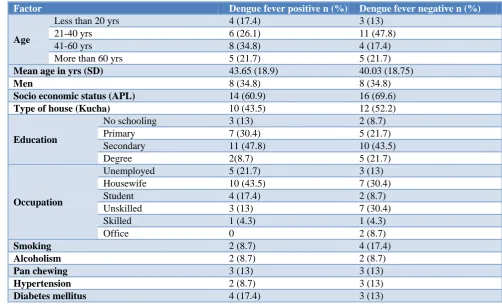
them the proportions of dengue positive subjects were 23 {50% (CI 49.7-50.3)}. Among the fever cases 30.4% and 8.7% were positive for IgM and IgG dengue respectively. PCR dengue was positive in 28.3%. There were 16 males and 30 females among dengue positive cases. The most frequent symptom was headache followed by myalgia, arthralgia and chills as shown in Table 1. 37% of the total fever cases were in 21-40 age group as shown in Table 2. Dengue positivity was high among 41-60 years. Chills [OR–3.55 (1.05-12.1)], p<0.03 was found to be significantly associated with dengue positivity. 51.2% of
the households had water storage containers at home. Mean platelet count among study subjects was 2,30,000 (SD 85,000) per microliter of blood. There was no piped water supply in the area. So in most of the houses there were water storage containers in the houses. The vector indices, Breteau index in ward no 9 and 10 were very high in the present study as shown in Table 3. Dengue positivity was higher among housewives, but when bi variable analysis was done the association was not found to be statistically significant. No other factor was found to be statistically significant.
Table 2: Bi variable analysis of risk factors of dengue fever.
Factor Dengue fever positive n (%) Dengue fever negative n (%)
Age
Less than 20 yrs 4 (17.4) 3 (13)
21-40 yrs 6 (26.1) 11 (47.8)
41-60 yrs 8 (34.8) 4 (17.4)
More than 60 yrs 5 (21.7) 5 (21.7)
Mean age in yrs (SD) 43.65 (18.9) 40.03 (18.75)
Men 8 (34.8) 8 (34.8)
Socio economic status (APL) 14 (60.9) 16 (69.6)
Type of house (Kucha) 10 (43.5) 12 (52.2)
Education
No schooling 3 (13) 2 (8.7)
Primary 7 (30.4) 5 (21.7)
Secondary 11 (47.8) 10 (43.5)
Degree 2(8.7) 5 (21.7)
Occupation
Unemployed 5 (21.7) 3 (13)
Housewife 10 (43.5) 7 (30.4)
Student 4 (17.4) 2 (8.7)
Unskilled 3 (13) 7 (30.4)
Skilled 1 (4.3) 1 (4.3)
Office 0 2 (8.7)
Smoking 2 (8.7) 4 (17.4)
Alcoholism 2 (8.7) 2 (8.7)
Pan chewing 3 (13) 3 (13)
Hypertension 2 (8.7) 3 (13)
Diabetes mellitus 4 (17.4) 3 (13)
Table 3: Vector Indices in the area around confirmed dengue cases.
Area visited House index Container index Breteau index
Pattazhi (Ward 10) 21 35 50
Pattazhi (Ward 9) 38 73 62
Kulakkada (Ward 1) 9 11 9
Kulakkada (Ward 9) 5 7 5
Table 4: Mosquito breeding sites found in the area around confirmed dengue cases.
Sl no Breeding sites No of positive houses (%)
1. Storage of water containers for use at home 41 (51.2)
2 Collection of water under refrigerator 24 (30)
3. Open tanks within 400 m from the house 9 (11.2)
4. Drains near the house 9 (11.2)
5. Rubber plantations within 400 m of the house 70 (87.5)
DISCUSSION
The proportion of dengue fever was very high in our study (50%) as against 14.8% and 20% were the prevalence obtained in the previous studies.6,7 Fever arthralgia myalgia was the commonest symptom complex. IgG positivity was 8.5% indicating the risk of severe forms of dengue like dengue hemorrhagic fever and dengue shock syndrome in the area if the vector breeding is not controlled. More awareness needs to be generated among the public on the importance of identifying and destroying the vector breeding sites around households. Uninterrupted supply of piped water supply has to be ensured in the community to prevent storage of water in household containers. The presence of rubber plantations in the surrounding area as shown in Table 4 is a serious challenge to dengue control activities. There are several reports on the efficiency of coconut shells as breeding sites for Aedes mosquito in the rubber plantations. Other sites being plastic containers. So there should be a multi sectoral approach to control dengue fever in the locality involving the agricultural department, public works department in addition to health department.
Tracking the density of the vector Aedes aegypti through vector surveillance is important to prioritise the areas for vector control activities and to detect any increase in density. The health service department in Kerala state mainly rely on larval surveys as the method of vector surveillance. The three main indices for larval survey are house index, container index and Breteau index. In the present study also these indices were measured.
The vector indices in ward no 9 and 10 were very high in the present study. Breteau index could be used as a predictor of dengue transmission with 81.8% sensitivity and 73.3% specificity.8 Dengue positivity was higher among house wives in this study. Another study in Malaysia reported a higher male predominance. The time of data collection in the morning might have influenced this finding as women might have been present at home during data sample collection.9 In our study majority of the study subjects were in 20-40 year age group, which involves the risk of bite in public places. In another study in Kerala age above 40 years was found to be associated with mortality.10 A study in Vietnam also reported household factors like improper waste disposal to be responsible for dengue outbreaks.11 In another study it was reported that vector breeding sites were mainly in public places or religious places. In public places the sites were mainly indoors. 12The history of having chills was significantly associated with dengue fever in this study. In another report abdominal pain and oliguria were predictors of dengue especially in children.13 Existing source reduction activities to be strengthened with the full participation of the community in the area with high vector indices. Active case finding and strengthening fever surveillance and entomological surveillance especially in the area with high vector indices. One of the
limitations of the study was the patients attending private sector were not included in the study. More awareness needed to be generated among the public of the importance of identifying and destroying the vector breeding sites around households as very often breeding sites are found right inside houses like refrigerators and water storage containers. Patients seeking treatment in private hospitals need to be traced to locate the area and see if there is any clustering of cases.
ACKNOWLEDGEMENTS
We would like to express our heartfelt gratitude to all the study participants, Dr. Rakesh P. S. and the field workers who have helped in collecting the relevant data for the present study and the faculty in the Department of Community Medicine for their support.
Funding: No funding sources Conflict of interest: None declared
Ethical approval: The study was approved by the Institutional Ethics Committee
REFERENCES
1. Nujum ZT, Thomas A, Vijayakumar K, Nair RR, Pillai MR, Indu PS, et al. Comparative performance of the probable case definitions of dengue by WHO (2009) and the WHO-SEAR expert group (2011). Pathog Glob Health. 2014;108(2):103-10.
2. Banerjee I. Dengue: The break-bone fever outbreak in Kerala, India. Nepal J Epidemiol. 2017;7(2):666– 9.
3. TN and Kerala had highest number of dengue cases in 2017, what went wrong? The News Minute. 2017. Available at: https://www.thenewsminute. com/article/tn-and-kerala-had-highest-number-dengue-cases-2017-what-went-wrong-73264. Accessed on 23 April 2018.
4. Valson JS, Soman B. Spatiotemporal clustering of dengue cases in Thiruvananthapuram district, Kerala. Indian J Public Health. 2017;61(2):74–80. 5. Sa-Ngasang A, Anantapreecha S, A-Nuegoonpipat
A, Chanama S, Wibulwattanakij S, Pattanakul K, et al. Specific IgM and IgG responses in primary and secondary dengue virus infections determined by enzyme-linked immunosorbent assay. Epidemiol Infect. 2006;134(4):820–5.
6. Kumar A, Balachandran V, Dominic A, Dinesh KR, Karim S, Rao G. Serological evidence of leptospirosis and dengue coinfection in an endemic region in South India. Ann Trop Med Public Health. 2012;5(4):286.
7. Serological & entomological investigations of an outbreak of dengue fever in certain rural areas of Kanyakumari district, Tamil Nadu - ProQuest. Available at: https://search.proquest.com/openview/
8. Breteau Index threshold levels indicating risk for dengue transmission in areas with low Aedes infestation - Sanchez - 2010 - Tropical Medicine & International Health - Wiley Online Library. Available at: https://onlinelibrary.wiley.com/doi/ full/10.1111/j.1365-3156.2009.02437.x Accessed on 16 April 2018.
9. Shah SA, Sani JA. Effectiveness of Aedes Index and Breteau Index in Predicting Dengue Outbreaks in Selangor, Malaysia. Epidemiolo. 2011;22(1):144. 10. Karunakaran A, Ilyas WM, Sheen SF, Jose NK,
Nujum ZT. Risk factors of mortality among dengue patients admitted to a tertiary care setting in Kerala, India. J Infect Public Health. 2014;7(2):114–20. 11. Risk factors associated with an outbreak of dengue
fever/dengue haemorrhagic fever in Hanoi, Vietnam, Epidemiology & Infection, Cambridge Core. Available at: https://www.cambridge.org/
core/journals/epidemiology-and-
infection/article/risk-factors-associated-with-an- outbreak-of-dengue-feverdengue-haemorrhagic-
fever-in-hanoi-vietnam/FA7E12B31FE0247075D2FF8EE241CDD 2. Accessed on 17 April 2018.
12. Arunachalam N, Tana S, Espino F, Kittayapong P, Abeyewickreme W, Wai KT, et al. Eco-bio-social determinants of dengue vector breeding: a multicountry study in urban and periurban Asia. Bull World Health Organ. 2010;88(3):173–84. 13. Pothapregada S, Kamalakannan B, Thulasingham
M. Risk factors for shock in children with dengue fever. Indian J Crit Care Med Peer-Rev Off Publ Indian Soc Crit Care Med. 2015;19(11):661–4.