Original Research Article
The role of women self-help groups in reproductive health:
an operational research
Vaishnavi Devi Moola Amarnath
1*, Anitha Rani Jeyaraju
2, Ramesh Harihara Iyer
2INTRODUCTION
Reproductive health has gained importance over hundreds and thousands of years and there has been a continuous evolution to improve reproductive health services in India. Although there is continuous evolution, the targets of millennium development goals (MDG’s) and sustainable development goals (SDG’s) were not met and
there is insufficient progress in decline of maternal mortality at rate of 2 percent per annuum. Almost 1.8 billion youngsters are entering the reproductive age group every year. The main aim of reproductive and child health (RCH) program is to ensure that throughout pregnancy and puerperium, the mother will have good health. One of the innovative strategies identified in RCH II program was empowering women by organizing into women Self Help Groups (SHG) to achieve reproductive health.1,2 Self
ABSTRACT
Background: In India, women in the reproductive age group (15-44 years) comprise 53% of women population (according to 2011 census). In spite of continuous evolution to improve reproductive health services in India, there is insufficient progress in decline of maternal mortality rate at 2 percent per annuum. One of the innovative strategies identified in reproductive and child health (RCH) II program and UN millennium declaration was establishment of women self-help groups (SHG’s) particularly in rural regions with high levels of poverty. So this study is aimed to assess the current role of women SHG’s in, maternal health, Family welfare and associated maternity benefit schemes. And also, to find out the constraints in involvement of women SHG’s and to assess the feasibility of enhancing their role in reproductive health services.
Methods: It is a population based cross sectional study carried out at Nemam sub centre area of Nemam primary health care centre under Thiruvallur housing and urban development. Women who have been a SHG member for more than 6 months were assessed quantitatively and qualitatively after obtaining informed consent which was approved by institutional ethics committee. Data was compiled and analyzed using SPSS 15.0. Qualitative data was analyzed using coding techniques.
Results: A total of 56 self-help groups from 10 villages resulted in a total study population of 392 individuals. Before identifying their role, their awareness was also evaluated. Ninety percent of the SHG women were aware of most of the components of maternal health services. But the role was good among 58% of the SHG women. This study brings forth the gap in knowledge and their role which is because they were not confident of their knowledge.
Conclusions: In a developing country like India, involving the well organized and available grass root volunteers like women SHG’s in reproductive health services will have a great bearing on the maternal health and consequently on health of children and community at large.
Keywords: Self-help group, Reproductive health, Child health
1Department of Community Medicine, Government Vellore Medical College and Hospital, Adukamparai, Vellore,
Tamil Nadu, India
2Department of Community Medicine, S.R.M.C. and R.I., Chennai, Tamil Nadu, India
Received: 18 November 2019
Accepted: 12 December 2019
*Correspondence:
Dr. Vaishnavi Devi Moola Amarnath, E-mail: [email protected]
Copyright: © the author(s), publisher and licensee Medip Academy. This is an open-access article distributed under the terms of the Creative Commons Attribution Non-Commercial License, which permits unrestricted non-commercial use, distribution, and reproduction in any medium, provided the original work is properly cited.
Help Group women are involved in maintenance of health sub centres by demanding proper service delivery from the village health Nurses, health supervisors and primary health care centre medical officers, transporting the seriously ill patients to the district and taluk hospitals and creating AIDS awareness. The government is fully utilizing the SHG members in the identification and registration of pregnant women, distribution of iron and folic acid tablets to them and for promoting contraception. In short, SHG’s are creating general health awareness and playing a vital role in health and sanitation of villages.3 There were no published literatures to depict the operational feasibility and scope of women SHG members in reproductive health services. This study has been undertaken to assess the current role of SHG women, constraints and feasibility of enhancing their role on various components of maternal health and family planning services.
METHODS
The study was done as a population based cross sectional study among rural SHG women in a sub centre area of primary health centre, Nemam near Chennai. The role of SHG women in reproductive health and family welfare services and their constraints were assessed by quantitative method using structured, validated and pre tested interview schedule. The feasibility of enhancing their role in reproductive health and family welfare services was assessed by qualitative method using focus group discussions.
Nemam health sub centre was selected randomly for this study and it has a total population of 8321, of whom 4196 were women in the reproductive age group. As per the list collected from village health nurse there were 56 women self-help groups in the area which comprised of 774 women as members. Women who have joined SHG’s at least 6 months before the time of data collection were eligible to participate in the study. With limit of accuracy as 10% of probable prevalence and Zα value of 1.96, the
sample size calculated was 384.
The structured interview schedule was reviewed by experts in the field for content validity. The reliability was tested by the test- retest procedure. The correlation coefficients were ranging 0.7 to 0.9 indicating good reliability. Internal consistency was assessed by crohnbach’s alpha which was 0.787. Knowledge was assessed on key aspects of reproductive health services. The answers were scored as 0 for incorrect response and 1 for correct response. Role of SHG women during last 6 months were coded on five point likert’s scale.
The study was approved by Institutional Ethics Committee. Written informed consent in native language was obtained. Data was collected by interviewing sessions and focus group discussions. Data entry and analysis of variables was done using SPSS 15.0 version and deductive, inductive coding respectively. Descriptive
analysis, test of proportions were done. Chi square test was used as statistical test of significance. Deductive and inductive coding was used to arrive at themes for focus group discussions.
RESULTS
The mean age of study participant was 34.6 years. Majority 380 (96.9%) SHG women were Hindus. Majority 245 (62.5%) SHG women completed middle school. Greater proportion of SHG women 325 (82.9%) were currently married and living with spouse (Table 1 and 2).
Table 1: Occupation, standard of living, socio economic status of SHG women (n=392).
Characteristics Frequency %
Occupation
Student 4 1.0
Homemaker 199 50.8 Unskilled 114 29.0 Semi-skilled 23 5.9
Skilled 51 13.0
Managerial 1 0.3
Standard of living
Low 162 41.3
Medium 229 58.4
High 1 0.3
Socio-economic status
Class I 7 1.8
Class II 50 12.8
Class III 113 28.8
Class IV 210 53.6
Class V 12 3.0
Table 2: knowledge of SHG women in various components of reproductive health services based on
percentage scoring (n=392).
RCH services Knowledge
Poor Fair Good
N (%) N (%) N (%) Maternal health 1 (0.3) 7 (1.8) 384 (97.9)
Family welfare 34 (8.7) 337 (86) 21 (5.3)
Government
schemes 21 (5.4) 141 (36) 230 (58.6)
The overall knowledge on various components of reproductive health services were graded as poor (score<50%), fair (score between 50- 75%) and good knowledge (score>75%).
questions to assess knowledge on birth spacing methods, permanent sterilization methods and emergency contraception methods. The knowledge of associated
maternity benefit schemes comprised questions on awareness on Doctor. Muthulakshmi Reddy maternity benefit scheme and Janani Suraksha Yojana (Table 3-7).
Table 3: Role of SHG women in reproductive health services (n=392).
Reproductive health services Never/ seldom
frequency (%)
Quite often frequency (%)
Very often/ always frequency (%)
Maternal health services
Motivated AN women for early registration 14 (3.6) 38 (9.7) 340 (86.7) Accompanied AN women to health facility at times of
need 26 (6.6) 141 (36.0) 225 (57.4)
Advised AN women on IFA tablets 8 (2.1) 38 (9.6) 346 (88.3) Advised AN women on TT immunization 7 (1.8) 35 (8.9) 350 (89.3)
Family welfare services
Advised eligible couples on importance of birth spacing
methods 18 (4.6) 15 (3.8) 359 (91.6)
Advised eligible couples on permanent sterilization
methods 14 (3.6) 13 (3.3) 365 (93.1)
Advised emergency contraception for eligible couples at
times of need 363 (92.6) 18 (4.6) 11 (2.8)
Miscellaneous services
Assisted AN women to avail financial assistance from
government 22 (5.6) 292 (74.5) 78 (19.9)
Table 4: Role of SHG women in RCH services based on percentage scoring (n=392).
RCH services Role
Poor Fair Good
N (%) N (%) N (%)
Maternal health 8 (2.0) 158 (40.3) 226 (57.7)
Family welfare 26 (6.6) 350 (89.3) 16 (4.1)
Government schemes 29 (7.4) 291 (74.2) 72 (18.4)
Table 5: Comparison between knowledge on various components of RCH and their role (n=392).
Components of RCH Knowledge Role P value
Poor/ fair Good
N (%) N (%)
Maternal health Poor/ fair 6 (75.0) 2 (25.0) 0.058
Good 160 (41.7) 224 (58.3)
Family welfare Poor/ fair 365 (98.3) 6 (1.7) 0.000
Good 11 (52.4) 10 (47.6)
Government schemes Poor/ fair 144(88.9) 18 (11.1) 0.002
Good 176 (76.5) 54 (23.5)
Table 6: Comparison between role of SHG women in RCH services and their leadership status.
RCH services Designation Role P value
Poor/ fair role Good role
N (%) N (%)
Maternal health Leaders* 34 (30.4) 78(69.6) 0.003
Other members 132 (47.1) 148(52.9)
Family welfare Leaders* 107 (95.5) 5(4.5) 0.782
Other members 269 (96.1) 11(3.9)
Government schemes Leaders* 92 (82.1) 20(17.9) 1.000
Table 7: Constraints in involvement of women SHG’s in various components of RCH services.
Constraints on various components Lack of awareness Not approached for advice Personal issues
N (%) N (%) N (%)
Maternal health 11 (2.8) 19 (4.8) 9 (2.3)
Family welfare 357 (91.1) 2 (0.5) 3 (0.8)
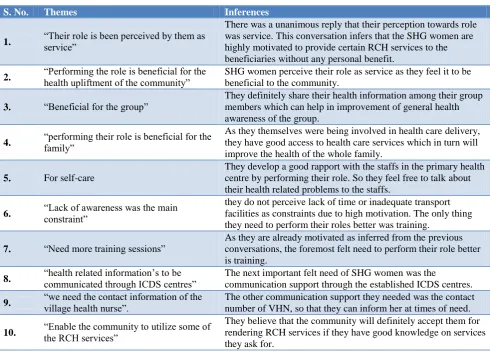
Table 8: Focus group discussions conducted among SHG women.
S. No. Themes Inferences
1. “Their role is been perceived by them as service”
There was a unanimous reply that their perception towards role was service. This conversation infers that the SHG women are highly motivated to provide certain RCH services to the beneficiaries without any personal benefit.
2. “Performing the role is beneficial for the
health upliftment of the community”
SHG women perceive their role as service as they feel it to be beneficial to the community.
3. “Beneficial for the group”
They definitely share their health information among their group members which can help in improvement of general health awareness of the group.
4. “performing their role is beneficial for the family”
As they themselves were being involved in health care delivery, they have good access to health care services which in turn will improve the health of the whole family.
5. For self-care
They develop a good rapport with the staffs in the primary health centre by performing their role. So they feel free to talk about their health related problems to the staffs.
6. “Lack of awareness was the main constraint”
they do not perceive lack of time or inadequate transport facilities as constraints due to high motivation. The only thing they need to perform their roles better was training.
7. “Need more training sessions”
As they are already motivated as inferred from the previous conversations, the foremost felt need to perform their role better is training.
8. “health related information’s to be communicated through ICDS centres” The next important felt need of SHG women was the
communication support through the established ICDS centres.
9. “we need the contact information of the village health nurse”. The other communication support they needed was the contact
number of VHN, so that they can inform her at times of need.
10. “Enable the community to utilize some of
the RCH services”
They believe that the community will definitely accept them for rendering RCH services if they have good knowledge on services they ask for.
Table 9: Focus group discussions conducted among beneficiaries of maternal health and family planning.
S. No. Themes Inferences
1. “SHG women are involved in micro financing and meetings” The beneficiaries on one hand know only about their microfinance activities and on the other they know that SHG women attend health related meetings at Nemam PHC and distribute IFA tablets.
2. “SHG women are of great help to them in seeking health care”
3. “SHG women do certain health services”
The SHG woman has advised the pregnant women and adolescent girl to take iron rich foods which can significantly contribute in prevention of anaemia.
4. “Ready to accept services from SHG women”
Focus group discussion
The results of focus group discussions conducted among SHG women to explore the feasibility of enhancing the role of SHG women in RCH services revealed (Table 8).
The results of focus group discussions conducted among beneficiaries of maternal health and family planning services revealed (Table 9).
DISCUSSION
This study was carried out to assess the current role of SHG women in maternal health and family welfare services and the constraints in performing their roles by quantitative method. The feasibility of involving women self-help group members in reproductive and child health services was assessed qualitatively by focus group discussions. This study brings out an answer to the question “Can existing women self-help group members be involved in reproductive and child health services in a rural area?”
Role on maternal health
The role on maternal health component included motivating ante natal women for early registration, consuming iron-folic acid (IFA) tablets, tetanus toxoid (TT) immunization and accompanying to a health facility at times of need.
Table 10: Utilization of ante natal care services in rural area of India.
Ante natal care facilities Utilization in
rural areas (%)
Early ante natal check up
(1st trimester) 54.2
100 IFA 25.9
At least one TT 88.6
Institutional delivery 75.1
More than 90% of the SHG women were aware of all the components of maternal health services. However, the role of SHG women was good among 58%. This study brings forth the gap in knowledge and their role which is because they were not confident of their knowledge in reproductive and child health. This gap can be narrowed down by providing them training to enhance their awareness level. With the existing maternal mortality ratio of 167 per 100000 live births (SRS’14) and the SDG target of 70 per 100000 live births to be achieved by the year 2030; the utilization rates of maternal health services are low as given in the Table 10 as per National Family Health Survey (NFHS)-4.
The training of SHG women can lead to an increase in the utilization of health services by the community which in
turn can contribute to the achievement of goals in reduction of MMR (measles, mumps, and rubella).
Role on family welfare
The role on family welfare component included advising eligible couples on birth spacing, permanent sterilization and emergency contraception methods.
The beneficiaries usually approach the experienced elder person for choosing the family welfare services. More than 95% of the SHG women were aware of at least one birth spacing method. The knowledge regarding oral pills and intra uterine device was also over 70%. The awareness on oral pills among SHG women is 88% which is high than the awareness among women in rural India (57.9%) as per District Level Household and Facility Survey (DLHS-3). However, the knowledge regarding use of condom was found to be low (15.6%). This signifies the need for creating awareness among SHG women on condoms which not only promote birth spacing method, but will also help in prevention of reproductive tract infections (RTI)/sexually transmitted infections (STIs). More than 90% of SHG women had knowledge on permanent sterilization methods. However their knowledge on emergency contraception methods was found to be very low around 6%. The knowledge is reflected back on role in family welfare. The role is good in more than 90% with regard to birth spacing and permanent sterilization methods but poor in more than 90% with regard to emergency contraception methods.
Greater proportion of motivators and representatives (86.5%) had good knowledge than other members (74.7%) (p<0.05), as they attend meetings regularly in primary health centre. In spite of the difference in knowledge between leaders and other members the role among leaders and other members found to be almost similar.
Strengths and limitations among SHG members
There was a unanimous reply from SHG members that they perceive the role as service. SHG women were found to be highly motivated and they expressed their willingness to get involved in reproductive and child health services without any personal benefit. Moreover, they perceived that their role in RCH services will be beneficial to the community, family and their own self. They share their thoughts and useful information’s among their group members which can help in improvement of general health awareness of the community and the group. Being empowered group of women in the community, they have good decision making power in household activities so that they can improve the health of the whole family.
the established integrated child development services (ICDS) centres to understand health related activities in the village. They also expressed their views for the need to have contact number of village health nurse (VHN) so that they can communicate at times of need. They believe that the community will definitely accept them for rendering RCH services if they have good knowledge on services they ask for.
They have all the possibility of performing their role better without much effort other than training them. This substantiates that SHG women can be involved in RCH services.
Strengths and limitations among beneficiaries of reproductive health services:
The beneficiaries on one hand know only about their microfinance activities and on the other they know that SHG women attend health related meetings at primary health care (PHC) Nemam and involved in distribution of IFA tablets. The beneficiaries began telling their own good personal experiences with the SHG women. The health services received through SHG women as mentioned by beneficiaries in the discussion sessions were diet / nutrition advice, receiving IFA tablets, oral rehydration solution (ORS) packets and motivation for receiving health care from the government and financial assistance for pregnant women. The SHG woman has advised the pregnant women and adolescent girl to take iron rich foods which can significantly contribute in prevention of anaemia. They also distribute IFA tablets by themselves or through their daughters of same age group. SHG women distributed ORS packets to mothers having child suffering from diarrhoea. They advise beneficiaries to seek government health care provided at free of cost with good service and access to financial support provided by government can cut down their out of pocket expenditure for health. The beneficiaries were comfortable and happy to have received the particular service from SHG women.
The limitations identified were that most of the participants in one group were aware only of their micro financing activities. This implies there is also a need to spread awareness among beneficiaries about the services of SHG women.
Focus group discussions with the beneficiaries revealed that the acceptance level of beneficiaries towards SHG women in reproductive health care services was good. This emphasized that it is feasible to involve SHG women in Reproductive health services for better utilization
CONCLUSION
In our study, the current role of SHG women was low in spite of good knowledge which was mainly attributed to the fact that they were not confident of their knowledge. This issue can be addressed by giving them training in nearby ICDS centres for their better access. Training is
the key factor not only to give them awareness also to stress upon what they knew is right for providing them with confidence to perform their role better. In most places, medical colleges have tie up with primary health centres as rural practice areas for training of medical and nursing students. The medical colleges can extend its service for training the SHG members at the ICDS centres. In this context, the students and doctors posted in the rural health centres can give spread awareness on health related information to the SHG women with prior orientation. This decentralization of training will provide a scope of improvement in overall health of the villages.
Apart from giving them training, the VHN has to spread awareness among the beneficiaries about approaching SHG women at times of need.
In a developing country like India, involving the well organized and available grass root volunteers like women self-help groups in reproductive and child health services will have a great bearing on the reproductive health and consequently on health of the children and the community at large.
This study emphasizes the feasibility of involving SHG women in RCH services after adequately training them thereby improving the utilization of reproductive and child health services in the community
Strengths and limitations of the study
The study was done among 392 randomly selected self-help group women at Nemam HSC area in Poonamalle block, Thiruvallur HUD taking 7 members from each group; among 56 women self-help groups to assess their current role in Reproductive health care services and the constraints they face. The randomness signifies representativeness and thereby the study findings can be applied to all SHG women population in rural areas. The interview schedule was validated with experts in the field and the reliability was tested by test pre-test procedure. Also, internal consistency of the interview schedule was found to be good with a crohnbach’s alpha value ranging 0.7 to 0.9. This signifies the validity, reliability and internal consistency of the tool used. Apart from the use of validated tool, focus group discussions were conducted to explore the extent of feasibility in field situations.
Funding: No funding sources Conflict of interest: None declared
Ethical approval: The study was approved by the Institutional Ethics Committee
REFERENCES
2. Kishore J. Reproductive and child health program II. J. Kishore. National health programs of India. New Delhi: century publications; 2009: 109.
3. Final draft document prepared regarding functioning of Village Health a Sanitation committee (VHSC) by Institute of Public Health, Poonamalle; 2011.