Original Research Article
Exclusive breastfeeding knowledge and attitude among
nursing students in Beni-Suef
Heba R. Elareed*, Shaimaa A. Senosy
INTRODUCTION
Despite the existence of evidence of the social and health benefits of breastfeeding (BF), still, the majority of mothers breastfeed their babies for a short time and choose bottle feeding.
High prevalence of poor practices of BF and complementary feeding is detected. according to UNICEF 2018, Global exclusive BF during 0-5 months of life was reported in 41% of infants also in the Middle East and Egypt, the exclusive breastfeeding rate was 33% and 40% respectively.1
Previous studies conclude that Egypt’s mothers have a low exclusive breastfeeding (EBF) rate and that effective strategies for improving exclusive breastfeeding are essential. Considering defective breastfeeding practices along with late introduction of breast milk and early additional (pre-lacteal) substances. That adversely affects
EBF and causes Egyptian mothers to stop
breastfeeding.2,3
The maternal decision for initiation and maintenance of EBF influenced by a variety of factors including the emotional support, practical, and encouragement from health professionals especially nurses.4
ABSTRACT
Background: Previous research conclude small amount of exclusive breastfeeding among the mothers of Egypt and reflect the obvious requirement for appropriate approaches to improve exclusive breastfeeding. The study objective was to evaluate the exclusive breastfeeding attitudes and knowledge among students of nursing in Beni-Suef, Egypt.
Methods: A cross-sectional study was performed among 800 undergraduate students in the Faculty of Nursing at Beni-Suef University; convenience sampling was applied in this study, by anonymous self-administered questionnaire composed of 20 items to evaluate the students' knowledge, 17 items to assess attitudes towards breastfeeding and socio-demographics characteristics questions.
Results: Overall the majority of study participants (80.2%) had inadequate knowledge, (54.4%) of the participants has negative attitude towards breastfeeding, a statistically significant association between gender and the score of knowledge, p=0.03. and a statistically significant association was found between the score of knowledge and attitude p=0.001.
Conclusions: The conducted study illustrated inadequate knowledge and a negative attitude of undergraduate nursing students of University of Beni- Suef to exclusive breastfeeding.
Keywords: Exclusive breastfeeding, Knowledge, Bottle feeding, Nursing students
Department ofPublic Health and Community Medicine, Faculty of Medicine, Beni-Suef University, Egypt
Received: 06 November 2019
Revised: 11 December 2019
Accepted: 12 December 2019
*Correspondence:
Dr. Heba R. Elareed,
E-mail: [email protected]
Copyright: © the author(s), publisher and licensee Medip Academy. This is an open-access article distributed under the terms of the Creative Commons Attribution Non-Commercial License, which permits unrestricted non-commercial use, distribution, and reproduction in any medium, provided the original work is properly cited.
Many studies have found that nursing healthcare providers lacked sufficient knowledge, training, and skills to successfully support breastfeeding.5 Many nursing programs offer little to no breastfeeding topics in curriculums; thus, nursing students have limited knowledge and skills to support breastfeeding practices.6 Spear (2006) stated that breastfeeding goals and recommendations can be achieved through appropriate preparation of nursing students to provide breastfeeding support to mothers.7 Thus, it is nurse educator’s responsibility to ensure competence of graduates to provide basic BF support in any community or healthcare setting.8
Therefore, knowledgeable health-care providers
especially nurse has a critical role to support and promote breastfeeding. WHO (2009a) affirmed the importance of medical and nursing students preparations to support infant and young child feeding.9
To date, in Egypt, no studies have been carried out to evaluate nursing students’ knowledge and attitudes
towards exclusive breastfeeding. For exclusive
breastfeeding health benefits of and the crucial role of nurses in promotion of breastfeeding, this study directed at quantifying the exclusive breastfeeding attitudes and knowledge among nursing students in Beni-Suef, Egypt.
METHODS
Setting and design
A cross-sectional design was performed among undergraduate students from the Faculty of Nursing, Beni-Suef University, Northern Upper Egypt, to assess the undergraduate nursing students’ knowledge and attitude regarding exclusive breastfeeding, conducted from February to May /2019
Egypt’s baccalaureate nursing program is a five-year program that involves theoretical and clinical courses for four years, and internship in different clinical settings for 1 year.
Target population
Convenience sampling was applied to this study, involving all undergraduate students from all grades and both genders. Among 1050 students enrolled in the Faculty of Nursing, 800 students participated in this study giving a response rate 76%.
Inclusion criteria
All undergraduate students from all grades and both genders in the Faculty of Nursing was included in this study.
Exclusion criteria
Absent and unwilling students were excluded in this study.
Data collection
For data gathering, an anonymous self-administered questionnaire was designed and included the following segments:
Socio-demographics characteristics
Generally, characteristics such as age in years, sex, grade, residence, and family income are being considered as socio-demographics
EBF knowledge
After an extensive review of the literature, authors developed this section that composed of 20 items to evaluate the students' knowledge about breastfeeding.10-12 Two closed-ended formats were used for the knowledge part, seventeen questions of true/false and do not know option and three questions of multiple-choice options. A score of more than 11 out of the possible 20 is considered as an adequate level of knowledge and lower than 11 is considered as an inadequate level of breastfeeding.
Items were selected for optimal infant feeding based on the WHO and UNICEF breastfeeding guidelines.9,13 The items were also selected considering the fact that nursing students will be engaged in providing care and support to mothers in different settings where fundamental breastfeeding knowledge and skills are expected.
BF knowledge items were translated into Arabic by a jury of qualified professionals then another independant expert subsequently translated into English.
Each correct answer is scored as one point with the possible score ranges from 0 - 20. The higher the score is the higher knowledge of breastfeeding. A score of more than 11 out of the possible 20 is considered as an adequate level of knowledge and lower than 11 is considered as an inadequate level of breastfeeding.
The Arabic version of Iowa Infant Feeding Attitude Scale (IIFAS)
This scale was initially adopted by De la Mora et al as a measure of infant feeding attitudes.14 attitudes towards breast and formula feeding have been evaluated by 17 items using a Likert scale ranging from 5 (strongly agree) to 1 (strongly disagree), the IIFAS items evaluate convenience, father’s involvement and health benefits of BF.
then summed with the remaining items to find out the overall score with a possible range of 17-85 points, the higher the scores, the more positive attitudes to breastfeeding.
Pilot testing
The tool was operated by 42 other faculty students, to explain terminology and identify possible difficulties with the administration of questionnaire. During the pilot process, the BF knowledge items internal consistency reliability coefficient (Cronbach’s alpha) of 0.735 and content validity was evaluated by a panel of experts to explore questionnaire items for readability, clarity and comprehensiveness while the Iowa infant feeding scale (IIFAS), yielded an internal consistency reliability coefficient (Cronbach’s alpha) of 0.776.
Ethical considerations
After obtaining institutional approvals, the protocol was approved by the Faculty of Medicine, University of Beni-Suef Research Ethics Committee. The students were told of the study's intent and its implications with confirmation of confidentiality of data. All participants had the right not to participate in the study.
Statistical analysis
Statistical package for the social sciences (SPSS) version 18 (SPSS Inc., Chicago, Illinois, USA) was used to analyze the research data. Frequency distribution and descriptive statistics were calculated. χ2
Test, t-test, and ANOVA were done when indicated. P values below 0.05 were perceived significant.
RESULTS
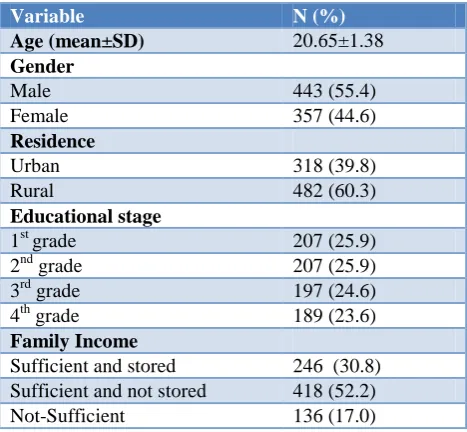
Descriptive statistics of the students showed that more than half of students were males (55.4%), and (44.6%) of them were females, with ages ranged between 18-25 years. The majority of the participants were from rural areas (60.3%) and (39.7%) were from urban areas, graded from 1st to 4th grade with almost equal numbers from each grade. more than half of the students (52.2%) has sufficient income but not saving, (30.8%) has sufficient and saving income while (17%) has not sufficient income (Table 1).
Overall the majority of the participants (80.2%) had
inadequate knowledge concerning exclusive
breastfeeding and 19.8% of them had adequate knowledge.
A significant association between gender and knowledge, p=0.01 and between Grade and knowledge p=0.007 was detected, While demographic variables related to income and residence were not statistically linked to knowledge of breastfeeding, p>0.05 (Table 2).
Table 1: Socio-demographic profile of studied students.
Variable N (%)
Age (mean±SD) 20.65±1.38
Gender
Male 443 (55.4)
Female 357 (44.6)
Residence
Urban 318 (39.8)
Rural 482 (60.3)
Educational stage
1st grade 207 (25.9)
2nd grade 207 (25.9)
3rd grade 197 (24.6)
4th grade 189 (23.6)
Family Income
Sufficient and stored 246 (30.8)
Sufficient and not stored 418 (52.2)
Not-Sufficient 136 (17.0)
Table 2: Relation between knowledge type and socio-demographic characters.
P value Knowledge
Socio-demographic characters
Adequate Inadequate
N (%) N (%)
Sex
0.01* 71 (16.0)
372 (84.0) Male
83 (23.2) 274 (76.8)
Female
Residence
0.886 62 (19.5)
256 (80.5) Urban
92 (19.1) 390 (80.9)
Rural
Grade
0.007* 23 (11.1)
184 (88.9) 1st
46 (22.2) 161 (77.8)
2nd
42 (21.3) 155 (78.7)
3rd
43 (22.8) 146 (77.2)
4th
Income
0.172 57 (23.2)
189 (76.8) Enough and
stored
73 (17.5) 345 (82.5)
Enough but not stored
34 (17.6) 112 (82.4)
Not enough
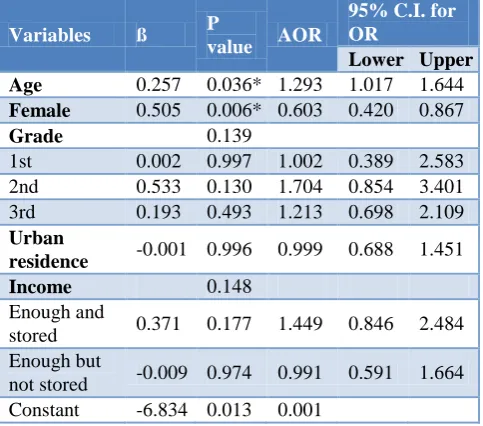
Logistic regression model employing cutoff of knowledge score as (≥11) points as being adequate knowledge (dependent) against the independent variables (age, sex, grade, residence and income).
Table 3: Logistic regression analyses indicating associations between socio-demographic variables and
adequate knowledge.
Variables ß P
value AOR
95% C.I. for OR
Lower Upper
Age 0.257 0.036* 1.293 1.017 1.644
Female 0.505 0.006* 0.603 0.420 0.867
Grade 0.139
1st 0.002 0.997 1.002 0.389 2.583
2nd 0.533 0.130 1.704 0.854 3.401
3rd 0.193 0.493 1.213 0.698 2.109
Urban
residence -0.001 0.996 0.999 0.688 1.451
Income 0.148
Enough and
stored 0.371 0.177 1.449 0.846 2.484
Enough but
not stored -0.009 0.974 0.991 0.591 1.664
Constant -6.834 0.013 0.001
About (54.4%) of the participants has negative attitude towards breastfeeding.
Table 4: Relation between attitude and socio-demographic characters. P value Attitude Socio-demographic characters Negative Positive N (%) N (%) Sex 1.000 182 (41.1) 261 (58.9) Male 146 (40.9) 211 (59.1) Female 0.340 Residence 137 (43.1) 181 (56.9) Urban 191 (39.6) 291 (60.4) Rural Grade 0.942 87.0 (42) 120 (58.0) 1st 87.0 (42) 120 (58.0) 2nd 78 (39.6) 119 (60.4) 3rd 76 (40.2) 113 (59.8) 4th Income 0.12 118 (48) 128 (52) Enough and stored 160 (38.3) 258 (61.7)
Enough but not stored
50 (36.8) 86 (63.2)
Not enough
No significant association between breastfeeding attitude and demographic variables was found, p>0.05 (Table 4).
A significant association has been identified between knowledge and attitude p=0.0001 (Table 5).
Table 5: Relation between knowledge score and attitude.
P value Knowledge
Attitude Inadequate Adequate N (%) N (%)
0.0001* 49 (10.4) 423 (89.6) Negative 105 (32.0) 223 (68.0) Positive DISCUSSION
The main objective of this research was to test the knowledge and attitudes of nursing students with respect to exclusive breastfeeding.
The study showed that the majority of the students
(80.2%) had inadequate exclusive breastfeeding
knowledge, in contrary to an Indian study, which declared an overall adequate knowledge for the majority of students to exclusive breast feeding.15 This inadequate knowledge may be due to the insufficient topics on breast feeding and nutrition in nursing student's curriculum, and may be due to lack of the clinical experience which improve their breastfeeding knowledge and skills Thus indicate the importance of breastfeeding education and its influence in improving nursing students’ knowledge and then future behaviors.
A statistically significant difference was found between gender and knowledge, p=0.01, where female nursing students showed adequate breastfeeding knowledge than male nursing students.
Similar results in North Dakota, as demonstrated that girl students had a significant high level of breastfeeding knowledge than their boy students (p=0.02).15
Kavanagh, et al also declared that female students had significant adequate breastfeeding knowledge than male ones (p=0.02).16 That explained while learning both male and female students are equally done, the nature of the female six make her more interested and concerned about the advantages of exclusive breast feeding as she will be a mother in the future.
Regarding the grade of nursing student, a statistically significant difference was found between student's grade and knowledge, p=0.0007, where 4th grade nursing students showed greater breastfeeding knowledge level than 1st grade nursing students. As nursing students accept more knowledge through their studies in nursing faculty.
breastfeeding knowledge and no association with other factors as family income, and age.17
The study showed nearly a negative attitude to exclusive breastfeeding that is because of the participant poor knowledge, Similar to an Egyptian study which showed also a negative attitude toward exclusive breastfeeding.18 Nursing students should have positive attitude as they will be dealing with and educate pregnant and lactating mothers.
A statistically significant difference between knowledge score and attitude, as significantly higher knowledge scores were observed among participants with positive attitude, similar results shown in a study conducted among female undergraduate university students in Syria and Lebanon.19 While the fair level of awareness among physicians to breastfeeding; more focus should be given to lactation education for nursing students to train future nurses to encourage breastfeeding among mothers and remove any wrong lactation skills.
CONCLUSION
The study showed an inadequate knowledge and a negative attitude of undergraduate nursing students of Beni-Suef University regards exclusive breast feeding. With a significant difference between gender and knowledge score, p=0.03. And a statistically significant difference was found between knowledge score and attitude p=0.001.
Limitations of the study
Choosing a convenient sample of students who filled out the questionnaires and delivered them to the investigators, making them a less representative sample. So, the stratified random sample is preferable for study design.
The studied population does not fairly capture all undergraduate students around Egypt, as one university has drawn the study participants.
ACKNOWLEDGEMENTS
First of all, thanks to ALLAH to whom we attribute the success of this work. Moreover, we would like to thank all of the students who participated in this study.
Funding: No funding sources Conflict of interest: None declared
Ethical approval: The study was approved by the Faculty of Medicine, University of Beni-Suef Research Ethics Committee
REFERENCES
1. United Nations Children’s Fund (UNICEF) (2018) infant and young child feeding. Available at:
https://data.unicef.org/topic/nutrition/infant-and-young-child-feeding/. Accessed on 13 July 2019. 2. Darmstadt GL, Hussein MH, Winch PJ, Haws RA,
Lamia M, El Said MA. Neonatal Home Care Practices in Rural Egypt during the First Week of Life. Trop Med Int Health. 2007;12783-97.
3. El-Gilany A. Breastfeeding indicators in Dakahlia governorate. East Mediterranean Health Journal, 2003;9(5-6):961-73.
4. Schmied V, Beake S, Sheehan A, McCourt C,
Dykes F. Women’s perceptions and experiences of breastfeeding support: a metasynthesis. Birth. 2011;38(1):49–60.
5. Ahmed A, Bantz D, Richardson C. Breastfeeding knowledge of university nursing students. Maternal Child Nursing. 2011;36(6):361-7.
6. Bozzette M, Posner T. Increasing student nurses’ knowledge of breastfeeding in baccalaureate education. Nurse Education in Practice, Advance Online Publication. 2012.
7. Spear, H. Baccalaureate nursing student’s
breastfeeding knowledge: A descriptive survey. Nurse Education Today. 2006;26(4):332-7.
8. Dodgson J, Tarrant M. Outcomes of a breastfeeding educational intervention for baccalaureate nursing students. Nurse Education Today. 2007;27(8):856-67.
9. World Health Organization (WHO) (2009a) Infant and Young Child Feeding, Model Chapter for Textbooks for Medical Students and Allied Health Professionals. Available at: http://whqlibdoc.who. int/publications/2009/9789241597494_eng.pdf. Accessed on 23 July 2010.
10. Oweis A, Tayem A, Froelicher ES. Breastfeeding practices among Jordanian women. Int J Nursing Pract. 2009;15(1):32-40.
11. Brodribb W, Falon A, Jackson C, Hegney D. Breastfeeding and Australian GP registrars – their knowledge and attitudes. Journal of Human Lactation. 2008;24(4):422-30.
12. Abdul HSB, Yahya N. Knowledge, Attitude, Prior Exposure and Intention to Breastfeed among Undergraduate University Students. J Clin Health Sci. 2008;3(2):26-35.
13. Sobti J, Mathur GP, Gupta A. WHO’s proposed global strategy for infant and young child feeding: a viewpoint. J Indian Med Assoc. 2008;100(8):502-6. 14. De la Mora A, Russell DW. The Iowa infant feeding
attitude scale: Analysis of reliability and validity. J Appl Soc Psychol. 1999;29:2362–80.
15. Marrone S, Vogeltanz-Holm N, Holm J. Attitudes, knowledge, and intentions related to breastfeeding among university undergraduate women and men. J Human Lactation. 2018;24:186-92.
16. Kavanagh KF, Zixin L, Nicklas JC, Habibi MF, Murphy LT. Breastfeeding knowledge, attitudes prior exposure and intent among undergraduate students. J Human Lactation. 2012;28:556-64.
17. Afrosea L, Banua B, Ahmeda KR, Khanom K.
breastfeeding among female garment workers in Dhaka city, WHO South-East Asia J Public Health. 2012;1(3):249-55
18. Ahmed A, El Guindy SR. Breastfeeding knowledge
and attitudes among Egyptian baccalaureate students Int Nurs Rev. 2011;58(3):372-8.
19. Hamade H, Naja F, Keyrouz S, Hwalla N, Karam J,
Al-Rustom L, Nasreddine L. Breastfeeding
knowledge, attitude, perceived behavior and intention among female undergraduate university students in the Middle East: The case of Lebanon
and Syria, Food Nutrition Bulletin. 2014;35(2):179-90.