Original Research Article
A cross-sectional study to assess the health profile of street sweepers
and sanitary workers in a zone of Greater Chennai
Corporation, Tamil Nadu, India
Joy Patricia Pushparani, Chitra A.*, Kalpana J.
INTRODUCTION
Occupational health is essentially a preventive medicine. Occupational health of the street sweepers and sanitary workers should aim at their promotion and maintenance of the highest degree of physical, mental and social well-being. But the prevalence of occupational hazards and mortality has been high among street sweepers and sanitary workers. Because high road dust concentrations are usually a problem of urban areas and the effects of the
dust on people exposed to it are a major source of concern as the biological materials in the dust are capable of causing allergic disease in humans, such as a runny nose, watery eyes, and sneezing by larger sized particles, as well as swelling of lung tissue and asthma by fine particles.1
However, National Institute for Occupational Safety and Health 2008 estimated that deaths from work-related respiratory diseases account for about 70% of all
ABSTRACT
Background: Sweepers and sanitary workers are getting exposed to hazardous dust during their work. The health profile of the sanitary workers and utilization of health services are not clearly known. This study aimed to assess the health profile and associated risk factors among street sweepers and sanitary workers.
Methods: A community based cross sectional study was conducted among 73 street sweepers and sanitary workers in a zone of Greater Chennai Corporation by multistage sampling method, during November 2016 to December 2016 using a semi structured questionnaire.
Results: Among the respondents 67.1% were females, 2/3rd of them belonged to the age group of 30-40 years. Majority of them (82.2%) had reported to have musculoskeletal problems followed by respiratory problems (61.6%), ophthalmic problems (53.4%), skin problems (38.4%), mental health problems (39.7%). Most of the respondents had multiple problems. Musculoskeletal problems were more common among the female workers (p=0.002). Health problems like headache, fatigue, giddiness were more common among the workers who worked for >5 years (p=0.006). The utilization of health services was better among those workers who had formal school education (p=0.042).
Conclusions: This study concludes majority of them have musculoskeletal problems followed by respiratory problems and ophthalmic problems. Usage of personal protective equipments and utilization of health services by the sweepers and sanitary workers were poor. Hence steps have to be taken to improve the health status by subjecting them to periodic screening and sensitization programs on usage of PPE.
Keywords: Health profile, Sanitary workers, Sweepers
Institute of Community Medicine, Madras Medical College, Chennai, Tamil Nadu, India
Received: 02 July 2018
Revised: 08 August 2018
Accepted: 09 August 2018
*Correspondence:
Dr. Chitra A.,
E-mail: [email protected]
Copyright: © the author(s), publisher and licensee Medip Academy. This is an open-access article distributed under the terms of the Creative Commons Attribution Non-Commercial License, which permits unrestricted non-commercial use, distribution, and reproduction in any medium, provided the original work is properly cited.
occupation related death worldwide.2 International Labour Organization (ILO) in March, 2000, outlined other working environment related factors to also include exposure to traffic accidents, diesel exhaust, dust, sun heat and glare, smell, noise, harassment and street crime. It is observed that, the working conditions tends to be unsafe for those handling the wastes, the collectors, street sweepers. Besides the danger of cuts and infections from the waste itself, they are also exposed to fumes, violence and speeding traffic.3
As per ILO, March, 2007, the street sweepers have more than one incidence of illness. The common illness experienced by sweepers included occasional flu, cough, eye irritation, rash, skin irritation, diarrhoea, stomach upset, chronic cough, eye disease.4
In an Indian study by Yogesh et al, morbidities detected among street sweepers were hypertension (9.5%), respiratory tract infections (7.3%) and chronic bronchitis (5.9%).5
The sanitary workers who strive hard daily to maintain a clean and healthy environment are exposed to adverse health hazards by nature of their occupation. Therefore, this study was done with the aim to assess the health profile and associated risk factors among Street sweepers and sanitary workers of Chennai Corporation in Tamil Nadu and to create awareness about their health hazards and health promotive measures.
METHODS
A community based cross sectional study was conducted among sweepers and sanitary workers in a Zone of Greater Chennai Corporation during November 2016-December 2016. Multistage sampling method was used.
Based on a Kerala study, with the proportion of accidents (p=22%) and considering confidence interval of 95%, absolute precision of 10%, with 10% excess sampling to account for non-response the sample size calculated was 73.6 The study participants were selected by simple random sampling method from the list provided by assistant executive engineer. Study includes both male and female above 18 years of age and those who were willing to participate in the study and excluded those who were not present on the day of visit and on two successive days and those who did not give consent.
A semi structured oral questionnaire administered by the investigator was the study tool and it had two parts a) Socio demographic profile which included the work characteristic of sanitary workers like age, sex, marital status, religion, literacy, working hours per day, duration of work in years monthly income and personal habits, usage of personal protective equipments and vaccination status; b) morbidity profile includes study variable like respiratory problems, skin problems, musculoskeletal problems, gastro intestinal problems, ophthalmic
problems, mental health problems, animal bites, infection, injuries/accidents, chronic illnesses and other problems like head ache, giddiness, fatigue.
Official permission to conduct the study was obtained from The Greater Chennai Corporation and the Institutional Ethics Committee, Madras Medical College. Informed written consent was obtained from the participants before conducting the study.
Data was entered in Micro Soft-Excel and analysed in SPSS version 16.0 by using chi square test and Fisher’s exact test, taking p value <0.05 as significant at 95% confidence interval.
RESULTS
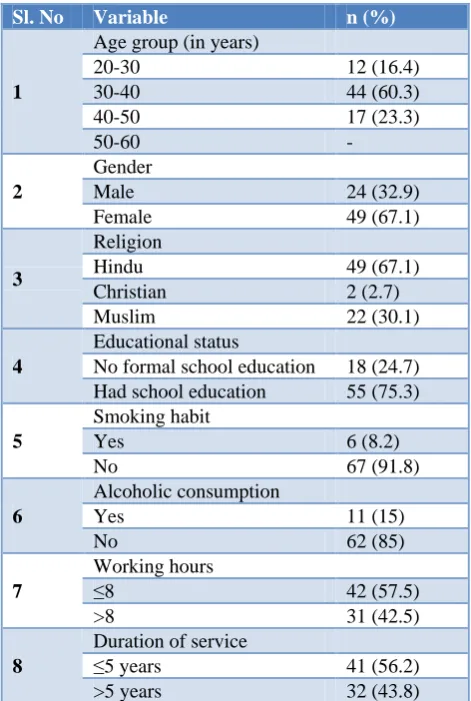
Table 1: Socio demographic details of the study participants.
Sl. No Variable n (%)
1
Age group (in years)
20-30 12 (16.4)
30-40 44 (60.3)
40-50 17 (23.3)
50-60 -
2
Gender
Male 24 (32.9)
Female 49 (67.1)
3
Religion
Hindu 49 (67.1)
Christian 2 (2.7)
Muslim 22 (30.1)
4
Educational status
No formal school education 18 (24.7) Had school education 55 (75.3)
5
Smoking habit
Yes 6 (8.2)
No 67 (91.8)
6
Alcoholic consumption
Yes 11 (15)
No 62 (85)
7
Working hours
≤8 42 (57.5)
>8 31 (42.5)
8
Duration of service
≤5 years 41 (56.2)
>5 years 32 (43.8)
workers working 6 days/week with average working hours of 8/day and average monthly income of INR 9000 (Table 1).
Most of the respondents had multiple problems, of which the most commonly observed morbidity of the workers were Musculoskeletal problems (82.2%), which is also more common in females followed by respiratory illness
and other problems like head ache, giddiness, fatigue, ophthalmic problems, mental health problems, skin problems. Few reported to have gastro intestinal problem, chronic illness, animal bite, injury /accidents, vector borne diseases, water borne illness also. Though the majority of the workers being non-smokers, respiratory illness was found to be the second most common illness (Table 2).
Table 2: Morbidity profile of the study participants.
S. No Morbidity Male Female Total
n % n % n %
1 Musculoskeletal problems 15 25 45 75 60 82.2
2 Respiratory problems 15 33 30 66.7 45 61.6
3 Other problems(Headache, giddiness, fatigue) 10 22.7 34 77.3 44 60.3
4 Ophthalmic problems 8 20.5 31 79.5 39 53.4
5 Mental health problems 7 24.1 22 75.9 29 39.7
6 Skin problems 7 25 21 75 28 38.4
7 Chronic illness (diabetes mellitus, hypertension, heart
disease, epilepsy, tuberculosis) 4 30.77 9 69.23 13 17.8
8 Gastro intestinal problems 5 41.67 7 58.33 12 16.4
9 Animal bite 0 0 8 100 8 11
10 Injury/accidents 6 75 2 25 8 11
11 Vector borne diseases 2 40 3 60 5 6.8
12 Water borne 1 33.33 2 66.67 3 4.1
Table 3: Gender vs. musculo-skeletal problems.
Musculoskeletal problems Test value P value
Gender
Present n (%)
Absent
n (%) 0.007 (Fishers
exact) 0.002
Male (24) 15 (62.5) 9 (37.5)
Female (49) 45 (91.8) 4 (8.2)
Table 4: Duration of work in years versus other problems (head ache, giddiness, fatigue).
Other problems Test value P value
Years of duration of work
Present n (%)
Absent n (%)
Chi Square=7.58; Df=1 0.006 ≤5 years (41) 19 (46.3) 22 (53.7)
>5 years (32) 25 (78.1) 7 (21.9)
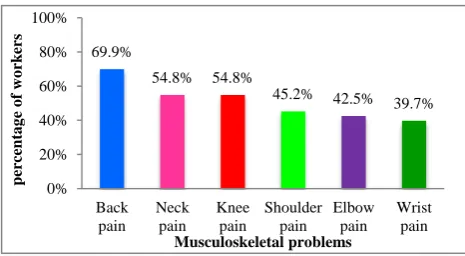
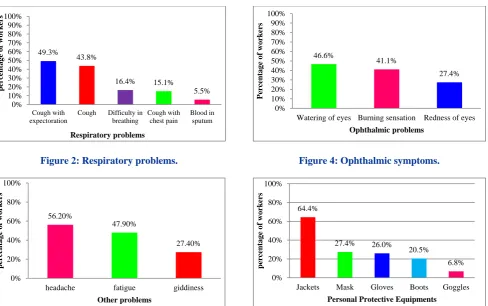
Among the musculoskeletal problems back pain was reported by 69.9% of the workers. Among the respiratory problems 49% of the respondents complained of having cough with expectoration at the time of study. Head ache ranks first in the other health problems, affecting 56.2%of the study participants. Among ophthalmic problems 46.6% were reported to have watering of eyes. In our study 67.1% of the study participants were in the habit of using any one personal protective equipment’s. Most of them were found to use reflector jackets (67.4%) followed by mask (27.4%) and gloves (26%) (Figures 1-5).
Majority of female respondents (91.8%) reported to have musculoskeletal problems as compared to 62.5% of male
and this difference is found to be statistically significant (p=0.002) (Table 3).
Figure 1: Musculoskeletal symptoms.
69.9%
54.8% 54.8%
45.2% 42.5% 39.7%
0% 20% 40% 60% 80% 100%
Back pain
Neck pain
Knee pain
Shoulder pain
Elbow pain
Wrist pain
percentag
e
o
f
w
o
rk
ers
Figure 2: Respiratory problems.
Figure 3: Other problems.
Figure 4: Ophthalmic symptoms.
Figure 5: Personal protective equipment usage.
Table 5: Educational qualification vs. health services availed.
Health services availed Test value P value
Educational qualification
Yes n (%)
No
n (%) Chi Square=4.142
Df=1 0.042
No formal school education (18) 8 (44.4) 10 (55.6) Had school education (55) 39 (70.99) 16 (29.1)
Other problems (head ache giddiness, fatigue) are more prevalent among workers who have work experience of more than 5 years as compared to workers having less than 5 years of experience and this difference is found to be statistically significant (p=0.006) (Table 4).
Among the participants who had completed school education, 70.99% of them availed health services as compared to 44.4% those who had no formal school education and this difference is found to be statistically significant (p=0.042) (Table 5).
Among the non-smokers 64.2% of them had respiratory problem which is not statistically significant. This study reveals 59.4% of those who worked for >5 years had ophthalmic problems compared to 48.8% among those who worked for <5 years.Among the participants with no formal school education, 72.2% were not vaccinated as compared to 61.8% who had completed school education but this difference is not statistically significant.
DISCUSSION
In our study 82.2% of the study participants had musculoskeletal problems. This is high when compared to the study done by Jaykrishnan et al.6 This increase in prevalence can be attributed due to the usage of short and damaged broom, inadequate supply of brooms and working posture. But the findings are consistent with similar study done by Pintakhamet al where 89.3% of the respondents had musculoskeletal problems.7
This study reveals a higher prevalence of respiratory problems in 61.6% of the workers when compared to 21.7% in a study done by Ewiss et al.8 Inspite of most of the workers being non-smokers and also having respiratory problems infer that the problems are not due to smoking alone, but may be due to the dust raised by sweeping and lesser usage of mask.
In our study, as the duration of work years increases there is a corresponding increase in the ophthalmic problems
49.3%
43.8%
16.4% 15.1%
5.5% 0% 10% 20% 30% 40% 50% 60% 70% 80% 90% 100% Cough with expectoration
Cough Difficulty in breathing Cough with chest pain Blood in sputum percentag e o f w o rk ers Respiratory problems 56.20% 47.90% 27.40% 0% 20% 40% 60% 80% 100%
headache fatigue giddiness
percentag e o f w o rk ers Other problems 46.6% 41.1% 27.4% 0% 10% 20% 30% 40% 50% 60% 70% 80% 90% 100%
Watering of eyes Burning sensation Redness of eyes
Perc entag e o f w o rk ers Ophthalmic problems 64.4%
27.4% 26.0%
20.5% 6.8% 0% 20% 40% 60% 80% 100%
Jackets Mask Gloves Boots Goggles
percentag e o f w o rk ers
among the workers which may be due to the negligence of workers in using the goggles. In our study, 53.4% of the respondents reported eye problems which are high when compared to 21% in a study done by Ewiss et al.8 This difference can be attributed to the lesser usage of goggles by our study participants.
The prevalence of skin problems (38.4%) in our study is consistent with the study done by Jayakrishnan et al.6
This study revealed the prevalence of injury/accidents to be 11% similar to the study done by Jayakrishnan et al where it was 9.9%.6
This study shows a high prevalence of animal bite (11%) when compared with the study done by Jayakrishnan et al and the study done in Punewhere it was 0.6% and 0.28% respectively.6,9 This difference needs to be explored further and steps are to be taken to educate the workers to protect themselves from animal bites.
This study shows that, 67.1% of the participants use at least one of the personal protective equipment’s as compared to 48% in a study done by Thirarattanasunthon et al.10 The most commonly used personal protective equipment is the reflector jacket which has contributed to the lesser accidents. About 64.4% of the participants use the reflector jacket and they attribute this practice to regular and quality supply of the reflector jacket. Though gloves and mask are also supplied adequately not all the participants use it as they find it inconvenient to wear the gloves and mask and they feel it interferes with their work. The participants felt the supply of boots and goggles have to be done on a periodic basis.
This study revealed a very less prevalence of chronic illness, only in about (17.8%) of the respondents when compared a study done by Chellamma et alwhere 43.26% had chronic illness.11
This study reveals those who had school education were availing prompt health care services, in a better way as compared to those who did not have school education. With regards to usage of personal protective equipment’s there was no difference between those who have school education and those who do not have formal school education and this may attributed to the lack of awareness of benefits of personal protective equipment’s by both the groups.
There is no difference with regards to vaccination in those who have school education and those who do not have formal school education because the benefits of vaccination are not known to both the groups. The above evidence shows that, in spite of having school education, only if the workers are sensitised of the benefits of using PPE, seeking timely health care and appropriate vaccination, they will adhere.
CONCLUSION
The prevalence of musculoskeletal problems, respiratory, other problems like headache, giddiness, fatigue, eye problems, mental health problems and skin problems were reported to be high among Corporation street sweepers.
This study concludes that majority of the problem faced by sweepers and sanitary workers may be attributed to improper working posture and inappropriate broom sticks, improper usage of personal protective equipment’s, lack of awareness regarding health problems and vaccination.
Recommendations
To create health consciousness, awareness of personal safety, importance and proper usage of personal protective equipment’s, by means of short films through mass media.
More ergonomic principles should be incorporated, like provision of long handled broom sticks, cotton mask, and sweat absorbing gloves of proper size. Periodical screening has to be conducted every three
months.
The usage of personal protective equipment’s by the workers has to be strictly monitored daily.
Adequate supply of personal protective equipment’s and user friendly equipment’s has to be ensured.
Funding: No funding sources Conflict of interest: None declared
Ethical approval: The study was approved by the Institutional Ethics Committee
REFERENCES
1. Park K. Park’s textbook of Preventive and social medicine. 24th ed. Jabalpur: Bhanot publishers; 2017: 1-976.
2. Williams BMD. Occupational Respiratory Diseases. The New England J Med. 2000;342(6):406-12. 3. Nku CO, Peters EJ, Estiet Al, Oku O, Osim EE.
Lung function, Oxygen Saturation and Symptoms among Street Sweepers in Calabar-Nigeria. Niger J physiol Sci. 2005;20(1-2):79-84.
4. International Labor Organization (ILO). The Baseline Survey of the Occupational Safety and health Conditions of Solid Waste Primary Collectors and Street Sweepers in Addis Ababa. March, 2007. 5. Yogesh DS, Sanjay PZ. A Study of Morbidity
Pattern in Street Sweepers: Indian J Community Med. 2008;33(4):224–8.
7. Pintakham K, Siriwong W. Health problems among street sweepers. IOSR J Environ Sci Toxicol Food Tech. 2015;9(7):15-8.
8. Ewis AA, Rahma MA, Mohamed ES, Occupational health related morbidities among street sweepers and waste collectors at Beni-Suef Egypt. Egyptian J Occupational Med. 2013;37(1):79-94.
9. The Occupational Health of waste pickers in Pune, Women in Informal Employement Globalizing and Organizing; 2014: 1-23.
10. Thirarattanasunthon P, Siriwong W, Robson M, Borjan M. Risk Manag Healthc Policy. 2012;5:97– 104.
11. Chellamma P, Sudhiraj, Vijayakumar A. Morbidity Profile of sanitary workers in Thrissur Corporation, Kerala. J Evol Med Dental Sci. 2015;4(89):15468-9.