56
Pedagogical sciences
clinical practice anD innoVatiVe MetHoDs of stuDent’s
proGress eValuation
alpyssova a.r., ilahi M.
RSE on the R of EU “Karaganda State Medical University”, Karaganda, e-mail: [email protected]
The article highlights aspects that reflect the education of foreign students in the “General Medicine” specialty
at the Department of emergency and ambulance Medical care # 1 of the Karaganda state Medical university. Dur-ing studyDur-ing on the course, students of the foreign faculty acquire skills in clinical thinkDur-ing, in particular, they study
the definition of diseases, risk factors, the principles of syndromic diagnosis for the subsequent hospitalization of patients, the transportation skills of patients with emergency conditions; they gain experience as emergency doctors
in practical classes. as a result of the application of innovative technologies of assessing knowledge within the cur-riculum, students become motivated to acquire more knowledge and practical skills. During practical classes, the students come to understand the importance of mastering practical skills during the practical training. the students
aspire to establish themselves as highly qualified specialists.
Keywords: integrated curriculum; innovative methods of clinical teaching, Emergency and Ambulance Medical Care, active clinical training with medical education
the current situation in health care requires reforming the system of medical education, making new demands for the training of highly qualified professionals [1].
in according to modern requirements, there has been a need to initiate new methods of control, including such concepts as systemic, measurable results, objectivity of their evalu-ation, unificevalu-ation, manufacturability and reli-ability [2].
clinical skills education in the undergradu-ate medical curriculum is fundamental to the development of basic clinical method and the lifelong achievement of excellence in clinical practice [3, 8].
clinical studying process is proceeded by basic clinical skills curriculum enhancement required in emergency medical care.
evaluation of the curriculum must not be overlooked, as it is a crucial component of suc-cessful curriculum implementation and efforts for continuous quality improvement of a cur-riculum over time. Done well, it provides essen-tial information to guide learner’s curriculum planners, faculty, and other stake holders such as those who allocate resources [4, 5, 6, 9, 10].
learning around a patient helps to convey a holistic approach to medical care that com-bines the necessary knowledge, clinical skills and attitudes [7].
The additional benefit of an actual clinical setting is that it allows for procedure perfor-mance within clinical context including ob-servation of student professionalism, and their ability to communicate with and provide com-fort for the patient.
The purpose of our research is to report the teaching process and review concerning with foreign medical students that how they are learning particularly theoretical, practical and
clinical based skills by applying innovative methods and further monitoring the student’s progress and evaluation of their clinical knowl-edge by specific assessment and examination procedure.
During the course “ambulance and emer-gency medical care” the foreign students must learn the theoretical material, in particularly, identification, risk factors, guidelines for syn-dromic diagnosis and emergency at a prehos-pital stage indication for hosprehos-pitalization, trans-portation conditions; to form skills in providing emergency care in an epidemic outbreak, in emergencies and disasters; to obtain practical skills working with physicians on emergency calls and in a hospital receptionist.
learning to perform basic and common clinical procedures enables the student not only to understand and perform required clinical procedures, but also to begin to develop con-fidence and competence at a more advanced level of patient-doctor relation and communi-cative skills.
implementation of curriculum development can be preceded by emergency calls and in a hospital receptionist, the student’s participation in a clinical analytical sessions, and analysis of repeat station calls that can be related with sud-den death or severe unconsciousness condition. Discussion about differential diagnoses medical card calls (form 110/u) and medical records in hospitals, the usage of communication skills to create an atmosphere of trust between patient and doctor and to obey the orders of establish-ment of ambulance services.
57
Pedagogical sciences
managing the medical records of ambulance and emergency care service.
for foreign students, in practical classes objective priority is that to focus the related topics under specific protocol for the purpose, in every practical class, discussion about re-lated topics are preceded on urgent diagnostics and treatment.
In the respective field of emergency medi-cine the most important act is the concerning knowledge and time duration; that how in short time we can diagnose and treat the pa-tient on urgent ambulatory call. additionally, in self-individual work with teacher, they are advised to solve concerning topic tasks about clinical situations. in the duration, teacher’s approaches to clarify the concerning tasks by which students can deal any emergency
situ-ations. During the period, there are given du-ties by department in ambulances in different stations to understand and practice of clinical skills. students are going to ambulances with concerning staff including emergency doctor or first aid man and nurse.
students are advised by teacher to do phys-ical examination for purpose of urgent diag-nose by apply their clinical skills to treat the patient urgently.
Next day of ambulance duty teacher is ask-ing about their work experience or progress; in that time asking about complaints, condition of patients and how student checked the patients and about student’s observations during clini-cal propaedeutic or physiclini-cal examination; at last, student’s strategy in a very short period to diagnose and treatment of patient.
58
Pedagogical sciences
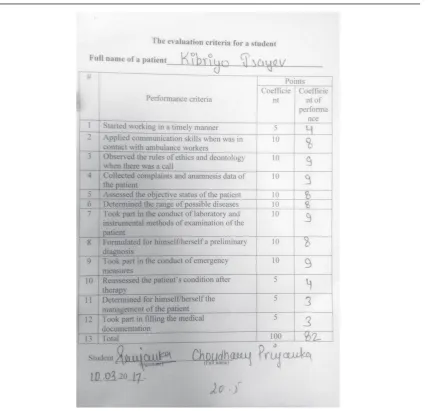
fig. 2. the evaluation criteria for a medical worker of an ambulance crew General disadvantages: during practical
classes, has been observed language barrier of some foreign students on occasion of commu-nication with crew and patients. the attitude and behaviour of crew of station are not so obligatory for foreign students. in ambulances the some doctors not allowed them to check the patients and not showed them practical skills (in form of electrocardiogram (ecG), glucom-eter results, sphinomanomglucom-eter results).
the practical classes are mandatory for all students, including the foreign students.
During the period of studying the discipline in addition of practical lessons, the foreign students obtain practical knowledge in centre of practical skills (cps) of Karaganda state Medical univer-sity, like that cardiopulmonary resuscitation, in particularly the technique of chest compressions, methods of artificial respiration “by mouth to mouth”, by mask, Ambo, and defibrillation
tech-nique; registration and interpretation of ECG; emergency assistance in cardiogenic shock, trau-matic shock, relief of bronchial obstruction, hy-pertensive crises, hypoglycaemic states.
at the practical classes on the ambulatory call, in cps, the foreign students have to be able to show the basic principles of diagnosis of emergency conditions, to render the first medical assistance for various emergency con-ditions and to improve skills of interpersonal communication and consultation of patients.
59
Pedagogical sciences
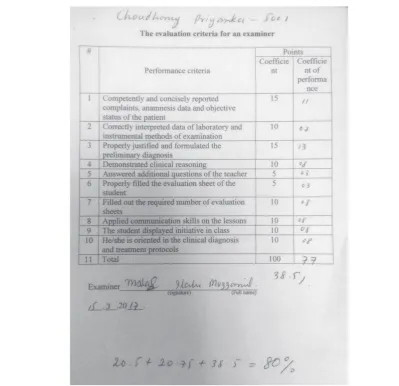
Fig. 3. The evaluation criteria for an examiner
Mini-clinical exam held during the learn-ing process. it is estimated in accordance with the 3 check lists: of medical workers, students and teachers (fig. 1, 2, 3).
Mini clinical examination, which is held at the Department of ambulance and emergency Medical care #1, stimulates students to learn practical skills well, due to the fact that the stu-dents start to understand that practical skills are important part of the work in practical public health.
about evaluation of practical skills: in 2016 academic year, students of foreign de-partment showed following results: marks of mini-clinical exam compiled 87,3 %; work of CPS – 87,8 %.
Conclusion
the foreign medical students are
con-practical clinical skills on the basis of inno-vative methods of clinical skills assessment. There is conducted specific examination pro-cess to evaluate students that are declared their success according to their performance. Successful graduates can be beneficial for their clinical professional practice in the field of medicine.
References
1. Electronic scientific journal “Apriori. Chapter: natural and technical science”. – 2014. – No. 6. – Р. 3.
2. Muminov t.a, Dauletbekova M.i. objective
struc-tured clinical examination in assessing the manual skills of
graduates in the speciality “general medicine” almaty
“eve-ro”. – 2007. – 136 p.
3. recommendations for clinical skills curricula for
under-graduate medical education; task force on the clinical medical colleges, Washington DC, November 2005.URL:http://www.
aamc.org/meded/clinical skills/
4. Bland c.J., starnaman s., Wersal l. et al. curricular
60
Pedagogical sciences
5. Kern D.e., thomas p.a., Howard D.M., Bass e.
Curriculum development for medical education; a six –
step approach/John Hopkins university press //
Balti-more. – 1998.
6. Harden r., cosby J., Devis M. aMee Guide no.14: outcome-based education: part 1 – an introduction to
out-come-based education. Med Teacher. – 1999. – Vol. 21,
1:7. – p. 14.
7. steven l. Kanter. essential skills for a medical
teacher / Churchill Livingstone // ELSEVIER. – 2012. –
Vol. 24. – p. 152.
8. alpyssova a.r., subbota Y.V., Mataeva l.M.,
Bo-charova L.I., Telembetov N.T. Experience in implementing
innovative methods for assessing knowledge. Journal
“Medi-cine and ecology”. – 2015. – No 1. – P. 63–66.
9. Alpyssova A.R., Subbota Y.V., Kyzyrova Zh. S. Ob
-jective structured clinical examination, as an innovative
method for assessing knowledge// Modern problem of
sci-ence and education. – 2016. – No 1; URL;http://scisci-ence-ed -ucation.ru/ru/article/view? id = 24111 (date of the
applica-tion):20.04.2017).
10. Alpyssova A.R., Subbota Y.V. “Simulation technolo -gies in assessing the practical skills of graduates”. conference materials service specialists of the sanitary aviation service,
am-bulance and simulation centers, central Asian scientific and prac