REVIEW ARTICLE
THE THREE-DIMENSIONAL PROBABILITY CSMA BASED ON DOUBLE CLOCKS MECHANISM
Shengjie Zhou, Yifan Zhao,
*Hongwei Ding, Zhijun Yang, Qianlin Liu and Chunfen Li
School of Information, Yunnan University, Kunming, Yunnan, 650091, P.R. China
ARTICLE INFO
ABSTRACT
IOT (Internet of Things, IoT) is predicted to continue another wave of science and technology and the global economy after the Internet information industry, by governments, businesses and academic attention, the United States, European Union, Japan, and even integrating them into national and regional information Strategy. As the Internet continues to rich business types, expand complex, from single to fusion, from a variety of access methods to the core network of the whole transition fusion. By applying the theory of double clocks control to the CSMA protocols, setting the probability of sending packet and the probability of sensing channel to improve system performance. Through modeling analysis, the proposed three-dimensional probability CSMA based on double clocks mechanism decrease the system idle time, making the channel resource highly use.
Copyright © 2015Shengjie Zhou et al.This is an open access article distributed under the Creative Commons Attribution License, which permits unrestricted use, distribution, and reproduction in any medium, provided the original work is properly cited.
INTRODUCTION
IOT (Internet of Things, IoT) is predicted to continue another wave of science and technology and the global economy after the Internet information industry, by governments, businesses and academic attention, the United States, European Union, Japan, and even integrating them into national and regional information Strategy (Zhao Dongfeng, 1999).
Definition of things by ITU is: things was to achieve to object (Thing to Thing: T2T), person to object (Human to Thing:
H2T) and person to person (Human to Human)
interconnections. Interconnection refers here to persons and things, people use sensors and other equipment interconnected with the object, and the interconnection between people refers to people using sensing system instead of the current computer
interconnects between people (Hongwei Ding et al., 2015).
The core of Things is interconnected to achieve an object (including people) between, enabling information exchange and communication between the object and the object. After the object information is transmitted to the information processing center, services and applications can be achieved through a variety of information by the network (Shengjie
Zhou et al., 2015). The primary role of Things is to reduce the
distance between the physical world and information systems, it can be a radio frequency identification (RFID), sensors, global positioning systems, mobile phones and other devices, according to the agreed protocol, all the objects in the world are all connected the information network, making them active
*Corresponding author: Hongwei Ding,
School of Information, Yunnan University, Kunming, Yunnan, 650091, P.R. China.
participants in the event handler, reflects the integration of
physical space and information space (Zhao Dongfeng et al.,
1997). These intelligent services and objects can interact through a network, access to any relevant information relating to these objects. As the Internet continues to rich business types, expand As the Internet continues to rich business types, expand the range of applications. Application requirements increasing, the network will pass the line from simple to complex, from single to fusion, from a variety of access methods to the core network of the whole transition fusion.
Things following the PC, the Internet, wireless
communications technology fourth IT revolution, have great scientific significance and application value. Things make that humans can rely on a more refined and dynamic management
of production and life, to achieve "smart" state (Yi Shang et
al., 2007), improve resource utilization and productivity
levels, improve relations between man and nature. Things appear from the life, production, social, economic, political, military, technological and other aspects of the impact of human life and the world.
Wireless communication, wireless intelligent sensor networks,
micro sensors, network communication, multimedia
communication and wide band communication has been relatively mature, but not yet in-depth study of these technologies and the relationship between things, things to communications technology brings new problems. The key to ensure wireless sensor network communications media (MAC) protocol in wireless sensor network protocol just bottom part, for a fair and effective sharing of communication medium between the sensor nodes have a greater impact on the
ISSN: 0976-3376
Vol.06, Issue, 12, pp.2070-2074, December,Asian Journal of Science and Technology 2015ASIAN JOURNAL OF
SCIENCE AND TECHNOLOGY
Article History:
Received 28th September, 2015
Received in revised form 16th October, 2015
Accepted 04th November, 2015
Published online 30th December, 2015
Key words:
Three-dimensional probability CSMA, Double clocks,
performance of the sensor network, is one network protocols. Performance of networks such as throughput, latency performance depends entirely on the dry MAC protocol used (Liu Binbin, 2006). Therefore, the design of a superior performance of MAC protocol algorithm has become a hot issue in research.
We proposed a three-dimensional probability CSMA based on double clocks mechanism, set the three probabilities to improves the controllability of the system, the channel utilization, system security, and reliability of packet transmission. Using the averaging cycle period conduct analytical and simulation experiment with the control strategy mentioned above. By modeling analysis, the analytical results and simulation results show that the theoretical analysis is consistent with the simulation experiments.
The Model
The model of three-dimensional probability CSMA protocol
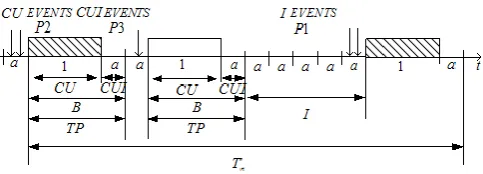
based on double clocks mechanism is showed as Fig. (1).
Fig. 1. The model of three-dimensional probability CSMA based on double clocks mechanism
In the proposed protocol, there will be three random events:
a. U events: Event that information packets are sent
successfully.
b. C events: Event that information packets collide with each
other (the collision appears).
c. I events: Event that there is no information packets in the
channel arrive, the channel is idle.
Set the probability
P
1of sending packet at the I events, theprobability P2of sensing channel during “1” of the TP time
and the probability P3of sensing channel during “a” of the TP
time.
Analysis of the system throughput
Before analyze the system performance, first do the following assumptions:
a. The channel is ideal with no noise and interference;
b. The basic unit of the system control clock is
a
, theinformation packets arrived at time
a
will transmit at thestarting time of the next slot (Ma Zuchang et al., 2004);
c. The channel propagation delay is
a
, the packet length isunit length and is an integral multiple of
a
;d. The arrival process of channel satisfy the Poisson process
whose independent parameter isG (Huang Jiancheng et
al., 1983);
e. The channel using the new protocol, the information
packets need to be sent at the first slot in the transmission period can always detecting the state of the channel at last moment (Zhao Dongfeng, 1999);
f. During the transmission of information packets, the
phenomenon of packet collisions occur inevitably, and continues to be sent after a random time delay, it sends will not produce any adverse effects on the arrival process channel (Zhao Dongfeng, 1997).
The arrival process of channel satisfies the Poisson process:
( )
( ) !
n aG
aG e P n
n
(1)
In Equation (1), ( )P n is the event of n packets arriving during
time of a.
First, solve the average length E U( ) of packet successfully
sent in the event of U.
Packet successfully sent into the following two cases:
(1) If packets arrive during the last slot of idle period, namely packet arrives at the continuous clock control, and in the next slot time, no one but it adhere to send it, then it is sent
successfully, the record for the event is U1.
The average length of U1is:
1
1 1
1 1
( ) ( ) 1
1 ap G
U ap G
ap Ge
E U E N
e
(2)
(2) If the packet arrives at the busy period, and the packet is the only packet adhere to sent at the current TP period, then the packet will be successfully transmitted within the next TP
period, referred to as an event of U2.
At the transmission period, if there is no information packets to be sent, its possibility is:
2 3
( )
0
G p ap
q
e
(3)In the transmission period (1a), if there is only one
information packet to be sent, its possibility is:
2 3
( ) 1 ( 2 3)
G p ap
q G p ap e (4)
In a cycle, the average length of information packets
transmitted successfully at the U2 is:
1
2 2 3
0
( ) q ( )
E U G p ap
q
(5)
Then the average length ( )E U is:
1 1
1
1 2 2 3
( ) ( ) ( ) ( )
1 p Ga
p Ga
p Gae
E U E U E U G p ap
e
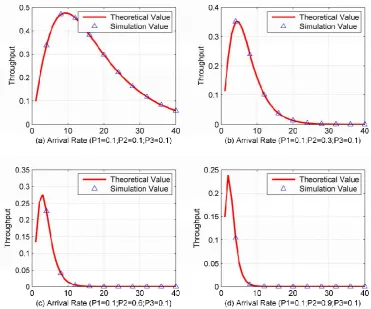
Fig. 2. The throughput of the new protocol with different P1
Secondly, the average length ( )E B during the busy period:
2 3
( ) 0
1 1
( ) ( B)(1 ) (1 ) G paap
E B E N a a
q e
(7)
Finally, the average length ( )E I during the idle period:
Since the number of idle slots I within the geometric distribution with the mean:
1
1 ( )
1 Gp a
E N e
, an information
packet arrive in a time slot with normalized probability:
1 1 1 1 1 Gp a
I Gp a
Gp ae p e
, more than an information packet arrives in
a time slot with the normalized probability:
1 1 1 1 2 1 1
Gp a Gp a
I Gp a
Gp ae e
p e .
Then we get:
1 1 1
1 1 1
2
1 (1 1 )
1
( ) ( 1)
1 2(1 ) 1
Gp a Gp a Gp a
Gp a Gp a Gp a
Gp a e Gp ae e a
E I a
e e e
(8)
Besides, we know that the average length '
( )
E I during the idle
period under the traditional three-dimensional probability is:
1
' ( )
1 Gp a
a E I e (9)
The throughput of the new protocol is:
1 1
1
2 3 1 1
1 1 1 1 2 3 2 1 ( ) 1 ( ) ( ) ( ) [ ( )] 1 1 1
/[ ( 1)
1 2(1 )
(1 ) ] 1 i p Ga p Ga Gp a
G p ap Gp a G p a
Gp a Gp a
Gp a
E U S
E B E I
p Gae
G p ap
e
Gp a e a
a
e e e
Gp ae e a
e (10) Simulation
From the above analysis, the expression of the system throughput under the double clocks three-dimensional probability CSMA with the functions of monitoring is got. Based on the above analysis, with the use of simulation tool: MATLAB R2010a, the simulation results are shown as following. During the simulation, transmission delay time:
0.1
a .
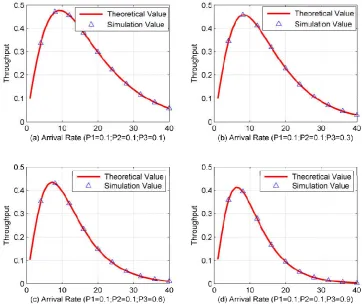
By the introduction of the three-dimensional probability CSMA, we are able to control the system throughput by change the probability of sending packet or the probability of sensing channel. Also we can change all of them at the same time too. So the new protocol can perform better than other
protocols on the controllability. In Fig. (2) and Fig. (4), the
simulation values of system throughput under the new protocol are consistent with the theoretical ones, verified the correctness of mathematical derivation done before.
Fig. 5. The throughput of the new protocol and the traditional one
By the Fig. (5), we know the system throughput under the new
protocol is higher than the traditional three-dimensional probability CSMA protocol.
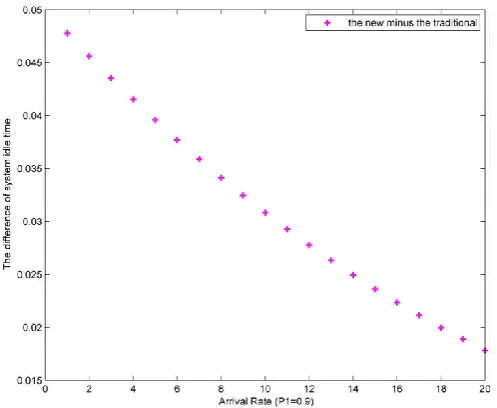
Fig. 6. The difference of system idle time between the new protocol and the traditional one
The introduction of double clocks is to lower the system idle
time. In the Fig. (6), we know the system idle time under the
new protocol is lower than the traditional three-dimensional probability CSMA protocol. And the channel resource is use more highly than the usually ones. Therefore the mechanism works effectively
Conclusions
IOT (Internet of Things, IoT) is predicted to continue another wave of science and technology and the global economy after the Internet information industry, by governments, businesses and academic attention, the United States, European Union, Japan, and even integrating them into national and regional information Strategy.
As the Internet continues to rich business types, expand complex, from single to fusion, from a variety of access methods to the core network of the whole transition fusion. By applying the theory of double clocks control to the CSMA protocols, setting the probability of sending packet and the probability of sensing channel to improve system performance. Through modeling analysis, the proposed three-dimensional probability CSMA based on double clocks mechanism decrease the system idle time, making the channel resource highly use. At last the analytical results and simulation results also show that the theoretical analyses are consistent with simulation experiments.
Acknowledgements
This work was supported by the National Natural Science Foundation of China (61461053, 61461054, 61072079);
Natural Science Foundation of Yunnan Province
(2010CD023); The Financial Support of Yunnan University (No.XT412004).
REFERENCES
Hongwei Ding, Yingying Guo, Yifan Zhao, Shengjie Zhou, and Qianlin Liu. 2015. Research on the Multi-Channel Probability Detection CSMA Protocol with Sensor
Monitoring Function. Sensor Lett. 13, 143-146.
Huang Jiancheng, Xie Hai and Xu Bingzheng, 1983. “Random Prediction Tree Protocol Decomposing Collision
Packets”(J), Journal of China Institute of
Communications,Vol.3, pp.21.
Liu Binbin, 2006. The Analysis of Multi-channel Random Multiple Access Wireless Communication Network Protocol based on Probability Detection (D). Kunming: Yunnan University, 55-59.
Ma Zuchang, Sun Yining and Mei Tao, 2004. “Survey on
Wireless Sensor Network”(J), Journal of China
Institute of Communications,Vol.25, pp.114-124, No.4.
Shengjie Zhou, et al., 2015. Research on the Discrete time
Three-Dimensional Probability Csma Protocol In
ad-hoc Network. International Journal of Recent Scientific
Research Vol. 6, Issue, 5, pp.4257-4262, June, 2015. Yi Shang and Hongchi Shi, 2007. Flexible Energy Efficient
Density Control on Wireless Sensor Networks(J). International Journal of Distributed Sensor Networks, 3(1): 101-120.
Zhao Dongfeng, 1997. “Study on A New Method for the
Slotted Access Channel”(J), Journal of
Electronics,Vol.19, pp.814-819, No.6.
Zhao Dongfeng, 1999. “Study on the Average Cycle Method for Slotted Multiple-Access Communications”(J), Journal of China Institute of Communications,Vol.20, pp.80-85, No.8.
Zhao Dongfeng, Li Bihai and Zheng Sumin, 1997. Study on a New Method for the Slotted Access Channel (J). Journal of Electronics, 19(6):814-819.
Zhao Dongfeng, 1999. Study on A New Method for Continuous-time Systems of Random Access Channel
(J). Journal of Electronics, 21(1): 37-41.