Original Research Article
Awareness and acceptance of contraceptives among the mothers of
infants attending an immunization session at a field practices
area of a tertiary care hospital
S. B. Gupta
1, Meenakshi Singh
1, Atul Kr. Singh
1, Huma Khan
1, Alpana Saxena
2*
INTRODUCTION
The postpartum period is an ideal time to initiate contraception because these women are accessing the healthcare system and might have increased motivation and zeal to avoid another pregnancy in the near future. As is known, non-breastfeeding women might ovulate as early as 25 days postpartum, therefore, it is imperative to initiate contraception in the postpartum period as early as feasible.1 Contraceptive use during postpartum period is critical for maternal and child health. Family planning can avert more than 30% of maternal deaths and 10% of child mortality if couples spaced their pregnancies more than two years apart.2 Closely spaced pregnancies within first year postpartum are the riskiest for both mother and
baby and lead to poor outcomes for both.3 According to an analysis of Demographic and Health Survey data from 27 countries, 65% of women who are 0-12 months postpartum want to avoid pregnancy in the next 12 months but are not using contraception.4
The largest population of women with an unmet and underestimated requirement for contraception is in their first year after childbirth.4 It has been seen that mortality risks are increased for both the previous child and the newborn infant if birth intervals are smaller than recommended.5
As a measure to reduce the adverse maternal, perinatal and infant outcomes, WHO (2006), recommended that
ABSTRACT
Background: India was the first country in the world to have launched a National Programme for Family Planning. Methods: A cross-sectional descriptive study was carried out in the in Vaccination unit of rural field practice area of Shri Ram Murti Smarak institute of Medical Sciences (SRMSIMS) Bareilly (U.P). Objective of the study was to assess knowledge and practice of postpartum contraception and factors affecting the usage of contraceptives in Rural area.All females who delivered within last one year were included in the study. A pre-structured questionnaire was used. A total of 98 females were included. The appropriate statistical analysis was done to present the results.
Results: 28.57% females had adopted one or the other postpartum contraceptive measure. Condom was the most common method used. Usage of postpartum contraception was significantly associated with women’s and husband’s education, type of delivery and availing of antenatal and postnatal visits.
Conclusions: Overall usage of postpartum contraception was low there is need to focus at every step to contact of these women with health facility or health workers.
Keywords: Postpartum contraception, Prevalence, Factors, Rural area, Usage
Department ofCommunity Medicine, 1Shri Ram Murti Medical College, 2SRMS, IMS, Bareilly, Uttar Pradesh, India
Received: 02 November 2018 Revised: 04 December 2018 Accepted: 05 December 2018 *Correspondence:
Dr. Alpana Saxena,
E-mail: [email protected]
Copyright: © the author(s), publisher and licensee Medip Academy. This is an open-access article distributed under the terms of the Creative Commons Attribution Non-Commercial License, which permits unrestricted non-commercial use, distribution, and reproduction in any medium, provided the original work is properly cited.
the interval between a live birth and the next pregnancy should be two years (24 months).6 Short birth intervals (<24 months) also lead to increased risk of maternal death and pregnancy related complications.7
Hence this cross–sectional study was undertaken to assess the knowledge and practice of contraception in the postpartum women attending an immunization session.
METHODS
This was a cross-sectional study conducted over a period of 3 month from July 2017 to September 2017 in Vaccination unit of field practices area of Shri Ram Murti smarak institute of Medical Sciences (SRMSIMS) Bareilly (U.P), a tertiary care hospital chosen purposely. A total of 98 post-partum women attending the immunization services for their infants were enrolled in the study after taking oral consent and were given a pre structured questionnaire to answer and their answers were noted. These mothers were asked questions to know about their knowledge and practice about contraception & the various methods available thereof. They were counseled about various methods of family planning accordingly. Permission for the study was obtained from the college authorities prior to commencement.
Inclusion criteria
Inclusion criteria were mother of infants for vaccination willing to participate and given oral consent.
Exclusion criteria
Exclusion criteria were mothers not willing to participate; age of child more than one year; mothers were not resuming sexual activity.
Data analysis
The data collected were entered in Microsoft Excel and checked for any inconsistency. The dichotomous/ categorical variables were analyzed by using Chi-square statistics. The p<0.05 was considered as significant. All the analysis was carried out by using SPSS 16.0 versions.
RESULTS
Tubectomy was the most commonly known method (91.84%) followed by condom (88.78%), 84.69% knew about male sterilization, 72.45% OC pills, 41.84% women knew about natural methods of contraception, 8.16% mother did not know about any method of family planning (Table 1).
Table 2 shows that total 28 mothers were using contraceptive out of them condom was the most preferred method of contraception by participants as it was 12 (42.86%) of total users, and 6 (21.43%) were adopted permanent sterilization 14.29% of participants adopted
IUCDs as method of family planning. 3 (10.71%) participants were using natural methods as a method of contraception.
Table 1: Distribution of participants according to knowledge of different contraceptive methods
(multiple response answers)*
Method No. of
participants Percentage (%)
Condom 87 88.78
IUCD 66 67.35
OC Pills 71 72.45 Tubectomy 90 91.84 Vasetomy 83 84.69 Injectable 41 41.84 Natural 41 41.84
Table 2: Distribution of participants according to type of contraceptive use (n=28).
Type of contraceptive use Contraceptive users
(N) (%)
Condom 12 42.86
Permanent methods 6 21.43
Pills 2 7.14
IUCD 4 14.29
Inj. /implants 1 3.57 Natural methods 3 10.71 Total contraceptive methods 28 100
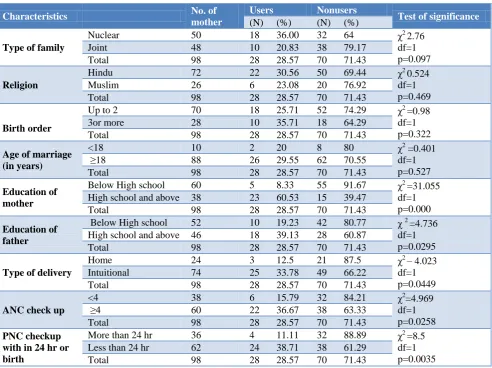
Table 3 shows that the most (37) of mothers were belonged to the age group of 18-24 years out of them 22.86% were the user of contraceptive methods and 82.86% were not using any method. While maximum user were among the mother were in age group of 25-34 years i.e. 38.89%, in age group of 35-45 only 22.23% were the users of contraceptives, but the association of age of mother with contraceptive use rate was not found significant (p=0.131).
Most of mother were in middle socio economic status, followed by lower and upper, contraceptive user were more among the upper and middle status group i.e. 30% in both group, while in lower group were 26.32% but there was no statistically significant association between socio economic status and contraceptive use (p=0.925). Most (50) of mother belonged to nuclear families. Contraceptive users were more (36%) among the mothers of nuclear families, 20.83% users were among the mothers belonged to joint families. But the type of family and contraceptive use rate was not found significantly associated (p=0.966).
difference had no statistically significant association (p=0.469).
Table 3: Demographic and other factors affecting contraceptive use rate.
Characteristics No. of
mother
Users Nonusers
Test of significance
(N) (%) (N) (%) Type of family
Nuclear 50 18 36.00 32 64 χ2
2.76 df=1 p=0.097
Joint 48 10 20.83 38 79.17
Total 98 28 28.57 70 71.43
Religion
Hindu 72 22 30.56 50 69.44 χ2
0.524 df=1 p=0.469
Muslim 26 6 23.08 20 76.92
Total 98 28 28.57 70 71.43
Birth order
Up to 2 70 18 25.71 52 74.29 χ2
=0.98 df=1 p=0.322 3or more 28 10 35.71 18 64.29
Total 98 28 28.57 70 71.43
Age of marriage (in years)
<18 10 2 20 8 80 χ2
=0.401 df=1 p=0.527
≥18 88 26 29.55 62 70.55
Total 98 28 28.57 70 71.43
Education of mother
Below High school 60 5 8.33 55 91.67 χ2
=31.055 df=1 p=0.000 High school and above 38 23 60.53 15 39.47
Total 98 28 28.57 70 71.43
Education of father
Below High school 52 10 19.23 42 80.77 χ 2
=4.736 df=1 p=0.0295 High school and above 46 18 39.13 28 60.87
Total 98 28 28.57 70 71.43
Type of delivery
Home 24 3 12.5 21 87.5 χ2 – 4.023
df=1 p=0.0449 Intuitional 74 25 33.78 49 66.22
Total 98 28 28.57 70 71.43
ANC check up
<4 38 6 15.79 32 84.21 χ2
=4.969 df=1 p=0.0258
≥4 60 22 36.67 38 63.33
Total 98 28 28.57 70 71.43
PNC checkup with in 24 hr or birth
More than 24 hr 36 4 11.11 32 88.89 χ2
=8.5 df=1 p=0.0035 Less than 24 hr 62 24 38.71 38 61.29
Total 98 28 28.57 70 71.43
Majorities (70) of participants were having two children, but the use rate was more among the mothers having 3 or more children i.e. 35.71%. Birth order was not significantly associated with contraceptive use rate (p=0.322).
Majority (88) of mothers were married at or after the legal age of marriage out of them 29.55% were the users of contraceptives, women married before 18 years were using less contraceptive also, but this difference of use of contraceptive methods with age of marriage of women was not found statistically significant (p=0.527).
Out of total 98 participants, mostly (74) delivery was conducted at institutions approved for delivery while 24 deliveries conducted at home, delivery places other than approved places considered as home deliveries. 33.78% were the contraceptive methods user were among the participants with last institutional delivery while only 12.5% were user of family planning methods among the participants last delivery at home, this difference was proved statistically significant (p=0.045).
60 Mother were receiving 4 or more ANC check up in their last pregnancy, out of them 36.67% were the users of contraceptive methods, while the mothers receiving less than 4 check up also adopting less contraceptives methods i.e. 15.79% and 36.67% respectively (p=0.0258).
(Minimum 4 check up recommended by GOI). First PNC check up within 24hr of child birth were received by most (62) of women. Maximum user of contraceptive also from this group i.e. 38.71% in comparison to contrast group i.e. 11.11%. This was proved statistically (p=0.0035).
DISCUSSION
72%, IUCD was the most commonly known methods followed by barrier methods i.e. 82.77% and 76.38%, injectable was known to 38.83% 9.72% were aware about lactation amoemorrea methods, few known to safe methods.8 Kripa et al Karnataka found that around 88% of the post partum women knew that there are methods to prevent pregnancy.9 Over all knowledge of contraceptive among women of reproductive age group was more than 90% by in NFHS 3.
In present study among the mothers post partum contraceptive use rate was 28.57%. In a study by Sidhu et al the postpartum contraceptive use observed in their study was 30.4%.10 Singh et al reported postpartum contraceptive usage was 33% in an urban area.11 Mahmood et al reported the post partum contraceptive use rate was 13.8%.12 Goel et al reported post partum contraceptives use was 28% for rural UP the current use of different methods of Family planning.13 Around 20.0% of post-partum contraception has been reported by NFHS-3 (2005-2006) for rural U.P.14 Singh et al in our study 36.6% postpartum women used contraceptive method after previous delivery, higher post-partum contraception prevalence of 41.0% has also been reported from a population council study.11,15
Condom was the most (42.86%) preferred methods of contraception by participants and 21.43% of participants adopted permanent methods as method of family planning.10.71% participants were using natural methods as a method of contraception. it was in comparable to Sidhu among those using contraceptives 71.4% used condoms while 10.6% had got permanent sterilization.10 Condom use was maximum as also reported in the studies by Singh KK, Mahmoodand, Goel et al.11-13
In present study most of user mothers were in age group of 25-34 years 38.89%, age of mother, socio economic status, age of marriage, parity not found significantly associated but the education of mother and father were found significantly associated with contraceptive use rate. Similarly the Mahmood et al found the education of mother was significantly associated with post partum contraception, similarly Singh et al reported that there was significant difference between contraceptive use and education status (p=0.05).12,15 Contraceptive use was higher in literate women.
In present study MCH services utilization was more found as a significantly associated with post partum contraceptive use, type of delivery and number of ANC and PNC checkup were found significantly associated with contraceptive use. Similar association was reported by Singh, Mahmood, Barber and Ekabua.11,12,16,17 Antenatal period is more appropriate to motivate a female to accept postpartum contraception than postnatal period. So this period should be adequately utilized for postpartum contraceptive counseling.16,17
CONCLUSION
In spite of good knowledge few women were using contraceptives in post partum period, so need to focus on providing correct information and proper counseling during their visit to health facility or contact to health worker at ANC visits, hospital stay for delivery, PNC visit or at the time of vaccination of their child. Such an approach will break all the myths and wrong beliefs among the women about contraception and the various devices that are available and help improve the general health of the women and their children.
ACKNOWLEDGEMENTS
I would like to express my profound gratitude to all the participants.
Funding: No funding sources Conflict of interest: None declared
Ethical approval: The study was approved by the Institutional Ethics Committee
REFERENCES
1. Laurie. CDC updates guidelines for postpartum contraceptive use. Medscape, 2011.
2. Mehata S, Paudel YR, Mehta R, Dariang M, Poudel P, Barnett S. Unmet need for family planning in Nepal during the first two years postpartum. Biomed Res Int. 2014;6(4)956-7.
3. DaVanzo J, Hale L, Razzaque A, Rahman M. Effects of interpregnancy interval and outcome of the preceding pregnancy on pregnancy outcomes in Matlab, Bangladesh. BJOG. 2007;114(9):1079-87. 4. Ross JA and Winfrey W. Contraceptive use,
intention to use and unmet need during the extended postpartum period. Int Family Planning Persp. 2001;27(1):20-7.
5. Hob craft J. Demographic and health surveys, Int health Rationale for Family Planning, 1st Ed, New York: United Nations; 1994: 112.
6. World Health Organization Report of a WHO technical consultation on birth spacing, in: WHO, Eds, WHO report, Geneva: WHO; 2006: 1-37. 7. Conde-Agudelo A, Belizán JM. Maternal morbidity
and mortality associated with interpregnancy interval: cross sectional study. BMJ. 2000;321(7271):1255-9.
8. Nath J. Contraception in Postpartum Women of North India – A Study of Knowledge, Concepts and Practice. SF Obste Heal J. 2017;1:1.
9. Kripa S, Shetty H. Knowledge, attitude and practice of contraception among the postnatal women in a tertiary care hospital in a rural area in Southern Karnataka, India. Int J Reprod Contracept Obstet Gynecol. 2017;6:1821-4.
practice area of a tertiary hospital. Indian J Comm Health. 2015;27(1):139-42.
11. Singh KK, Verma S, Tanti S. Contraceptive use among postpartum women in India. Asian Population Studies. 2014;10(1):23-39.
12. Mahmood SE, Srivastava A, Shrotriya VP, Shaifali I, Mishra P. Postpartum Contraceptive Use in Rural Bareilly. Indian J Comm Health. 2011;23(2):56-7. 13. Goel S, Bhatnagar I, Khan ME, Hazre A. Increasing
postpartum Contraception in Rural Uttar Pradesh. The Journal of Family Welfare. 2010;56:57-64. 14. International Insti of population Sc. Mumbai,
National Family Health Survey. 2007;2:1-168. 15. Singh A, Meena P, Radhakrishnan G, Rutela M. A
knowledge, attitude and practice study on awareness and acceptance of contraception in postpartum
women in a tertiary care hospital. Int J Reprod Contracept Obstet Gynecol. 2016;5:1921-4.
16. Barber SL. Family planning advice and postpartum contraceptive use among low-income women in Mexico. Int Fam Plan Perspect. 2007;33(1):6-12. 17. Ekabua JE, Ekabua KJ, Odusolu P, Iklaki CU, Agan
TU, Etokidem AJ. Factors associated with contraceptive use and initiation of coital activity after childbirth. Open Access Journal of Contraception. 2010;2010:I85-91.
Cite this article as: Gupta SB, Singh M, Singh AK, Khan H, Saxena A.Awareness and acceptance of contraceptives among the mothers of infants