Original Research Article
Assessment of knowledge regarding issues related to adolescence
among male students in Allahabad district, India
Deepak Anand, Khurshid Parveen*, Gyan Prakash
INTRODUCTION
School students are vital asset of a country because they will become tomorrow's young men and women and will provide the human resource required for the country's development. Majority of these students are in adolescent stage of life. The World Health Organization defines adolescents as young people aged 10-19 years.1 Adolescents face a great challenge, many critical biological, as well as psychological changes, occur during adolescence phase. During early adolescence, an individual enters the genital phase from latency phase and throughout the adolescence the genital phase is maintained. The sexuality, which remains quiescent during the latency phase, becomes active during the genital phase. Also during puberty, growth is disorganized confusing and rapid, compared to the
relatively stable earlier period of childhood. Adolescents are normally interested in information about sexuality and other adolescence related health issues. When pubescent children are not informed of the changes that take place at puberty, it is traumatic to undergo these changes and may develop unfavorable attitudes towards these changes.2 In present scenario adolescents find themselves in a complex emotional state, where it is disgraceful to discuss on matters of sexuality and also there is widespread gender inequality, which makes very difficult for adolescents to attain the knowledge they need. Moreover sociocultural influences in the delivery of this education affects the likelihood of effectiveness. Furthermore in Indian society child marriage is also in practice and is reported in national family health survey.3 Child marriage is defined as one where the girl is below the age of 18 years and the boy below the age of 21 years.4
ABSTRACT
Background: Providing information about changes during adolescence and sexually transmitted diseases is an important means of promoting healthy development and reducing negative outcomes of social behaviors in adolescents. For this purpose we must know their level of knowledge. So this study was designed to assess the knowledge of male students of class VIth to IXth about issues related to adolescence, their attitude for sexuality related problem and their source of information.
Methods: It is a cross-sectional study, sample size was 400. Data was collected between August 2017 and December 2017 by using structured questionnaire.
Results: Regarding physical changes4.5% students have no knowledge, 58.75% have some knowledge and 36.75% have satisfactory knowledge. Whereas 9.75% have no knowledge, 80.75% have some knowledge and 9.50% have satisfactory knowledge regarding sexually transmitted diseases. Only 24.75% students knew legal age for marriage.
Conclusions: It was found in study that majority of students do not have satisfactory knowledge and there is a need for targeted education for providing proper knowledge.
Keywords: School students, Physical changes, Sexually transmitted disease, Marriage age, Sexuality attitude Department of Community Medicine, M.L.N Medical College, Allahabad, Uttar Pradesh, India
Received: 27 September 2018
Accepted: 30 October 2018
*Correspondence:
Dr. Khurshid Parveen,
E-mail: [email protected]
Copyright: © the author(s), publisher and licensee Medip Academy. This is an open-access article distributed under the terms of the Creative Commons Attribution Non-Commercial License, which permits unrestricted non-commercial use, distribution, and reproduction in any medium, provided the original work is properly cited.
Studies have shown that there are still many misconceptions and misbelieves regarding issues related to sexuality in adolescence, which should be tackled comprehensively by imparting formal puberty and sex education at proper age.5 Therefore, for helping adolescents in establishing a healthy lifestyle and for avoiding health risk behaviors, providing proper information is crucial and should be started before incorrect behaviors are firmly established. For this purpose it is essential to have information concerning the level of knowledge, source of knowledge and their attitude regarding adolescent health issues, so as to target appropriate interventions.
METHODS
Study design
The study design was cross-sectional.
Period of study
Study was conducted between July 2017 to December 2017.
Sampling
Random selection was done for choosing 1 Government Inter College in Urban Allahabad having only male students, and 400 students from class VI to IX of the selected school were randomly chosen for this study.
Sample size determination
Sample size: The sample size was calculated using the formula, n= Z2(1-α/2)pq/d2 (where Z(1-α/2)=1.96 at 95%
confidence; p = prevalence of proper knowledge, q =1-p; d=absolute allowable error. Since there was no similar study from Allahabad district we presumed maximum variability, hence p=0.5; q=0.5; d=5%. Sample size thus yielded was of 384. Rounding off to 400 subjects was taken.
Inclusion criteria
Students willing to participate in the study
Exclusion criteria
Students not willing to participate in the study
Tools of data collection
Permission to conduct the study was taken from the principal of concerned school. All the students were explained about the study and also how to answer the questionnaire, questionnaire was distributed in class and 30 minutes time was given to fill their response. Teacher of concerned class cooperated in maintaining discipline.
Classification of level of knowledge
Those students who responded that they didn’t knew what the term physical changes means were termed having no knowledge, those knowing changes such as increase in height, weight, growth of body hair, change in voice were termed having some knowledge and those who were having also the knowledge of changes occurring in genitals and breasts were classified as having satisfactory knowledge.
Students who responded that they did not knew anything about the term sexually transmitted diseases were termed as having no knowledge, those knowing however some knowledge but not knowing method of prevention were classified as having some knowledge, and those who knew the method of prevention of STD were termed as having satisfactory knowledge.
Data analysis
Data was tabulated on Microsoft Excel sheet and analyzed using the SPSS software, p<0.05 were considered significant.
RESULTS
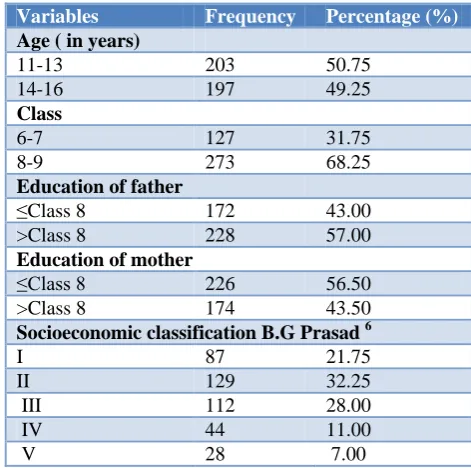
Result shows that 50.75% of students are of age group 11 to 13 years and remaining were of 14 to 16 years age group and considering their class, majority of them (68.25%) were students of class VIII and IX, and more than half of the father of the students (57.00%) were educated more than VIIIth standard, whereas it was found that their mother had relatively lower educational status, 43.50% of their mother had education of more than VIIIth standard. Majority of the students (60.25%) belonged to IInd and IIIrd category of S.E classification.
Table 1: Socio economic profile of study subjects.
Variables Frequency Percentage (%)
Age ( in years)
11-13 203 50.75 14-16 197 49.25
Class
6-7 127 31.75
8-9 273 68.25
Education of father
≤Class 8 172 43.00 >Class 8 228 57.00
Education of mother
≤Class 8 226 56.50 >Class 8 174 43.50
Socioeconomic classification B.G Prasad 6
I 87 21.75
II 129 32.25
III 112 28.00
IV 44 11.00
Table 2: Knowledge of students regarding selected variable.
Knowledge regarding
Age in years (n)
Class (n)
Education of father (n)
Education of mother (n)
Socioeconomic classification (n)
11-13 14-16 6-7 8-9 ≤8 >8 ≤8 >8 I II III IV V
Physical changes
No (4.5%) 10 8 9 9 8 10 7 11 4 4 6 2 2 Some
(58.75) 140 95 91 144 117 118 139 96 49 65 78 24 19 Satisfactory
(36.75%) 53 94 27 120 47 100 80 67 34 60 28 18 7 Chi square test P=0.000041 P=0.000041 P=0.002844 P=0.201823 P=0.068881
Sexually transmitted disease
No (9.75%) 28 11 28 11 25 14 19 20 6 8 10 7 8 Some
(80.75%) 163 160 91 232 130 193 191 132 72 110 92 32 17 Satisfactory
(9.50%) 12 26 8 30 17 21 16 22 9 11 10 5 3 Chi square test P=0.001922 P≤0.00001 P=0.017155 P=0.079029 P=0.030831
Legal age for marriage
Yes
(24.75%) 53 46 23 76 42 57 49 50 31 34 22 7 5 No
(75.25%) 150 151 104 197 130 171 177 124 56 95 90 37 23 Chi square test P=0.522801 P=0.035838 P=0.893883 P=0.105079 P=0.043211
p<0.05 are significant.
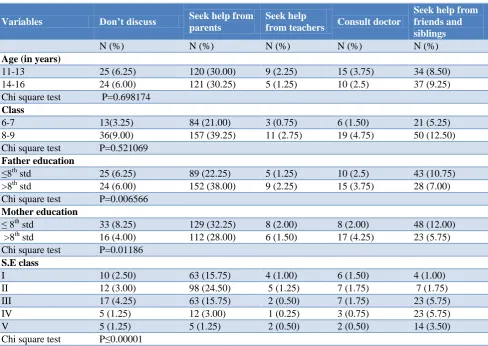
Table 3: Attitude for issues related to sexuality.
Variables Don’t discuss Seek help from
parents
Seek help
from teachers Consult doctor
Seek help from friends and siblings
N (%) N (%) N (%) N (%) N (%)
Age (in years)
11-13 25 (6.25) 120 (30.00) 9 (2.25) 15 (3.75) 34 (8.50) 14-16 24 (6.00) 121 (30.25) 5 (1.25) 10 (2.5) 37 (9.25) Chi square test P=0.698174
Class
6-7 13(3.25) 84 (21.00) 3 (0.75) 6 (1.50) 21 (5.25) 8-9 36(9.00) 157 (39.25) 11 (2.75) 19 (4.75) 50 (12.50) Chi square test P=0.521069
Father education
≤8th
std 25 (6.25) 89 (22.25) 5 (1.25) 10 (2.5) 43 (10.75) >8th std 24 (6.00) 152 (38.00) 9 (2.25) 15 (3.75) 28 (7.00) Chi square test P=0.006566
Mother education
≤ 8th
std 33 (8.25) 129 (32.25) 8 (2.00) 8 (2.00) 48 (12.00) >8th std 16 (4.00) 112 (28.00) 6 (1.50) 17 (4.25) 23 (5.75) Chi square test P=0.01186
S.E class
I 10 (2.50) 63 (15.75) 4 (1.00) 6 (1.50) 4 (1.00) II 12 (3.00) 98 (24.50) 5 (1.25) 7 (1.75) 7 (1.75) III 17 (4.25) 63 (15.75) 2 (0.50) 7 (1.75) 23 (5.75) IV 5 (1.25) 12 (3.00) 1 (0.25) 3 (0.75) 23 (5.75) V 5 (1.25) 5 (1.25) 2 (0.50) 2 (0.50) 14 (3.50) Chi square test P≤0.00001
Table 4: Major source of information.
Major source Teacher
(%)
Parents (%)
Friends and siblings (%)
TV and radio (%)
Newspaper & magazine (%)
Internet (%)
Percent distribution of students 15.25 11.75 41.25 19.75 8.50 3.5
Above Table 2 shows that regarding physical changes 4.5% students were found having no knowledge, 58.75% having some knowledge and 36.75% having satisfactory knowledge. A statistical significant difference was found regarding age group, class and education of father, revealing that students of age group 14-16 years, from class VIIIth-IXth and those whom father were having education of more than VIIIth standard were having significantly better knowledge. Whereas no statistical significant difference was found regarding education of mother and socioeconomic status. For knowledge regarding sexually transmitted diseases, it was found that 9.75% of them had no knowledge, 80.75% have some knowledge and only 9.50% had satisfactory knowledge. A statistical significant difference was found regarding age group of student, class, education of father and socioeconomic status. Students of age group 14-16 year, class VIIIth and IXth, whom father were educated more than VIIIth class and were belonging to better socioeconomic status had significantly better knowledge about STD. However no statistical significant difference was found regarding education of mother. For knowledge of legal age of marriage, only 24.75% students knew the answer, statistical significant difference was found regarding class and socioeconomic status. Students of class VIIIth and IXth and belonging to better socioeconomic status had significantly correct knowledge, whereas regarding age group of student, education of father and education of mother no statistical significant difference was found.
Table 3 shows the attitude of students for issues related to sexuality, and it was found that 12.25% of students have the attitude of not discussing, 60.25% students revealed attitude of seeking help from parents, 3.50% showed attitude for seeking help from teachers, 6.25% showed attitude for consulting doctor, 17.75% revealed attitude for seeking help from friends and siblings. No statistical significant difference was found regarding age group and class of student, whereas regarding education of father, education of mother and socioeconomic status significant statistical significant difference was found.
As per Table 4 friends and siblings are reported as major source of information by 41.25% of students, whereas teachers and parents by 15.25% and 11.75% of students respectively. Television and radio was answered by 19.75% students as major source of information, while 8.50% stated Newspaper and magazine, and only 3.5% of them affirmed Internet as their major source of information.
DISCUSSION
sources of information for rural adolescents. Among the socio-demographic and economic characteristics of the respondents sex, age, educational status, living arrangement (living with grandparents and other relatives) and family income were found to have statistically significant association with Reproductive Health knowledge.11 Furthermore Iqbal et al found that regarding adolescent sexual and reproductive health there is a low level of perception amongst adolescents in Lahore district, it was also observed that overcoming strategies regarding perception of sexual and reproductive health is that 58.3% adolescents consult with parents/caregivers, 43.3% consult with siblings/cousins, 72.3% consult with friends, 23.7% consult with teachers, also findings showed a high level of perception in adolescents of 15 and 18 years of age, having educated parents, with 5 and above siblings and belonging to the rich wealth status.12 Jadeja et al found that in 14 to 18 year students Majority (62%) knew the changes occurring during puberty, 67% knew about family planning methods, 77% knew about STDs and its transmission. It was also found that friends (64.34%) were most common source of information regarding reproductive health knowledge followed by teachers (58.19%), doctors (55.96%), TV, internet and other media (54.23%).13 Agarwal et al found that only 51.2% of girls aged 15-19 years were knowing correct minimum legal age for marriage.14 Likewise Pandya and Bhanderi also reported that only 38.6% women have correct knowledge about legal age of marriage.15
CONCLUSION
Our results showed that there is lack of knowledge regarding changes occurring during adolescence, sexually transmitted diseases and legal age of marriage. Moreover it was found that students get information from their surroundings, mainly from friends and the media but here the reliability of information is uncertain, particularly from friends as they belong to the same age group and are experiencing the same. Study also revealed that large number of students have attitude of concealing their problems or discuss it with their friends or siblings, which shows that topics related to sexuality are social stigma. These data highlight the need for targeted education and focused efforts providing proper knowledge and facilitating healthy life style of adolescent students.
ACKNOWLEDGEMENTS
The authors would like to thank the Principal and teachers of the school for their support and cooperation.
Funding: No funding sources Conflict of interest: None declared
Ethical approval: The study was approved by the Institutional Ethics Committee
REFERENCES
1. World Health Organization. Geneva: World Health Organization. Adolescent Friendly Health Services – An Agenda for Change; 2002: 5.
2. Sharma N. A study of social and psychological problems related to puberty among high school students. J Institute Med. 1998;19:1-5.
3. National family health survey. Available at http://rchiips.org/nfhs/pdf/NFHS4/UP_FactSheet.pd f. Accessed on 16 September 2018.
4. The prohibition of child marriage act, 2006. Available at: http://www.legislative.gov.in/sites/ default/files/A2007-06.pdf. Accessed on 10 September 2018.
5. Singh BP, Singh G, Singh KK. Pubertal changes in teenagers of Varanasi- The spiritual city of India. Ind J Youth Adol Health. 2014;1(3&4):1-5. 6. Singh T, Sharma S, Nagesh S. Socio-economic
status scales updated for 2017. Int J Res Med Sci. 2017;5(7):3264-7.
7. Jain RB, Kumar A and Khanna P. Assessment of self-awareness among rural adolescents: A cross-sectional study. Indian J Endocrinol Metab. 2013;17(1):367–72.
8. Sheoran P, Rani M, Kumar Y, Singh N. Knowledge and Attitude Regarding Pubertal Changes among Pre-Adolescent Boys: An Interventional Study in Rural Area in India. J Nursing Care. 2016;5(5):1-5. 9. Sheoran P, Rani M. Knowledge and Attitude
Regarding Pubertal Changes among Pre-Adolescent Boys: An Interventional Study in Rural Area in India. J Nurs Care. 2016;5:5.
10. Rani M, Sheoran P, Kumar Y. Knowledge and attitude regarding pubertal changes among pre-adolescents – A descriptive survey study. Int J Current Res. 2016;8(6):33697-702.
11. Alosaimi JA. Saudi intermediate school girls' knowledge, attitudes and practices of puberty in Taif, Saudi Arabia. Int J Med Sci Public Health. 2014;3(2):196-202.
12. Abajobir AA, Seme A. Reproductive health knowledge and services utilization among rural adolescents in east Gojjam zone, Ethiopia: a community-based cross-sectional study. BMC Health Services Res. 2014;14:138.
13. Iqbal S, Zakar R, Zakar MZ, Fischer F. Perceptions of adolescents’ sexual and reproductive health and rights: a cross-sectional study in Lahore District, Pakistan. BMC Int Health Human Rights. 2017;17(5):1-13.
14. Jadeja YM, Joshi JB, Nimavat JH, Jasani PK, Koringa HT, Thekdi KP, et al. A study on knowledge about various aspects related to reproductive health among school going adolescent boys. International Journal of Medical Science and Public Health. 2017;6(1):12-7.
reproductive health and related problems. Indian J Prev Soc Med. 2007;38(1&2):36-41.
16. Pandya YP, Bhanderi DJ. An Epidemiological Study of Child Marriages in a Rural Community of Gujarat. Indian J Community Med. 2015;40(4):246– 51.