Original Research Article
Barriers to dengue preventive activities in rural
Cuddalore, Tamil Nadu: a study using health belief model
Sahithyaa J., Suguna A.*, Surekha A., Ankitha S.
INTRODUCTION
The number of dengue cases reported globally has increased from 2.2 million in 2010 to 3.2 million 2015. Dengue is known in India since 1940s, but has become a common health issue over the past two decades.1 Recently, dengue has become endemic in many states and union territories throughout the country.2 In addition to the increased number of cases and disease severity, there has also been a major shift in the geographical range of
the disease. Dengue had been restricted to urban and semi-urban areas, but it has now made its way to rural regions, due to availability of favourable mosquito breeding sites.3 The expansion of dengue in India has been related to unplanned urbanization, changes in environmental factors, host–pathogen interactions and population immunological factors.
As of now, no specific treatment is available for the disease. Therefore, mosquito control remains the
ABSTRACT
Background: Mosquito control is the cornerstone in the prevention of dengue. There is a need for active community
participation in the control of the disease. However, there have been various barriers in preventive activities. Understanding the barriers to the preventive activities would help in designing appropriate intervention/awareness program.
Methods: A community based descriptive cross-sectional study was done in the villages of Kudikadu and Echangadu.
House-to-house visit was done and persons above 15 years of age, present at the time of visit were included in the study. The data was captured using ‘Epicollect 5’, a mobile application for data collection based on the constructs of health belief model.
Results: A total of 155 individuals were interviewed, whose mean age was 41.3 (±13.8). A majority of them were females (71.3%), had no formal education (27.5%) and belonged to socio-economic class 5. Majority of households 140 (87.5%) responded they have mosquito problem in the house and 103 (64.3%) of them perceived that there were barriers for carrying out dengue preventive activities. The barriers reported by the participants were lack of awareness (30%), poor government support (25%), financial issues (16.9%) and lack of motivation (7.5%). There was a significant association of socioeconomic class with lack of motivation and financial issues, with a high number of participants belonging to socioeconomic class IV and V reporting lack of motivation (p=0.028) and financial issue (p=0.025).
Conclusions: Health providers have to find an appropriate and effective strategy to create awareness among people
about the simple ways to prevent mosquito breeding.
Keywords: Dengue, Preventive activities, Barriers to prevention, Health belief model
Department ofCommunity Medicine, Mahatma Gandhi Medical College and Research Institute, Sri Balaji Vidyapeeth University, Puducherry, India
Received: 04 October 2019
Accepted: 12 November 2019
*Correspondence: Dr. Suguna A.,
E-mail: [email protected]
Copyright: © the author(s), publisher and licensee Medip Academy. This is an open-access article distributed under
the terms of the Creative Commons Attribution Non-Commercial License, which permits unrestricted non-commercial use, distribution, and reproduction in any medium, provided the original work is properly cited.
cornerstone in the prevention of dengue. Government of India has taken various steps for prevention and control of dengue in the country. These include mosquito fogging activities, establishing laboratories and sentinel surveillance hospitals for detection and treatment of dengue, providing diagnosis of dengue to the community at free of cost, etc.4 Despite these measures the number of dengue cases reported remains high in the country. Hence, we understand that there is a need for active community participation in the control of the disease. But there have been various barriers in preventive activities such as lack of awareness among community, financial issues, poor lack of motivation, to name a few.
Preventive health behaviour is defined as ‘any activity undertaken by a person believing himself to be healthy for the purpose of preventing disease’.5 The health belief
model (HBM) developed by Rosenstock in 1966 has been the most frequently used model to study the health behaviour. In this study, we used the health belief model to understand the residents’ perception of dengue and the barriers to the preventive activities, based on the constructs of perceived severity, perceived susceptibility, perceived barriers and self-efficacy. Understanding the barriers to the preventive activities would help in designing appropriate intervention/awareness program. Very few studies have been conducted to assess the barriers to dengue preventive activities. In this background the study was conducted to understand the peoples’ perceptions of dengue, the preventive activities they undertake and the barriers to those activities.
METHODS
A community based descriptive cross-sectional study was done in the villages of Kudikadu and Echangadu, located in the SIPCOT industrial zone of Cuddalore district, Tamil Nadu. The study was conducted during November 2017. The required sample size was 280, assuming that 25% of the people have knowledge about mosquito breeding sites.6 The permission to conduct the study was obtained from the village leaders. The interviewers, who are doctors from a tertiary care hospital were sensitized about the study and were trained to use the data collection app and to identify the mosquito breeding sites.
The study participants were chosen by convenient sampling method. House-to-house visit was done by the interviewers along with social workers. People above 15 years of age, present in the house at the time of visit, were included in the study. A total of 160 individuals were interviewed after obtaining informed consent.
The data was captured using ‘Epicollect 5’, a mobile application for data collection. The questionnaire had 3 sections. The first section captured the sociodemographic details; the second section was based on health belief model, in which the participants’ perception about dengue was captured (perceived severity, perceived
susceptibility, perceived self-efficacy and perceived barriers). The third section contained information on the various dengue preventive activities carried out by them. They were also asked about the barriers that they faced during these activities and asked to suggest possible solutions. Further the barriers for the preventive activities and the possible solutions were explored during focused group discussions (FGDs) with the residents. However, the results of the FGDs are not discussed in the article. Data from Epicollect 5 were exported into MS Excel and analyzed using SPSS version 16. The results are described as frequency and proportion for qualitative variables and as mean and standard deviation for continuous variables. Chi square test was used to determine the association between socio-demographic factors and barriers to dengue preventive activities.
RESULTS
Socio-demographic characteristics
A total of 155 individuals were interviewed, whose mean age was 41.3 (±13.8). A majority of them were females (71.3%), had no formal education (27.5%) and belonged to Socio-economic class 5, as described in Table 1. In 12% of the participant households, one or more family member had suffered from Dengue in the previous 4 months, while 23% of the participants reported that they had heard of someone suffering from dengue in the village. Majority of households 140 (87.5%) responded they have mosquito problem in the house. Larvae were present in 3 out of 155 houses surveyed. Aedes larvae were present in 2 out of three houses identified with larvae. The house index (HI), which gives the percentage of houses infected with larvae was 1.25.
Health belief model
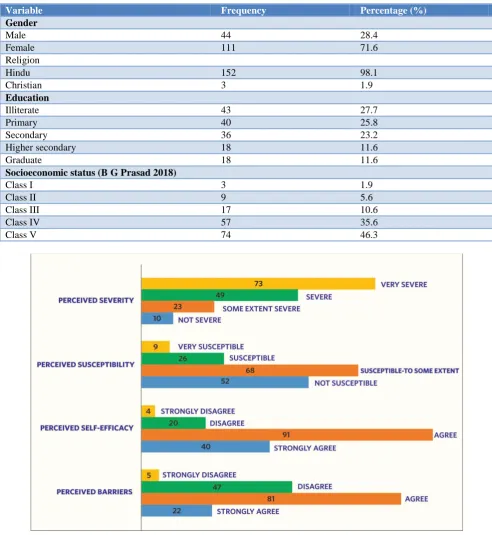
The perception of the study participants regarding dengue was assessed using HBM (Figure 1). 46.8% of the participants’ perceived dengue fever as a very severe condition and 64.3% participants considered themselves susceptible to dengue. Almost 59% of the participants thought that they were efficient in preventing dengue. However, 64.3% of them perceived that there were barriers for carrying out dengue preventive activities.
Dengue preventive activities
Barriers for preventive activities
More than half of the participants reported that there were barriers for carrying out dengue preventive activities (Table 2). The barriers reported by the participants were lack of awareness (30%), poor government support (25%), financial issues (16.9%) and lack of motivation (7.5%).
Association between socio-demographic characteristics and perceived barriers to dengue preventive activities
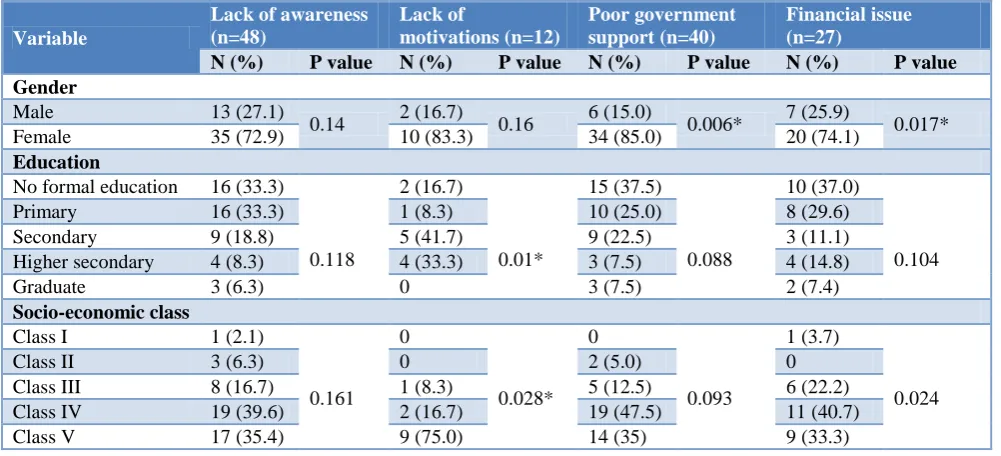
There was a significant association of socioeconomic class with lack of motivation and financial issues, with a high number of participants belonging to socioeconomic class 5 reporting lack of motivation (p=0.028) and financial issue (p=0.025). More number of females reported lack of government support (p=0.006) and financial issue (p=0.017).
Table 1: Socio-demographic characteristics of the study population (n=155).
Variable Frequency Percentage (%)
Gender
Male 44 28.4
Female 111 71.6
Religion
Hindu 152 98.1
Christian 3 1.9
Education
Illiterate 43 27.7
Primary 40 25.8
Secondary 36 23.2
Higher secondary 18 11.6
Graduate 18 11.6
Socioeconomic status (B G Prasad 2018)
Class I 3 1.9
Class II 9 5.6
Class III 17 10.6
Class IV 57 35.6
Class V 74 46.3
Table 2: Perceived barriers of the participants for dengue preventive activities (n=155).
Variable Frequency Percentage (%)
Perceived barrier
Strongly agree 22 14.1
Agree 81 52.6
Disagree 47 30.1
Strongly disagree 5 3.2
Barriers
Lack of awareness 48 30.0
Lack of motivation 12 7.5
Poor Government support 40 25.0
Financial issue 27 16.9
Table 3: Association between socio-demographic characteristics and perceived barriers to dengue preventive activities.
Variable
Lack of awareness (n=48)
Lack of
motivations (n=12)
Poor government support (n=40)
Financial issue (n=27)
N (%) P value N (%) P value N (%) P value N (%) P value
Gender
Male 13 (27.1)
0.14 2 (16.7) 0.16 6 (15.0) 0.006* 7 (25.9) 0.017*
Female 35 (72.9) 10 (83.3) 34 (85.0) 20 (74.1)
Education
No formal education 16 (33.3)
0.118
2 (16.7)
0.01*
15 (37.5)
0.088
10 (37.0)
0.104
Primary 16 (33.3) 1 (8.3) 10 (25.0) 8 (29.6)
Secondary 9 (18.8) 5 (41.7) 9 (22.5) 3 (11.1)
Higher secondary 4 (8.3) 4 (33.3) 3 (7.5) 4 (14.8)
Graduate 3 (6.3) 0 3 (7.5) 2 (7.4)
Socio-economic class
Class I 1 (2.1)
0.161 0
0.028* 0
0.093
1 (3.7)
0.024
Class II 3 (6.3) 0 2 (5.0) 0
Class III 8 (16.7) 1 (8.3) 5 (12.5) 6 (22.2)
Class IV 19 (39.6) 2 (16.7) 19 (47.5) 11 (40.7)
Class V 17 (35.4) 9 (75.0) 14 (35) 9 (33.3)
DISCUSSION
In the current study, about 87% of the participants have reported that they have mosquito problem in their home. In spite of high number of people perceiving mosquito problem, most of them thought that they are either not susceptible or susceptible only to some extent to dengue. More than half of the participants reported that there were barriers for carrying out dengue preventive activities, the major barrier being lack of awareness.
Thus, from this study we understand that though people know that dengue is preventable by controlling mosquito breeding, they perceive that there are barriers to these activities. Significantly higher number of females considers that there is poor Government support and that they have financial issues in carrying out dengue preventive activities.
In the current study, 64.3% of the people perceived that there were barriers to dengue prevention. In a study done
in Ecuador, 68% of the people have reported that there are barriers to dengue preventive activities.7 Whereas, a study in Malaysia has reported that only around 14% of the people perceived that there were barriers to dengue prevention.8 This difference could be possibly because of the financial status, and the dengue preventive activities in the place where the study was conducted. The common barriers to dengue preventive activities reported in other studies were economic constrains, lack of awareness and lack of time, which are almost similar to the reasons reported in this study.7
From this study, we understand that, though people perceive mosquito as a problem in their locality, they do not carry out preventive activities adequately to stop mosquito breeding. Further studies are required to explore the people’s perception in other localities to carry out appropriate interventions.
CONCLUSION
Health providers have to find an appropriate and effective strategy to create awareness among people about the simple ways to prevent mosquito breeding. Financial assistance and support from government are essential to carry out dengue preventive activities. Thus, understanding the barriers help in designing appropriate intervention.
Funding: No funding sources Conflict of interest: None declared
Ethical approval: The study was approved by the Institutional Ethics Committee
REFERENCES
1. Directorate General of Health Services, Ministry of Health and Family Welfare G of I. DENGUE/DHF SITUATION IN INDIA : National Vector Borne Disease Control Programme (NVBDCP). Available at: http://nvbdcp.gov.in/index4.php?lang=1& level=0&linkid=431&lid=3715. Accessed on 1 October 2019.
2. Chakravarti A, Arora R, Luxemburger C. Transactions of the Royal Society of Tropical
Medicine and Hygiene Fifty years of dengue in India. Trans R Soc Trop Med Hyg. 2012;106(5):273–82.
3. Jagtap MB, Sale LS, Bhosale AS, Sathe A, Sathe TV. Incidence of dengue and shifting trend to rural in Kolhapur District, India; 2009.
4. Home: National Vector Borne Disease Control Programme (NVBDCP). Available at: https:// nvbdcp.gov.in/index.php. Accessed on 1 October 2019.
5. Becker MH. The health belief model and personal health behavior. Health Educ Monogr. 1974;2(4):324–473.
6. Jeelani S, Sabesan S, Subramanian S. Community knowledge , awareness and preventive practices regarding dengue fever in Puducherry South India. Public Health. 2015;1–7.
7. Heydari N, Larsen DA, Neira M, Ayala EB, Fernandez P, Adrian J, et al. Household Dengue Prevention Interventions, Expenditures, and Barriers to Aedes aegypti Control in Machala, Ecuador; 2016: 1–16.
8. Chandren JR, Wong LP, Abubakar S. Practices of Dengue Fever Prevention and the Associated Factors among the Orang Asli in Peninsular Malaysia. 2015: 1–18.
Cite this article as: Sahithyaa J, Suguna A, Surekha