ISSN: 2395-3519
www.ijatca.com 14
International Journal of Advanced Trends in
Computer Applications
www.ijatca.com
SURVIVABILITY OF BACKUP CONNECTIVITY IN OPTICAL
MULTI-LAYER IP BASED CONNECTIVITY
Shammy Samita#1, Neeraj Mohan*2
Rayat &Bahra Institute of Engineering and Bio-Technology, Mohali
1
(MTech CSE Student, [email protected],)
2
(Associate Professor and Head CSE, [email protected])
Abstract:
Optical cable based network gives better solution for communication on large area networks without any distortion. The WDM based network routed data on the wired based networks; and this network affects only when disaster materialize. We grip this disaster based solution by wielding multi-layer networks approach applying on three layers i.e. Physical layer, Medium access layer and Network Layer. The physical layer interconnects the two non-identical networks through optical cable for transmission of data. The MAC layer discover the authenticate machines and different devices for casting packet data unit along with the network layer. The restoration technique exploring in this paper, for backup the data -- and then restore the data through the wired network. The experimental test bed analyzes the incoming and outgoing traffic by using Open shortest path first (OSPF) protocol in the wired networks. The OSPF protocol has enhancing the performance of the wired network and distributes the load in the different edges. The failure of multi-layer in optical networks could be survived at pre-domain level. This level also balanced the load. This level uses OSPF-TE (open shortest path first-Traffic engineering) that regenerates and monitoring the traffic at boundary level.Keywords
: WDM, Sequence number, protection failure, TE, OSPF, LED.I. INTRODUCTION
In modern communication, optical fibers play an important role in telecommunication systems. The single mode and multi mode fiber cable has used in telecommunication systems. These modes had used to interconnect a number of networks like local area network (LAN), metropolitan area networks (MANs), and wide area networks (WANs). The advantage of multi mode communication systems provides lower cost of source light-emitting diodes (LEDs) used in the interconnecting networks. The extensive wavelength spectrum of LEDs spread for communication in large area without any noise disturbance.
The number of technologies had come since 1990s to speed up the transmission of the network and Wavelength Division Multiplexing (WDM) is one of the speedy technologies that employ number of wavelengths; supported upstream and downstream data transmissions. This technology bear number of protocols, architectures and standards. Dynamic WDM protection approach that out performs the WDM networks and analyzes its impact on blocking probability and connection availability [1]. The Path
protection schemes recovered in mobile ad hoc networks and the failure occurred in between the network is recovered by the proposed scheme. Re-routing is performed by the node connected to the failed link to the neighboring node on the original path [2].
A. Interoperability
ISSN: 2395-3519
www.ijatca.com 15
PAD
PA D
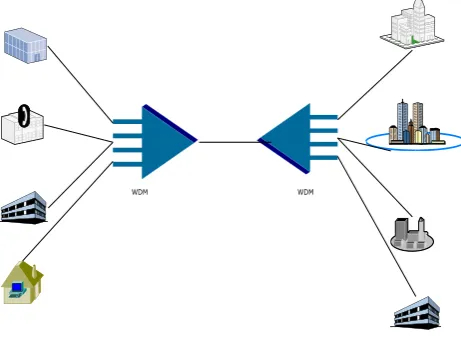
Fig. 1 WDM Architecture
This paper arrange in the following order: section II briefly describes the literature review where number of theories suggested by the authors and conclude the results. Section III describes the technology employ by the WDM network and overall solution suggested in this paper. Section IV profiles the experimental test bed and Section V explored the results and discussion. Section VI concludes the paper.
II. RESEARCH BACKGROUND AND
MOTIVATION
The connections using link protection, where only the nodes adjacent to the failed link would perform the recovery and focus of this paper is to protect end-to-end connections from dual-link failures using link protection [3]. The backup would be assigned in the networks if any of failure occurred on the network. The assigned link protection methods created on the overall network.
Dual-link failure resiliency strategies have applied on this network to increases the performance of the network. The link protection employ in the fast recovery approach [4]. It uses an on-demand approach for finding routes, that is, a route is established only when it is required by a source node for transmitting data packets.
The approach improves the performance of Ad Hoc Networks. The process of rerouting [5] happens on the WDM network then also affects the traffic because the system confuses to choose the new shortest path. The link failure capability in the network also restored using different restoration techniques. The WDM based network [6] that transport the large quantity of data from one place to another. The bandwidth is allocated for backup path and this can be shared by other disjoint paths. The disjoint path can be primary or backup path [7]. The authors design the frame work to prevent the link failures on the WDM based network. Shared
segment recovery method was establishing backup path. When a node in the network receives the request to establish a new route, the node creates an appropriate working path. At the same time, the node also establishes a dedicated backup path. The number of different guaranteed quality of recovery levels has been proposed in WDM mesh networks [8]. These levels well suited on the large networks and therefore, parallel executed the restoration mechanisms. The common protection schemes available in WDM optical networks and spare resources that were planned. The protection was achieved by a standby redundancy strategy [9].
The motivation finds from the following papers and to be outlined in this paper. The previous research creates the backup path only if a failure affects its primary path. The Path protection schemes recover from a failure by re-routing the connections at the source. Path protection schemes may be classier into three categories based on their knowledge of the failure location. The Channel assignment between primary and backup path is automatically satisfied for all link failures. Link protection at the fiber level offers fast recovery time requiring lesser signaling compared to path protection approaches. But recovery could not be satisfactory when these schemas to be employed in the optical networks. The existing schemes had worked on open system interconnection model and layout of the existing scenario to be finalized on the Physical layer. This paper has to improve the bandwidth from the primary and backup paths. The recovery method is the Reroute or the Segment Restoration method fails, a new route will substitute the old one. The light paths in the current scenario evaluated the probability of reached node in the set of inner nodes. The information distributed on the inner node in the sense of bits stream.
III. PROPOSED RESEARCH
ISSN: 2395-3519
www.ijatca.com 16 other via OSPF based protocol [11]. The version 2
OSPF network monitoring the boundaries of the networks and regenerate the necessary traffic on all optical based network when any link-disjoint problem occurred. These devices are correlating with MAC and Network Layer [12].
Our assumption on this proposed work is that these three layers provided services to the upper layers that mean the lower layer does not disconnect with the upper layers and also protection with dual link failures. The efficient design of such multi-layer networks is an important task and implemented on the current work. In the proposed scheme analyze the incoming data traffic and this traffic can be captured. A group of server is pooled together to form a server pool in which all the resources are shared, if a single server fails the particular server is removed from the pool. The restoration setup has to backup the label based switch networks and then map with the routers.
IV. PROPOSED ALGORITHM AND
FLOW CHART
The proposed algorithm utilized resources so that each node shares their data without any delay; this algorithm balanced the nodes and mitigates the risk. The primary and backup light-path creates on every WDM based network against any link failure. The OLSR protocol is import on the domain network for rerouting and choosing shortest path on the nodes. The inter-domain and intra-domain network arrange in this manner the resultant probability of link failure is less. The proposed algorithm is shown in figure 2. The flowchart related to the proposed algorithm that works according to the proposed scenario shown in figure 4.
Fig.2: Proposed Algorithm
Fig.3: Flowchart
V. RESULTS AND DISCUSSION
The Network topology consists of twenty nodes communicates in the current scenario to support backbone networks. This topology deployed on the 1000 m x 1000 m square area with connecting link and composed by different clients in a coverage range of 70 meters by using NS2.34 Simulator [18]. The mobile node is able to access the other node via wireless link with a packet size of 1024 bytes and round trip time is set to 2ms. The transmission rate is set to 24 Mbps and Dijkstra algorithm is applied to compute the routes. It is assumed that the available spectrum width of each server and host link is 2500 GHz, each frequency slot is 25 GHz, the link cost denotes the link length. The actual request sizes are further varied uniformly between 200 Mbps–1 Gbps in between router, host and servers with increments of 200 Mbps, i.e., to model fractional Ethernet demands. Links that are shared by many backup light paths appear replicated in the sub networks corresponding to all the sharing connections. The mobile nodes communicate with routers to send the data through hosts. When a node in the network receives the request to establish a new route, the node creates an appropriate working path. Each node in the network is required to maintain a routing table that contains an ordered list of a number of fixed shortest routes to each destination node. The link shares the frequency band so that sending and receiving nodes transmitted/receiving the packets. The packets are placed on each link and every node was responsible for maintaining the queue. Queues are served in order. A queue is inspected before an actual frequency switch; if
YES NO
START
DEPLOY WDM BASED NETWORK
IMPORT OSPF PROTOCOL
APPLY PROPOSED ALGORITHM
START COMMUNICATION
USE ROUTING TABLES TO SHARE INFORMATION EVERY WHERE WITH
CONTINUE COMMUNICATION IF LINK
FAILURE OCCUR
ISSN: 2395-3519
www.ijatca.com 17 the queue is empty the next queue in turn will be
inspected.
Fig. 4: WDM experimental Test-bed
Suppose total traffic t measured in light paths applied on the traffic engineering with proposed algorithm and these light paths access by the number of clients that share the information. The average time to access these information represented ρ. The access ratio denoted the total packets sent to the clients namely C. The given below equation also determine the loss packets and these loss packets is also being resent. This procedure known as effective ratio and it is denoted as x. The ρ, x sent to the light paths represented by Lp.
t=
(1) From equation (1) the total number clients per edge Sn calculated and formulated as:S
n=
(2) The S represents the total number of clients connected to the router and switches whereas the number of edges n connected these clients for sending or receiving the data. This equation (2) calculates the average edge per client node.A. Sequence number of packet IDs
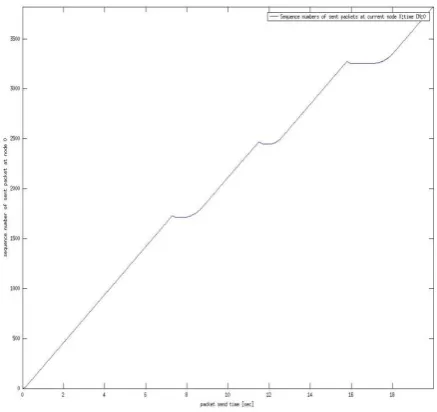
The number of sent packets sends to the mobile nodes to the router and then the packets send to the hosts and all packet related information save to the servers; these servers follow the backup procedures. The sequence number allocate the specific numbers to the packets; when unordered packets received by the receiver then these sequence number rearrange the packets so that correct ordered wise packets collected by the receiver
mobile station. The result aims to know about the number of packets generated by the machine, sends by the machine and then received by the destination mobile station. The OSPF protocol is used in this implementation to define the shortest path and arranging the sequence number in correct order so that traffic may regularly pass in each node. The approximately start time of the packets was 0.1 seconds and the each sequence number assign the packets with difference of 500. The start time of the sequence number of the packet was 1 to 10. The packets regularly send to sender to the destination machine but some packets retransmitted in the packets when losses happen i.e. time 7, 11 and 17 seconds. The table 1.1 describes the graph in values with different type of packet with total sent packets.
Fig. 5: Sequence number of sent Packets
ISSN: 2395-3519
www.ijatca.com 18 Table 1.1: Packet Status
B. Protection Failure Rate
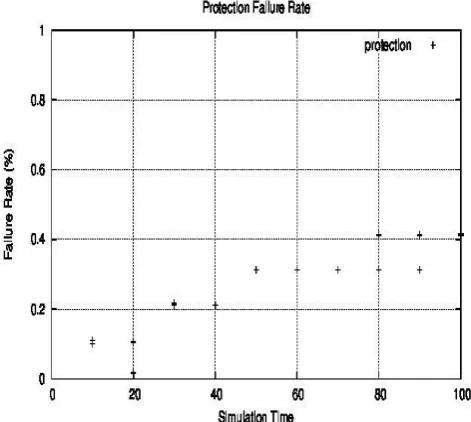
The protection failure rate depends on the primary path, when different nodes connected to each other for sharing the data. When the failure rate arises then it would degrade the performance of the network. Here in this figure the protection failure rate on light path WDM network is minimum i.e. 0.4 percentage. This protection failure rate counted with simulation time divided by the failure rate and calculated with percentage. The table 1.2 describes the graph in values with regular packet length.
Fig. 7: Protection Failure rate
Table 1.2: Packet Length vs. Failure rate
VI. CONCLUSION
The paper fully describes the wired based network with utilizes the fiber based optical networks. The IP based restoration technique used on the network layer; thus it finds that the efficiently recovery based scheme used and optimized the performance of the network. The proposed algorithm implemented on this paper with import the packages of the OSPF version2 protocol that helps to find the shortest path and avoid reroute the data from longer distances. This Traffic Engineering based algorithm (computation of path-pair) applies on inter and intra domain networks. The observed results find the minimum blocking probability and proper utilization of the resources. The IP based restoration scheme as well defined on this paper and generates the traffic different path. This path failure scheme then recalculates the shortest path; the failure path again recover it for some period but the traffic rerouted at that time decided by the OSPF protocol. The analyzed results shows that the appropriate path and restoration techniques utilizes on the wired cum wireless networks.
REFERENCES
[1] Marco D. D. Bicudo, Igor M. Moraes and Rafael P. Laufer, "Protection and Minimal Interference in WDM Mesh Networks", Globecom, 2010, pp.1-5.
[2] Ashwina .N. Patil, S.S. Kanade and S.S. Bhakare, "Fast Recovery For Dual-Link Failure Through Backup Path", IJERA, 2012, pp.1486-1489.
[3] Ashok Kumar Velpuri and Sreenivas Velagapudi, "A Novel Approach for Link/Path Protection in Dual-Link Failures", IJMER, 2012, pp.384-389.
[4] Saraswati Bhakare, C.A. Laulkar and Rashmi Hiraje, "Hybrid Approach to Recover from Double Link Failure Using Backup Path in Ad-Hoc Networks", IRNet Transactions on Computer Science and Engineering, 2011, pp.47-51.
[5] Refat Kibria and Md. Aminul Haque Chowdhury," Multilayer Protection And Survivability In WDM optical Network", Daffodil International University Journal Of Science And Technology, 2007, pp.19-27.
[6] Mallika and Neeraj Mohan, "Link Failure Recovery in WDM Networks", IJCSEE, 2013, pp.599-602.
[7] M. Farhan Habib, Massimo Tornatore, Ferhat Dikbiyik and Biswanath Mukherjee,"Disaster survivability in optical communication networks”, Elsevier, 2013, pp.630-644.
Packet Length Simulation Time (sec)
Failure Rate (%)
Regular packet Initial (0.1 seconds)
0.0
Regular packet 20 0.1
Regular packet 40 0.2
Regular packet 60 0.3
Regular packet 80 0.3
Type of Packet Initial Time
Total Packet Sent
Generated packets 2.2 1024 Bytes (max.)
Sent Packet 2.2 1024 Bytes (max.)
ISSN: 2395-3519
www.ijatca.com 19 [8] I-Shyan Hwang,I-Feng Huang and Hung-Jing
Shie," Guaranteed Quality of Recovery in WDM Mesh Networks", IJCNS, 2007, 243-251.
[9] Daniele Arci, Guido Maier and Achille Pattavina," Availability models for protection techniques in WDM networks", DRCN, 2003, pp.158-166.
[10] F. Xu, N. Min-Allah, S. Khan and N. Ghani,"Diverse Routing in Multi-Domain Optical Networks With Correlated and Probabilistic Multi-Failures”, New Trends in Optical Networks Survivability, International Conference on Communications-IEEE, 2012, pp.6247-6251.
[11] http://RFC 1131: OSPF Protocol, Last Access: September, 2014.
[12] http://RFC 2328: OSPF2 Protocol, Last Access: September, 2014.
[13] Yonggang Wen,Vincent W. S. Chan and Lizhong Zheng,"Efficient Fault-Diagnosis Algorithms for All-Optical WDM Networks With Probabilistic Link Failures", IEEE, 2005, pp.3358-3371.
[14] Bin Wu, Pin-Han Ho and Kwan L. Yeung," Monitoring Trail: On Fast Link Failure Localization in all-Optical WDM Mesh Networks", IEEE, 2009, pp.1-11.
[15] Parminder Singh, "Comparative study between unicast and Multicast Routing Protocols in different data rates using vanet", IEEE, 2014, pp.278-284.
[16] Nazbanoo Farzaneh and Mohammad Hossein Yaghmaee Moghaddam,"Virtual Topology Reconfiguration of WDM Optical Networks Using Fuzzy Logic Control", International Symposium on Telecommunications-IEEE, 2008, pp.504-509.
[17] Jane M. Simmons, "Catastrophic Failures in a Backbone Network", IEEE communications letters, 2012, pp.1328-1331.
[18] http://www.ns2.org
[19] WDM Reference Guide, FINISAR corp., 2008.