Vehicles Accident In Tanzania: Causes And Control
Challenges
Walter Eliakunda, Mary Mashoke, Leticia and Zuberi Gurisha
1.
Walter Kissimbo Eliakunda -Bcom, MBA University of Dar Es Salaam, CSP (T), Diploma in port operation management and harbors Technique, handling of dangerous goods and statistics - APEC- Belgium, certificate of handling dangerous goods and safety advisor- In Went/BLG-Germany2. Mary Mashoke – MA. BA, Diploma in education
3. Leticia Edward Mihayo, MSc in Computer Science – UDOM, Postgraduate Diploma in Scientific Computing, Advanced Diploma in Information Technology
4. Zuberi Gurisha Hamis - MSc Urban Planning and Management -Ardhi University
Post Graduate Diploma in Urban Planning and Management-Ardhi University, Advanced Diploma in Transport Management
Abstract
This study was conducted to assess the causes of vehicle accidents in Tanzania and its control challenges. It was guided by fur specific objectives; being to assess human factors involvement in accidents in Tanzania, Road and road environment factor involved in accidents in Tanzania, Vehicle involvement factor in accidents in Tanzania, and to evaluate strategies to solve road accidents in Tanzania and propose way forward
The data were analyzed using STATA. The study analysis followed a quantitative approach. It uses Dynamic Factor Model (DFM) analysis technique. The data was sourced from SUMATRA. The data covers the years 1990 to 2017. The analysis-involved 8 time series factors, namely reckless driving, vehicle defects, driving speed, external factors, alcohol/intoxication, careless motorcyclists, careless cyclists and careless pedestrians. The estimation used Maximum Likelihood Estimator (MLE).
The findings indicate that accidents have been increasing over time since 1990 towards 2017. All the 8 factors loaded significantly and were positive except for external factors which negatively contribute to road accidents. All the variables are economically large in terms of magnitudes of contribution to total road accidents. The factor path trace indicates that the accidents have been persistent and especially in 2010 to 2012 period.
Factor path analysis indicates shows that the path over the years for the corruption index. The factor with the largest magnitude index is reckless driving; other factors that are significant are external factors, vehicle defects and driving speed. Alcohol intoxication contributes the least to accidents in the index.
Therefore, since the factors identified above contribute to accidents in Tanzania, there is a need to establish measures and policies that will directly address these factors. The accident index indicates that the degree level of accidents are declining since 2012, that means more can be done to push the downward trend of the decline in accidents, especially by looking at the factors that are contributing more to the accident index as above.
1.
BACKGROUND TO THE PROBLEMthe rate of accident. Measures for Roads: This can be executed by building new Modern roads where possible financially and spatially and make proper and planned maintenance on the existing roads and to reduce traffic congestion and the like. Measures for drivers; this can be executed by improving driver's driving techniques etc. and measures for Vehicle; this includes the maintenance of vehicles in safe, pollution-free conditions.
Road traffic crashes and injuries are threatening human, social, and economic development in many African countries. Recent statistics show that more than 100 people die in road traffic crashes per 10,000 vehicles in African countries compared to the 1.7 fatalities per 10,000 vehicles in the USA (Greg Chain, 2009). Much needs to be done to slow and/or reverse the trend. The rate of road accident in Africa calls for more studies on the issue of road accident in the continent. This study is expected to contribute valuable information on the cause of road accident and go further on provision of professional opinion to solve the road accident problem in Tanzania. The study objectives are
(i) To assess human factors involvement accidents in Tanzania
(ii) To assess Road and road environment factor involved in accidents in Tanzania (iii) To assess Vehicle involvement factor in accidents in Tanzania
(iv) To evaluate strategies to solve road accidents in Tanzania and propose way forward
2.SITUATION OF ROAD ACCIDENTS IN TANZANIA 2.1 Reported Road Traffic Accidents in Tanzania 1990 – 2017
The police road accident data in Tanzania captured through completing an accident form for those accidents reported to traffic offices. There substantially a number of minor road accidents are not reported The Police are not informed of all road accidents involving personal injury, especially when minor injuries are involved and so mainly fatal accident reporting is complete
Narrated Causes of those accidents for the period under review are:
2.2 Public Transport State Accidents in Tanzania
Studies show that factors caused an accident by public transport in Tanzania are Human factors – 72%, External factors – 18%, Lack of enforcement – 2.5%, Vehicle condition – 7.5%. If one has to uses those statistics extra effort required to solve human factors, external factors, and vehicle conditions.
The human factor is perceived to be the principal cause of most bus accidents. However there are a number of sub factors within the human factor, those sub factors are: Misjudgment; Excessive speed; Overtaking errors; Negligent pedestrians, passengers, cyclists, and cart pushers; Alcohol and drugs consumption; Reckless driving; Overloading of passengers and goods; Parking errors and; Driver fatigue
The traveling public blames deregulation of the public transport system for the increased number of accidents occurring on both urban and long distance services. Inevitably this has led to an increase in the number of buses servicing the network, although demand has not similarly increased consequently, buses competing for passengers by speeding.
Reckless driving, over speeding and driving errors were cited as the most common causes of bus accidents with respect to long distance and urban buses.. Some drivers and respondents ironically revealed that passengers encourage drivers to speed without considering the increase in accident risk. However other drivers use speed as a marketing tool to encourage passengers to travel with them.
Other factors contributing to accidents include poor parking and buses stopping especially Daladalas little respect for other drivers and the influence of alcohol and drugs to combat tiredness. The contribution of human error in causing accidents is not only confined to drivers. Passengers and pedestrians also contribute to accidents. It is common for passengers to try to disembark from a bus while it is in motion or to distract the attention of the driver. Pedestrians, especially in the rural areas, are also not very conversant with traffic regulations governing the use of the road. Some fatal bus accidents may occur during the rainy season when drivers often make irrational decisions and attempt to cross flooded rivers. Drivers are often encouraged by passengers to cross flooded bridges and as a result often make errors in judgment resulting in the bus being washed away. In brief, human error is perceived by most respondents to be the main cause of bus accidents in Tanzania.
was significantly reduced to approximately 17% in 1997 due, in part, to ongoing economic reform changes that have led to a growth in vehicle sales and hence a younger but fleet being operated. The state of Tanzania operating vehicles poses a problem not only in a road accident but also environmental problems.
3. RESEARCH METHODOLOGY
Data for undertaking the study were collected from different sources to respond to the above research objectives. For the research objectives one to three secondary data collected from Police force and SUMATRA were used. The data obtained covering reported road accident for the year 1990 to 2017. The data were analyzed using STATA. The study analysis followed a quantitative approach. It uses Dynamic Factor Model (DFM) analysis technique. The analysis-involved 8 time series factors, namely reckless driving, vehicle defects, driving speed, external factors, alcohol/intoxication, careless motorcyclists, careless cyclists and careless pedestrians. The estimation used Maximum Likelihood Estimator (MLE). The exact DFM expresses Xt as a distributed lag of a small number of unobserved common factors, plus an idiosyncratic disturbance that itself might be serially correlated: Let Xt be a n×1 vector of stationary time series variables observed for t = 1,…,T.
... (1)
...………. (2)
where ft is the q×1 vector of unobserved dynamic factors, vector lagpolynomial, called the ―dynamic factor loadings,‖ and uit is the idiosyncratic disturbance which we model as following an autoregression. The factors and idiosyncratic disturbances are assumed to be uncorrelated at all leads and lags, that is, E(ftuis) = 0 for all i, t, s. In addition, the idiosyncratic terms are taken to be mutually uncorrelated at all leads and lags, that is,
………. (3)
For the fourth research objective the study uses expect opinion from fourteen transport expert used to evaluate Tanzania strategies to solve road accidents its weakness and area for improvement and propose way forward.
4. DATA ANALYSIS AND DISCUSION 4.1 DYNAMIC FACTOR MODEL ANALYSIS AND DISCUSSION
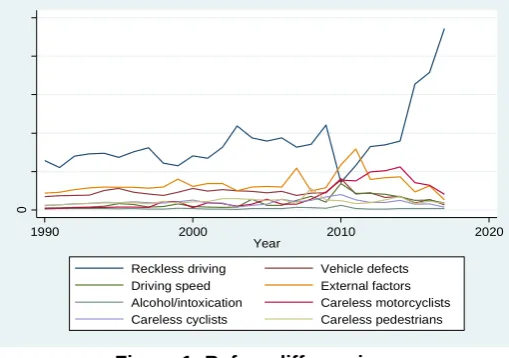
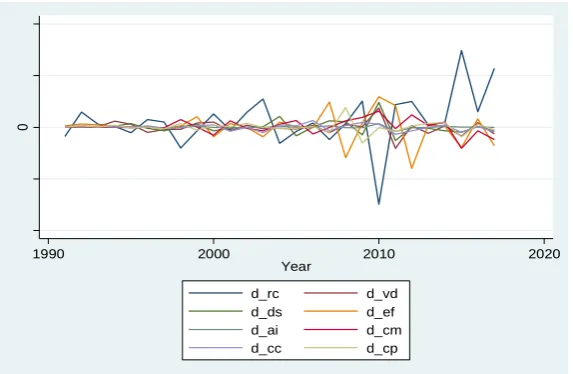
In order to assess human factors, road and road environmental factors and vehicle involvement factors dynamic factor model were used The time series lines in the figure below indicates that on a type level the cause of accidents have been increasing over time since 1990 towards 2017. Figure 1 and 2 below indicated the series before and after differencing.
0
5
0
0
0
1
0
0
0
0
1
5
0
0
0
2
0
0
0
0
2
5
0
0
0
1990 2000 2010 2020
Year
Reckless driving Vehicle defects Driving speed External factors Alcohol/intoxication Careless motorcyclists Careless cyclists Careless pedestrians
Figure 1: Before differencing:
-1
0
0
0
0
-5
0
0
0
0
5
0
0
0
1
0
0
0
0
1990 2000 2010 2020
Year
d_rc d_vd
d_ds d_ef
d_ai d_cm
d_cc d_cp
Figure 2: After first differencing:
The model (in table 1) was statistically significant (most of the variables at .0000 and only one variable at .0002), which means the results are reliable. The results were statistically significant. All the 8 factors loaded significantly and were positive except for external factors which negatively contribute to road accidents. All the variables are economically large in terms of magnitudes of contribution to total road accidents.
Table 1: Factor loadings and weights
Log likelihood = -1683.4911 Prob > chi2 = 0.0000 Wald chi2(18) = 7393.64 Sample: 1990 - 2017 Number of obs = 28 Dynamic-factor model
f 236.724 45.90771 5.16 0.000 146.7466 326.7015 cp
f 212.5791 39.91647 5.33 0.000 134.3442 290.8139 cc
f 372.9892 119.6192 3.12 0.002 138.5398 607.4386 cm
f 40.51573 8.720219 4.65 0.000 23.42441 57.60704 ai
f 746.0116 136.7918 5.45 0.000 477.9047 1014.119 ef
f 478.4045 102.0207 4.69 0.000 278.4476 678.3613 ds
f 457.7488 85.84117 5.33 0.000 289.5032 625.9944 vd
f -1980.514 432.6185 -4.58 0.000 -2828.43 -1132.597 rc
Table 2: Variance Loadings
e.cp 170337.8 47732.33 3.57 0.000 76784.16 263891.5 e.cc 46331.95 13821.75 3.35 0.000 19241.81 73422.08 e.cm 326303.5 96494.03 3.38 0.000 137178.6 515428.3 e.ai 5226.265 1542.333 3.39 0.000 2203.349 8249.181 e.ef 688874 220224.5 3.13 0.001 257241.8 1120506 e.ds 124603 52896.15 2.36 0.009 20928.42 228277.5 e.vd 139108.3 51670.14 2.69 0.004 37836.64 240379.9 e.rc 1614444 883076.3 1.83 0.034 0 3345242 Variance
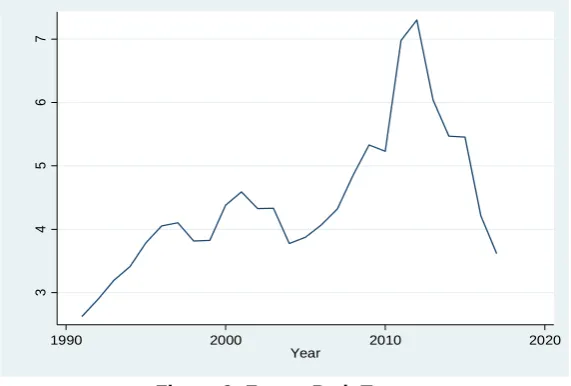
The factor path trace in figure 3 indicates that the accidents have been persistent and especially in around 2010 to 2012.
Factor path analysis indicates an index showing the path over the years for the corruption index. The factor with the largest magnitude seem to be reckless driving, other factors that are significant are external factors, vehicle defects and driving speed. Alcohol intoxication contributes the least to accidents in the index.
3
4
5
6
7
fa
ct
o
rs,
f
,
o
n
e
st
e
p
1990 2000 2010 2020
Year
Figure 3: Factor Path Trace
Therefore, since the factors identified above contribute to accidents in Tanzania, there is a need to establish measures and policies that will directly address these factors. The accident index indicates that the degree level of accidents are declining since 2012, that means more can be done to push the downward trend of the decline in accidents, especially by looking at the factors that are contributing more to the accident index as above.
5.ASSESSING ON EXISTING TRAFFIC CONTROL MEASURES AND ITS CHALLENGES IN TANZANIA
The analysis of research objective one to three above shows the seriousness of the problem of vehicle accidents in Tanzania .The results above indicates need specific measures to minimize the accident. The research objective four focused on discussion of various measures taken to curb the problem of vehicle accident by the Police force, SUMATRA, and training institutions. The study looks on measures for vehicle inspection, driver licensing, and driver training, roads constructions and maintenance separately. Its believed compressive strategy to curb problem of road accident should effective strategies on all factors. The measures and its strength, weakness, and challenges are discussed below.
5.1 Vehicles inspection measures in Tanzania
vehicle roadworthiness through eyes checkup. There is a need to incorporate existing machines technology in vehicle inspection. Statistics show that most of the vehicles undergone vehicle inspection through machines at NIT despite its outside condition look good found with defections while undergone machines vehicles inspection. The exercise of vehicle inspection in the country conducted once per year mainly during the road safety week whereby it caters only for awareness purpose. Stickers are only sold to vehicle owners without inspecting the vehicle. The fact that over 95 percents of privately imported vehicles are used one magnifies the importance of mandatory vehicle inspection.
5.2 Drivers training and licensing in Tanzania
Other aspects need special attention is the driver's training and licensing in the country. The process resulted in unqualified drivers. As the statistics show above over 75% of the causes of the accident in the country are the human factor.
Drivers training
Driver training in the country is undertaken mostly with private owned schools without approved harmonized national curricula, certification of the trainers as well as control of assessing procedures. Training lack of control on who qualifies to be a trainer and to be a trainee. The profit motive interest surpasses the need for qualified trainees in terms of knowledge, skills and appropriate attitudes. Focus had been a number of students undertaken the course rather than the quality of the trained people. Much blame is for the regulators NACTE and VETA for allowing the free market forces to control the industry. It is high time to look at how the drivers are trained and what is control measures should be in place to have qualified and accident-free drivers. It's advised to consider how other countries offer its driver training. The use of driving simulators could assist to improve on the quality of our drivers.
Driver’s license
The procedure for drivers licensing in the country had undergone various changes, where initial were only under traffic police but currently involve traffic police, Tanzania revenue authority and training institutes. Before focus were both technical knowledge, experience and drive attitudes. Current system despite taking account of training institute certification, it fails to consider other factors such as age, driving experience, attitudes, and skills. Driver trained from VETA accredited institute which does not have proper control on how to examine their skills and attitudes undertake four weeks training course can obtain certification for competence and use it to obtain vehicle driving license class D or E. After having that license for one year without checking wither he /she had actually driven the car for that time he/she qualify for undertaking advance driving course for six weeks from NIT or VETA and qualify for driving license class C. . The major problem for that system is it fails to consider an important aspect such as age, driving experience and candidate attitudes. The attitudes to maximize profit by those driver training Institutes compromise the quality of drivers completing those training. One could wonder other institutes no anyone fails drivers exams.
5.3 State of Tanzania Roads
5.4 General challenges of Vehicle Accident in Tanzania
Over and above the three major factors of the road accident in Tanzania namely human factors, vehicle factors and state of the roads the country facing below general challenges
Vehicle control Institution Framework
In Tanzania, vehicle regulation is under TANROADS, SUMATRA and traffic police. Despite the laws and regulation stipulate clearly the role of each organization on vehicle control regulations still the public and even government fail to separate the role of each of them. One may find blames put in one organization while the actual cause is under other institution. For example, after the Mbeya Mbalize accidents most of blames were on traffic police where actual problem was state of the road which falls under TANROADS.
Vehicle regulations challenges
The current vehicles regulation does not differentiate road users where motor vehicles and motorcycles drivers are subjected to the same regulations and other road users such as bicycles drivers and pedestrian are related as none offender which is not true. The regulations should design in such a way that it covers all source of a road accident.
Lack of voluntary abide by traffic regulations in the country
The degrees of voluntary abide by traffic regulations and laws still are very low. In order to decrease the rate of a road accident in the country, it’s important to increase awareness program so as drivers and vehicles owners are voluntary to abide by traffic regulations. The study observed that t is common to find Bodaboda and other motorcycles drivers pass red traffic light without no any action taken by traffic police. That tendency had become a tendency and according to them, they do so to avoid city enforces agent who mostly uses traffic light as a point to catch them. Also as long as our defense forces drivers (police, Prisons, defense forces) being the major breakers of the traffic laws as if they are above of the laws causes other drivers to undermine traffic laws too. It is high time ore forces to be a good example involuntary abides by the traffic laws to improve the voluntary abide by traffic laws in the country.
Uses of a mobile telephone while driving
The problem of mobile phone usage during driving had become common phenomena. It had gone to the extent that most trucks and bus drivers can chart and sending massage during driving. Our traffic regulations does not charter for that. Its high time our traffic regulation and low enforcers to control the problem of phone usage to all drivers including Bodaboda drivers.
BODABODA challenges
Introduction of BODABODA as ways of improving movement of peoples and employment for our youth has both advantages and risks. Currently in the country, as statistics above show motorcycles contribute a lot to road accident in the country. The major challenges of BODABODA are lack of political will to address the issue of BODABODA safety and security, Government officials resistance for change, How to transfer effective traffic safety measures from developed countries, BODABODA drivers culture, Low level of awareness on safety and security for BODABODA drivers and users, Lack of sufficient financial investment on road traffic safety for motorcycles so as to create separate lane for them , Lack of coordinated efforts toward road accidents and who is champion of the road safety and security for the BODABODAs, Low enforcement on aspect of safety and security, How to create serious long-term decision on traffic safety and security
Corruptions attitudes and culture
Despite current government efforts to face the corruption problem in the county yet the attitudes and culture of traffic police towards decision influenced by corruption still very high. The tendency needs more investment to reduce the dependency of traffic on the sole decision without machines. Installation of CCTV cameral alongside our roads could automatically record the offenders of traffic law.
5.6 PROPOSED MEASURES TO ADDRESS THE CHALLENGES
In order to address the challenges of a vehicle accident in the country it important to make sure the comprehensive approach to overcome both human factors, road factor, vehicle factor, and general factors as indicated above. The solutions should short, medium, long term. Basically, the key main measures to address the above problem is to introduce professionalism, impart competency-based skills to practitioners of transport and logistics business and Control practices of practitioners for ethical conduct in their daily business, proper vehicle inspection, and defensive driving.
Measures to overcome the problems of vehicle inspection
enforcement of traffic regulations. Further the nation need effective penalties systems for offenders of traffic law to create voluntary adhering of safety measures.
Measures to improve Tanzania Road Safety and Defensive Driving
In Tanzania, Drivers are trained mostly on private owned driving schools situated in all major cities and towns. The country lacks a national drivers training curriculum and qualified drivers instructors. Furthermore, there no standard training tracks and the training schools have inadequate training facilities. Also, there is no unified monitoring mechanism for the motor vehicle drivers training. The country needs to address the challenge by developing standard driver's curricula in the country, training driver instructor and develop simulation track for the use of private driver training schools. The fact that the drivers are aware of the effect of accidents only after accidents happen to call for simulator training to increase drivers awareness of the effect of accidents. The training is intended to cater to both drivers and other road users.
Measures for Transport Management
There is a need for enhancing technical and managerial capacity in the transport sector. The ongoing reforms in the sector necessitate further human resource development to face challenges posed by developments in science and technology as far as the transport sector is concerned. A deliberate move is necessary to:-
(i) Ensure availability and sustainability of local technical and managerial capacity to man the transport sector;
(ii) Ensure the private sector allocated a certain percentage of the operational budget to human resource development;
(iii) Review training program to meet needs for local capacity building
The World Bank is already supporting the East African Community (EAC) and its members in infrastructure development and trade and transport facilitation along the regional corridors. The Bank is also supporting developing countries in capacity building of the private sector. It is against this background that there's need to give the capacity to transport and logistics agencies in order to make the Central Corridor an efficient and economic trade route.
Measure to improve Vehicle Inspection
Measure to address vehicle inspection problem in the country involves the need to have mandatory machine checked inspection n the country. The country should have well planned operational vehicles inspection plan whereby all vehicles in the county must undergo vehicle inspection to prove its roadworthiness. Vehicle inspection should separate to mandatory vehicles inspection to be undertaken inspection institutes and spot inspection to be undertaken by traffic police. Traffic police should only conduct spot inspection as control tools only.
It is proposed that there should be four (4) Categories of Mandatory Vehicle Inspection where;
Initial Inspection: to undergo when initially operating the vehicle or to undergo when re-operating a vehicle that had been suspended (e.g. Accident rehabilitated vehicles).
Renewal Inspection: to undergo when operating the vehicle after the expiration of thevalid term of the Motor Vehicle Inspection Certificate.
Modification Inspection: To undergo when Modifications are made concerning the length, width, height, maximum
Roadside Inspection: Carried out on the roadside to bar out vehicles with poormaintenance and vehicles with unauthorized modification
NB: Inspection No. 1 – 3 should be carried out by vehicle inspection centers such as the one at National Institute of Transport(NIT) Inspection Centres. Roadside inspections should be carried out by the Traffic Police (Law enforcers).
6.CONCLUSIVE REMARKS
Review of the causes and challenges of exist road accident in the country indicate for the need of compressive action to tackle the problem.
The following actions are proposed for solution;
i. political will to adopt scientifically proven measures on safety and security
ii. Government officials should remove its resistance for change such as separation of mandatory and roadside vehicle inspections
iii. To put in place a proper method of o transfer effective traffic safety measures from developed countries iv. Change of Culture of considering road accident an act of Gods or other forces more than what studies
indicate
v. Improve awareness on vehicle safety and security risks vi. Invest in CCTV alongside our roads
vii. Put in place coordinated efforts toward road accidents
ix. Improve enforcement of laws and regulations of safety and security in the country x. Create serious long-term decision and plans to improve traffic safety and security
xi. Promoting Defensive Driving and mandatory vehicle inspection through TV & Radio discussion, presentation.
REFERENCES
A.M. Bachani, C.B. Risko, C. Grimm, S. Coelho and A.A. Hyder, Knowledge, attitudes, and practices around drinking and driving in Cambodia: 2010–2012, Public Health, 144, (S32), (2017).
Adesola O. Olumide and Eme T. Owoaje, the Rural-urban disparity in knowledge and compliance with traffic signs among young commercial motorcyclists in selected local government areas in Oyo State, Nigeria, International Journal of Injury Control and Safety Promotion, 24, 2, (198), (2017).
Adnan A. Hyder, Mariam Labinjo and Samar S. F. Muzaffar, A New Challenge to Child and Adolescent Survival in Urban Africa: An Increasing Burden of Road Traffic Injuries, Traffic Injury Prevention, 7, 4, (381), (2006).
Ali H. Ziyab and Saeed Akhtar, Incidence and trend of road traffic injuries and related deaths in Kuwait: 2000– 2009, Injury, 43, 12, (2018), (2012).
Ashis Das, Hallvard Gjerde, Saji S. Gopalan, and Per T. Normann, Alcohol, Drugs, and Road Traffic Crashes in India: A Systematic Review, Traffic Injury Prevention, 13, 6, (544), (2012).
Becky P. Y. Loo, S. C. Wong, W. T. Hung, and Hong K. Lo, A review of the road safety strategy in hong kong, Journal of Advanced Transportation, 41, 1, (3), (2007).
Behrooz Hamzeh, Farid Najafi, Behzad Karamimatin, Tuoraj Ahmadijouybari, Aresh Salari, and Mehdi Moradinazar, Epidemiology of traffic crash mortality in the west of Iran in a 9 year period, Chinese Journal of Traumatology, 19, 2, (70), (2016).
Charles G. Manyara, Combating Road Traffic Accidents in Kenya: A Challenge for an Emerging Economy, Kenya After 50, 10.1057/9781137574633_7, (101-122), (2016).
Charles N Mock, Samuel N Forjuoh and Frederick P Rivara, Epidemiology of transport-related injuries in Ghana, Accident Analysis & Prevention, 31, 4, (359), (1999).
Chavin D. Gopaul, Aruna Singh-Gopaul, Joan M. Sutherland, Luke Rostant, Kristie L. Ebi and Dave D. Chadee, The Epidemiology of Fatal road traffic Collisions in Trinidad and Tobago, West Indies (2000–2011), Global Health Action, 9, 1, (32518), (2016).
Feleke Hailemichael, Mohammed Suleiman and Wondimagegn Pauolos, Magnitude and outcomes of road traffic accidents at Hospitals in Wolaita Zone, SNNPR, Ethiopia, BMC Research Notes, 8, 1, (2015).
Ghorbanali Mohammadi, Variation of road traffic crashes among drivers and passengers, International Journal of Crashworthiness, 14, 5, (419), (2009).
Gilyoma and Philip Chalya, A Retrospective Study on the Unseen Epidemic of Road Traffic Injuries and Deaths Due to Accidents in Mwanza City—Tanzania, Open Journal of Preventive Medicine, 04, 04, (222), (2014).
Hashim M.N. Al-Madani, Global road fatality trends' estimations based on country-wise micro-level data, Accident Analysis & Prevention, 111, (297), (2018).
Homayoun Sadeghi Bazargani, Reza Gholi Vahidi, and Ali Akbar Abhari, Predictors of Survival in Motor Vehicle Accidents Among Motorcyclists, Bicyclists and Pedestrians, Trauma Monthly, 22, 2, (2016).
Ian R. H. Rockett, Shuhan Jiang, Qian Yang, Tingzhong Yang, Xiaozhao Y. Yang, Sihui Peng and Lingwei Yu, Prevalence and regional correlates of road traffic injury among Chinese urban residents: A 21-city population-based study, Traffic Injury Prevention, 18, 6, (623), (2017).
Joëlle Sobngwi-Tambekou, Junaid Bhatti, Guy Kounga, Louis-Rachid Salmi and Emmanuel Lagarde, Road traffic crashes on the Yaoundé–Douala road section, Cameroon, Accident Analysis & Prevention, 42, 2, (422), (2010).
Josephine Herman, Shanthi Ameratunga, Iris Wainiqolo, Berlin Kafoa, Eddie McCaig and Rod Jackson, The case for improving road safety in Pacific Islands: a population-based study from Fiji (TRIP 6), Australian and New Zealand Journal of Public Health, 36, 5, (427), (2012).
Juha Luoma and Harri Peltola, Does facing traffic improve pedestrian safety?, Accident Analysis & Prevention, 50, (1207), (2013).
Karen Zimmerman, Ali A. Mzige, Patience L. Kibatala, Lawrence M. Museru and Alejandro Guerrero, Road traffic injury incidence and crash characteristics in Dar es Salaam: A population-based study, Accident Analysis & Prevention, 45, (204), (2012).
Leonardo González-Wilhelm, Prevalence of Alcohol and Illicit Drugs in Blood Specimens from Drivers Involved in Traffic Law Offenses. Systematic Review of Cross-Sectional Studies, Traffic Injury Prevention, 8, 2, (189), (2007). Luca Delgrossi and Tao Zhang, Traffic Safety, Vehicle Safety Communications, (1-9), (2012).
Mohammed Seid, Aklilu Azazh, Fikre Enquselassie, and Engida Yisma, Injury characteristics and outcome of road traffic accident among victims at Adult Emergency Department of Tikur Anbessa specialized hospital, Addis Ababa, Ethiopia: a prospective hospital-based study, BMC Emergency Medicine, 15, 1, (2015).
Mohammed Umer Mir, Junaid Abdul Razzak, and Khabir Ahmad, Commercial vehicles and road safety in Pakistan: exploring high-risk attributes among drivers and vehicles, International Journal of Injury Control and Safety Promotion, 20, 4, (331), (2013).
Mtatiro, Julias (2018) Tanzania Daima Newspaper 4880 of 15th July 2018.
Nina Verzosa and Rebecca Miles, Severity of road crashes involving pedestrians in Metro Manila, Philippines, Accident Analysis & Prevention, 94, (216), (2016).
Peter Reilly, The impact of neurotrauma on society: an international perspective, Neurotrauma: New Insights into Pathology and Treatment, 10.1016/S0079-6123(06)61001-7, (3-9), (2007).
Peter Wells, Deaths and injuries from car accidents: an intractable problem? Journal of Cleaner Production, 15, 11-12, (1116), (2007).
Reza Majdzadeh, Kazem Khalagi, Kamran Naraghi, Abbas Motevalian, and Mohammad Reza Eshraghian, Determinants of traffic injuries in drivers and motorcyclists involved in an accident, Accident Analysis & Prevention, 40, 1, (17), (2008).
Roksana Mirkazemi and Anita Kar, A Population-Based Study on Road Traffic Injuries in Pune City, India, Traffic Injury Prevention, 15, 4, (379), (2014).
Salifu Nanga, Nii Afotey Odai and Anani Lots, Survival pattern of first accident among commercial drivers in the Greater Accra Region of Ghana, Accident Analysis & Prevention, 103, (92), (2017).
Tanuj Kanchan, Vaman Kulkarni, Shankar M. Bakkannavar, Nithin Kumar and B. Unnikrishnan, Analysis of fatal road traffic accidents in a coastal town of South India, Journal of Forensic and Legal Medicine, 19, 8, (448), (2012).
Viola Artikova, Michael E Thompson, Elena Platonova, Gerald F Pyle and Samat Toimatov, Trends in traffic collisions and injuries in Kyrgyzstan, 2003–2007, Bulletin of the World Health Organization, 89, 5, (345), (2011).
Watson, V. Siskind, J. Fleiter and D. Soole, Profiling high-range speeding offenders: Investigating criminal history, personal characteristics, traffic offenses, and crash history, Accident Analysis & Prevention, 74, (87), (2015).
Williams Ackaah and David O. Adonteng, Analysis of fatal road traffic crash in Ghana, International Journal of Injury Control and Safety Promotion, 18, 1, (21), (2011).
Wonmongo Lacina Soro and Didier Wayoro, A mixed-effects negative binomial analysis of road mortality determinants in Sub-Saharan African countries, Transportation Research Part F: Traffic Psychology and Behaviour, 52, (120), (2018).
Wonmongo Lacina Soro, Yiwei Zhou, and Didier Wayoro, Crash rates analysis in China using a spatial panel model, IATSS Research, 41, 3, (123), (2017).