Effect of Political Risk on Bank Profitability
Selim Şanlısoy
Assist. Prof. Dr., Dokuz Eylül University, Faculty of Economic and Administrative Sciences, Department of Economics, Dokuzçeşmeler Campus, 35160, Buca, İzmir, Turkey.
Üzeyir Aydın
Assist. Prof. Dr., Dokuz Eylül University, Faculty of Economic and Administrative Sciences, Department of Economics, Dokuzçeşmeler Campus, 35160, Buca, İzmir, Turkey.
Ayşe Elif Ay Yalçınkaya
Dr., Dokuz Eylül University, Faculty of Economic and Administrative Sciences, Department of Economics, Dokuzçeşmeler Campus, 35160, Buca, İzmir, Turkey.
Abstract.
Affected by political instability and policy uncertainty, political risk determines the inter-temporal expectations and decisions of economic units, and affects microeconomic, mesoeconomic and macroeconomic fields. Thereby, impacts of political risks that occur frequently in Turkey over bank profitability are specified in this study. At first, the reasons of political risk and political instability in Turkey are analyzed. Secondly, the mechanisms that transfer the impacts of political risk to bank profitability are specified. Then, panel ARDL method is used to determine the effects of political instability on bank profitability in Turkey. In addition to the variable of political risk index, some endogenous, macroeconomic and financial variables that affect bank profitability are also included and these variables are found to have a significant effect on bank profitability in accordance with the literature. In the context of the aim of the study, we find negative effect of the political risk on the bank profitability. Also, by separating banks as public and private banks, this effect is examined and the negative effect of political risk on public banks is found stronger. According to these results, it can be argued that implementations towards political stability should be worked as soon as possible for steady economic growth, in terms of the financing of real sector more favourably and the requirement of financial stability.
Keywords: Bank Profitability, Political Risk, Panel ARDL, Turkey. JEL Classification Codes: C33, D22, G21.
INTRODUCTION
With the 24th January 1980 decisions, transition was made to a free market system and liberalization was begun to implement in the real sector. Some structural changes in monetary and banking field such as application of positive real interest rates were carried out. Liberalization process in financial sector was realized with the Decree No. 32 on the Protection of the Value of Turkish Currency put into practice in 1989. The financial sector was opened up to short-term foreign capital movements with financial liberalization process. Thus, significant economic growth was observed as of 1980s.
the general deposit rates grew by nearly 660%, the total loans grew by nearly 200% and nearly 400% growth was observed in fixed prices and total assets in the period of 1980-2000 in the banking sector which is the basic element of financial sector. In the same period, the growth rate of GDP remained only at 85%. Although the high inflation rates, and as a result, the economic instability continued in this period; the increase in the possibility of providing funds/resources from abroad, the free medium in the deposit interest rates, and the increasing opportunity in having savings in exchange emerged as the factors that accelerated the growth of financial sector. The deposits were the fastest growing variables; however, the growth of the credit stock that was allocated for the private sector did not occur simultaneously with the growth in the deposits. The increase in the credit rates allocated for the private sector remains limited because of the growing demand for treasury bonds and public securities depending on the increasing needs for resources by the public sector in 1990s (The Banks Association of Turkey, 2008). The obvious growth in the financial sector became structural in 1980s and 1990s, and continued in 2000s.
Political stability or instability is one of the determinants of profitability in the banking sector. The effects of political instability in economic studies have been witnessed intensely since the 1990s. This is a result of the lack of the knowledge of the effects of the democracy variable on macroeconomic performance in a clear manner, although democracy is taken as the political variable in the search for variables aside from economic variables to determine the economic performance differences between the developed and developing countries. Political instability stemming from different sources in different countries prevented the consensus on the conceptual definition of this instability type. However, based on the viewpoints of Alesina and Perotti (1996), regarding the political instability, it can be argued that two facts are at the forefront; constitutional or non-constitutional government changes as well as social unrest and political violence. The increasing political instability in a country firstly increases the political risks, and then increases the risk in economy, which stems from political field, in other words the political risk. The increasing political risk influences on the one hand the financial variables and on the other hand the real economic variables, and affects the microeconomic and macroeconomic performance of the country in a negative manner. Based on this point, the banking sector, which is the basic element of financial sector, is exposed to these influences both in terms of supply and demand. Increasing risk premium due to the rise of political risks and so increasing interest rates are influential in the supply side by increasing the costs of banks. On the other hand, increasing interest rates causes banking sector to be influenced in the demand side by increasing the credit cost and decreasing credit demands of economic agents.
Turkey may be considered as a country where political instabilities are experienced frequently in terms of the period dealt with in this study. In this period, the sources of the political instabilities experienced in the country can be listed as (Yalçınkaya et al. 2016):
April 27th, 2007 e-memorandum,
Concerns on possible military intervention, Gezi Park events,
The arguments on the independency of the Central Bank of the Republic of Turkey (CBRT) and on potential presidential system,
The polarization in the society and the electorate The investigations on parallel state,
Early elections in November 2015 because a permanent government could not be established after the elections in June 2015,
Terrorist events by the PKK terrorist organization.
Political instability may stem from domestic events and may also be caused abroad mainly from neighboring countries. At this point, the problems experienced in the countries bordering Turkey and the area where Turkey is located constantly producing problems constitute the major foreign sources of political instability. In this context, socio-political unrest and the conflicts in Iraq and Syria, ISIS terror, the problems that emerged in Russia indicate the recent political instability sources stemming from abroad.
Political instability has a potential of influencing macroeconomic, mesoeconomic and microeconomic fields by producing the political uncertainty and risks and also by preventing the economic units from predicting the future in an accurate manner. Based on this point, the aim in this study is to reveal the effects of political instabilities observed in Turkey together endogenous and exogenous factors and on the profitability of the banks, and to determine the conditions required for the banking sector to sustain its existence in a more efficient manner. In this context, the study is organized as follows. In the first section, the previous studies that evaluate the performances of the banks and/or investigate the effects of political instability on banking sector are examined briefly. The empirical models we employ are described in section 2, along with a description of the data used in the study. Then, the effects of political instability and defined endogenous and exogenous variables on bank profitability are determined with econometric analyses that are used by applying panel data method in section 3. The issue of whether the effects of political instability on the profitability of public and private sector banks are different or not, is investigated in the econometric study. This study concludes with policy recommendations.
1. LITERATURE REVIEW
Table 1. Literature Summary
Authors Dataset Variables Result
Single Country
Berger (1995) US banks (1983-1992) Return on equity, Capital asset ratio and control variables Return on equity and capital asset ratio are positively related.
Naceur (2003) Tunisian banks (1980-2000)
Net interest margin, return on assets, bank’s characteristics, financial structure, macroeconomic indicators
High profitability tends to be associated with banks that hold a relatively high amount of capital, and with large overheads. The macroeconomic
indicators such inflation and growth rates have no impact on bank’s profitability.
Jiang, Tang, Law and Sze (2003)
Hong Kong (1997-2002)
Return on assets
Bank-specific determinants: provisions for losses, non-interest expenditure share, non-interest income share Macroeconomic determinants: real GDP growth, inflation, real interest rate Expenses outside reserves and interests, revenues outside interests, tax rate, real interest, inflation and growth rate
In terms of bank-specific factors, operational efficiency is the most important factor. In addition to bank-specific factors, macroeconomic developments have an important effect on banks’ profitability post-Asian financial crisis.
Wu, Chen and
Shiu (2007) China (1996-2004)
Return on assets
Financial development, bank characteristics: bank age and size
Higher levels of moneterization that can translate into better ROA performance for banks. The longer a bank has been in existence, the worse its ROA
performance is found to be.
Athanasoglou, Brissimis and Delis (2008)
Greece (1985-2001)
Return on assets
Bank-specific determinants: capital, credit risk, productivity, expenses management, size
Industry-specific determinants: ownership, concentration
Macroeconomic determinants: inflation expectations, cyclical output,
Profitability of Greek banks is shaped by bank-specific determinants and
macroeconomic, control variables that are not the direct result of a bank’s managerial decisions.
Yalçınkaya et al. (2016)
Turkey (2002-2015)
Return on assets
Endogenous Variables: Total loans/total assets, total assets and capital adequacy ratio.
Exogenous Variables: GDP growth rate, CBRT borrowing interest rate, exchange rate volatility, political risk index
The higher capital adequacy ratio, the higher profitability. Also, the increase in exchange rates and in CBRT borrowing interest rate affected the profitability of banks. It is also concluded that banks were affected negatively by political risk.
Panel of Countries
Molyneux and Thomton (1992)
18 European countries (1986-1989)
Return on equity, interest rates, bank concentration, government ownership
There is a significant positive relationship between the return on equity and the level of interest rates in each country, bank concentration and government ownership.
Demirgüç-Kunt,
Huizinga (1999) 80 countries (1988-1995)
Net interest margin, bank characteristics, macroeconomic conditions, explicit and implicit bank taxation, deposit insurance regulation, overall financial structure, and underlying legal and institutional
indicators
A larger ratio of bank assets to gross domestic product and a lower market concentration ratio lead to lower margins and profits, controlling for differences in bank activity, leverage, and the macroeconomic environment. Abreu and Mendes (2002) Portugal, Spain, France and Germany (1986-1999)
Net interest margin, return on assets and equity capital profitability, unemployment rate, inflation, personnel expenses, credit market share.
Inflation and unemployment rate affect bank profitability in a positive manner.
Petria et. al. (2015)
EU27 (2004-2011)
Return on assets, return on equity bank-specific, industry specific and macroeconomic determinants
2. EMPIRICAL METHODOLOGY AND SAMPLE DATA
2.1. Model and Variable Definition
The aim of the banks is to maximize their profits, which is also the aim of all commercial firms. The objective function of banks is as follows;
max → 0, (1)
where: – profit, – total revenue, – total cost.
Thus, there are two ways to maximize the profits: These are; “maximizing the revenues” and “minimizing the costs”.
The variables such as profit and net interest margin, Tobin q, return on assets (ROA), return on equity (ROE) are considered in measuring the performance of the banks. Performance models are divided into two groups in the literature. In the first group, simple models that are based on basic criteria such as ROA, ROE and net interest margin are tested (Jiang et al. 2003).
The models in the second group are a little more complex. These models handle the performance/profitability in a multi-dimensional manner according to the effects of endogenous and exogenous variables. Endogenous variables are under the control of the bank. Exogenous variables, on the other hand, are not under the control of the bank. Macroeconomic and financial variables may be given as examples for exogenous variables. (see Tunay and Silpar, 2006a, 2006b; Demirgüç Kunt and Huizinga, 1999; Türker Kaya, 2002; Naceur, 2003)
In the literature, a linear equation relating the performance of the bank measures to a variety of factors is displayed in equation (2):
, , , , (2)
where: , represents profit/performance measures for the bank j during the period t; , are
endogenous variables for the bank j at time t; are macroeconomic variables; are measures of financial structure indicators. In the literature, bank’s characteristic variables such as the ratio of liquid assets to total assets, the ratio of loans and receivables to total assets, the ratio of equity to total assets, the ratio of general expenses to total assets, the log of bank assets, capital adequacy ratio are usually used as endogenous determinants of profitability. Inflation, industrial production index, GDP growth rate are some macroeconomic variables whereas exchange rate volatility, relative sizes of banks, development levels of financial markets, ratio of banks’ total assets to national income, concentration ratio, borrowing rate of CBRT are some financial variables which are used as determinants of bank’s profitability in the finance literature (Naceur, 2003). In this study, bank profitability is determined according to the model in the equation (2). Also, the variables, which are used in this model, are as follows:
In this study, the performance of a bank is measured by its return on assets (ROA). ROA, defined as a ratio computed by dividing net income over total assets, reflects how well a bank’s management is in transforming bank’s investment resources to profits (Taşkın, 2011). We use a set of bank characteristics, macroeconomic indicators and financial structural variables in order to explain bank’s profitability. The ratio of total loans to total assets (TLTA), log of bank assets (LNTA), the ratio of liquid assets to total assets (LATA) and capital adequacy ratio (CAR) are used as the endogenous variables of the bank profitability.
Two dummy variables are used to determine whether the effect of political instability on the profitability of public and private banks is different: PUB, public banks are given 1 value, private banks are given 0 value and PRB, private banks are given 1 value, public banks are given 0 value. These dummy variables are included in the model by multiplying them by the political risk index.
Beyond the bank characteristic variables, this study examines whether GDP growth rate (GDP), CBRT borrowing interest rate (BIR), exchange rate volatility (ERV)1 and political risk index (LPRI) variables could be accepted as explanatory variables for bank profitability.
Political risk index, which is taken from “ICRG-International Country Risk Guide” and prepared by Political Risk Group (PRS Group), is considered as the indicator of political instability. The political risk components are as follows: Government stability, socioeconomic conditions, investment profile, internal conflict, external conflict, corruption, military in politics, religious tensions, law and order, ethnic tensions, democratic accountability and bureaucracy quality.
According to this, two models are used in the study:
1: . . . .
. . (3)
1
2: . . . .
. . (4)
In Model 2, different from Model 1, the effect of the interaction between public/private banks and political instability on bank profitability is also investigated.
This paper follows in the footsteps of Demirgüç-Kunt and Huizingha (1999), Naceur (2003) and Yalçınkaya et al. (2016) among others. It extends the existing literature in several ways. First, although there is a number of studies on the determinants of bank profitability, there are few studies in the literature that are taken political instability as a determinant of bank profitability. Second, there is only one study in the literature in which the political risk index is taken as a variable for political instability (see Yalçınkaya et al., 2016). In this study, the political risk index is used similarly to that study, and the data set is expanded. Last but not least, the effect of political instability on the bank profitability is first examined in this study by separating them into public and private banks.
In the literature review, it is observed that there is only one study dealing with the effect of political risk on the performances of banks in Turkey. In this study, performance of 41 banks is analyzed with the panel ARDL method. In addition, the banks are separated according to their ownerships, and the effects of political risk on the performances of the public and private banks are investigated by using the dummy variable. With these aspects, this study aims to contribute to the literature.
This study includes the quartile data of the banks that operate in Turkey from 2002-q4 to 2015-q2. However, some banks that have missing data in the period, the ones that are included in the sector later, and that have very small size are not included in the analysis. As a result, 41 banks that operate in Turkey are analyzed. Endogenous variables are obtained from the Association of Banks of Turkey, and exogenous variables are obtained from CBRT, and Turkey Statistical Institution.
2.2. Econometric Modelling
The panel autoregressive distributed lag (panel ARDL) model, which is a panel error correction model developed by Paseran et al. (1999), is used in this study. Panel ARDL performs modeling of both short and long terms simultaneously and also shows after how many periods the deviations between the variables would remove depending on the error correction mechanism. Another characteristic of panel ARDL model is that it allows heterogeneity of coefficients. In this way, it is possible to see the differences in the performance of each bank. The application of a panel ARDL model for the relation between the determinants of bank performance and bank profitability is shown with Equation (5.1) and Equation (6.1) as follows:
∑ ∑ ∑ ∑ ∑
∑ ∑ ∑ ∑ (5.1)
∑ ∑ ∑ ∑ ∑
∑ ∑ ∑ ∑ ∑ (6.1)
where 1, 2, . . . , represents the number of cross-sections and 1, 2, . . . , represents time dimension.
From this equation, short-term error correction model and long term coefficients are obtained.
∆
∑ ∆ ∑ ∆ ∑ ∆ ∑ ∆ ∑ ∆
∑ ∆ ∑ ∆ ∑ ∆ ∑ ∆
∅
(5.2)
∆
∑ ∆ ∑ ∆ ∑ ∆ ∑ ∆ ∑ ∆
∑ ∆ ∑ ∆ ∑ ∆ ∑ ∆ ∑ ∆
∅
(6.2)
bank performance determinants and bank profitability, and tells us after how many periods a shock stemming from bank performance determinants would disappear.
In predicting these equations, Pesaran et al. (1999) developed two estimators, which are Mean Group (MG) and Pooled Mean Group (PMG). The MG estimator does not limit the model parameters, and obtains the long-term parameters via the mean values of the individual ARDL model parameters. On the other hand, the PMG variable is a method that allows long-term homogeneity and short-term heterogeneity in the parameters, which is different from the MG variable. Pesaran et al. (1999) indicate that the selection between the MG and PMG might be performed with the Hausman test. In the panel ARDL estimation, it is necessary to determine the appropriate number of lags for both PMG and MG estimation. The delay length can be determined according to the Akaike-Schwarz information criteria.
In panel unit root tests, one of the important problems is the issue of whether the cross section units that constitute the panel are handled in a manner that is independent from each other or not. The tests, which are called as the First Generation Panel Unit Root Tests, are fictionalized with the hypothesis that cross section units are independent from each other (Güloğlu and Ispir, 2009). It is not realistic to talk about cross section independency in situations where cross section units are affected by the same shock. This situation constitutes the basic logic of the second-generation unit root tests, which consider the cross section dependency. For this reason, it is necessary to apply cross section dependency tests before unit root test. In this study, the cross section independency is tested with Breusch-Pagan (1980) CDLM1 and Pesaran (2004) CDLM2 and CDLM tests. When the time dimension is bigger than the cross section dimension (T>N), the CDLM1 test is provided; when T and N are sufficiently big, the CDLM2 test is provided and when the cross section dimension is bigger than the time dimension (T<N), the CDLM test is provided. The cross section dependency tests and t statistics are given in Table 2.
Table 2: Cross Section Dependency Tests
Variable CDLM1 CDLM2 CDLM
BIR 41820 1011.41 204.4994
GDP 41820 1011.41 204.4994
ERV 41820 1011.41 204.4994
LATA 5696.683 119.4087 7.784231
LPRI 41820 1011.41 204.4994
LNTA 20670.1 489.1508 113.7646
ROA 7811.518 171.6308 54.28167
CAR 7772.287 170.6621 32.06783
Note: All values are significant at 1%. The tests on TLTA could not be performed depending on the value of some values of this variable was 0.
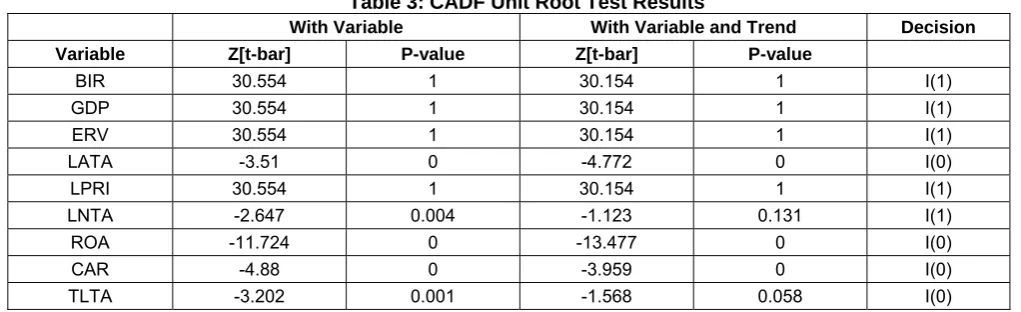
When the cross section dependency analyses of the variables are examined, it is concluded that the series include cross section dependency. Based on this point, it is necessary to suggest that the unit root tests that consider the cross section dependency are needed to examine the stabilities of the series. For this reason, the Cross-Sectionally Augmented Dickey-Fuller Test (CADF), which is developed by Pesaran (2007), is used in the study. In Monte Carlo simulations, Paseran revealed that CADF test continued its validity both in N>T and T>N conditions (Pesaran, 2007:269).
The test results are provided in Table 3 below.
Table 3: CADF Unit Root Test Results
With Variable With Variable and Trend Decision
Variable Z[t-bar] P-value Z[t-bar] P-value
BIR 30.554 1 30.154 1 I(1)
GDP 30.554 1 30.154 1 I(1)
ERV 30.554 1 30.154 1 I(1)
LATA -3.51 0 -4.772 0 I(0)
LPRI 30.554 1 30.154 1 I(1)
LNTA -2.647 0.004 -1.123 0.131 I(1)
ROA -11.724 0 -13.477 0 I(0)
CAR -4.88 0 -3.959 0 I(0)
When Table 3 is examined, it is observed that the series are not stable at the same level. For this reason, the Panel ARDL Method is preferred in the study, and both the existence of a cointegration relation and the estimation of the coefficient are made. It is observed that PMG and MG variables are consistent; however, it is also observed that the PMG variable is the efficient variable according to Hausman test (Pesaran et al., 1999: 627).
3. EMPIRICAL FINDINGS The model estimations are provided in Table 4 below.
Table 4: Panel ARDL Results
MODEL 1 MODEL 2
PMG MG PMG MG Coefficient Coefficient Coefficient Coefficient C (0,4716) 6,0793* 12,9438* (5,4752) (0,5673) 5,4779* 13,7858* (5,4279)
BIR -0,0112* (0,0044) -0,0193* (0,0287) -0,0082* (0,0043) (0,0295) -0,0202
GDP (0,0041) 0,0773* (1,3716) 0,0642* (0,0040) 0,0746* (0,0164) 0,0640*
ERV -0,3556* (0,1285) (0,1150) 2,1623* -0,3777* (0,1252) 2,1296** (1,2891)
LATA (0,0025) 0,0058* 0,0408** (0,0223) (0,0026) 0,0133* 0,0404** (0,0223)
PUB -1,4168* (0,3153) (0,5833) -0,6819
PRB -0,5231* (0,2122) (1,5009) -2,3400
LPRI -0,6616* (0,1989) -2,8339** (1,6227)
LNTA -0,4011* (0,0665) (0,3296) -0,5164 -0,4453* (0,0653) -0,5355* (0,3224)
CAR -0,01017* (0,0004) (0,0247) 0,0623* (0,0012) 0,0122* (0,0247) 0,0212*
TLTA (0,0024) 0,0120* (0,0446) 0,0164 (0,0027) 0,0268* (0,0410) -0,9925
EC -0,6830* (0,0364) -0,9929* (0,0365) -0,6943* (0,0421) -0,9925* (0,0367)
DBIR (0,0194) 0,0466* (0,0353) 0,0401 (0,0228) 0,0543* (0,0346) 0,0403
DGDP -0,0364* (0,0057) -0,0482* (0,0125) -0,0342* (0,0069) -0,0477* (0,0123)
DERV (0,7566) 1,0045 -0,8823** (0,5335) (0,7504) 1,1263 -0,9175** (0,5475)
DLATA (0,0242) -0,0301 -0,0584* (0,0310) (0,0240) -0,0244 -0,0554** (0,0303)
DPUB (1,1393) 0,6325 (0,7531) 0,5930
DPRB (2,9165) -1,9203 (3,6154) -0,4952
DLPRI (2,8056) -0,7739 (3,4748) -0,0986
DLNTA (0,5596) 0,4593 (0,4540) 0,5054 (0,7080) 0,9206 (0,4558) 0,4954
DCAR (0,0196) 0,0484* (0,0127) -0,0010 (0,0195) 0,0456* (0,0129) -0,0013
DTLTA (0,0254) -0,0334 (0,0335) 0,0528 (0,0289) -0,0282 (0,0328) -0,0529 Hausman Test Chi (8)=6.70
Prob>chi2=0.5689
It is observed that the long-term coefficients and the error-correction coefficients are significant for both Model 1 and Model 2. This situation also shows that there is a cointegration relation. In addition, when both model results are examined according to Hausman test, it is concluded that the PMG estimators are efficient estimators. According to Model 1, BIR, ERV, LNTA and CAR variables cause negative effects, and GDP, LATA
and TLTA variables cause positive effects on bank profitability. Similar results are valid in Model 2.
CBRT borrows from the banks and lends to them as the last source of liquidity in economy. In other words, the interest rate, that a bank experiencing liquidity problems is obliged to pay in order to borrow from CBRT in short-term is called as the CBRT Borrowing Interest Rate (BIR). The increase in the CBRT interest rate would create an increase in the bank costs and would affect the profitability negatively. The sign of coefficient is consistent with the expectations, and when the BIR increases, ROA decreases.
GDP growth rate (GDP) is a frequently used variable to reveal changes in production of final goods and services in an economy. It is foreseen that the growth rate affects the supply-demand of loans, and therefore the bank profitability positively. This finding is consistent with the expectation, and an increase in growth rate may also increase the bank profitability.
According to the results of the study, the increase in exchange rate volatility (ERV) has a more dominant effect on bank profitability than the other exogenous variables. However, this effect has a negative direction. This finding is an expected result of the negative effect of exchange rate risk and the increase in exchange rates against TL on the banks’ foreign exchange positions.
Size of the assets of the bank (LNTA) is one of the endogenous determinants of profitability. The changes, occurring in the banks in long term, may reveal some advantages or disadvantages stemming from economies of scale for the banks. There are some studies in the literature reporting that large banks are affected by economies of scale positively, and there are also some other studies reporting that they are affected negatively. In this context, this study is among the ones reporting that profitability is affected negatively. For this reason, the increase in the banks’ asset size decreases ROA. Large banks may create negative scale disadvantages in many aspects.
Capital Adequacy Ratio (CAR) shows that the equity capital level which is sufficient to overcome the shock. According to the literature, the structure of the capital must be strong, and depending on this, the capital adequacy ratio must be at an acceptable level in order to overcome shocks with minimum damage and to ensure continuity in profitability. In this study, the estimated coefficient of the CAR is positive in Model 1, and negative in Model 2. The positive ratio means that the bank's dependence on external sources would decrease and it would lead to higher profits. The decision-making units in economy trust more in the banks that have high capital adequacy ratio and equity, and direct their financial operations to such banks.
The estimated sign of CAR is negative in Model 2. In this context, the PUB variable having higher values than the PRB variable shows that the negative effect of political instability is higher on public banks. For this reason, this effect is influential on the sign of CAR. In this context, the high negative effect of political instability on public banks causes that these banks increase CAR. However, depending on the high amounts of equity capital of the banks, the high value of CAR may lead to profitability decreases by causing a conflict with the proposition of “more risks, more revenues”, which is used frequently in the field of finance. In such a situation, it may be claimed that banks limit their productions for the purpose of decreasing moral hazard and reverse selection risk.
As the ratio of loans to deposits increases, the expectation that profitability will increase over the net interest margin. The expected sign of total loans/total assets is positive. Consistent with this, an increase in
Total Loans/Total Assets (TLTA) also increases ROA in the model.
It is reported in the literature that the increase in political risk (LPRI) influences the microeconomic, macroeconomic and financial decisions in a negative way. For this reason, it is concluded that this variable influences the bank performance or the profitability in a negative manner, as it is consistent with the literature.
4. DISCUSSION
In this study, the effects of political risks on the profitability of Turkish banking sector are studied particularly along with some economic and financial factors. An effect of a shock towards political stability, on the central bank’s balance sheet and decisions is not examined as such effect is outside the purpose of the study. The quality of assets in the balance sheet of central banks dwindled in terms of the changing roles after global financial crisis in 2008. So the effects of political instability on central banks’ decisions and banking and capital markets via the transmission mechanisms would be assessed in another study. In this way, that question can be discussed: Can the negative effects of political instability, that we found, be minimized before taking place, and what is policy suggestion? A micro-level- study can be developed for the literature by considering the changes on the profitability of each banks because of the variables that are involved in the analysis.
RESULT
As previously mentioned, political risk is formed by political instability and uncertainty, and determines the inter-temporal expectations and decisions of the economic units, and influence economic fields. One of these fields is the banking sector. In this context, some endogenous and exogenous variables, mainly the political risks, which have effects on profitability, have been examined in this study. The panel ARDL method was used in order to analyze these effects, and two models were formed. It was observed that the long-term coefficients and error-correction coefficients are significant both for Model 1 and Model 2, and there is a cointegration relation. When the results of both models were assessed in terms of Hausman test, it was observed that the PMG estimators were efficient estimators. According to Model 1, BIR, ERV, LNTA and CAR variables have negative effects on bank profitability, and GDP, LATA and TLTA variables have positive effects. Similar results were obtained in Model 2, in which the effects of political risk on the performances of public and private banks were investigated. According to Model 2, the negative effect of political risk/instability on public banks is found to be higher. This situation causes that these banks increase their capital adequacy ratio.
On the other hand, the fact that banks are also influenced negatively by political risk/instability as a whole is one of the considerable outcomes of the study. It is possible that the variable in question creates macro effects via interest and credit mechanism, and creates micro effects by causing financial risks and fragility over the banks whose capital structures are not so strong.
According to the results, it is necessary that CBRT decreases the interest rates, and the exchange rate volatility is reduced, economic growth is increased; banks keep their reserves in liquid values, provide loans instead of reserves, and adjust the scale well. In addition to these, banks must continue to strengthen their capital structures, sustain their traditional banking assets, provide alternative services together with alternative profit opportunities, and thus, important contributions would be made to increase the profitability of the banking system as a result of the decrease in the systematic risks after the diversification of international funds.
REFERENCES
Abreau, M.; Mendes, M. 2002. Commercial bank interest margins and profitability: evidence from EU countries, University of Porto Working Paper Series 122.
Alesina, A.; Perotti, R. 1996. Income distribution, political instability, and investment, European Economic Review 40: 1203-1228.
Athanasoglou, P.P.; Brissimis, S. N., Delis, M.D. 2008. Bank-specific, industry-specific and macroeconomic determinants of bank profitability, Journal of International Financial Markets, Institutions and Money 18: 121-136.
Berger, A. N. 1995. The relationship between capital and earnings in banking, Journal of Money, Credit and Banking, 27(2): 432-456.
Breusch, T. S. and Pagan, A. 1980. The lagrange multiplier test and its applications to model specification in Econometrics,
Review of Economic Studies, 47(1): 239-253
Demirgüç-Kunt, A.; Huizinga, H. 1999. Determinants of commercial bank interest margins and profitability: some international evidence, The World Bank Economic Review 13: 379-408.
Güloğlu, B.; İspir, S. 2009. Yeni gelişmeler ışığında Türkiye’de satın alma gücü paritesi önsavının panel birim kök sınaması,
Pamukkale Üniversitesi İ.İ.B.F. İktisat Bölümü Yayınları(in Turkish).
Jiang, G.; Tang N., Law, E., Sze, A. 2003. Determinants of bank profitability in Hong Kong [online], [cited 16 May 2016],
Hong Kong Monetary Authority Research Memorandum. Available from Internet: http://www.info.gov.hk/hkma/eng/research/RM_on_Banz_Profitability.pdf.
Molyneux, P.; Thornton, J. 1992. Determinants of European bank profitability: a note, Journal of Banking and Finance 16(6): 1173-1178.
Naceur, B.S. 2003. The determinants of the Tunisian banking industry: panel evidence. Proceedings of the Economic Research Forum 10th Annual Conference, Marakesh, Morocca. Available from Internet: http://www.mafhoum.com/press6/174E11.pdf
Pesaran, M. H.; Shin, Y., Smith, R.J. 1999. Pooled mean group estimation of dynamic heterogeneous panels, Journal of The American Statistical Association 94: 621-634.
Pesaran, M. H. 2004. General Diagnostic Tests for Cross Section Dependence in Panels. IZA Discussion Paper, No. 1240.
Peseran, H. 2007. A simple panel unit root test in the presence of cross-section dependence, Journal of Applied Econometrics 22: 265-312.
Petria, N., Capraru, B., Ihnatov, I., 2015. Determinants of banks’ profitability: evidence from EU 27 banking systems,
Taşkın Dilvin F., 2011. Türkiye'de ticari bankaların performansını etkileyen faktörler.Ege Akademik Bakış 11(2): 289-298 (in Turkish).
The Banks Association of Turkey. 2008. 50. Yılında Türkiye Bankalar Birliği ve Türkiye’de Bankacılık Sistemi: 1958-2007 [online], [cited 28 November 2015], Available from Internet: https://www.tbb.org.tr/Content/Upload/Dokuman/808/2tbb50yil.pdf, (in Turkish).
The PRS Group, International Country Risk Guide [online], [cited 28 August 2015], Available from Internet: http://epub.prsgroup.com/products/international-country-risk-guide-icrg.
Tunay, K. B.; Silpar, A. M. 2006a. Türk ticari bankacılık sektöründe karlılığa dayalı performans analizi - I. Türkiye Bankalar Birliği Araştırma Tebliğleri Serisi 2006/I, (in Turkish).
Tunay, K. B.; Silpar, A. M. 2006b. Türk ticari bankacılık sektöründe karlılığa dayalı performans analizi - II. Türkiye Bankalar Birliği Araştırma Tebliğleri Serisi 2006/II, (in Turkish).
Türker-Kaya, Y. 2002. Türk bankacılık sektöründe karlılığın belirleyicileri 1997-2000. BDDK Mali Sektör Politikaları Dairesi Çalışma Raporları 2002/1, (in Turkish).
Wu, H.L.; Chen, C.H., Shiu, F.Y. 2007. The impact of financial development and bank chracteristics on the operational performance of commercial banks in the Chinese transitional economy, Journal of Economic Studies 34: 401-414.