http://www.ijcmph.com pISSN 2394-6032 | eISSN 2394-6040
Original Research Article
Health care seeking behavior of parents of under five in
District Kanga, Himachal Pradesh
Akshay Minhas
1*, Vishav Chander
2, Seema Sharma
3, P. Bansal
2INTRODUCTION
There is growing recognition, in both developed and developing countries, that providing education and knowledge at the individual level is not sufficient in itself to promote a change in behavior. Utilization of the formal system in case of illness is also known as health care
seeking behavior and the process involved in achieving a health state has been termed as health seeking behavior. Studies demonstrate that the decision to engage with a particular medical channel is influenced by a variety of socio-economic variables, sex, age, the social status of women, the type of illness, access to services and perceived quality of the service.1
ABSTRACT
Background: Health seeking behavior denotes the process involved in seeking a particular health state. Whereas, the healthcare seeking behavior of any individual denotes the end point contact of care. The objectives of the study were to understand the health seeking behavior and health care seeking behavior of parents of children, 0-5 yrs of age in Himachal Pradesh.
Methods: A community based cross- sectional study on 2400 children of age less then and equal to 59 months was conducted. Morbidity profile and socio demographic indicators along with other variables were defined as indicators of health and health care seeking behaviour. The study was conducted using 30 cluster techniques with 80 participants from each cluster of district Kangra.
Results: Water and sanitation was taken as one of the indicators of health seeking behavior and majority of our study population was dependent on ‘bavdi’ as water source. Earthen and steel pots were the most sought after storage vessel. In slums however plastic buckets were used. More than 80% of the households did nothing for purification. Majority responded that (82.6%) their child took bath daily. Institutional delivery was prevalent among 81.2% cases and lowest among rural slum. Nutrition was also taken as an indicator. Exclusive breast feeding was prevalent in 51.1% cases. In case of health care seeking behavior in our study around 47.0% parents visited the health facility, but also 24.0% were dependent on home remedies. Majority (30.5%), took treatment from secondary level of health care followed by 28.4% from private Ayurvedic doctor.
Conclusions: The system needs to understand its weaknesses as to why the population still practices unsatisfactory behavior across various areas. Especially in case of institutional deliveries, breast feeding and seeking treatment from a quack.
Keywords: Behavior, Parents, Under five children,Sickness, Health
1Zonal Hospital Mandi, Himachal Pradesh, India 2
Department of Community Medicine, 3Department of Pediatrics, Dr. RPGMC Tanda, Kangra, Himachal Pradesh, India
Received: 29 August 2017
Accepted: 06 December 2017
*Correspondence:
Dr. Akshay Minhas,
E-mail: [email protected]
Copyright: © the author(s), publisher and licensee Medip Academy. This is an open-access article distributed under the terms of the Creative Commons Attribution Non-Commercial License, which permits unrestricted non-commercial use, distribution, and reproduction in any medium, provided the original work is properly cited.
Thus there is growing acknowledgement that health care seeking behaviors and local knowledge need to be taken seriously in programme and interventions to promote health in a variety of contexts.2,3
Health seeking behaviors more generally are factors which enable or prevent people from making ‘healthy choices’, in either their lifestyle behaviors or their use of medical care and treatment.
Child health is one area of research where both the health and health care seeking behavior can be well understood as it involves the behavior of family which decides for their children. The health seeking behavior studies which are either facility or household based miss the opportunity of capturing the wider community picture, which could be all important in understanding why, when and how people use health system facilities. Where health systems are characterized by high out-of-pocket payments and a wide range of public and private health care providers, understanding the health-seeking behaviors of different communities and population groups is essential if adequate access to services and protection against unaffordable health costs are to be achieved.4 There is literature from the country focusing on health care seeking behavior of parents but in our analysis we aimed to understand the health seeking behavior and health care seeking behavior of parents of children, 0-5 yrs of age in Himachal Pradesh.
METHODS
Study area
This study was carried out in urban, rural and slum population of district Kangra, of Himachal PradeshThe majority of population of district (94.3%) resided in rural areas. In this study, 9 towns of district Kangra heaving 68 wards, with population of 86, 281 along with its slum population were included as urban and urban slum population, while rest of the district Kangra, with a population of 14, 23,794 were taken as rural and rural slum population.
Study design
A community based cross- sectional study
Study population
The study population included children in the age group of 0 to 59 completed months of age from the selected areas.
Study period
The study was carried out for a period of one year from April 2014 through March 2015.
Sample size
Estimated population of children less than five years in district Kangra is about 1, 20,000. Taking margin of error 2%, confidence level 95% and 50% response distribution, minimum sample size was calculated to be 2354 which was round figured for continence to 2400.
The study population of 2400 was divided in a proportion of 90% and 10% between rural and urban areas respectively in accordance with the demographic distribution prevalent in Himachal Pradesh hence we recruited 2160 from rural areas and 240 from urban.
Study tool
A semi structured questionnaire with various variables was used and details from respondent were recorded. Health seeking behaviour has been studied using following variables:
1. Water and sanitation 2. Delivery preferences 3. Breast feeding
4. Immunization practices 5. Sleep and play habit of children
Health care seeking behaviour has been studied about children who fell sick in last two weeks from the date of interview. This has been interviewed as the first point of contact in case of illness and the type of health facility approached if any present.
Following terms have been used whose operational definition is as follows:
Bavdi: It is Hindi name of water reservoir used in local dialect in the state of Himachal Pradesh. Historically this term has been used for step well however in this state the water from mountains collect in plain areas and are used for different purposes.
Quack: He/ She is a fraudulent or ignorant pretender to medical skill or a person who pretends, professionally or publicly, to have skill, knowledge, or qualifications he or she does not possess.
Witch craft: The religious practices involving ritual, spells, and nature worship, usually within a pagan tradition.
Primary level health care: involves primary health centers, sub centers, dispensaries and anganwadi centers from where treatment is sought.
Tertiary level heath care: It comprises public sector apex referral institute generally a medical college and hospital.
Ethical justification
The ethical approval for the initiation of the study was sought by Institutional Ethics Committee of Dr. Rajendra Prasad Government Medical College, Kangra at Tanda (H.P.).
Sampling technique
For this study 30 Cluster sampling technique, by World Health Organization for immunization surveillance was used. The study participants from rural areas (2400) were distributed among 30 clusters, which come out to 80 participants per cluster. District Kangra’s population is catered by 440 Health Sub Centres and each sub centre was considered as cluster or primary sampling unit and children from 0 to 59 months of age was secondary sampling unit.
440 Health sub centres were divided into 331 rural and 9 urban Health centres. Rural and urban Health Centres were arranged alphabetically and a numerical number was allocated to each health sub centre of rural and urban area. Among these heath sub centres 27 serving rural population and three serving urban were selected randomly by using online software for randomization. The Chief Medical officer of District Kangra was briefed about the study and prior permission was sought. The respective Block Medical Officers of the blocks in which the sub centres were located were informed and due permission was sought to carry out the study.
The clusters were mapped and first cluster was picked up randomly by using the lottery method. To mark the starting point of the survey an empty bottle was twisted in the courtyard of Health Sub centre. First house in the direction pointed by the bottle was marked as first starting point of that cluster and the subsequent adjacent houses were visited till the required sample size of 80 participants was completed in that cluster. Respondent (mother or care taker of child) was explained about the purpose of study and an informed consent from either parents or legal guardian any adult of household of age more than 18 years of age was sought. If any child was found absent at the time of first visit, that house was visited twice again. During third visit if child is found absent, he or she was excluded from the study and next eligible study participant from other household in the same cluster was included in the study to complete the sample size of 80 in that cluster. Similar procedure was adopted in the remaining 29 clusters. The questions were asked by the interviewer in the language spoken by the natives.
Statistical analysis
Data collected on the variables, entered on Microsoft excel sheets and summarized in form of proportions.
RESULTS
Health seeking behavior
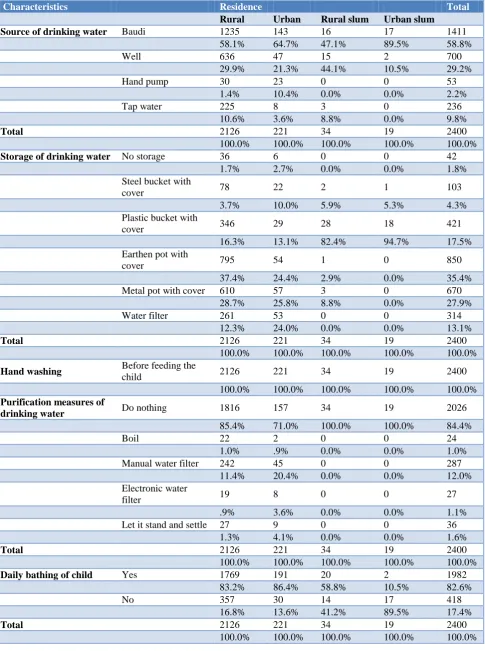
The health seeking behavior was determined by various parameters depicted in Table 1. Residence wise distribution shows that majority of the households of children of the study used baudi (water reservoir) as source of drinking water. Well was also used by 29.9% of rural population and 21.3% urban. Water filter was used by 24% of urban and 12.3% of rural population for storage of drinking water. Majority of rural population (37.4%) used earthen pot with cover for storage of water. Slum population in majority used plastic buckets with cover. All the households in slum and majority in rural (85.4%) and urban (71.0%) areas did nothing actively for purification of water. All the respondents washed their hand before feeding the child. Majority responded that (82.6%) their child took bath daily. However this proportion reduced in urban (10.5%) and rural slums (58.8%). Almost equal proportion of respondents said that they fed their child on demand and on fixed interval. Exclusive breast feeding was prevalent in 51.1% cases. This was highest among urban residents (62.9%) and lowest among rural slum (35.3%). Institutional delivery was prevalent among 81.2% cases and lowest (44.1%) among rural slum. Adequate sleep and play was present in more than 90% of children. All children were vaccinated till date and their parents took them for regular health check up.
Health care seeking behavior
Type of health systems in which study participants had faith
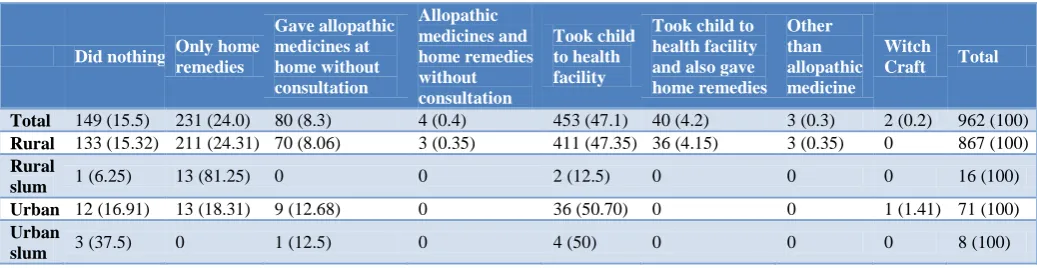
The health facility selection for treatment of their children who were sick in last two weeks has been shown in Table 3. Around 47.0% parents visited the health facility, but also 24.0% were dependent on home remedies. Around 16% did nothing during sickness period. Out of 962 respondents 8.3% used allopathic medicines which were already present in their home without consultation with doctor. It was observed that in rural slum majority (81.2%) of the patients gave home remedies only. Among the urban study participants, majority (50.7%) of parents took the treatment from health facility.
Type of health facility service
Table 1: Environmental, social and nutritional characteristics determining health seeking behavior of parents’ of children under the age of five years.
Characteristics Residence Total
Rural Urban Rural slum Urban slum
Source of drinking water Baudi 1235 143 16 17 1411
58.1% 64.7% 47.1% 89.5% 58.8%
Well 636 47 15 2 700
29.9% 21.3% 44.1% 10.5% 29.2%
Hand pump 30 23 0 0 53
1.4% 10.4% 0.0% 0.0% 2.2%
Tap water 225 8 3 0 236
10.6% 3.6% 8.8% 0.0% 9.8%
Total 2126 221 34 19 2400
100.0% 100.0% 100.0% 100.0% 100.0%
Storage of drinking water No storage 36 6 0 0 42
1.7% 2.7% 0.0% 0.0% 1.8%
Steel bucket with
cover 78 22 2 1 103
3.7% 10.0% 5.9% 5.3% 4.3%
Plastic bucket with
cover 346 29 28 18 421
16.3% 13.1% 82.4% 94.7% 17.5%
Earthen pot with
cover 795 54 1 0 850
37.4% 24.4% 2.9% 0.0% 35.4%
Metal pot with cover 610 57 3 0 670
28.7% 25.8% 8.8% 0.0% 27.9%
Water filter 261 53 0 0 314
12.3% 24.0% 0.0% 0.0% 13.1%
Total 2126 221 34 19 2400
100.0% 100.0% 100.0% 100.0% 100.0%
Hand washing Before feeding the
child 2126 221 34 19 2400
100.0% 100.0% 100.0% 100.0% 100.0%
Purification measures of
drinking water Do nothing 1816 157 34 19 2026
85.4% 71.0% 100.0% 100.0% 84.4%
Boil 22 2 0 0 24
1.0% .9% 0.0% 0.0% 1.0%
Manual water filter 242 45 0 0 287
11.4% 20.4% 0.0% 0.0% 12.0%
Electronic water
filter 19 8 0 0 27
.9% 3.6% 0.0% 0.0% 1.1%
Let it stand and settle 27 9 0 0 36
1.3% 4.1% 0.0% 0.0% 1.6%
Total 2126 221 34 19 2400
100.0% 100.0% 100.0% 100.0% 100.0%
Daily bathing of child Yes 1769 191 20 2 1982
83.2% 86.4% 58.8% 10.5% 82.6%
No 357 30 14 17 418
16.8% 13.6% 41.2% 89.5% 17.4%
Total 2126 221 34 19 2400
Characteristics Residence Total Rural Urban Rural slum Urban slum
Child delivered at Institution 1728 196 15 10 1949
81.3% 88.7% 44.1% 52.6% 81.2%
Home 398 25 19 9 451
18.7% 11.3% 55.9% 47.4% 18.8%
Total 2126 221 34 19 2400
100.0% 100.0% 100.0% 100.0% 100.0%
Exclusive breast feeding Yes 1069 139 12 7 1227
50.3% 62.9% 35.3% 36.8% 51.1%
No 1057 82 22 12 1173
49.7% 37.1% 64.7% 63.2% 48.9%
Total 2126 221 34 19 2400
100.0% 100.0% 100.0% 100.0% 100.0%
Feeding frequency At fixed intervals 1059 90 21 4 1174
49.8% 40.7% 61.8% 21.1% 48.9%
On demand 1067 131 13 15 1226
50.2% 59.3% 38.2% 78.9% 51.1%
Total 2126 221 34 19 2400
100.0% 100.0% 100.0% 100.0% 100.0%
Sleep Adequate 2085 219 34 18 2356
98.1% 99.1% 100.0% 94.7% 98.2%
Not adequate 41 2 0 1 44
1.9% .9% 0.0% 5.3% 1.8%
Total 2126 221 34 19 2400
100.0% 100.0% 100.0% 100.0% 100.0%
Play/interact with child Yes 2112 221 34 19 2386
99.3% 100.0% 100.0% 100.0% 99.4%
No 14 0 0 0 14
.7% 0.0% 0.0% 0.0% .6%
Total 2126 221 34 19 2400
100.0% 100.0% 100.0% 100.0% 100.0%
Regular health check up Yes 2126 221 34 19 2400
100.0% 100.0% 100.0% 100.0% 100.0%
Vaccinated till date Yes 2125 220 34 18 2397
100.0% 99.5% 100.0% 94.7% 99.9%
No 1 1 0 1 3
.0% .5% 0.0% 5.3% .1%
Total 2126 221 34 19 2400
100.0% 100.0% 100.0% 100.0% 100.0%
Table 2: First point of care given to children in case of illness among those who fell ill in last two weeks.
Did nothing Only home remedies
Gave allopathic medicines at home without consultation
Allopathic medicines and home remedies without consultation
Took child to health facility
Took child to health facility and also gave home remedies
Other than allopathic medicine
Witch
Craft Total
Total 149 (15.5) 231 (24.0) 80 (8.3) 4 (0.4) 453 (47.1) 40 (4.2) 3 (0.3) 2 (0.2) 962 (100)
Rural 133 (15.32) 211 (24.31) 70 (8.06) 3 (0.35) 411 (47.35) 36 (4.15) 3 (0.35) 0 867 (100)
Rural
slum 1 (6.25) 13 (81.25) 0 0 2 (12.5) 0 0 0 16 (100)
Urban 12 (16.91) 13 (18.31) 9 (12.68) 0 36 (50.70) 0 0 1 (1.41) 71 (100)
Urban
Table 3: Distribution of sick participants according to type of health facility service taken during sickness period.
Type of health facility N (%) Rural Rural slum Urban Urban slum
Allopathic (public sector)
Tertiary level care 3 (0.5) 2 (0.4) 0 1 (1.9) 0
Secondary level care 184 (30.5) 154 (28.4) 0 29 (56.9) 0
Primary level care 78 (12.9) 76 (14.0) 1 (50) 0 0
Allopathic (private sector)
General physician 12 (2.0) 11 (2.0) 0 1 (1.9) 0
Specialist 31 (5.1) 30 (5.5) 0 3 (5.9) 0
Ayurveda (public sector) 12 (2.0) 11 (2.0) 0 1 (1.9) 0
Ayurveda (private sector) 171 (28.4) 164 (30.2) 0 5 (9.8) 4 (100)
Homeopathic (private
sector) 3 (0.5) 3 (0.6) 0 0 0
Quack 79 (13.1) 70 (12.9) 0 5 (9.8) 0
Chemist shop 30 (5.0) 23 (4.2) 1 (50) 6 (11.8) 0
Total 603 (100) 544 (100) 2 (100) 51 (100) 4 (100)
DISCUSSION
The boundaries of health services are broad and include all activities whose primary purpose is to improve or maintain health. It includes multi-sectoral interventions which include health care services as one of the domains.5 Hence in the current analysis health seeking behavior included all the modifiable determinants of health which promote, maintain or restore health. Health care seeking behavior on other end is for an individual to respond to an illness episode by seeking first and foremost help from a trained allopathic doctor, in a formally recognized health care setting.
The underlying assumption is that behavior is best understood in terms of an individual’s perception of their social environment. When an individual makes a decision in relation to their health, they weigh up the potential risks or benefits of a particular behavior. But they do so in a way that is mediated by their immediate practical environment, their social rootedness and their whole outlook on life more generally. Individual healthcare-seeking pattern in a community is determined by complex interrelationships between socio-economic and physical environment along with individual characteristics and behaviors.6
Health seeking behavior
Poor water, sanitation and hygiene conditions are the primary routes of exposure and infection. Hence water source, storage and purification determine ones health and illness. Majority of our study population was dependent on ‘baudi’ as water source as majority of the state of Himachal Pradesh has hilly terrain. Earthen and steel pots were the most sought after storage vessel. In slums however plastic buckets were used. More than 80% of the households did nothing for purification.
Majority responded that (82.6%) their child took bath daily. However this proportion reduced in urban and rural slums. Probably due to shortage of water in slums and majority of population from slums in our study belonged to lower or lower middle socio economic status. This is an important predictor of behavior in terms of sanitation and hygiene. Exclusive breast feeding was prevalent in 51.1% cases. This was highest among urban residents and lowest among rural slum. The prevalence was lower than that reported by National family and health survey, Himachal Pradesh 2015-16 (67.2%) and higher than reported by another study from same region.7,8 Exclusive breast feeding also acts as a primary prevention intervention against morbidity and mortality related to three major conditions i.e. neonatal infections, diarrhea and pneumonia. Breast feeding is regarded as a good health practice maintaining positive health of mother and child both. Institutional delivery was prevalent among 81.2% cases and lowest among rural slum. This was comparable to that reported by NFHS- 4.8 Adequate sleep and play was reported by more than 90% of respondents. All children were vaccinated till date and their parents took them for regular health check up. Evidence suggests that adequate sleep is associated with growth, maturation, and health during growing years of child.9
In terms of some parameters the health seeking behavior of attendants of our study participants is quite satisfactory. However sanitation and hygiene still remains a major area of concern.
Health care seeking behavior
the prevalence of visits to medical facilities is highest among children aged 6-23 months, children of lower birth orders, children in urban areas, children of mothers with at least secondary education and children of mothers exposed to any sort of mass media.10 According to Khalid et al, out of 217 children who had diarrhea, fever, ARI and other illnesses two weeks preceding the survey, higher proportion (87.6%) were taken to health facilities or health care provider. No care was sought for 12.4% children. The private sector was preferred source of care for illnesses followed by unqualified practitioner. Only 26.8 percent went to government health facility where as in our study overall government health facilities were the most preferred health institutions for treatment.11 More than half of the ailments were treated by non-qualified practitioners in a rural setting of West Bengal. Only about 13% visited qualified physicians from Govt. sector.12 The scenario was similar in other parts of India, Vietnam and Bangladesh. Easy availability, less fees and better responsiveness were probably in favor of visiting non-qualified practitioners.13-15 Multiple studies from Nepal reported that 26% of people visited traditional healers exclusively while only 19% first visited formal health care institutions, medical shops without consultation were common source of medicines, and around half of episodes of childhood illnesses were treated by pharmacists.16-18 In a study by Gera et al, from on women of Uttarakhand all respondents went for traditional/home remedies/other remedy initially and only 6.5% opted allopathic medicine as the first choice.19 In a survey on females of tribal area of Gujarat more than half approached public sector and 14.3% to private sector in case of illnesses of their children.20 In rural West Bengal private sector was the first choice in seeking health care in 32% childhood illnesses and 11.4% believed in homeopathic medicine.21 Our study reported majority of treatment seeking from secondary level of health care (community health centers and government civil hospital) followed by private Ayurvedic Doctor. A good proportion also visited Quacks.
Despite the ongoing evidence that people do choose traditional and folk medicine or providers in a variety of contexts which have potentially profound impacts on health, few studies recommend ways to build bridges to enable individual preferences to be incorporated into a more responsive health care system.22
Rahman demonstrates that a woman’s decision to attend a particular health care facility is the composite result of personal need, social forces, the actions of health care providers, the location of services, the unofficial practices of doctors, and in some contexts has very little to do with physical facilities at a particular service point. The complexity of such findings is rarely traced in detail, and is usually disaggregated, losing all sense of the actual reality.23 Thus what seems to be missing in much of the literature around health seeking behaviour is a sense of how that process of ‘seeking’ extends over time, space and the health system in complex ways, and cannot be
picked out as something intrinsic to the individual and their social, economic or cultural circumstances alone. Health seeking behavior of our study participants in terms of water and sanitation was satisfactory however poor among slum population. Similarly in terms of institutional delivery the behavior is improving. Nutrition of children in terms of EBF shows that still a low proportion practice the behaviour. Immunization was very much satisfactory among children. In case of healthcare seeking behavior the population in majority visited public sector but first point of contact in rural and slum areas was Ayurvedic practitioner or quack. This denotes that there is still a lack of faith in public sector among the population.
Funding: No funding sources Conflict of interest: None declared
Ethical approval: The study was approved by the Institutional Ethics Committee
REFERENCES
1. Tipping G, Segall M. Health Care Seeking Behaviour in Developing Countries: an annotated bibliography and literature review Development Bibliography Institute of Development Studies, Sussex University; 1995.
2. Price N. The performance of social marketing in reaching the poor and vulnerable in AIDS control programmes. Health Policy Planning. 2001;16(3):231-9.
3. Runganga AO, Sundby J, Aggleton P. Culture, identity and reproductive failure in Zimbabwe Sexualities. 2001;4(3):315-32
4. Grundy J, Annear P. Health seeking behaviour studies: a literature review of study design and methods with a focus on Combodia, 2010. Available at: http://ni.unimelb.edu.au/__data/assets/pdf_file/ 0020/542450/wp7.pdf. Accessed on 3 August 2017. 5. Murray CJ, Frenk J. A framework for assessing the
performance of health systems. Bulletin of the World Health Organization, 2000;78:717–31. 6. The determinants of health. Health Impact
Assessment, Use of evidence. World Health Organization (WHO). 2014. Available at: http://www.who.int/hia/evidence/doh/en/. Accessed on 3 August 2017.
7. Kaushal A, Singh M, Sharma P, Chander V, Raina SK. Determinants of exclusive breastfeeding among lactating women in sub-Himalayan region. Trop J Med Res. 2017;20:70-4.
8. Govt. of India. National family Health survey IV (2015-16). Himachal Pradesh factsheet. IIPS. Mumbai: Ministry of Health Family Welfare; 2017. 9. Spruyt K, Gozal D: The underlying interactome of
childhood obesity: the potential role of sleep. Child Obes. 2012;8:38-42.
of mothers regarding their children in a rural community of Darjeeling district, West Bengal. International Journal of Medicine and Public Health. 2013;3(1):12-6.
11. Khalid M, Kumari R, Mohan U, Manar KM, Singh VK. Morbidity profile of preschool children from below poverty line families of Lucknow district, North India. Int J Adv Res. 2014;2(11):627-634. 12. Kanungo S, Bhowmik K, Mahapatra T, Mahapatra
S, Bhadra UK, Sarkar K. Perceived Morbidity, Healthcare-Seeking Behavior and Their Determinants in a Poor-Resource Setting: Observation from India. PLoS One. 2015;10(5):e0125865.
13. Giang KB, Allebeck P. Self-reported illness and use of health services in a rural district of Vietnam: findings from an epidemiological field laboratory. Scand J Public Health Suppl. 2003;62:52–8. 14. Ahmed SM, Tomson G, Petzold M, Kabir ZN.
Socioeconomic status overrides age and gender in determining health-seeking behaviour in rural Bangladesh. Bull World Health Organ. 2005;83:109–17.
15. Chaturvedi HK, Mahanta J, Pandey A. Treatment-seeking for febrile illness in north-east India: an epidemiological study in the malaria endemic zone. Malar J. 2009;8: 301.
16. Jimba M, Poudyal AK, Wakai S. The need for linking healthcare-seeking behavior and health policy in rural Nepal. Southeast Asian J Trop Med Public Health. 2003;34:462–3.
17. Shankar PR, Kumar P, Theodore AM, Partha P, Shenoy N. A survey of drug use patterns in western Nepal. Singapore Med J. 2003;44:352–6.
18. Sreeramareddy CT, Shankar RP, Sreekumaran BV, Subba SH, Joshi HS, Ramachandran U. Care seeking behaviour for childhood illness- a questionnaire survey in western Nepal. BMC International Health and Human Rights. 2006;6:7. 19. Gera A, Ramachandran S, Gera R, Singh AP.
Comparison of health care seeking behavior in rural versus urban women in Uttarakhand. Indian J Child Health. 2015;2(3):122-5.
20. Chandwani H, Pandor J. Healthcare-Seeking Behaviors of Mothers regarding their Children in a Tribal Community of Gujarat, India. Electronic Physician. 2015;7(1):990-7.
21. Dey I, Chaudhuri RN. Acute Childhood Illnesses and Health Seeking Behaviour among under five children in a village of Hooghly district, West Bengal. Int J Med Public Health. 2012;2(2):15-7 22. Ahmed S, Adams A, Chowdhury M Bhuiya A.
Gender, socio-economic development and health-seeking behaviour in Bangladesh. Social Science and Medicine. 2000;51(3):361-71.
23. Rahman SA. Utilization of Primary Health Care Services in Rural Bangladesh: the population and provider perspectives Unpublished PhD Thesis, London School of Hygiene and Tropical Medicine, University of London, 2000.